The signal from Davos was unambiguous: the raw model-scaling gold rush is fading.
As Ilya Sutskever put it, we’re ramping up an "age of model research and discovery." The magic now lies in the design of the AI nervous system, not just the size of the AI brain.
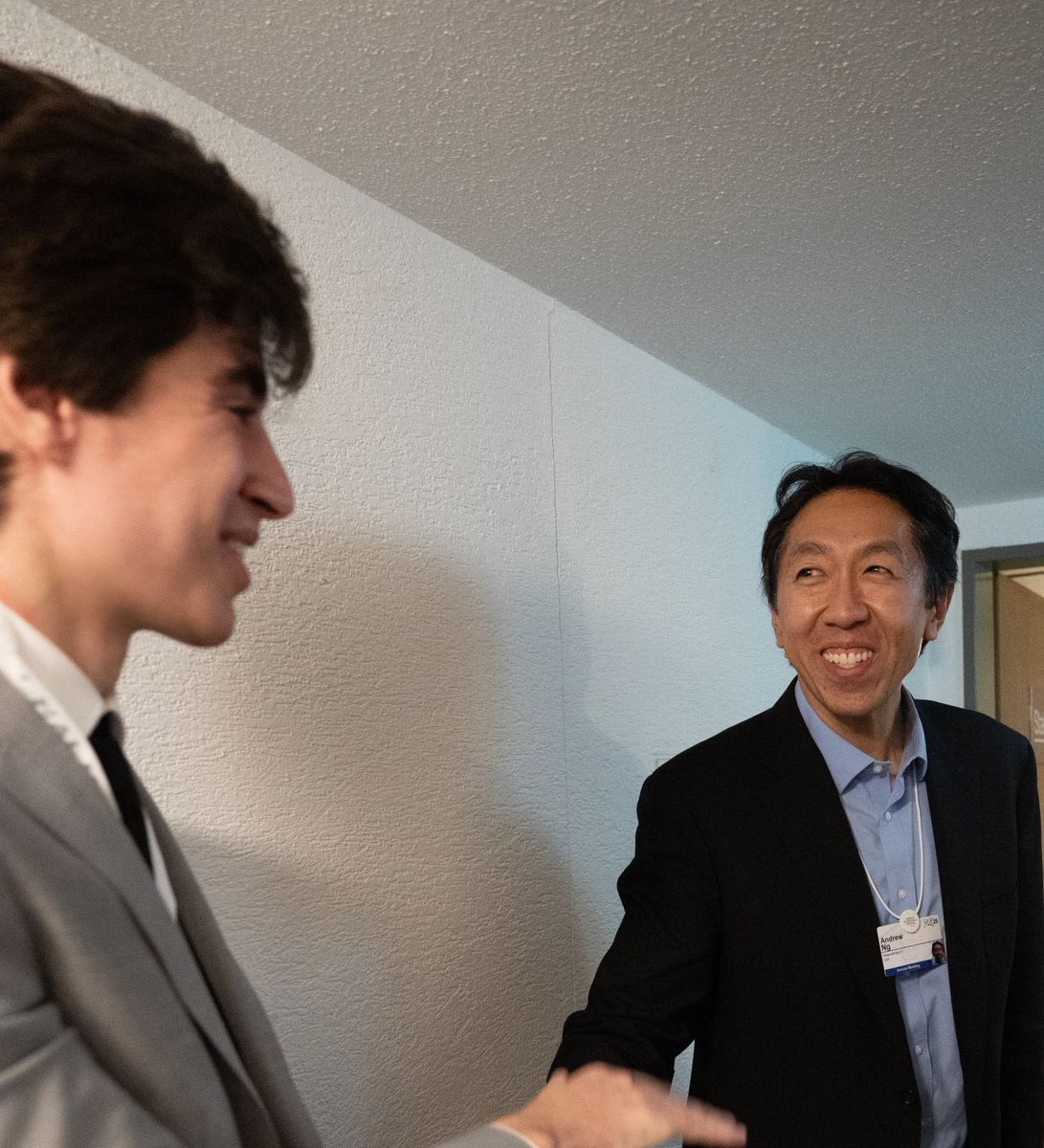
I joined leaders at the World Economic Forum to map this shift.

Fei-Fei Li warns that AI may be staring too hard at language models.
The world is not just text on a screen.
It is physical, visual, spatial, and always changing. Most of the economy runs on seeing, moving, interacting, and embodied intelligence.
Symbolic learning is not a replacement for coding agents, it's a replacement for gradient descent & NNs: a low-level, completely general, extremely scalable new learning substrate.
A South Los Angeles student is celebrating the incredible accomplishment of receiving 65 college acceptance letters. 🤩🎓✨
The straight-A student and valedictorian from Verbum Dei Jesuit High School is picking an Ivy League school, but he had to do a lot to get to this point.
Lamont Newell is the first male in his family to graduate high school. His mother says the family has been impacted by gang violence and incarceration, making the achievement layers deep. abc7.la/iSCbuG
There are only two honest metrics when it comes to benchmarking intelligence: novelty and efficiency.
You don't need intelligence to solve a known problem (only memory). And you don't need intelligence to solve a problem via brute force. But to solve a novel problem efficiently, intelligence is the only way.
SoftBank's Son is moving on to the next thing: physical AI and robotics, writes @shuli_ren. It's a reflection of where the capital markets are heading (via @opinion) bloomberg.com/opinion/articl…
Stockholm's talent teams are rapidly becoming AI native. We're helping them.
Last week we invited Sweden's highest performing talent teams to our office. Legora, Tandem Health, Flower, and more.
They are why Stockholm is becoming the most talent-dense AI scene in Europe.
But the bar they have to clear is enormous:
– Huge headcount targets, with no compromise on quality
– Sourcing candidates so rare they might not even exist yet
– Scanning global job markets for trends before competitors do
The only way to keep up is to go AI native.
With Strawberry it's easy.
With Strawberry, you don't need to be a prompting genius. You tell it your problem, brainstorm with it, and before you know it you have several AI agents working for you:
– Sourcing passive candidates while you're in calls
– Deep-diving GitHub contributions and past work
– Turning hiring manager calls into candidate briefs in minutes
One senior recruiter at the lunch said:
"I've been recruiting for 30 years. I don't care about AI. But Strawberry is different, it has completely changed the way I work."
He then showed a sourcing workflow that used to take 6 hours. With Strawberry, 6 minutes. 🤯
It's not just talent teams. GTM, marketing, ops, and engineering are all going AI native with Strawberry.
The goal of Personal AI: civilization where individual humans, augmented by AI, can do consequential work without being captured by extractive institutions.
Freedom to write your prompt and own your data.
This is the new battleground.
2034 won’t have to be like 1984.
WATCH: Taiwanese grandmothers aged 89 and 91 train at the gym. An increasing number of elderly people in Taiwan’s super-aged society are hitting the gym to stay healthy, both physically and mentally.
Eric Schmidt (ex-Google CEO): “if you really want to make money, it’s actually easy. found an agentic AI company.”
spoiler: the supply of builders is tiny. the demand is enormous.
this guy is literally giving away the exact 2026 playbook to build and sell AI automations to make $10k/mo
bookmark and start this weekend
Our team ran a verifiable quantum algorithm that probes how parts of a quantum system interact, from molecules to magnets and beyond. On our Willow chip, it ran 13,000× faster than the best classical supercomputers. A first in quantum computing → goo.gle/42z9E2d
Japan Airlines will trial humanoid robots for baggage handling and aircraft cleaning at Tokyo's Haneda Airport starting in May, citing workforce shortages and rising tourist numbers
Robot dogs with hyper-realistic silicone heads modeled after Elon Musk, Mark Zuckerberg, Jeff Bezos, Kim Jong Un and other global figures roam around a Berlin museum in an exhibit by American artist Beeple. Read more: bit.ly/42BDBic
Although we don’t yet have the details about the motives behind last night's shooting at the White House Correspondents Dinner, it’s incumbent upon all us to reject the idea that violence has any place in our democracy. It’s also a sobering reminder of the courage and sacrifice that U.S. Secret Service Agents show every day. I’m grateful to them – and thankful that the agent who was shot is going to be okay.
DeepSeek, the Chinese artificial intelligence startup that shook world markets last year, launched preview versions of its latest major update Friday as the AI rivalry between China and the U.S. heats up. apnews.com/article/deepse…
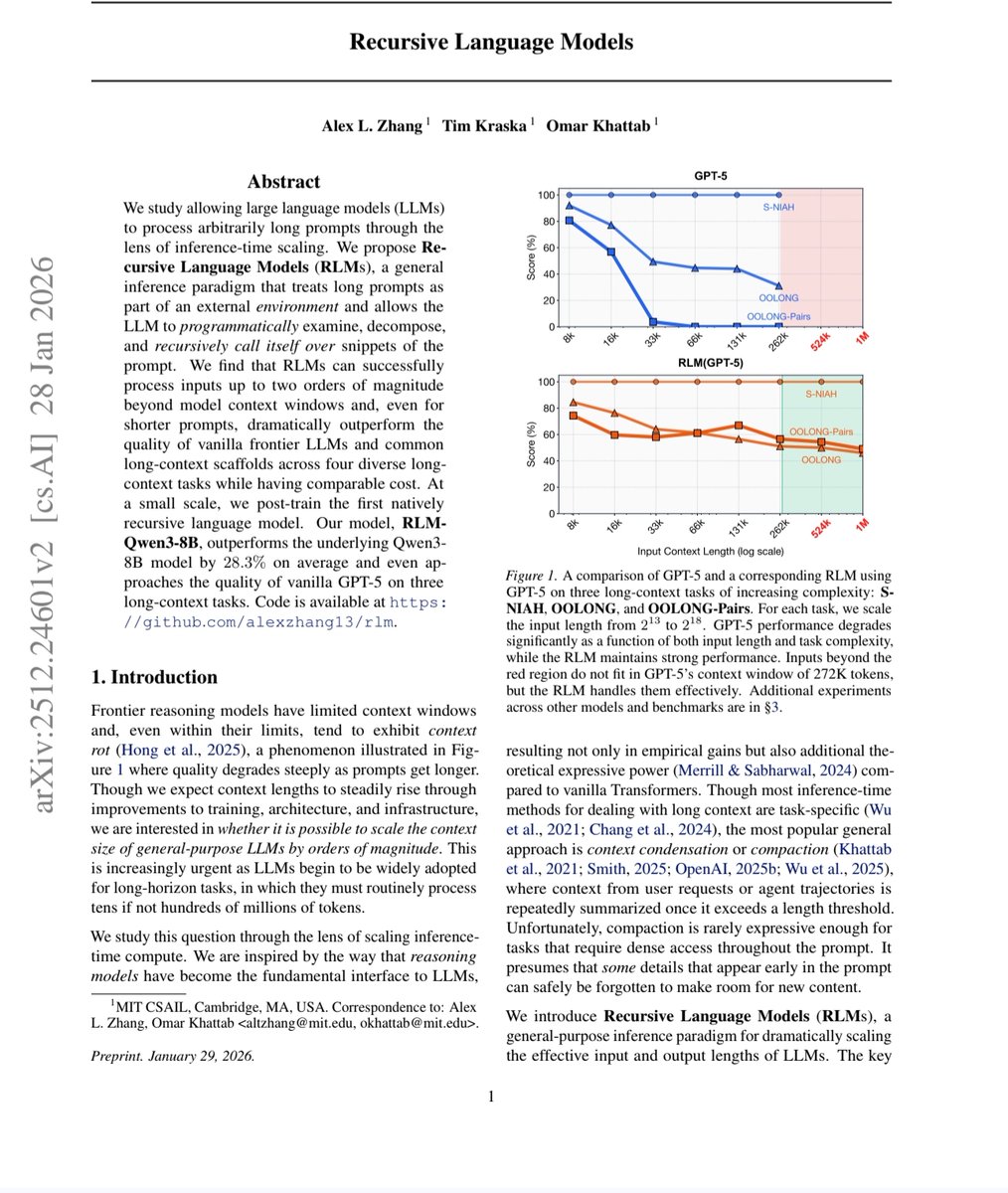
MIT just made every AI company's billion dollar bet look embarrassing.
They solved AI memory. Not by building a bigger brain. By teaching it how to read.
The paper dropped on December 31, 2025. Three MIT CSAIL researchers. One idea so obvious it hurts. And a result that makes five years of context window arms racing look like the wrong war entirely.
Here is the problem nobody solved.
Every AI model on the planet has a hard ceiling. A context window. The maximum amount of text it can hold in working memory at once. Cross that line and something ugly happens — something researchers have a clinical name for.
Context rot.
The more you pack into an AI's context, the worse it performs on everything already inside it. Facts blur. Information buried in the middle vanishes. The model does not become more capable as you feed it more. It becomes more confused. You give it your entire codebase and it forgets what it read three files ago. You hand it a 500-page legal document and it loses the clause from page 12 by the time it reaches page 400.
So the industry built a workaround. RAG. Retrieval Augmented Generation. Chop the document into chunks. Store them in a database. Retrieve the relevant ones when needed.
It was always a compromise dressed up as a solution.
The retriever guesses which chunks matter before the AI has read anything. If it guesses wrong — and it does, constantly — the AI never sees the information it needed. The act of chunking destroys every relationship between distant paragraphs. The full picture gets shredded into fragments that the AI then tries to reassemble blindfolded.
Two bad options. One broken industry. Three MIT researchers and a deadline of December 31st.
Here is what they built.
Stop putting the document in the AI's memory at all.
That is the entire idea. That is the breakthrough. Store the document as a Python variable outside the AI's context window entirely. Tell the AI the variable exists and how big it is. Then get out of the way.
When you ask a question, the AI does not try to remember anything. It behaves like a human expert dropped into a library with a computer. It writes code. It searches the document with regular expressions. It slices to the exact section it needs. It scans the structure. It navigates. It finds precisely what is relevant and pulls only that into its active window.
Then it does something that makes this recursive.
When the AI finds relevant material, it spawns smaller sub-AI instances to read and analyze those sections in parallel. Each one focused. Each one fast. Each one reporting back. The root AI synthesizes everything and produces an answer.
No summarization. No deletion. No information loss. No decay. Every byte of the original document remains intact, accessible, and queryable for as long as you need it.
Now here are the numbers.
Standard frontier models on the hardest long-context reasoning benchmarks: scores near zero. Complete collapse. GPT-5 on a benchmark requiring it to track complex code history beyond 75,000 tokens — could not solve even 10% of problems.
RLMs on the same benchmarks: solved them. Dramatically. Double-digit percentage gains over every alternative approach. Successfully handling inputs up to 10 million tokens — 100 times beyond a model's native context window.
Cost per query: comparable to or cheaper than standard massive context calls.
Read that again. One hundred times the context. Better answers. Same price.
The timeline of the arms race makes this sting harder. GPT-3 in 2020: 4,000 tokens. GPT-4: 32,000. Claude 3: 200,000. Gemini: 1 million. Gemini 2: 2 million. Every generation, every company, billions of dollars spent, all betting on the same assumption.
More context equals better performance.
MIT just proved that assumption was wrong the entire time.
Not slightly wrong. Fundamentally wrong. The entire premise of the last five years of context window research — that the solution to AI memory was a bigger window — was the wrong answer to the wrong question.
The right question was never how much can you force an AI to hold in its head.
It was whether you could teach an AI to know where to look.
A human expert handed a 10,000-page archive does not read all 10,000 pages before answering your question. They navigate. They search. They find the relevant section, read it deeply, and synthesize the answer.
RLMs are the first AI architecture that works the same way.
The code is open source. On GitHub right now. Free. No license fees. No API costs. Drop it in as a replacement for your existing LLM API calls and your application does not even notice the difference — except that it suddenly works on inputs it used to fail on entirely.
Prime Intellect — one of the leading AI research labs in the space — has already called RLMs a major research focus and described what comes next: teaching models to manage their own context through reinforcement learning, enabling agents to solve tasks spanning not hours, but weeks and months.
The context window wars are over.
MIT won them by walking away from the battlefield.
Source: Zhang, Kraska, Khattab · MIT CSAIL · arXiv:2512.24601
Paper: arxiv.org/abs/2512.24601
GitHub: github.com/alexzhang13/rlm