

Jing Wang
94 posts
Jing Wang
@JingWJ6
Building AI Agent OS | Ex-Microsoft | CMU alum
San Francisco Katılım Nisan 2021
611 Takip Edilen90 Takipçiler

As founders building in the audio space, I am personally sad to hear that Huxe is shutting down. We still deeply believe in personalized, interactive listening experiences — and we’re continuing to build for that future.
Over the past year, we’ve scaled beFreed to hundreds of thousands of users. Now, we’re launching a new version where users can fully customize voice, narration style, and length — whether that’s AI updates delivered in gossip girl vibe or recent news explained through cinematic storytelling tailored just for you.
It’s currently on TestFlight. Comment “audio” if you’d like an invite.
Huxe@gethuxe
We've made the decision to wind down Huxe. The team is moving on to new things, and we won't be continuing development of the product. What this means for you: Today May 21st: We're removing Huxe from the App Store and Play Store. If you have the app installed, it will continue to work for the next 7 days. May 28th: Service ends. If you have the app installed, it won’t uninstall automatically, but the features will stop working at 10AM Pacific Time, and audio will cease to play. May 29th: All user data will be securely and permanently deleted from our systems. The fact that you used it, told friends about it, sent us your suggestions and your ideas, made it feel like we built it together. Thank you for everything. -The Huxe Team
English
Jing Wang retweetledi


The reason I didn't join the China-US leaders meeting in Beijing? I was busy launching this. 😉
Jokes aside, after months of work, Plaud Embedded is officially live!
Today, I’m proud to announce the launch of our brand-new developer platform at dev.plaud.ai!

English
Jing Wang retweetledi

Today we’re launching the OpenAI Deployment Company to help businesses build and deploy AI.
It's majority-owned and controlled by OpenAI. It brings together 19 leading investment firms, consultancies, and system integrators to help organizations deploy frontier AI to production for business impact. openai.com/index/openai-l…
English
Jing Wang retweetledi

This works really well btw, at the end of your query ask your LLM to "structure your response as HTML", then view the generated file in your browser. I've also had some success asking the LLM to present its output as slideshows, etc.
More generally, imo audio is the human-preferred input to AIs but vision (images/animations/video) is the preferred output from them. Around a ~third of our brains are a massively parallel processor dedicated to vision, it is the 10-lane superhighway of information into brain. As AI improves, I think we'll see a progression that takes advantage:
1) raw text (hard/effortful to read)
2) markdown (bold, italic, headings, tables, a bit easier on the eyes) <-- current default
3) HTML (still procedural with underlying code, but a lot more flexibility on the graphics, layout, even interactivity) <-- early but forming new good default
...4,5,6,...
n) interactive neural videos/simulations
Imo the extrapolation (though the technology doesn't exist just yet) ends in some kind of interactive videos generated directly by a diffusion neural net. Many open questions as to how exact/procedural "Software 1.0" artifacts (e.g. interactive simulations) may be woven together with neural artifacts (diffusion grids), but generally something in the direction of the recently viral x.com/zan2434/status…
There are also improvements necessary and pending at the input. Audio nor text nor video alone are not enough, e.g. I feel a need to point/gesture to things on the screen, similar to all the things you would do with a person physically next to you and your computer screen.
TLDR The input/output mind meld between humans and AIs is ongoing and there is a lot of work to do and significant progress to be made, way before jumping all the way into neuralink-esque BCIs and all that. For what's worth exploring at the current stage, hot tip try ask for HTML.
Thariq@trq212
English
Jing Wang retweetledi

New for financial services: ready-to-run Claude agent templates for building pitches, conducting valuation reviews, closing the books at month-end, and more.
Install them as plugins in Cowork and Claude Code, or use our cookbooks to run them in production as Managed Agents.
English

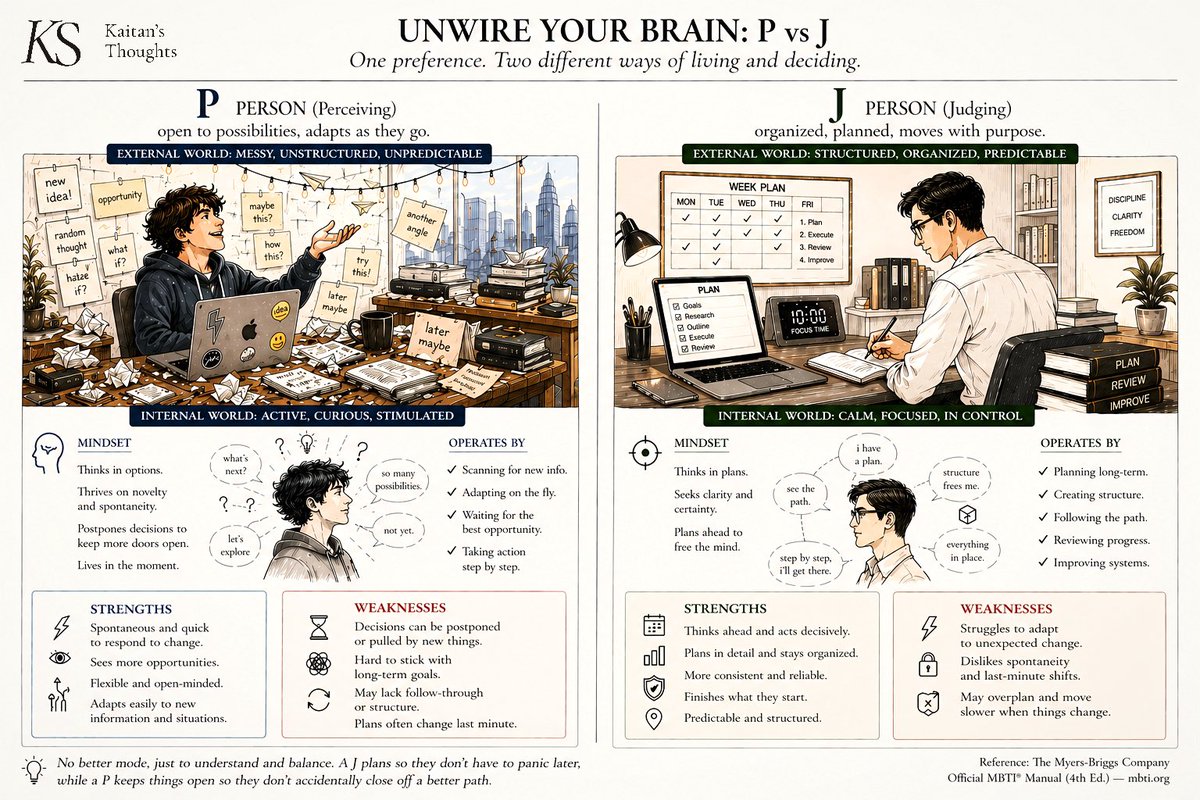
🤯 Most people get MBTI P vs J completely backwards.
Messy desk (P) ≠ chaotic mind.
Clean desk (J) ≠ rigid mind.
——
P types keep the outside world deliberately open. Multiple tabs, loose plans, decisions on hold.
They’re not messy inside.
They’re running a wide net — scanning for better signals before committing. The “mess” is their fishing method.
——
J types lock the outside world down early.
Calendar blocked. Saturday already planned. Everything sorted.
They’re not rigid inside.
Once the structure is set, their mind is finally free to focus, create, and live inside the moment.
——
Two opposite operating systems.
Same goal: protect mental energy so the mind can do its real work.
Neither is better. Both are valid.
You don’t need to fix your partner.
You don’t need to apologize for yourself.
Just see the wiring — and let each other run their system.
Stop judging the desk. Read the wiring.
Can you think of typical P/J behaviors?
#MBTI #SelfAwareness #SelfUnderstanding #selfdevelopment
English
Jing Wang retweetledi



Jing Wang retweetledi

🚨BREAKING: Anthropic just published a study mapping exactly which jobs its own AI is replacing right now.
The workers most at risk are not who anyone expected. They are older. They are more educated. They earn 47% more than average. And they are nearly four times more likely to hold a graduate degree than the workers AI is not touching.
The argument is straightforward. Anthropic built a new metric called "observed exposure." Not what AI could theoretically do. What it is actually doing right now in professional settings, measured against millions of real Claude conversations from enterprise users.
For computer and math workers, AI is theoretically capable of handling 94% of their tasks. It is currently handling 33% of them. For office and administrative roles, theoretical capability is 90%. Current observed usage is 40%. The gap between what AI can do and what it is already doing is enormous. The researchers are explicit about what comes next. As capabilities improve and adoption deepens, the red area grows to fill the blue.
The demographic finding is what makes the paper uncomfortable. The most AI-exposed workers earn 47% more on average than the least exposed group. They are more likely to be female. They are more likely to be college educated. This is not a story about warehouse workers or truck drivers. It is a story about lawyers, financial analysts, market researchers, and software developers. The exact group whose education was supposed to insulate them.
Computer programmers showed the highest observed AI exposure at 74.5%. Customer service representatives at 70.1%. Data entry keyers at 67.1%. Medical record specialists at 66.7%. Market research analysts and marketing specialists at 64.8%. These are not predictions. These are measurements of work that is already happening on AI platforms right now.
Then there is the pipeline finding nobody is talking about loudly enough.
Anthropic's researchers found a 14% decline in the job-finding rate for workers aged 22 to 25 in highly exposed occupations since ChatGPT launched. No comparable effect for workers over 25. Entry-level roles were never just jobs. They were the training ground where junior analysts became senior analysts, where junior lawyers learned how arguments hold together. If that layer disappears, nobody has answered the question of where the next generation of senior professionals comes from.
The detail buried in the paper that most coverage missed: 30% of American workers have zero AI exposure at all. Cooks. Mechanics. Bartenders. Dishwashers. The technology reshaping professional careers is completely irrelevant to roughly a third of the workforce. The divide is no longer between high skill and low skill. It is between presence and absence.
The company publishing this study is the same company selling the AI doing the replacing. Anthropic had every commercial incentive to soften these findings. They published them anyway.
If you spent four years and $200,000 on a degree to land a white collar career, the company that builds Claude just confirmed your job is more exposed than the bartender pouring drinks at your graduation party.
Source: Anthropic, "Labor market impacts of AI: A new measure and early evidence"
PDF: anthropic.com/research/labor…

English
Jing Wang retweetledi

AI-Native Service Companies
@gustaf
The total spend on services is many times larger than the spend on software, and a lot of those services are already outsourced, which makes them easier to replace with an AI-native product.
We're excited about companies that don't sell a tool to help you do the work: they just do the work.
English
Jing Wang retweetledi

I'm convinced that the biggest vertical SaaS companies of the AI era will not be vertical.
They will be horizontal AI harnesses that let the customer build the vertical themselves.
For my entire career, vertical SaaS meant the software company learned the industry and built product/marketing specific for it.
The moat was domain knowledge, and the vendor was the expert, and the customer was the user.
The harness era flips it. Inference has disrupted the moat.
The customer is the expert... again.
The vendor's job is not to know the industry. It's to build the rails the customer assembles their own software on top of.
The industry is about to split in two.
The companies that own the rails, payments, identity, compliance, data, become infrastructure.
The companies that owned only domain knowledge become a feature on someone else's harness.... There is no third outcome.
Vertical SaaS was built on the premise that the vendor was smarter than the customer about the customer's own business.
The premise was always weirdly insulting and now it is also obsolete.
English
Jing Wang retweetledi
Software for Agents
@aaron_epstein
The next trillion users on the internet won't be people. They'll be AI agents, and they're already doing real work on top of software that was designed for humans clicking buttons.
Every major category of software needs to be rebuilt for agents as first-class citizens, and that won't come from incumbents.
English
Jing Wang retweetledi
Company Brain
@t_blom
Every company has critical know-how scattered across people's heads, old Slack threads, support tickets, and databases, and AI agents can't operate like that.
We think every company in the world is going to need a new primitive: a living map of how the company works that turns its own artifacts into an executable skills file for AI.
English
Jing Wang retweetledi
Jing Wang retweetledi

My biggest takeaways from Claude Code's Head of Product @_catwu:
1. Anthropic’s product development timelines have gone from six months to one month, sometimes one week, sometimes one day. Part of this acceleration is access to the latest models (i.e. Mythos). Another is shipping new products into “research preview,” making clear it's early, experimental, and might not be supported forever. Another is an evergreen "launch room "where engineers post ready features and marketing turns around announcements the next day.
2. The PM role is shifting from coordinating multi-month roadmaps to enabling teams to ship daily. As Cat puts it, “There should be less emphasis on making sure you are aligning your multi-quarter roadmaps with your partner teams and more emphasis on, OK, how can we figure out the fastest way to get something out the door?”
3. The most efficient shipping unit is an engineer with great product taste. On Cat’s team, many engineers go end-to-end—from seeing user feedback on Twitter to shipping a product by the end of the week—without a PM involved. Also, almost all the PMs on the Claude Code team have either been engineers or ship code themselves, and the designers have been front-end engineers. The roles are merging, and the most valuable skill is product taste, not job title.
4. Build products that are on the edge of working. Claude Code’s code review product failed multiple times because earlier models weren’t accurate enough. But because the prototype was already built, they could swap in Opus 4.5 and 4.6 and immediately test whether the gap was closed. Teams that wait for the model to be ready will always be a cycle behind.
5. The most underrated skill for building AI products is asking the model to introspect on its own mistakes. Cat regularly asks the model why it made an unexpected decision. The model will explain that something in the system prompt was confusing, or that it delegated verification to a subagent that didn’t check its work. This reveals what misled the model so the team can fix the harness.
6. Every model release forces their team to revisit existing products and audit their system prompt to remove features the model no longer needs. Claude Code’s to-do list was a crutch for earlier models that couldn’t track their own work. With Opus 4, the model handles it natively. Features built as scaffolding for weaker models become debt when the model catches up—so the team actively strips them.
7. Anthropic employees build custom internal tools instead of buying SaaS products. A sales team member built a web app that pulls from Salesforce, Gong, and call notes to auto-customize pitch decks—work that used to take 20 to 30 minutes now takes seconds. Their core stack is Claude Code, Cowork, and Slack. No Notion, no Linear, no Figma.
8. People underestimate how much Claude’s personality contributes to its success. As Cat describes it, “When you reflect on everyone you’ve worked with, there’s just some people where you’re like, I really like their energy, their vibe.” Claude is designed to be low-ego, positive, competent, and earnest—qualities that make it feel like a great coworker, not just a tool. This isn’t cosmetic; it’s what makes people want to use Claude for hours every day. The team has a dedicated person, Amanda, who “molds Claude’s character,” and it’s one of the hardest roles at the company because success is so subjective.
9. The future of work is managing fleets of AI agents, not doing the work yourself. Cat sees a clear progression: first, individual tasks become successful. Then people start running multiple tasks at the same time (multi-Clauding). Next, people will run 50 or 100 tasks simultaneously, which will require new infrastructure—remote execution, better interfaces for managing tasks, agents that fully verify their work, and self-improving systems that incorporate feedback. The human role shifts from doing the work to knowing which tasks to look into, verifying outputs, and giving feedback that makes the system better over time.
10. Hire people who lean into chaos and face every challenge with a smile. At Anthropic, there are weeks when a P0 on Sunday becomes a P00 by Monday and a P000 by Monday afternoon. If you get too stressed about any one thing, you’ll burn out. Their team looks for people who can look at a hard challenge and say, “Wow, that’s gonna be hard. But I’m excited to tackle it and I’m gonna do the best that I possibly can.” This mindset—optimism, resilience, and comfort with constant change—is increasingly essential as the pace of AI development accelerates.
Don't miss the full conversation: youtube.com/watch?v=Pplmzl…
YouTube
Lenny Rachitsky@lennysan
How Anthropic’s product team moves faster than anyone else I sat down with @_catwu, Head of Product for Claude Code at @AnthropicAI, to get a peek into their unprecedented shipping pace, how AI is changing the PM role, and how to be the right amount of AGI-pilled. We discuss: 🔸 How Anthropic’s shipping cadence went from months to weeks to days 🔸 The emerging skills PMs need to develop right now 🔸 Why you should build products that don't work yet—then wait for the model to catch up 🔸 Why a 95% automation isn't really an automation 🔸 Cat’s most underrated AI skill (introspection) 🔸 What Cat actually looks for when hiring PMs now (hint: it's not traditional PM skills) Listen now 👇 youtu.be/PplmzlgE0kg
English
Jing Wang retweetledi

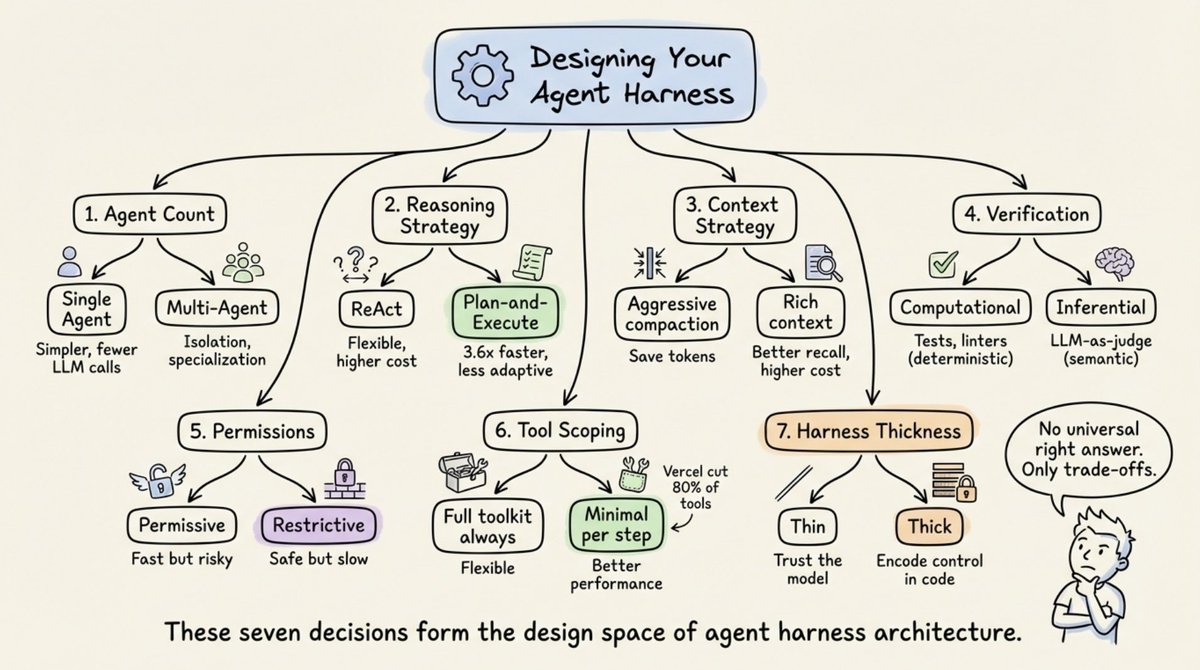
Design principles for building an Agent harness.
Most agent builders get three of the seven core design decisions exactly backwards.
Every production agent harness is the result of seven architectural bets. Agent count, reasoning strategy, context strategy, verification, permissions, tool scoping, and harness thickness.
On three of these, the obvious answer is the wrong one.
𝗠𝗼𝗿𝗲 𝘁𝗼𝗼𝗹𝘀 𝗺𝗲𝗮𝗻𝘀 𝗮 𝗺𝗼𝗿𝗲 𝗰𝗮𝗽𝗮𝗯𝗹𝗲 𝗮𝗴𝗲𝗻𝘁.
This is the first intuition that breaks. More tools feels like more capability, the same way more options on a menu feels like a better restaurant.
It isn't.
Every tool you expose to the model eats context, adds a decision point, and creates another chance for the model to pick the wrong function for the job. Vercel cut 80% of the tools from v0 and the agent got better. Claude Code dynamically loads only the tools needed for the current step and cuts context by 95%.
The principle is the opposite of what most teams ship with. A bloated toolkit looks like capability and behaves like cognitive load.
𝗥𝗲𝗔𝗰𝘁 𝗶𝘀 𝘁𝗵𝗲 𝗺𝗼𝗱𝗲𝗿𝗻 𝘄𝗮𝘆. 𝗣𝗹𝗮𝗻𝗻𝗶𝗻𝗴 𝗶𝘀 𝗼𝗹𝗱 𝘀𝗰𝗵𝗼𝗼𝗹.
ReAct is the default pattern in most tutorials. Think, act, observe, repeat. It feels sophisticated because the model reasons at every step.
But reasoning at every step is expensive. Plan-and-execute, where the agent makes a plan once and then runs through it, hits 3.6x faster on many workloads. The reason is simple. Most steps in a multi-step task don't need fresh reasoning. They need execution.
ReAct buys adaptability. Plan-and-execute buys speed and predictability. For bounded tasks with clear structure, planning once and executing wins cleanly. The "obviously more advanced" pattern is often the worse choice.
𝗣𝗲𝗿𝗺𝗶𝘀𝘀𝗶𝘃𝗲 𝗵𝗮𝗿𝗻𝗲𝘀𝘀𝗲𝘀 𝘀𝗵𝗶𝗽 𝗳𝗮𝘀𝘁𝗲𝗿. 𝗥𝗲𝘀𝘁𝗿𝗶𝗰𝘁𝗶𝘃𝗲 𝗼𝗻𝗲𝘀 𝘀𝗹𝗼𝘄 𝘆𝗼𝘂 𝗱𝗼𝘄𝗻.
This is the one that burns teams in production.
Permissive harnesses feel fast in development. The agent just works. It calls tools, mutates state, takes actions. No friction. No approval gates.
Then it ships. And the first time the agent does something irreversible that it shouldn't have, the post-mortem starts. Restrictive harnesses feel slow because they ask for confirmation on high-stakes operations. That friction is the feature. A gated tool call is a tool call you can still recover from.
The teams that ship permissive harnesses to production are the ones who haven't yet had the incident that makes them switch.
𝗧𝗵𝗲 𝗽𝗮𝘁𝘁𝗲𝗿𝗻
All three mistakes share a shape. The intuitive answer optimizes for what feels good during development. More capability on display, more reasoning happening, less friction in the loop. The correct answer optimizes for how the agent actually performs under real workloads. Less context pressure, fewer wasted LLM calls, fewer irreversible mistakes.
The diagram below lays out all seven decisions. The ones above are where most teams are currently betting wrong.
The article goes deep on each trade-off, with examples from how Anthropic, OpenAI, CrewAI, and LangChain have actually answered them.
I'm also building a minimal agent harness from scratch. Didactic, easy to read, no magic. Open-sourcing it soon. Stay tuned.
Akshay 🚀@akshay_pachaar
English
Jing Wang retweetledi

wake up because this is the GREATEST time in history to start a company with TRILLIONS of dollars up for grabs over the next 10 years
1. consumer mobile is INTERESTING again for the first time since like 2017. apps can actually do things now.
do things. real things. book the flight, draft the contract, follow up with the lead, negotiate the rate, do things. we went from "tap to view" to "tap to deploy." the entire interaction model of software just flipped & most people haven't even registered it yet. OH, and the cost to create these apps is 1/100th of 2017.
2. HARDWARE is back on the table because you can shove Gemma 4 or DeepSeek onto a device that costs less than dinner & it runs locally with zero cloud costs. a year ago that sentence would have sounded insane. you can ship a physical product with a real brain in it now. the last time hardware was this accessible was the early smartphone era & that created a trillion dollar app economy from scratch.
3. literally EVERY category is open to be rebuilt AI-first. the incumbents know it & they're paralyzed. they can't move fast because moving fast because incumbents move slower than you (usually). that paralysis is your opportunity. build the app. build the SaaS. build the AI agent
4. distribution is FREE. you can go from zero audience to 10,000 people who trust you in 90 days on X or YT or IG your first 100 customers are sitting in your replies right now. the old playbook of "raise money, hire sales team, buy ads" is being lapped by a solo founder with a twitter account & a working demo. Oh, and you can use AI to automate a lot of it (ideas, research, AI avatars etc)
5. Idk about you but it feels like companies are doing LAYOFFS like it's the great depression and it's only getting started. No job is secure. So, building a side project that could turn into the main project is more important than ever.
6. the ENTIRE economy is being repriced in real time. the surface area for new companies has never been wider. the tools to build are free. the models are open source. the incumbents are running committees about their "AI strategy" while you could have already shipped.
and somehow the predominant response from most people is to watch youtube videos about it & go back to their 9-5.
not saying this is easy
not saying everyone will win
but im saying right now is a time worth trying
YOU ARE LIVING through a mass reshuffling of who owns what & who builds what. the last time this happened was the internet itself. before that, electricity.
this almost never happens.
& you're sitting there doing nothing about it?
wake up.
English