The Joe Walker Podcast

2.1K posts

The Joe Walker Podcast banner
The Joe Walker Podcast

The Joe Walker Podcast

@joewalkerpod

Well-researched interviews on ideas, technology, and policy. (Sometimes Australian.) Hosted by @JosephNWalker.


Sydney Katılım Ocak 2017
453 Takip Edilen3.6K Takipçiler
The Joe Walker Podcast retweetledi
Joseph Noel Walker
Joseph Noel Walker@JosephNWalker·
Mike Pezzullo ran Australia's immigration apparatus for nearly a decade. We discuss how Australia actually selects and integrates migrants. This is the final episode in my immigration series. Mike oversaw Operation Sovereign Borders from 2013-2014. He then ran the Department of Immigration and Border Protection (which became Home Affairs) from 2014 to 2023. Across these roles, he was responsible for how Australia selects migrants, screens for risk, and thinks about social cohesion. Someone with so much institutional knowledge would rarely be both recently retired and willing to speak in great depth about how the system really works. We discuss: - How the broad spread of source countries among Australia's overseas-born population (a key to our success with acculturating migrants) is a happy accident, not the result of deliberate policy -- a remarkable fact about modern Australia which is not well understood. - What the migrant selection process looks like at a concrete level, and whether AI will favour the gamers or the gatekeepers. - Australia hasn't gotten worse at acculturating migrants. As Pezzullo puts it: "we are incredibly successful at blending together different demographies, ethnicities, religions, and cultures." (With one exception, which we discuss.) - The two groups that Pezzullo thinks present the greatest extremist-threat. - Australia vs France as a case study: why we've been much more successful at integrating migrants than France, and what that has to do with the history of France's style of imperialism (different to British imperialism). - Even with today's federated digital screening and the benefit of hindsight, Pezzullo doubts the father of the Bondi attackers would have been refused a student visa in 1998. - A never-aired constitutional fix to Australia's "permanent temporaries" problem -- which Pezzullo calls "the Pezzullo special": close off the High Court's original jurisdiction over non-citizens, and replace it with a single 30-day review. - What a 2027 China-Taiwan blockade would mean for the Australian migration system in real time, and how Pezzullo would manage it operationally. - The case for "populate or perish" returning as strategic policy: speaking "as a military strategist and a military defence planner," Pezzullo (who is also a former Deputy Secretary of the Department of Defence and wrote the 2009 White Paper that reputedly displeased Beijing) wants Australia at 40 million people by 2050, rather than the projected 35 million. - And much more. Watch below, or on YouTube, Apple Podcasts or Spotify. Timestamps: (0:00:00) – Introduction. (0:02:19) – How Australia selects migrants. (0:37:01) – Australia's broad distribution of source countries is a happy accident. (1:05:03) – Acculturation services. (1:48:50) – The temporary migration dilemma. (2:07:56) – Social cohesion and the politics of immigration. (2:40:22) – Radical Islamism and the limits of selection. (3:03:35) – What if China blockades Taiwan tomorrow? (3:14:13) – Should 'populate or perish' make a comeback?
English
26
10
80
61.3K
The Joe Walker Podcast retweetledi
Joseph Noel Walker
Joseph Noel Walker@JosephNWalker·
Episode 2 of my Immigration Series: Australian immigration policy is genuinely sui generis. Not even Australians fully appreciate this. A potted history: - The only country to have run assisted passage at scale -- around 3.5 million people whose fares were subsidised, sometimes fully, in a program that began in the 1830s and ran for around 150 years, ending only in 1981. - The first country in the world to have a dedicated Department of Immigration (founded 1945). - Probably the only nation in history to have set an explicit population target after WWII -- 1% growth from migration plus 1% from natural increase. - The first country in the world to offer adult migrants English-language training (in 1948, still running) and (I'm pretty sure) a telephone interpreting service for migrants (from 1973). - In the late 1970s and early 1980s, Australia took 60,000 Indochinese refugees -- proportionally more per population than any other country in the world. - One of the earliest countries in the world to introduce mandatory detention for unlawful non-citizens (1992). - Per capita, it's been the world's largest receiver of international students for decades. - The OECD country with the highest share of overseas-born among countries with more than 10 million people -- around 32%, about 8-9x the world average, and projected to climb into the 40s, a level likely not seen in Australia since the 1880s. I discussed the history of Australia's migration exceptionalism with Mark Cully. Mark has written the first truly general history of Australian immigration (to be published later this year). He has direct experience, having served as the inaugural Chief Economist of Australia's Department of Immigration. We discuss the six most decisive decades in Australian migration history, as well as some bigger picture questions: - has migration actually increased Australians' living standards (Mark believes it probably hasn't)? - the three potential constraints on our ability to accept migrants, and which has tended to be binding in practice - what does history teach us about the rise of One Nation? - and much more. Watch below, or on YouTube, Apple Podcasts or Spotify. Timestamps: (0:00:00) – Introduction. (0:03:21) – Why didn't Australia turn to slavery? (0:10:17) – The decade that made modern Australia (1850s) (0:20:51) – What was White Australia really about? (0:30:23) – The most epic policy experiment in Australian history (the postwar migration program) (1:01:57) – The 1970s: an underrated decade (1:07:02) – The drift into a temporary-migrant economy (1:21:49) – Inside the chief economist's office (1:28:56) – Culture, social cohesion, and integration (2:01:17) – Has migration made Australia richer? (2:06:56) – The main constraint on Australian immigration over the past 200 years (2:16:11) – What makes Australian immigration exceptional?
English
43
25
145
146.6K
The Joe Walker Podcast retweetledi
Joseph Noel Walker
Joseph Noel Walker@JosephNWalker·
New episode! Learned a lot chatting with Martin Parkinson about the economics of migration policy. The issue that most people haven't properly understood: Australia has built an economy that requires roughly 2 million more workers than our population of citizens and permanent residents can supply. We've drifted into a guest-worker system that no government ever proposed. Is it possible to have an ethical temporary program for unskilled workers where there is no path to permanency? And what does that look like? We also discuss: - International student fees now fund close to 50% of the cost of all university research in Australia, which means a cap on student numbers trades off with research, R&D, and ultimately productivity. (Australian R&D spending already sits at 1.7% of GDP versus an OECD average of 2.7%.) - Australia has 250,000 skilled migrants -- including 50,000 engineers, 20,000 teachers, 16,000 nurses, and 1,300 electricians -- who were admitted because their qualifications were assessed as commensurate with Australian standards, but who cannot work in their fields because of state-government and professional-body licensing barriers. - The Australian skilled-occupation list is based on a 2001 taxonomy, which is why employers trying to bring in a global procurement manager were forced to map the role to "supermarket manager." - The Australian points test is "dumb": being 40 years and 1 month old gets you dramatically fewer points than being 39 years and 11 months -- Canada's system steps down gradually, ours falls off a cliff. - Indonesia's diaspora in Australia is 90,000 people -- the same size as Fiji's, and roughly 0.03% of Indonesia's population -- despite Indonesia being projected to become the world's fourth-largest economy by 2045. - And much more. Watch below - or on YouTube, Apple Podcasts or Spotify. Timestamps: (0:00:00) – Introduction. (0:02:37) – What surprised Parkinson about Australia's immigration system? (0:10:20) – How does migration affect Australians' living standards? (0:16:56) – The political equilibrium (0:19:23) – What are the objectives of the migration program? (0:24:01) – The drift into a guest-worker system (0:41:40) – How leveraged are universities to international students? (0:47:56) – Should we have an official low-skilled migration program? (0:51:32) – Using migration to slow population ageing (0:58:42) – What "skills shortage" actually means (1:08:17) – Problems with the points test (1:14:52) – Our Soviet-style occupation list (1:24:45) – We need to better utilise our skilled migrants (1:34:39) – What is the biggest problem with Australia's migration system? (1:42:01) – How can we attract true global talent? (1:45:58) – Is the migration system robust to AI disruption? (1:53:38) – What should the upper/lower bound for net migration be? (1:56:43) – The Indonesian question (2:06:53) – How much more strategic weight would a bigger population buy us?
English
52
36
165
166K
The Joe Walker Podcast retweetledi
Joseph Noel Walker
Joseph Noel Walker@JosephNWalker·
This week I'm running a series of three episodes on Australian immigration policy. Immigration is one of the most important yet poorly understood areas of Australian public policy. I learned this first-hand last year, after I did an interview with Abul Rizvi, a former Deputy Secretary of the Department of Immigration. The quality of responses to that interview by otherwise smart people showed me there's a real absence of knowledge about how the system actually works. People are starved of good information here in a way they aren't for other policy areas. Part of the reason for this is simply that most Australians don't have direct experience with the immigration system because they're not themselves immigrants. In contrast, people have more contact with, for example, the housing system, because they're either homeowners or renters, and so their opinions about housing are somewhat more informed than their opinions about immigration. But the other reason is that there seems to be a dearth of good intellectual content on immigration policy. In comparison, take defence and foreign policy: it feels like every couple of years in Australia we produce and then debate a really good new book in that field. Who is our Hugh White for immigration policy? There's been some excellent work on immigration policy over the last few decades, some of which we discuss in this series. But it feels less frequent or less prominent than in other fields. Recently I've been puzzling over why high-quality analysis on immigration seems relatively scarce. I don't have a complete answer, but I suspect at least part of it is that immigration policy feels intellectually low-status. Or to put it differently: it just doesn't excite people's intellectual curiosity (as distinct from their tribal passions) as much as topics like housing, AI, or foreign affairs. People who could write about it, and people who would read about it, don't fully realise how interesting it can be. (I was one of these people until a couple of years ago.) Immigration policy appears boring possibly because it feels like something that we have both no control over and complete control over -- like some combination of "the weather" and "accounting". On the one hand, it's always there in the background, and feels like it just happens to us. On the other hand, it's this clockwork system of categories and lists, points and quotas. Both framings lead to the same outcome: intellectually checking out. But checking out is a mistake because immigration is no longer (if it ever was) merely a task for technocrats. We've arrived at a moment, as we have at only a few other times in our history, where immigration policy requires momentous choices. Immigration literally built Australia. And whether we get it right or wrong over the next few years could shape our national fortune as powerfully as assisted passage did in the 19th century, or the postwar migration program in the 20th century. To provide people with as much high-quality information as possible, I decided to do a series on Australian immigration policy. In constructing the series, I wanted to boil immigration down to three (more or less) mutually exclusive, collectively exhaustive interviews: 1. The economics of immigration policy. 2. The history of immigration to Australia. 3. The social cohesion, cultural, and security dimensions of immigration policy. Then I went out to find the best guest to speak to each of those topics. As luck would have it, I was able to wrangle each guest. For economics, it was Martin Parkinson. Martin ran Treasury, then PM&C, then chaired the Australian government's 2023 Migration Review -- the most substantial review of our migration system in more than three decades. For history, it was Mark Cully. Mark was chief economist at the Department of Immigration from 2009 to 2012. He has just written what will really be the first general history of immigration to Australia, all the way from assisted passage in the 1830s to the present day. The book, Waves of Plenty, is out in September. (That Australia hasn't had a general history of its immigration until 2026 is further proof of the strange undersupply of immigration content.) And third was Mike Pezzullo. Mike ran Australia's immigration and border protection apparatus for almost a decade. He oversaw Operation Sovereign Borders, the policy that stopped the boats. Then he was appointed Secretary of the Department of Immigration and Border Protection from 2014, leading it through its transition into the mega-department of Home Affairs, until his departure in 2023. Few officials with his depth of recent experience are out of the department and able to share what they know about how the system actually works. Getting immigration policy right is more important now than at any point in my lifetime. And yet the quality of the debate seems to be as poor as it's ever been. We're not asking good questions, by which I mean we're not asking specific enough questions. The debate so far has occurred at a very low level of resolution. So I hope these interviews help people understand how the system actually works, the trade-offs involved, what we can reasonably expect of our immigration system in 2026 and beyond. And some questions we should be asking to improve it.
English
38
15
111
20.4K
The Joe Walker Podcast retweetledi
Joseph Noel Walker
Joseph Noel Walker@JosephNWalker·
Best person to talk to about the long-run economic returns of data centres?
English
10
2
13
3.9K
The Joe Walker Podcast retweetledi
Zac Gross
Zac Gross@ZacGross·
I interview @JosephNWalker for his 2025 retrospective! Find out what got Joe red pilled about YIMBYism Why the podcast is pivoting to video Where in the world Joe is (and will be!)
Joseph Noel Walker@JosephNWalker

2025 retrospective episode! Continuing the tradition I started two years ago, for my end-of-year episode the tables are turned: I'm interviewed by a listener of the show. We discuss my biggest takeaways from my podcast interviews in 2025, as well as the behind-the-scenes work of running the pod, and my plans for 2026. Huge thanks to @ZacGross for doing this and asking such incisive questions! All credit to him. Was a lot of fun. Enjoy! Timestamps: 0:00:00 - Introduction. 0:01:33 - Behind the scenes of the podcast. 0:24:47 - 2025 episodes: lessons, updates and reflections.

English
5
7
31
5.9K
The Joe Walker Podcast retweetledi
Joseph Noel Walker
Joseph Noel Walker@JosephNWalker·
2025 retrospective episode! Continuing the tradition I started two years ago, for my end-of-year episode the tables are turned: I'm interviewed by a listener of the show. We discuss my biggest takeaways from my podcast interviews in 2025, as well as the behind-the-scenes work of running the pod, and my plans for 2026. Huge thanks to @ZacGross for doing this and asking such incisive questions! All credit to him. Was a lot of fun. Enjoy! Timestamps: 0:00:00 - Introduction. 0:01:33 - Behind the scenes of the podcast. 0:24:47 - 2025 episodes: lessons, updates and reflections.
English
2
5
14
13.4K
The Joe Walker Podcast retweetledi
Joseph Noel Walker
Joseph Noel Walker@JosephNWalker·
Quite a good summary of my latest podcast: podchemy.com/notes/cabinet-… @vtslkshk
Joseph Noel Walker@JosephNWalker

A special new episode to finish the year: Glyn Davis & Terry Moran are two former Secretaries of the Department of Prime Minister & Cabinet -- they're two of the tiny number of Australians who have literally sat in the Cabinet Room, week after week, watching the highest-stakes decisions get made from the inside. Terry was Secretary from 2008 to 2011, including during the GFC. Glyn was Secretary from 2022 to 2025, resigning only a few months ago. As far as I know, neither has done a long-form podcast like this before -- let alone together. My goal was to ask as many naive questions as possible about the nuts and bolts of Cabinet, and how power is used, shaped and constrained in Canberra. We go into lots of tactical detail. One general takeaway for me was how surprisingly malleable the institutions in a Westminster system are -- for better or worse, the PM really can mould the government around their persona. But the flipside of this is that once they leave power, the machinery snaps back to its default state, or reconfigures around the next PM. So PM's are very powerful, but not in a lasting way. Also, given how reflexively and unfavourably we compare government to the private sector, it was interesting to invert the lens and consider the Cabinet process as an example of operational excellence -- a system refined over more than a century and stress-tested through wars, disasters and depressions. Learning about even small details -- like what the template for Cabinet submissions looks like -- was fascinating. Links below, or watch/listen wherever you get your podcasts. Enjoy! Timestamps: 0:00:00 - Introduction. 0:02:50 - What is the biggest thing Australians get wrong about how federal government works day to day? 0:06:17 - Where does power sit in Canberra? 0:12:38 - Two powerful figures: Nugget Coombs and John Monash. 0:15:44 - Have prime ministers been getting more powerful in Australia? 0:18:24 - Is Cabinet government in the UK and Canada dead? Why not Australia? 0:20:04 - Is Albanese more powerful in Australia than Trump is in the U.S.? 0:22:42 - What is the institutional or conventional source of the PM's power? 0:29:01 - What does a typical day for the PM look like? 0:38:14 - The gritty details of the Cabinet process. 1:15:54 - What are the root causes of big mistakes by governments? 1:19:00 - How often does physical exhaustion impair outcomes? 1:21:00 - How should decision-making structures change in a crisis? 1:24:40 - One thing you'd change about the machinery of government? 1:32:23 - If the PM made solving the housing crisis their top priority, how would that be reflected in the machinery of government? 1:45:15 - How are decisions about war made? 1:49:33 - Questions about "state capacity" — that is, the ability of our governments to achieve their goals. 2:22:33 - What great book remains to be written about government in Australia? (And an explanation of the Red and Blue books.)

English
2
4
13
2.9K
The Joe Walker Podcast retweetledi
Joseph Noel Walker
Joseph Noel Walker@JosephNWalker·
The Prime Minister isn’t in the Constitution. There’s no “PM” clause, and no statute that defines the role. So where does the PM’s actually power come from? The biggest lever is deceptively simple and procedural: chairing Cabinet, and controlling what makes it onto the agenda:
Joseph Noel Walker@JosephNWalker

A special new episode to finish the year: Glyn Davis & Terry Moran are two former Secretaries of the Department of Prime Minister & Cabinet -- they're two of the tiny number of Australians who have literally sat in the Cabinet Room, week after week, watching the highest-stakes decisions get made from the inside. Terry was Secretary from 2008 to 2011, including during the GFC. Glyn was Secretary from 2022 to 2025, resigning only a few months ago. As far as I know, neither has done a long-form podcast like this before -- let alone together. My goal was to ask as many naive questions as possible about the nuts and bolts of Cabinet, and how power is used, shaped and constrained in Canberra. We go into lots of tactical detail. One general takeaway for me was how surprisingly malleable the institutions in a Westminster system are -- for better or worse, the PM really can mould the government around their persona. But the flipside of this is that once they leave power, the machinery snaps back to its default state, or reconfigures around the next PM. So PM's are very powerful, but not in a lasting way. Also, given how reflexively and unfavourably we compare government to the private sector, it was interesting to invert the lens and consider the Cabinet process as an example of operational excellence -- a system refined over more than a century and stress-tested through wars, disasters and depressions. Learning about even small details -- like what the template for Cabinet submissions looks like -- was fascinating. Links below, or watch/listen wherever you get your podcasts. Enjoy! Timestamps: 0:00:00 - Introduction. 0:02:50 - What is the biggest thing Australians get wrong about how federal government works day to day? 0:06:17 - Where does power sit in Canberra? 0:12:38 - Two powerful figures: Nugget Coombs and John Monash. 0:15:44 - Have prime ministers been getting more powerful in Australia? 0:18:24 - Is Cabinet government in the UK and Canada dead? Why not Australia? 0:20:04 - Is Albanese more powerful in Australia than Trump is in the U.S.? 0:22:42 - What is the institutional or conventional source of the PM's power? 0:29:01 - What does a typical day for the PM look like? 0:38:14 - The gritty details of the Cabinet process. 1:15:54 - What are the root causes of big mistakes by governments? 1:19:00 - How often does physical exhaustion impair outcomes? 1:21:00 - How should decision-making structures change in a crisis? 1:24:40 - One thing you'd change about the machinery of government? 1:32:23 - If the PM made solving the housing crisis their top priority, how would that be reflected in the machinery of government? 1:45:15 - How are decisions about war made? 1:49:33 - Questions about "state capacity" — that is, the ability of our governments to achieve their goals. 2:22:33 - What great book remains to be written about government in Australia? (And an explanation of the Red and Blue books.)

English
1
2
10
1.8K
The Joe Walker Podcast retweetledi
Joseph Noel Walker
Joseph Noel Walker@JosephNWalker·
A special new episode to finish the year: Glyn Davis & Terry Moran are two former Secretaries of the Department of Prime Minister & Cabinet -- they're two of the tiny number of Australians who have literally sat in the Cabinet Room, week after week, watching the highest-stakes decisions get made from the inside. Terry was Secretary from 2008 to 2011, including during the GFC. Glyn was Secretary from 2022 to 2025, resigning only a few months ago. As far as I know, neither has done a long-form podcast like this before -- let alone together. My goal was to ask as many naive questions as possible about the nuts and bolts of Cabinet, and how power is used, shaped and constrained in Canberra. We go into lots of tactical detail. One general takeaway for me was how surprisingly malleable the institutions in a Westminster system are -- for better or worse, the PM really can mould the government around their persona. But the flipside of this is that once they leave power, the machinery snaps back to its default state, or reconfigures around the next PM. So PM's are very powerful, but not in a lasting way. Also, given how reflexively and unfavourably we compare government to the private sector, it was interesting to invert the lens and consider the Cabinet process as an example of operational excellence -- a system refined over more than a century and stress-tested through wars, disasters and depressions. Learning about even small details -- like what the template for Cabinet submissions looks like -- was fascinating. Links below, or watch/listen wherever you get your podcasts. Enjoy! Timestamps: 0:00:00 - Introduction. 0:02:50 - What is the biggest thing Australians get wrong about how federal government works day to day? 0:06:17 - Where does power sit in Canberra? 0:12:38 - Two powerful figures: Nugget Coombs and John Monash. 0:15:44 - Have prime ministers been getting more powerful in Australia? 0:18:24 - Is Cabinet government in the UK and Canada dead? Why not Australia? 0:20:04 - Is Albanese more powerful in Australia than Trump is in the U.S.? 0:22:42 - What is the institutional or conventional source of the PM's power? 0:29:01 - What does a typical day for the PM look like? 0:38:14 - The gritty details of the Cabinet process. 1:15:54 - What are the root causes of big mistakes by governments? 1:19:00 - How often does physical exhaustion impair outcomes? 1:21:00 - How should decision-making structures change in a crisis? 1:24:40 - One thing you'd change about the machinery of government? 1:32:23 - If the PM made solving the housing crisis their top priority, how would that be reflected in the machinery of government? 1:45:15 - How are decisions about war made? 1:49:33 - Questions about "state capacity" — that is, the ability of our governments to achieve their goals. 2:22:33 - What great book remains to be written about government in Australia? (And an explanation of the Red and Blue books.)
English
3
7
35
11.1K
The Joe Walker Podcast retweetledi
Joseph Noel Walker
Joseph Noel Walker@JosephNWalker·
Say I was leaving Australia in only a couple of months. Who should I interview while I’m still here? Particularly interested in guests who’ve never given interviews before, and guests building interesting technology or companies. The more underrated the better.
English
17
1
23
6.4K
The Joe Walker Podcast retweetledi
Patrick Heizer
Patrick Heizer@PatrickHeizer·
If you'd like to learn more about H. pylori, Joe Walker recently hosted Dr. Barry Walker for a long-form interview. Highly recommend! x.com/i/status/19605…
Joseph Noel Walker@JosephNWalker

The most cancer-causing pathogen in the world is Helicobacter pylori. It lives in the stomach of about half the world's population. As the leading cause of stomach cancer, it's therefore responsible for about 5% of the total burden of new cancer cases globally. It's also the leading cause of peptic ulcers. It's crazy to think that until H. pylori was discovered, ulcers were simply put down to stress; there was no real cure. ("Time to retire", etc.) Happily, H. pylori is eradicable with antibiotics. We didn't discover H. pylori until 1979. We could've discovered it decades earlier, but the relevant literatures were too siloed and there was an ironclad medical dogma that the stomach was sterile. Even after the link between H. pylori and gastritis / peptic ulcers / gastric cancer was established in the mid-1980s, it still took a full decade before it became mainstream consensus. It's an amazing reminder of how scientific knowledge diffuses much more slowly than you might expect. I had the honour of interviewing Barry Marshall (@barjammar), who (along with Robin Warren) won the 2005 Nobel Prize for discovering the bug and its link to gastritis and peptic ulcer disease. Barry is also famous for proving this causality by drinking the bacteria and making himself sick. Links below. Enjoy! Timestamps: (0:00:00) - Introduction. (0:01:53) - Was H. pylori behind Darwin's dyspepsia and Napoleon's cancer? (0:09:57) - Which cancer has killed the most in history? (0:12:18) - Why stomach cancer fell in the West. (0:15:05) - Why are duodenal ulcers and stomach cancer mutually exclusive? Both are caused by H. pylori. (0:26:15) - Quick gastrointestinal anatomy lesson. (0:30:15) - The "H. pylori enigmas" (Africa, India, Costa Rica, etc). (0:35:15) - Is there a "point of no return" in the cascade from H. pylori infection to stomach cancer? (0:43:11) - Joe does a urea breath test live on the pod! (1:08:40) - What Barry learned about manufacturing by trying to make millions of H. pylori tests in Perth. (1:16:50) - Four clues to the existence of H. pylori. (If you'd known these, you could have discovered it without even laying eyes on it.) (1:25:58) - How MEDLINE/the internet enabled the discovery. (1:31:45) - Why wasn't H. pylori discovered earlier than 1979? (1:37:45) - How fiberoptic endoscopes enabled the discovery. (1:38:44) - The 1954 Palmer null result and its fallout. (1:43:08) - Scientific knowledge diffuses more slowly than you'd expect (H. pylori as a case study). (1:44:49) - If H. pylori was discovered in 2015, would mainstream acceptance still have taken 10 years? (1:47:40) - Self-experimentation in science. (1:55:40) - Barry reflects on his partnership with Robin Warren (with whom he shared the Nobel). (2:07:09) - Benefits of H. pylori? (2:09:45) - Eradication prospects & vaccine timeline. (2:14:29) - Blurring infectious vs chronic disease.


English
0
4
110
107.5K
The Joe Walker Podcast retweetledi
Andrew Leigh
Andrew Leigh@ALeighMP·
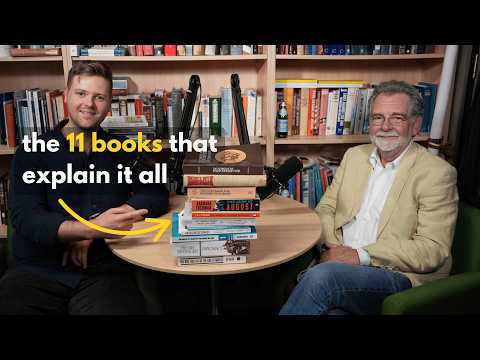
When it comes to deep-dive podcasts, no-one in Australia beats Joe Walker. In his latest episode, Joe sits down with the brilliant Hugh White to discuss 11 books about strategy. Yes, it's 4½ hours long. But it's a true masterclass. podcasts.apple.com/au/podcast/why… @JosephNWalker
English
7
16
42
6.4K
The Joe Walker Podcast retweetledi
DJ Thornton
DJ Thornton@djthornton97·
Picking Joe's brain for a couple of hours is one of the most fun and insightful things you could possibly do with your time. Go and apply!!!
Joseph Noel Walker@JosephNWalker

Apply to interview me for my end-of-year retrospective episode! One of my highlights in 2023 was being interviewed by a listener of the show, @djthornton97, who did an exceptional job despite having no former interviewing experience. There was no better way to crystallise my learnings from the year than being Socratically pushed by a thoughtful questioner who was a genuine listener of the show. This year, I'm continuing the tradition. I'm looking for a listener with a knack for asking good questions. We'll meet up in late Dec or early Jan and discuss the progress of the pod in 2025. Apply at the link below. Looking forward to seeing who applies!

English
0
2
4
2.2K
The Joe Walker Podcast retweetledi
Joseph Noel Walker
Joseph Noel Walker@JosephNWalker·
Apply to interview me for my end-of-year retrospective episode! One of my highlights in 2023 was being interviewed by a listener of the show, @djthornton97, who did an exceptional job despite having no former interviewing experience. There was no better way to crystallise my learnings from the year than being Socratically pushed by a thoughtful questioner who was a genuine listener of the show. This year, I'm continuing the tradition. I'm looking for a listener with a knack for asking good questions. We'll meet up in late Dec or early Jan and discuss the progress of the pod in 2025. Apply at the link below. Looking forward to seeing who applies!
Joseph Noel Walker tweet media
English
3
6
30
6.1K
The Joe Walker Podcast retweetledi
Joseph Noel Walker
Joseph Noel Walker@JosephNWalker·
The influence a book has on you is always an interaction between the book itself and *your context at the time you read it*. There are books that have strongly influenced me because I found them at a certain point in my development, even if I now find them banal or incomplete.
English
4
4
47
17.1K