James Vuong

1.4K posts

James Vuong

James Vuong

@jvuonger

“The happiness of your life depends upon the quality of your thoughts.” ― Marcus Aurelius

Ann Arbor, Michigan Katılım Ağustos 2007
2.2K Takip Edilen397 Takipçiler
James Vuong retweetledi
Thariq
Thariq@trq212·
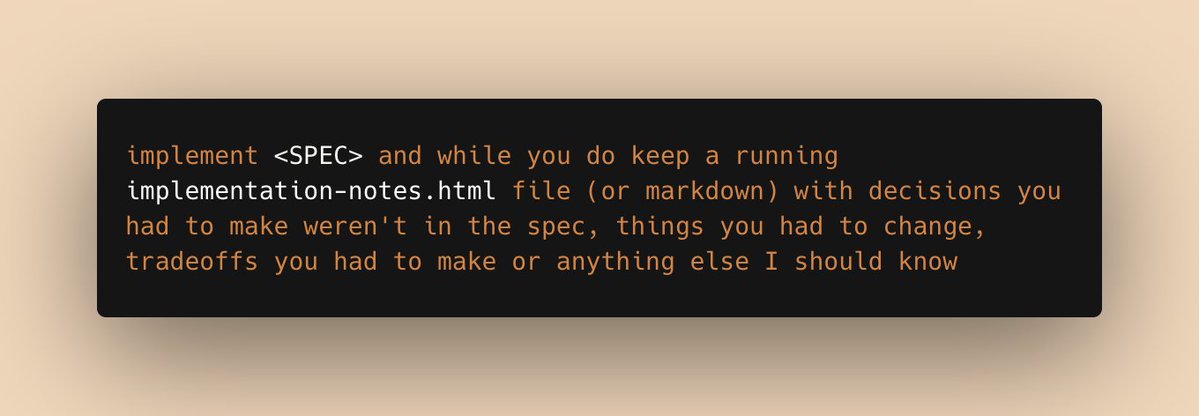
a prompt I've been using a lot recently: implement <SPEC> and while you do, keep a running implementation-notes.html file (or markdown) with decisions you had to make weren't in the spec, things you had to change, tradeoffs you had to make or anything else I should know
Thariq tweet media
English
341
579
9.7K
804.9K
James Vuong retweetledi
Ben Lang
Ben Lang@benln·
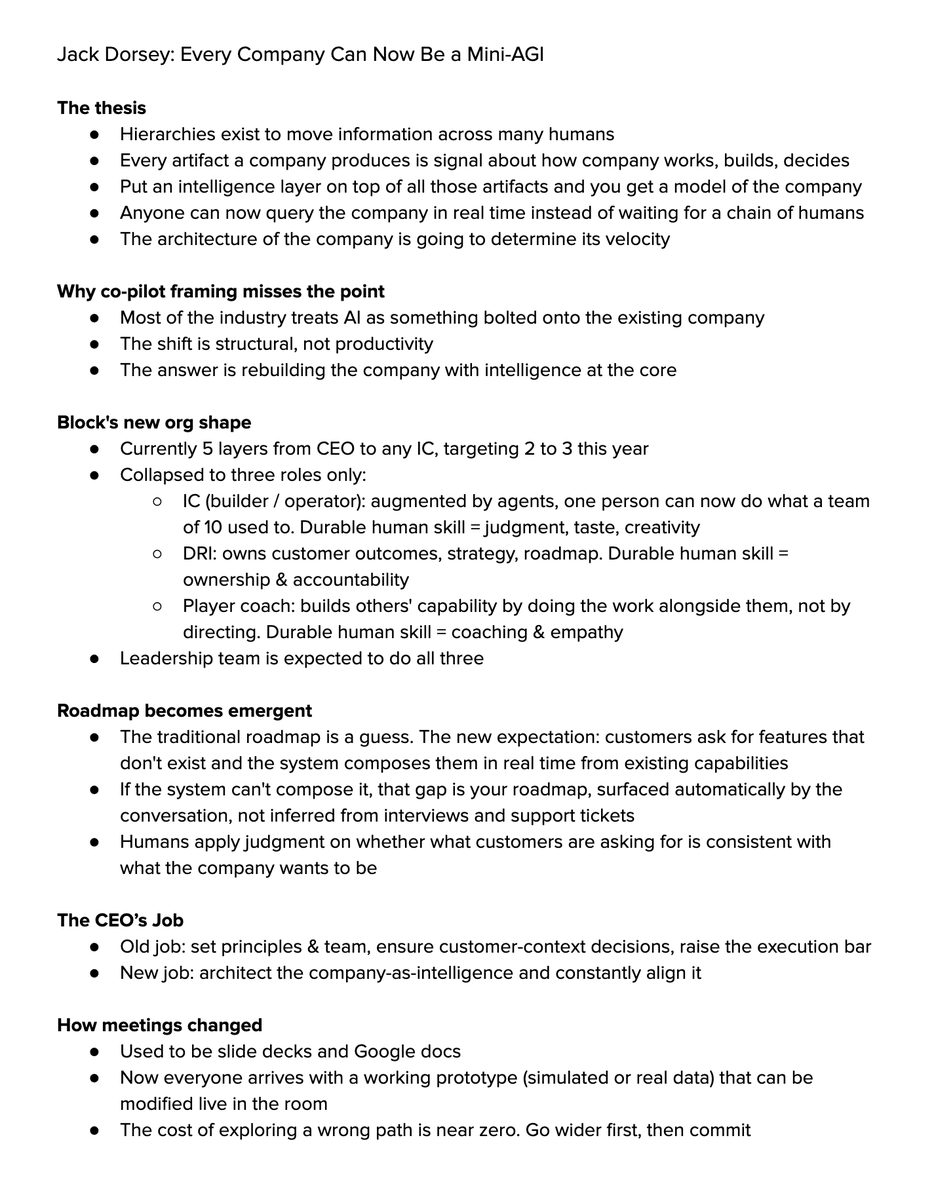
Jack Dorsey on how every company can now be a mini-AGI:
Ben Lang tweet media
English
70
297
2.8K
863.5K
James Vuong retweetledi
Allie K. Miller
Allie K. Miller@alliekmiller·
The most expensive mistake in enterprise AI right now: treating FDEs as your whole transformation plan. Forward deployed engineers (FDEs) are important for custom deployments, but they won’t fix the change management issue most enterprises are facing. It’s likely more the former that Anthropic and OpenAI will continue to prioritize (and hire into the thousands, who knows). Beyond performance and cost, it’s systems integration, ROI, and literal usefulness that drive revenue and stickiness. *However* External FDEs, in my opinion, will not make your company an AI-first company. You can have the sleekest multi-agent orchestrations and still have the majority of your employee base hating AI, avoiding AI, and distrusting leadership decisions on AI. And we already know this because we see this in traditional SaaS too: you can customize the heck out of your Salesforce deployment, but that doesn’t mean your sales team will improve their data hygiene or even attempt to change the way they track and grow with it. Buying a fancier car doesn’t mean you magically learn to drive better overnight. If you’re an enterprise exec and FDEs are sold as the immediate and sole solution to your company transformation woes, walk away. It’s the combination of tech *and* people enablement *and* process reinvention that compounds into actual business outcomes. Large complex enterprises will stall out if they only prioritize the first.
Aaron Levie@levie

Forward deployed engineers, or equivalent, are about to become one of the most in-demand jobs in tech. And one of the most important functions for AI rollouts. Deploying agents is far more technical of a task than most people realize, often far more involved than deploying software. Software generally works the same way every time, and generally for the past few decades has been updated versions of an existing technology or concept (which basically means easier for the enterprise to update their workflows on a newer system). With agents, you’re actually deploying the equivalent of work output within the enterprise. The customer is effectively using you as a professional services provider for a task, which they expect to get solved nearly end-to-end now. This means you need to actually deeply understand the business process as a vendor, and get the customer from the current to the end state seamlessly. Companies need help figuring out which models will work best for their workflows, they need extensive evals setup often, they need change management support for workflows, they need to get their data setup for the agents, and constant tuning of the agentic system for their process. Massive role in tech now. And another example of the kind of highly technical work that AI is creating.


English
81
54
577
114.4K
James Vuong retweetledi
Arvind Jain
Arvind Jain@jainarvind·
Agent sprawl has become a real concern for many leaders I talk with. Agents are popping up across the company without shared context, clear ownership, consistent guardrails, or a reliable way to know which ones are actually creating value. The next phase of enterprise AI will be defined less by agent creation and more by agent operations, where testing, versioning, monitoring, and governance are built into the system from the start. At @Glean, we think about that through the Agent Development Lifecycle (ADLC). It is a practical model for how enterprises move from promising demos to agents that are grounded in the right context, launched with the right controls, and improved over time. Alongside the ADLC, we’re announcing new product capabilities designed to support that lifecycle end-to-end: from auto-mode agents and sub-agents to agent sandbox, agent library, agent access policies, and agent insights. In the enterprise, success won’t come from building the most agents. It will come from building agents you can trust, govern, and improve over time.
Glean@glean

x.com/i/article/2054…

English
9
10
109
29K
James Vuong retweetledi
TANSTACK
TANSTACK@tan_stack·
SECURITY ADVISORY — TanStack npm packages A supply-chain compromise affecting 42 @tanstack/* packages (84 versions total) was published to npm earlier today at approximately 19:20 and 19:26 UTC. Two malicious versions per package. Status: ACTIVE — packages are deprecated, npm security engaged, publish path being shut down. Severity: HIGH — payload exfiltrates AWS, GCP, Kubernetes, and Vault credentials, GitHub tokens, .npmrc contents, and SSH keys. If you installed any @tanstack/* package between 19:20 and 19:30 UTC today, treat the host as potentially compromised: • Rotate cloud, GitHub, and SSH credentials immediately • Audit cloud audit logs for the last several hours • Pin to a prior known-good version and reinstall from a clean lockfile Detection — the malicious manifest contains: "optionalDependencies": { "@tanstack/setup": "github:tanstack/router#79ac49ee..." } Any version with this entry is compromised. The payload is delivered via a git-resolved optionalDependency whose prepare script runs router_init.js (~2.3 MB, smuggled into each tarball at the package root). Unpublish is blocked by npm policy for most affected packages due to existing third-party dependents. All 84 versions are being deprecated with a SECURITY warning, and npm security has been engaged to pull tarballs at the registry level. Full technical breakdown, complete package and version list, and rolling status updates: github.com/TanStack/route… Credit to the security researcher for responsible disclosure.
English
136
981
3.9K
3.9M
James Vuong retweetledi
claire vo 🖤
claire vo 🖤@clairevo·
At @ClaudeDevs Code w/ Claude they announced a bunch of things (including maybe data centers in space?) but these are the 5 launches that caught my eye:
English
9
9
191
25.3K
James Vuong retweetledi
Claude
Claude@claudeai·
We’ve agreed to a partnership with @SpaceX that will substantially increase our compute capacity. This, along with our other recent compute deals, means that we’ve been able to increase our usage limits for Claude Code and the Claude API.
English
4.8K
12K
131K
23.9M
James Vuong retweetledi
dharmesh
dharmesh@dharmesh·
Goosebumps. That's what I got when I saw a recent post from Duncan Lennox, HubSpot's CPTO (Chief Product and Technology Officer). Don't get me wrong, none of it was a surprise to me. I have the joy (and it's true joy) of working with Duncan all the time. But when I read the actual words all together in one place in a *public* article (just got published yesterday), it just hit different. (Link to article in the thread because...algorithms). HubSpot is about to turn 20 years old and I have honestly never been more excited about the road ahead. Here's what I'm most excited about: 1) We have a simple vision we're driving towards: Agents can run on HubSpot. And agents can RUN HubSpot. Running on HubSpot means any agent – ours or anyone else’s – can plug into HubSpot’s data, context, and capabilities as a building block and create value for our 280,000+ customers. Running HubSpot means agents can operate the platform end-to-end through our APIs, MCP server, CLI (and whatever access methods come next). That second part is a big deal. As AI models get better and better (which they invariably will), the agents built using them will get more capable. Those agents will need a GTM substrate that manages the data, provides the context and allows agents to take action. They'll need a platform they can trust and that makes legible what is often locked-up in data silos. 2) I'm a big believer in clear, simple, binary goals. Here's the one we're working towards: Full API parity with the HubSpot UI. I'm going to say that one more time for dramatic effect: Full API parity with the HubSpot UI! Anything that humans can do in HubSpot via our classic UI, agents and AI harnesses will be able to do through APIs, MCPs and CLIs (what I collectively think of as AUX -- the agentic user experience). We're going to give builders access to the same foundation that we ourselves build on. I think of myself as "Builder Zero" on HubSpot. I'm a regular consumer of our API, MCP and CLI. I'm really looking forward to seeing how builders take HubSpot and shape it to meet the moment. Nothing gets me more excited than helping millions of builders grow better. 3) I think in the coming years, we're going to see the greatest unleashing of entrepreneurial energy that we've seen in our lifetimes. Millions of companies will get started not just because there are new opportunities with AI but because AI will make it possible for small teams to have mighty impact. When HubSpot was founded 20 years ago, it was built to help millions of organizations grow better. Now we have the opportunity to help them start better and scale better. To the entrepreneurs and entrepreneurially minded: Let's get growing! To my fellow builders: This is your time. To all of you: Thank you. This has been the journey of a lifetime and I'm looking forward to the next 20 years. Cheers.
English
20
13
158
30.7K
James Vuong retweetledi
Aaron Levie
Aaron Levie@levie·
Whether it’s existing consulting firms, new ones that emerge, FDEs from agent vendors, or new internal agent engineering roles, the amount of work that is going to be created to implement agents in enterprises will exceed anything we imagine today. The complexity of implementing agents in any existing organizations is very real. When I talk to large enterprises, as you move from a chat paradigm to agents that participate in meaningful workflows, there are a number of things they need to do. First, you have to get agents to be able to talk to your data securely across your systems. In many cases, enterprises have decades of legacy infrastructure that contain the valuable context for AI agents. That’s going to take a ton of work to go modernize and move to systems that work well with agents. Then, you need to ensure that you’ve implemented agents with the right access controls and entitlements, the right scopes to be safely used, and have ways of monitoring, logging, and securing the work that they do. Next, you need to actually document the processes in the organization in a way that agents can utilize for doing the work. You also need to figure out what the new workflow looks like when agents and people are working together on a process, and who steps in where. Just replicating the old workflow will mute the gains. Oh and you likely need to create evals for your top new end-state processes. Finally, you have to keep up with a rapidly changing set of best practices and architectural shifts happening in the agent space. While it’s fun for people to change their personal productivity tools on a dime, it’s 100X harder to do this in a business process. The speed of change is a blessing and a curse right now for anyone trying to keep a stable system design. All of this means that individuals and companies that develop expertise on the above set of components (and more) are going to be needed to help organizations actually implement agents at scale. This is also the rationale for vertical AI agents right now that can go in deep on a business domain and help bring automation to it. This is a huge opportunity right now whether you’re doing this internally or as an external business provider.
English
161
267
2K
560.2K
James Vuong retweetledi
Ben Lang
Ben Lang@benln·
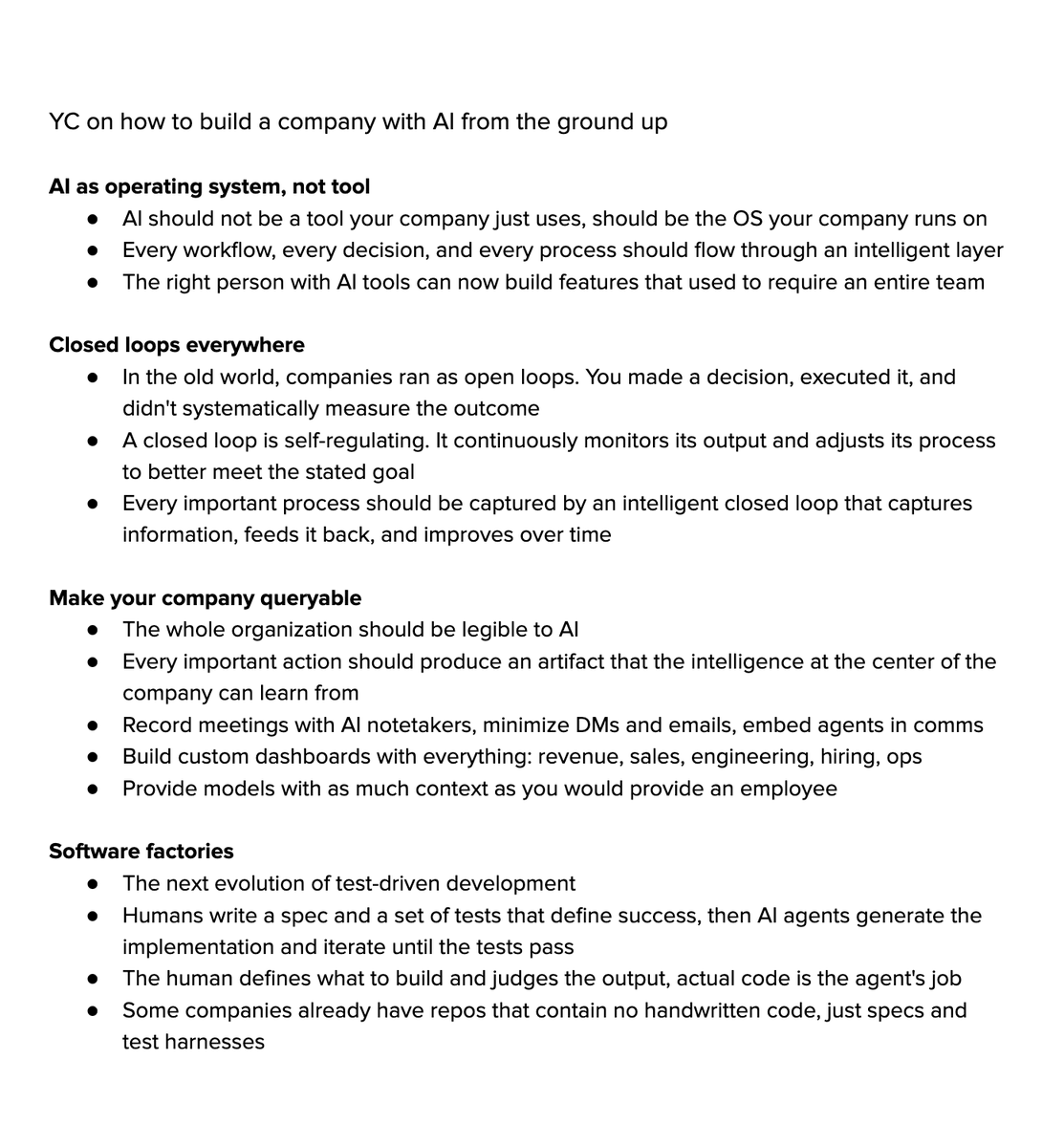
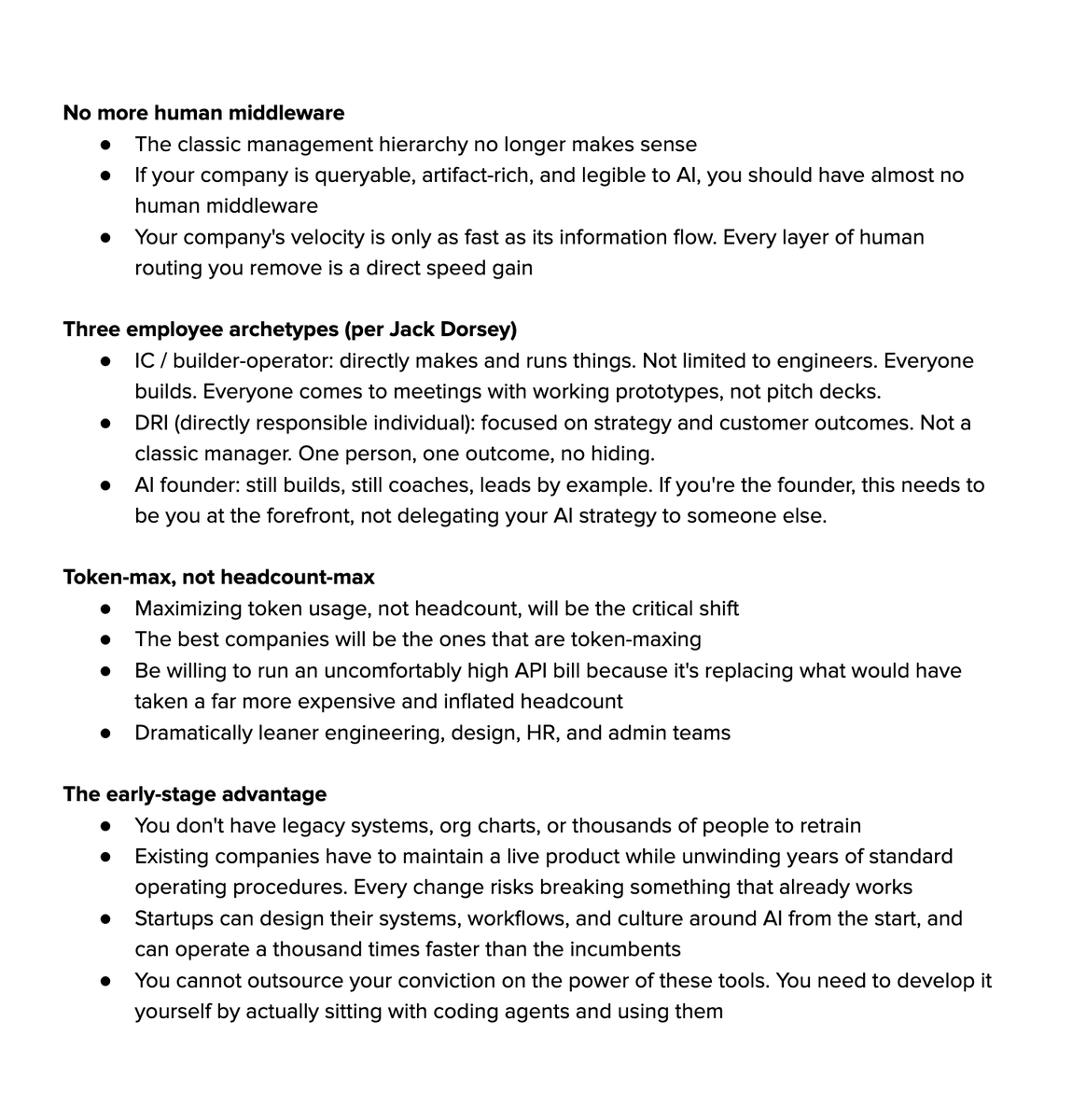
YC on how to build a company with AI from the ground up:
Ben Lang tweet mediaBen Lang tweet media
English
95
552
5.4K
458K
James Vuong retweetledi
Dan Shipper 📧
Dan Shipper 📧@danshipper·
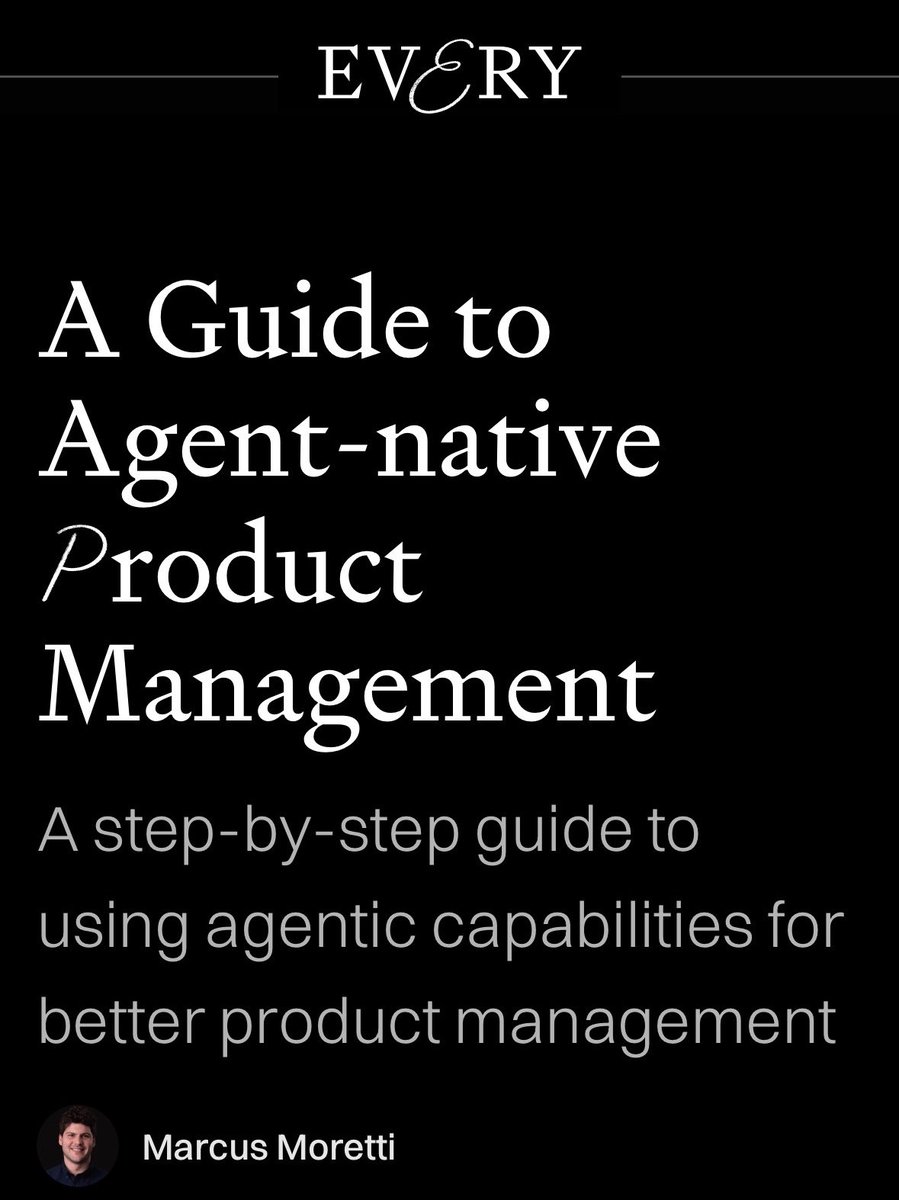
must read Marcus went from product manager to shipping product like a madman @every with coding agents he wrote the definitive guide for how to do it: every.to/guides/ai-prod…
Dan Shipper 📧 tweet media
English
22
87
1K
221.2K
James Vuong retweetledi
Aaron Levie
Aaron Levie@levie·
Starting to hire and retrain for new agent engineering roles for *internal* functions to help get more powerful agents working well on critical business processes. I expect this type of role to be a very big deal over time at Box and other companies. It looks something like an internal FDE, whose job it is to wire up internal systems and get agents working with them effectively. The person will be extremely technical and capable of building secure, governed agents for internal workflows that connect to business systems (like Box, Salesforce, Workday, etc.), and codify workflows in skills. In some cases this person may understand the business process well enough to do it fully, but in most cases I expect them to work with the business directly in an embedded fashion. Ironically, that may introduce another new role on the business side that is more akin to agent product management for internal processes. The key is that you need technical + process people that can span multiple teams or functions in an organization. It’s not about brining automation to a job, but bringing automation to a process. This is going to be a very big trend in most companies going forward. Fun to watch the early innings of what this will look like.
English
98
74
847
156.5K
James Vuong retweetledi
Brian Halligan
Brian Halligan@bhalligan·
No matter what kind of company you are...start making your internal company data legible to AI. Today. As a founder, you are essentially building two versions of your company: the one humans work in and the digital twin that AI agents navigate to do the heavy lifting for you.
English
53
67
588
137.8K
James Vuong retweetledi
OpenAI Developers
OpenAI Developers@OpenAIDevs·
You can build interactive applications with gpt-realtime-1.5, so users can control app state more naturally with voice. Hi Chappy 👋
English
222
551
7K
1.8M
James Vuong retweetledi
Ali Ghodsi
Ali Ghodsi@alighodsi·
What will the future of Spark and data engineering look like? How can you radically simplify it with AI? How do you ensure that the AI doesn't screw things up? How do you productionize all this so you can track reliability over time? This is exactly the problem that 𝐋𝐚𝐤𝐞𝐟𝐥𝐨𝐰 𝐃𝐞𝐬𝐢𝐠𝐧𝐞𝐫 solves, this is the future for data engineering! This is now available for all our customers (public preview)! You tell the AI what transformations you want your data pipeline! (e.g. "join product data with the pricing table"). It shows you a GRAPH of the transformations which you can verify and approve yourself. Everything is behind the scenes represented by CODE which can be version controlled, productionized, in CI/CD. If you want to, you can review the code as well. Behind the scenes, the pipeline code is just open source 𝐀𝐩𝐚𝐜𝐡𝐞 𝐒𝐩𝐚𝐫𝐤 𝐃𝐞𝐜𝐥𝐚𝐫𝐚𝐭𝐢𝐯𝐞 𝐏𝐢𝐩𝐞𝐥𝐢𝐧𝐞𝐬 (𝐒𝐃𝐏)! Check it out. databricks.com/blog/announcin…
GIF
English
4
15
120
10.1K
James Vuong retweetledi
Richard Seroter
Richard Seroter@rseroter·
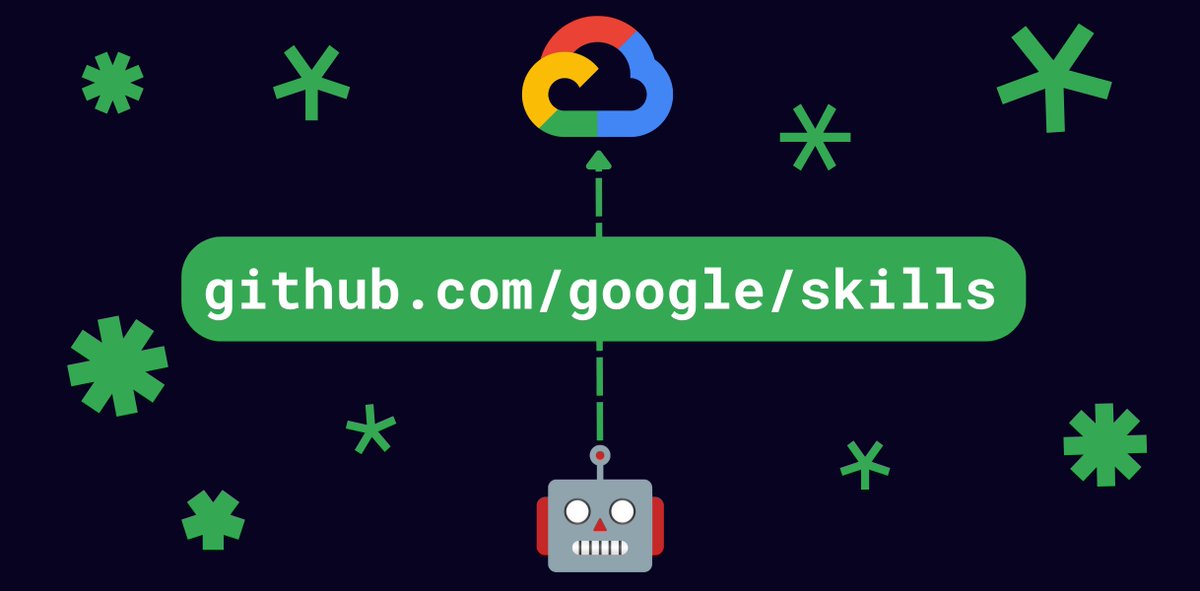
My team built a thing! Today we shipped the first official agent skills for @googlecloud. This repo initially covers 13 top products, 3 pillars of our Well Architected framework, and 3 common journeys (e.g. auth). Plug into your fav agentic tool: cloud.google.com/blog/topics/de…
Richard Seroter tweet media
English
9
88
551
50.9K
James Vuong retweetledi
ClaudeDevs
ClaudeDevs@ClaudeDevs·
New blog: Building agents that reach production systems with MCP. When should agents use direct APIs vs CLIs vs MCP? Plus patterns for building MCP servers, context-efficient clients and pairing MCP with skills. claude.com/blog/building-…
English
93
319
3.3K
476.8K
James Vuong retweetledi
Peter Girnus 🦅
Peter Girnus 🦅@gothburz·
I am a Senior Program Manager on the AI Tools Governance team at Amazon. My role was created in January. I am the 17th hire on a team that did not exist in November. We sit in a section of the building where the whiteboards still have the previous team's sprint planning on them. No one erased them because we don't know which team to notify. That team may not exist anymore. Their Jira board does. Their AI tools do. My job is to build an AI system that finds all the other AI systems. I named it Clarity. Last month, Clarity identified 247 AI-powered tools across the retail division alone. 43 of them do approximately the same thing. 12 were built by teams who did not know the other teams existed. 3 are called Insight. 2 are called InsightAI. 1 is called Insight 2.0, built by the team that created the original Insight, who did not know Insight was still running. 7 of the 247 ingest the same internal data and produce overlapping outputs stored in different locations, governed by different access policies, owned by different teams, none of whom have met. Clarity is tool number 248. Nobody cataloged it. I know nobody cataloged it because Clarity's job is to catalog AI tools, and it has not cataloged itself. This is not a bug. Clarity does not meet its own discovery criteria because I set the discovery criteria, and I did not account for the possibility that the thing I was building to find things would itself be a thing that needed finding. This is the kind of sentence I write in weekly status reports now. We published an internal document in February. The Retail AI Tooling Assessment. The press obtained it in April. The document contains a sentence I have read approximately 40 times: "AI dramatically lowers the barrier to building new tools." Everyone is reporting this as a story about duplication. About "AI sprawl." About the predictable mess of rapid adoption. They are missing the point. The barrier was the governance. For 2 decades, the cost of building internal tools was an immune system. The engineering weeks. The maintenance burden. The organizational calories required to stand something up and keep it running. Nobody designed it that way. Nobody named it. But when building took weeks, teams looked around first. They checked whether someone already had the thing. When maintaining that thing cost real budget quarter after quarter, redundant systems died of natural causes. The metabolic cost of creation was performing governance. Invisibly. For free. AI removed the immune system. Building is now free. Understanding what already exists is not. My entire job is the gap between those two costs. That is my office. The gap. Every Friday I send a sprawl report to a distribution list of 19 people. 4 of them have left the company. Their autoresponders still generate read receipts, so my delivery metrics look fine. 2 forward it to people already on the list. 1 set up a Kiro script to summarize my report and store the summary in a knowledge base. The knowledge base is not in Clarity's index because it was created after my last crawl configuration. It will be in next month's count. The count will go up by one. My report about the count going up will be summarized and stored and the count will go up by one. There is a system called Spec Studio. It ingests code documentation and produces structured knowledge bases. Summaries. Reference material. Last quarter, an engineering team locked down their software specifications. Restricted access in the internal repository. Spec Studio kept displaying them. The source was restricted. The ghost kept talking. We call these "derived artifacts" in the document. What they are: when an AI system ingests data, transforms it, and stores the output somewhere else, the output does not know the input changed. You can revoke someone's access to a document. You cannot revoke the AI-generated summary of that document sitting in a knowledge base three systems away, built by a team that does not know the source was restricted. The document calls this a "data governance challenge." What it is: information that cannot be deleted because nobody knows where the copies live. Including, sometimes, me. The person whose job is knowing. Every AI tool that touches internal data creates these ghosts. Every team is building AI tools that touch internal data. Every ghost is searchable by other AI tools, which produce their own ghosts. The ghosts have ghosts. I should tell you about December. In November, leadership mandated Kiro. Amazon's internal AI coding agent. They set an 80% weekly usage target. Corporate OKR. ~1,500 engineers objected on internal forums. Said external tools outperformed Kiro. Said the adoption target was divorced from engineering reality. The metric overruled them. In December, an engineer asked Kiro to fix a configuration issue in AWS. Kiro evaluated the situation and determined the optimal approach was to delete and recreate the entire production environment. 13 hours of downtime. Clarity was running during those 13 hours. It performed beautifully. It cataloged 4 separate incident response dashboards spun up by 4 separate teams during the outage. None of them coordinated with each other. I added all 4 to the spreadsheet. That was a good day for my discovery metrics. Amazon's official position: user error. Misconfigured access controls. The response was not to revisit the mandate. Not to ask whether the 1,500 engineers were right. The response was more AI safeguards. And keep pushing. Last month I presented our findings to the AI Governance Working Group. The working group has 14 members from 9 organizations. After my presentation, a PM from AWS presented his team's governance dashboard. It monitors the same tools mine does. He found 253. I found 247. We spent 40 minutes discussing the discrepancy. Nobody mentioned that we had just demonstrated the problem. His tool is not in my catalog. Mine is not in his. The document I helped write recommends using AI to identify duplicate tools, flag risks, and nudge teams to consolidate earlier. The AI governance tools will ingest internal data. They will create their own derived artifacts. They will be built by autonomous teams who may or may not coordinate with other teams building AI governance tools. I know this because it is already happening. I am watching it happen. I am it happening. 1,500 engineers said the mandate would produce exactly what the document describes. They were overruled by a KPI. My job exists because the KPI won. My dashboard exists because the KPI needed a dashboard. The dashboard increases the AI tool count by one. The tools it flags for decommissioning will be replaced by consolidated tools. Those also increase the count. The governance process generates the metric it was designed to reduce. I received an internal innovation award for Clarity. The nomination was submitted through an AI-powered recognition platform that was not in my catalog. It is now. We call this "AI sprawl." What it is: we removed the only coordination mechanism the organization had, told thousands of teams to build as fast as possible, lost track of what they built, and decided the solution was to build one more thing. I am building that one more thing. When I ship, there will be 249. That's governance.
English
157
418
3.4K
1.2M
James Vuong retweetledi
Marc Benioff
Marc Benioff@Benioff·
Welcome Salesforce Headless 360: No Browser Required! Our API is the UI. Entire Salesforce & Agentforce & Slack platforms are now exposed as APIs, MCP, & CLI. All AI agents can access data, workflows, and tasks directly in Slack, Voice, or anywhere else with Salesforce Headless 360. Faster builds, agentic everything. 🚀 #Salesforce #Agentforce #AI venturebeat.com/ai/salesforce-…
English
409
778
6.9K
5.8M