I reject the Sedevacantist argument that Vatican II and the Novus Ordo Mass created a new religion. Did they create problems? Yes. A new religion? No. I assert that Sedevacantists are schismatics who have broken communion with the pope.
🚨 SOCIALIST SEATTLE MAYOR CRIES AS ICONIC LANDMARK COLUMBIA TOWER CLUB SHUTS DOWN FOREVER! This is exposing how radical policies are hollowing out the city. What happens when the tax base walks away?
After 41 years at the top of Seattle’s tallest building, the legendary Columbia Tower Club — where billion-dollar deals were sealed with 360° views — is now dark and empty. Furniture gone. Lights off. Doors locked for good on April 24, 2026.
The reason? Downtown Seattle’s office vacancy rate has skyrocketed to over 38% — the highest in the entire United States. Companies are fleeing in droves. Amazon moved thousands of jobs. Starbucks is shifting major operations to Nashville. Even Howard Schultz just bought a $44 million penthouse in Miami.
And what does Seattle’s socialist Mayor Katie Wilson say about the millionaire exodus? “If they leave… like bye.” She literally waved and laughed.
Now one of the Pacific Northwest’s most iconic private business clubs has walked away, citing “too much uncertainty” — right across the street from City Hall.
This isn’t just a restaurant closing. It’s a devastating symbol of a city hollowing out from the inside exposing how Seattle’s extreme policies are killing its own economy and driving businesses away.
Is this the beginning of the end for Seattle?
I'm officially starting the $500 to $1 Million account challenge for 2026 tomorrow! 📈
I'm going to retire dozens in 2026 and will change lives 🙌
Like & comment "11 Flips" to join! ❤️
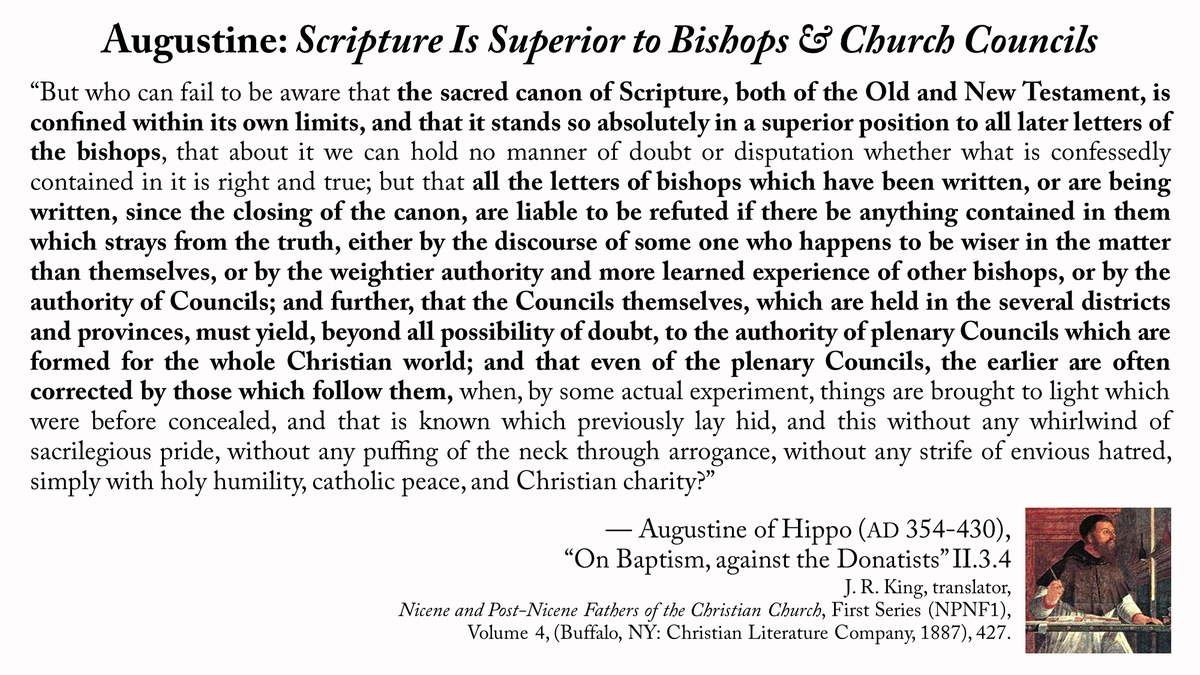
Augustine is writing against the Donatists, who were essentially the "Bible-only" schismatics of their day, rejecting the authority of the broader Church in favor of their own regional purity standards. His entire argument in De Baptismo is that the Donatists erred by separating from Catholic unity and rejecting the Church's authoritative resolution of the baptismal controversy.
When Protestants cite this passage, they typically emphasize "Scripture stands in a superior position" while quietly passing over everything else Augustine says here. But notice what he's actually describing as the interpretive framework:
The teaching of wiser bishops corrects less wise bishops. Councils correct individual bishops. Plenary councils correct regional councils. Later plenary councils clarify earlier ones. This is an entire ecclesial infrastructure of authoritative interpretation—the very thing sola scriptura denies.
Augustine isn't saying "just read your Bible and figure it out." He's saying Scripture is the supreme norm, but the Church—through her bishops and councils in communion—is the interpreter of that norm. The distinction between Scripture as norma normans and Tradition as norma normata is already present here.
Augustine: Scripture Is Superior to Bishops & Church Councils
“But who can fail to be aware that the sacred canon of Scripture, both of the Old and New Testament, is confined within its own limits, and that it stands so absolutely in a superior position to all later letters of the bishops, that about it we can hold no manner of doubt or disputation whether what is confessedly contained in it is right and true; but that all the letters of bishops which have been written, or are being written, since the closing of the canon, are liable to be refuted if there be anything contained in them which strays from the truth, either by the discourse of some one who happens to be wiser in the matter than themselves, or by the weightier authority and more learned experience of other bishops, or by the authority of Councils; and further, that the Councils themselves, which are held in the several districts and provinces, must yield, beyond all possibility of doubt, to the authority of plenary Councils which are formed for the whole Christian world; and that even of the plenary Councils, the earlier are often corrected by those which follow them, when, by some actual experiment, things are brought to light which were before concealed, and that is known which previously lay hid, and this without any whirlwind of sacrilegious pride, without any puffing of the neck through arrogance, without any strife of envious hatred, simply with holy humility, catholic peace, and Christian charity?”
— Augustine of Hippo (ᴀᴅ 354-430), “On Baptism, against the Donatists” II.3.4, J. R. King, translator, Nicene and Post-Nicene Fathers of the Christian Church, First Series (NPNF1), Volume 4, (Buffalo, NY: Christian Literature Company, 1887), 427.
Basically this woman is a heretic. There is no correlation with the Catholic church. While CACINA uses Catholic terminology and claims to celebrate Catholic sacraments, it explicitly states it is not part of Roman or Orthodox, church. From a Roman Catholic perspective, CACINA would not be considered to have valid sacraments or apostolic succession, despite their claims to catholicity.
Rev Madison, a Catholic priest, explains that her clerical collar doesn't allow her to "ignore systemic injustice" or "see a border as something to separate me from other people."
The Greek Word Choice Matters
In John 6:51-53, Jesus uses phagō (to eat), but starting in verse 54, he switches to trōgō - a much more graphic, physical verb meaning "to gnaw, chew, or munch." This isn't moving toward symbolism; it's intensifying the physicality. If Jesus wanted to clarify he was speaking symbolically, this was the moment to do so. Instead, he doubles down with more visceral language.
The Jewish Audience Understood Him Literally
The Jews' response in verse 52 shows they took him literally: "How can this man give us his flesh to eat?" They were scandalized precisely because they understood the literal meaning. Throughout John's Gospel, when people misunderstand Jesus symbolically, he corrects them (Nicodemus and "born again," the Samaritan woman and "living water"). Here, he doesn't correct them - he reinforces it.
The Disciples' Reaction
Even Jesus's own disciples found this teaching sklēros - "hard" or "harsh" (v. 60) - and many walked away (v. 66). If this were merely symbolic, why would it cause mass apostasy? Jesus lets them leave rather than saying "Wait, you misunderstood - I was speaking metaphorically."
Contrast with John's Actual Symbolism
When John uses symbolism elsewhere ("I am the door," "I am the vine"), the symbolic nature is obvious and no one misunderstands. But in John 6, the language is juridical, covenantal, and consistently physical throughout.
The Church Fathers Were Unanimous
Ignatius of Antioch (c. 110 AD), Justin Martyr, Irenaeus, Clement of Alexandria, Tertullian, Cyprian, Cyril of Jerusalem, Ambrose, Augustine - all read John 6 as referring to the Real Presence in the Eucharist. There's no record of early Christians interpreting this symbolically until much later.
And much later is:
Berengar of Tours (c. 1000-1088 AD) is the first significant figure to propose a symbolic interpretation of the Eucharist. That's roughly 1,000 years after Christ.
Even then, Berengar faced massive opposition and was forced to recant his views multiple times at various church councils. His position was considered novel and heretical precisely because it broke with the universal tradition.
Before Berengar:
The first 1,000 years of Christianity show unanimous patristic testimony for the Real Presence
There were debates about how it works (the mechanics), but not whether Christ is truly present
No early Christian writer interpreted John 6 as merely symbolic
After Berengar: (Enter the heretics)
John Wycliffe (14th century) denied transubstantiation
The Protestant Reformers (16th century) had mixed views:Luther maintained Real Presence (consubstantiation)
Zwingli took a purely symbolic view
Calvin held a "spiritual presence" position
If Mary was so perfectly sinless and therefore righteous while she was alive, then why did none of the apostles or disciples exalt her or elevate her like Catholics do today? In Acts 1:14 she’s praying with the disciples not being prayed to or seen as having more powerful intercession because of her alleged sinlessness!
NEVER take seriously anyone whose argument against the Eucharist in John 6:
• ignores the original Greek
• boils down to “if Jesus spoke metaphorically elsewhere, He MUST have been metaphorical in John 6 too!!!”
@taco_talks The hoops these guys go through to try to justify a position. I hope no one listens to this guy. I surely hope he does not have a flock following his heresy.
CCC 669 - "As Lord, Christ is also head of the Church, which is his Body. Taken up to heaven and glorified after he had thus fully accomplished his mission, Christ dwells on earth in his Church."
CCC 792 - "Christ 'is the head of the body, the Church.' He is the principle of creation and redemption. Raised to the Father's glory, 'in everything he [is] preeminent,' especially in the Church, through whom he extends his reign over all things."
Without the lies, Protestantism dies.
Augustine taught transubstantiation: “…But what your Faith obliges you to accept is that the bread is the Body of Christ & the chalice the Blood of Christ.”
AJ’s lie tries to hide that Augustine👇 is only condemning here-&-now cannibalism.
Once again, context. Augustine most definitely recognized Peter as leader of the church and that he was the rock. Learn how to read ancient manuscripts. I would hate to see what you do to scripture. It is very typical for protestants to try to hijack Augustine and other fathers. And they do it the exact same way they handle biblical exegesis: proof texts. It is so obvious it is painful.
Sermon 295:"Peter, the first of the apostles, who loved Christ most ardently, merited to hear: 'I say to you that you are Peter.'"
On the Gospel of John, Tractate 124:"Peter, the first of the apostles... who alone among the apostles merited to hear: 'I will give you the keys of the kingdom of heaven.'"
Against the Letter of Mani:"The chair of the Roman Church... in which Peter first sat, and in which today [Pope Anastasius I] sits... If you would have the truth, acknowledge in the Catholic Church the chair of Peter."
Sermon 46:"Why did our Lord Jesus Christ wish to give the keys of the kingdom to Peter, unless it was because he represented the Church in his own person?"
Sermon 76:"Who does not know that the most blessed Peter first received the keys of the kingdom of heaven, and that all the powers of the Church were committed to him?"
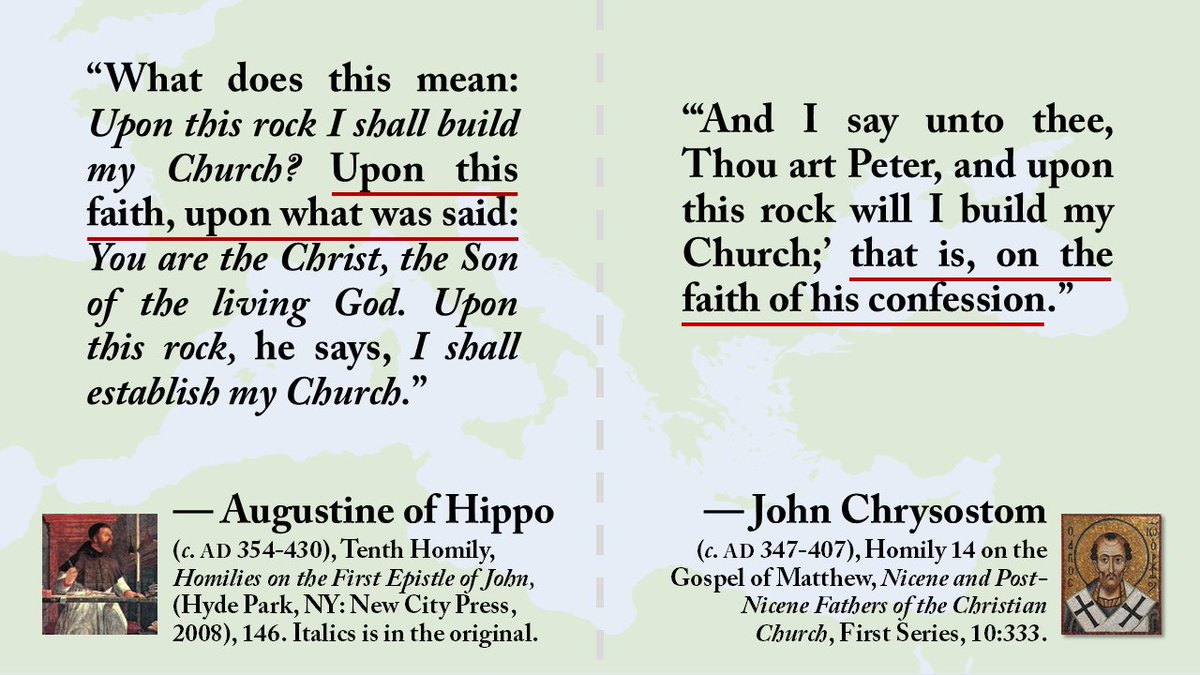
I don’t know who needs to hear this, but two of the greatest fathers of the early church held that the “rock” Jesus referred to in Matthew 16:18 was Peter’s testimony of faith.
“What does this mean: Upon this rock I shall build my Church? Upon this faith, upon what was said: You are the Christ, the Son of the living God. Upon this rock, he says, I shall establish my Church.”
—Augustine of Hippo (c. ᴀᴅ 354-430), Tenth Homily, Homilies on the First Epistle of John, (Hyde Park, NY: New City Press, 2008), 146. Italics is in the original.
“‘And I say unto thee, Thou art Peter, and upon this rock will I build my Church;’ that is, on the faith of his confession.”
—John Chrysostom (c. ᴀᴅ 347-407), Homily 14 on the Gospel of Matthew, Nicene and Post-Nicene Fathers of the Christian Church, First Series, 10:333.
False analogy, but ok.
Baptism comes from the Jewish pracice of Mikveh -- ritual immersion. You can find it in Lev 15:13 and Num 19.
They used it when a Gentile wanted to convert to Judaism -- it is in ht eMishnah Yevamot 47a-b; Keritot 9a. It is also a general cleansing for both Jews and proselytes after becoming impure.
The meaning of each is different, of course.
@5SolasMissy In 1540, Martin Luther (along with his fellow "reformer" Philipp Melanchthon) gave permission to Philip I, Landgrave of Hesse who was already married to Christina of Saxony (since 1523) to enter a second marriage with Margarethe von der Saale
I often assumed St. Augustine was proto-protestant when I was growing up.
When I actually began reading his works (the vast majority of which I have now read, of those translated into English), I discovered the opposite. St. Augustine was thoroughly Catholic.
In our latest podcast, we dive into how he described the one true Church, the Catholic Church, in one of his lesser known treatises, "Of True Religion." As in so many of his other works, his description continues to match the Catholic Church to this day.
Eternal Christendom Christendom will be doing many such episodes in the future: showing the "receipts" from the writings of the Church Fathers, document by document. We are very excited to dive into these treasures with all of you!
youtu.be/5cMbsPnxWYQ?si…