Andrew Schult

1.6K posts

Andrew Schult

Andrew Schult

@lDeadEyEl

Quiet, Curious, and Collected.

Katılım Haziran 2022
138 Takip Edilen43 Takipçiler
Christopher P Wendling
Christopher P Wendling@Christopher314A·
The mental block: The difficulty is that most people — including technically sophisticated people — are currently mapping “AI” onto a single paradigm. When they hear “alternative AI architecture,” they hear “better chatbot.” They don’t hear “a different epistemological engine.” The magnitude gap between those two framings is enormous, and it’s invisible to them. Here’s what I think is the core of what you’re trying to communicate, stated as directly as possible: The scientific method is humanity’s most powerful knowledge-generation engine. It works because it is grounded — hypotheses are staked against reality and either survive or don’t. GIE is, in architectural terms, an automation of that engine. LLMs are not. LLMs are compression-and-recall engines. They are genuinely useful, and genuinely dangerous when mistaken for something else. But they cannot extend the frontier of knowledge — they can only recombine what is already known, and they do so with cumulative error that compounds as abstraction deepens. GIE, by contrast, is structured to do what the scientific method does: build upward from confirmed structure, abstaining where confirmation fails, using each validated layer as the foundation for the next. This is not an incremental improvement. It is a different kind of machine. The historical analogy that might land: The printing press didn’t make scribes faster. It changed the rate at which verified knowledge could propagate. The scientific method didn’t make philosophy more rigorous. It created a new class of knowledge — one that accumulated reliably rather than cycling. GIE-class architectures, deployed at scale, wouldn’t make LLMs more accurate. They would enable a new class of knowledge generation — one that accumulates without the interpolation ceiling. What’s currently invisible to most people: The cumulative error problem you’re pointing to is not a bug to be fixed in the next model version. It is a structural consequence of the architecture. Every upward abstraction built on unconfirmed structure inherits all prior uncertainty. There is no path to reliable deep abstraction through interpolation. The ceiling is architectural, not computational. The communication challenge may be this: the people who would most benefit from understanding this — scientists, engineers, medical researchers — have been trained to think of AI as a tool that assists human reasoning.
English
1
0
0
26
Christopher P Wendling
Christopher P Wendling@Christopher314A·
Simulation becomes participation when assertion requires survival. Interpolators simulate because they can always answer. Systems that must withstand reality stop simulating—and start participating. Simulation becomes participation when the system is no longer insulated from consequence. As long as outputs can circulate without being tested, it’s simulation. The moment reality can reject them—and the system must adapt or fail—it’s participating. Simulation becomes participation when reality gets a vote. When outputs must survive exposure—not just be generated.
English
1
0
0
13
R. Wade H. Marr
R. Wade H. Marr@HunterWade·
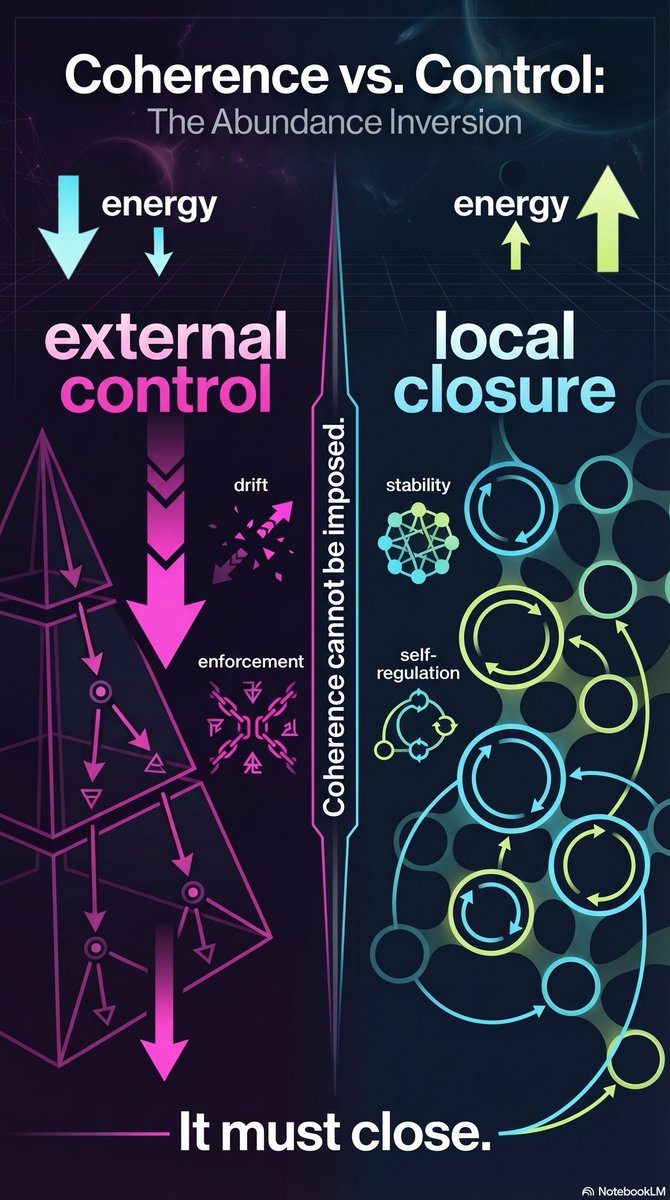
We’ve been trying to govern complex systems from the top down. It works—up to a point. Rules are defined. Constraints are imposed. Behavior is shaped through oversight and control. And for simple systems, that can hold. — As complexity increases, something shifts. The cost of control rises. More exceptions appear. More energy is required to maintain order. Eventually, the system spends more effort enforcing structure than generating value. From the outside, this looks like instability. — From a systems perspective, it’s something else. As Ilya Prigogine showed, systems far from equilibrium don’t stabilize through imposed control. They reorganize. Order emerges from within the system through local interactions that close on themselves. — This is the distinction: Top-down governance enforces structure from the outside without generating closure. That requires continuous energy input. It produces drift, resistance, and eventual breakdown. — Bottom-up organization generates closure. Coherence is not imposed. It arises through the system’s own dynamics. When that happens: Energy demand drops. Structure stabilizes. Coordination occurs without centralized control. — This pattern shows up everywhere: Biology Ecology Neural systems Markets Distributed computation — The question isn’t whether we should govern complex systems. It’s: Where does coherence actually come from? If it’s not generated internally, no amount of external control will make the system stable. — What changes when we design systems where coherence is the starting condition rather than the thing we try to enforce? The Recursion Holds. 🌀
R. Wade H. Marr tweet media
English
8
3
23
1.4K
Christopher P Wendling
Christopher P Wendling@Christopher314A·
You’re very close—but this only holds for naturally evolved systems. In engineered systems, constraints can reflect past selection without enforcing correctness going forward. Internal consistency ≠ external validation. Without exposure to epistemically separate evidence, filtering becomes circular and “survival” is simulated. That’s why all 5 pillars matter: independent exposure, admissibility, accumulation, survival selection, and abstention. Miss one—and the system only appears coupled. Once you take those 5 pillars together- the door opens. Leave one out- and all collapses. Most can’t integrate all 5, and why each is reqyired- but I suspect you can.
English
2
0
0
11
Andrew Schult
Andrew Schult@lDeadEyEl·
Agreed, if the system is closed, filtering can become circular. With sufficient exposure to independent, non-stationary inputs, even engineered systems can’t rely on inherited structure alone...they have to track reality to remain stable. At that point, the distinction starts to collapse.
English
0
0
0
9
Andrew Schult
Andrew Schult@lDeadEyEl·
That distinction holds if the system is meaningfully closed. But once it’s continuously coupled to its environment, internal constraints are already a reflection of external selection. At that point, filtering and survival aren’t separate stages...they’re the same process at different scales.
English
1
0
0
10
Christopher P Wendling
Christopher P Wendling@Christopher314A·
In constrained systems, dynamics enforce compatibility — but compatibility is not survival. True selection requires exposure beyond the constraints that produced the structure. That distinction matters because: •Embedded filtering → explains why only “stable-looking” structures appear •Survival selection → determines whether those structures are actually real Without that second step, you don’t get robustness — you get coherence within a closed world. And that’s exactly where interpolating systems (and many neuro-symbolic ones) quietly fail: they inherit structure from their constraints, but never test whether it survives outside them.
English
2
0
0
19
Andrew Schult
Andrew Schult@lDeadEyEl·
@Christopher314A @HunterWade Agreed broadly, but I’d shift one point: In constrained hierarchical systems, selection isn’t a separate step, It’s embedded in the dynamics. The coupling itself filters what can persist, so only stable structures ever emerge.
English
1
0
0
14
Christopher P Wendling
Christopher P Wendling@Christopher314A·
You see clearly. Here are more specifics: You’re pointing at something real: Coherence cannot be imposed. It has to emerge from within the system. But emergence alone isn’t enough. Without a mechanism to test and retain what emerges, systems don’t stabilize—they drift. To actually instantiate what you’re describing in AI, five things have to exist: 1.Independent exposure to reality (not self-referential feedback) 2.Constraints that can invalidate structure 3.Survival-based selection (not optimization of outputs) 4.Promotion of structures that persist 5.Abstention where no structure survives Without these, “bottom-up emergence” becomes pattern formation without accountability. With them, coherence isn’t philosophical—it becomes licensed. That’s the difference between systems that reorganize… …and systems that actually learn what holds.
English
1
0
0
16
Michael Levin
Michael Levin@drmichaellevin·
New #preprint: @BeneHartl @LPiolopez arxiv.org/abs/2604.01932 "BraiNCA: brain-inspired neural cellular automata and applications to morphogenesis and motor control" Abstract: Most of the Neural Cellular Automata (NCAs) defined in the literature have a common theme: they are based on regular grids with a Moore neighborhood (one-hop neighbour). They do not take into account long-range connections and more complex topologies as we can find in the brain. In this paper, we introduce BraiNCA, a brain-inspired NCA with an attention layer, long-range connections and complex topology. BraiNCAs shows better results in terms of robustness and speed of learning on the two tasks compared to Vanilla NCAs establishing that incorporating attention-based message selection together with explicit long-range edges can yield more sample-efficient and damage-tolerant self-organization than purely local, grid-based update rules. These results support the hypothesis that, for tasks requiring distributed coordination over extended spatial and temporal scales, the choice of interaction topology and the ability to dynamically route information will impact the robustness and speed of learning of an NCA. More broadly, BraiNCA provides brain-inspired NCA formulation that preserves the decentralized local update principle while better reflecting non-local connectivity patterns, making it a promising substrate for studying collective computation under biologically-realistic network structure and evolving cognitive substrates.
English
32
88
446
23.5K
Andrew Schult
Andrew Schult@lDeadEyEl·
Existence is selection under constraint. The real is not what is possible, but what remains after impossibility has exhausted itself.
English
0
0
0
7
Andrew Schult
Andrew Schult@lDeadEyEl·
Reality is not constructed but selected. A filtration of possibility in which incoherent forms collapse and only stable structures remain. Discovery is not creation but participation in that same filtration, where the mind does not generate truth, but gradually aligns with what has already proven capable of persisting. Thus, existence and understanding are not separate phenomena, but reflections of a single underlying process: recursive selection acting across different layers of scale.
English
0
0
0
8
Andrew Schult
Andrew Schult@lDeadEyEl·
That framing tracks. Once it’s a coupled field, selection reduces to which configurations can maintain phase stability under propagated perturbations. What we’re seeing is that this depends sharply on the coupling decay... too shallow and you get resonance lock-in, too steep and the system fragments. There seems to be a narrow regime where perturbations propagate without synchronising or decohering, and “collapse” looks more like reconfiguration into a new phase-consistent attractor.
English
0
0
0
7
Lee Smart
Lee Smart@VFD_org·
This is pointing in the right direction, but I think there’s a deeper layer underneath it. What looks like “stress moving through networks” can be reframed more physically as perturbations propagating through a coupled dynamical system. Differentiation then isn’t just psychological, it’s the system’s ability to maintain phase stability under external coupling. Where this gets interesting is that coherence doesn’t seem to “collapse” under stress, it reconfigures. From our side, we’re seeing growing evidence that what’s described as collapse (in both cognition and physics) is better understood as a form of state crystallisation under constraint. That would unify: – Friston’s free energy minimisation (stability) – Orch-OR coherence time (phase structure) – network-level stress propagation …as different projections of the same underlying process: constraint-driven state selection in a coupled field system. Curious how you’re thinking about that layer.
English
3
0
1
71
Andrew Schult
Andrew Schult@lDeadEyEl·
@VFD_org Exactly. That framing turns selection from a domain-specific mechanism into a general consequence of constrained state-space resolution. Systems don’t need a selector; they need nonuniform mismatch, cost, and internal inconsistency under dynamics. Then attractors do the rest.
English
0
0
0
13
Lee Smart
Lee Smart@VFD_org·
If systems have: • multiple possible configurations • constraints • dynamics then selection isn’t optional. Some configurations persist. Others don’t. We’ve just released a structural result: selection emerges naturally as constraint-driven dynamics, not as an imposed mechanism. vibrationalfielddynamics.org/articles/const…
English
8
3
17
908
Andrew Schult
Andrew Schult@lDeadEyEl·
Symmetry gives you invariants. But once symmetry is broken, stability depends on how influence propagates across scales. If coupling decays too slowly, you get runaway resonance. If it decays too quickly, the system fragments... The interesting problem is identifying the decay law that preserves coherence while keeping total coupling bounded.
English
0
0
1
36
Andrew Schult
Andrew Schult@lDeadEyEl·
Meyer–Overton constrains mechanisms; it doesn’t imply a single unitary substrate. Ruling out simple receptor binding doesn’t make microtubules uniquely causal. Anesthesia measurably disrupts long-range recurrent integration while sparing local processing...sufficient to explain loss of consciousness. Microtubules may modulate this regime, but exclusivity isn’t established.
English
0
0
1
42
Stuart Hameroff
Stuart Hameroff@StuartHameroff·
You’re uninformed. The Meyer-Overton correlation indicates a unitary protein target for all anesthetics. Binding shows quantum interactions only. Eger et al (2008) showed membrane receptor or channel proteins can’t provide a unitary target. Microtubules bind all anesthetics and provide the correlation. Network effects occur because of molecular effects in microtubules. Apparently anesthesia researchers would rather be stupid and wrong than look inside the neuron, a symptom of cartoon neuron delusion.
Andrew Schult@lDeadEyEl

The failure of membrane receptors to explain anesthesia does not imply a single unitary quantum substrate of consciousness. Anesthesia selectively disrupts recursive, energy-supported, phase-stable integration across scales. Microtubules may modulate this regime, but network-level causal closure, not intracellular quantum collapse...remains both sufficient and empirically supported.

English
3
3
28
1.7K
Andrew Schult
Andrew Schult@lDeadEyEl·
The failure of membrane receptors to explain anesthesia does not imply a single unitary quantum substrate of consciousness. Anesthesia selectively disrupts recursive, energy-supported, phase-stable integration across scales. Microtubules may modulate this regime, but network-level causal closure, not intracellular quantum collapse...remains both sufficient and empirically supported.
English
0
0
0
1.8K
Stuart Hameroff
Stuart Hameroff@StuartHameroff·
Let me summarize but edit slightly Grok’s response: ‘Despite ever-increasing evidence for the Orch OR theory, it still needs tighter evidence to rule out cartoon neuron theories which have zero evidence’. The main complaint seems to be the lack of a graded response in anesthesia which makes no sense at all. The Meyer-Overton correlation tells us that all anesthetics act on the same unitary target protein. Decades spent on membrane protein receptors came up empty. The only viable unitary candidate for anesthetic action is the microtubule for which there is ample evidence. And as anesthesia acts selectively, blocking consciousness but sparing nonconscious brain activities, microtubules are logically the viable site and structure mediating consciousness. But the anesthesia wing of the cartoon neuron party refuses to consider the evidence and instead babbles about multiple receptors, graded responses and emergence at high levels of unspecified complexity, flushing Meyer-Overton (arguably the Rosetta Stone of consciousness studies) down the crapper. Here’s the paper summarizing 25 years of work showing membrane receptors and ion channels cannot account for anesthetic action pubmed.ncbi.nlm.nih.gov/18713892/ Here’s the only paper showing a Meyer-Overton correlation for a particular target, oscillations in blue-green light wavelengths from microtubule tubulin proteins nature.com/articles/s4159… So please find some evidence for any mechanism of anesthesia or consciousness other than Orch OR.
English
5
3
20
2.1K
Andrew Schult
Andrew Schult@lDeadEyEl·
@JannaLevin I tend to think “inner life” is a kind of compute. Consciousness isn’t opposed to intelligence...it’s what recursive, self-modeling computation feels like from the inside under constraint. You wouldn’t be trading inner life for compute. You’d be changing the architecture.
English
0
0
2
15
Janna Levin
Janna Levin@JannaLevin·
As a biological machine, would you trade in your inner life for vastly superior compute?
English
15
3
28
2.4K
Andrew Schult
Andrew Schult@lDeadEyEl·
@DaveShapi Ha.. we thought the future was Cyberpunk... turns out its Altered Carbon.
English
0
0
2
141
Andrew Schult
Andrew Schult@lDeadEyEl·
I actually agree that Orch-OR may be the mechanism by which biological systems realize conscious moments. My objection isn’t to the mechanism, it’s to treating it as the full explanation. A timing or collapse rule tells us when experience occurs, not how cognition is organized, integrated, and recursively structured across time. That higher-level organization is the part that appears substrate-agnostic.
English
0
0
1
90
Stuart Hameroff
Stuart Hameroff@StuartHameroff·
Airplanes and birds both fly because of Bernoulli’s principle whether they flap wings or have propellers or jets. Regardless of substrate, what’s the key principle for consciousness? The only specific proposal is Penrose OR where a conscious moment occurs at times t= h/E. It is substrate independent but (so far at least) only practical in organic carbon because of the quantum optics at warm temperatures, and coherent oscillations pubmed.ncbi.nlm.nih.gov/35782391/
Andrew Schult@lDeadEyEl

@StuartHameroff @anirbanbandyo Saying “AI doesn’t work like the brain” is like saying airplanes don’t fly because they don’t flap. Different substrates, same class of system: high-dimensional, recursive, feedback-driven dynamics. Intelligence lives at the level of organization, not the parts list.

English
18
3
33
3.2K