Peer
1.8K posts

@peer_muller
In Shanghai living German. My family is the source of my energy and motivation. I invest in the people behind companies, their energy and ideas.


We still have too many day traders. They all need to get out❗️ We'll make the breakthrough soon, $DGXX family. Stay bullish every day‼️


What is the smallest object that, if it stopped being made tomorrow, would freeze the entire AI industry by Friday? Not a chip. Not a GPU. Not a model. A polished piece of indium phosphide the size of a coaster, grown in a furnace over two weeks, made by exactly two companies in the world that are not Chinese. I learned that around 4 a.m. one night about two years ago. I have not really stopped thinking about it since. To understand why a coaster of crystal can hold up a trillion-dollar industry, you first have to understand that almost nothing about modern computing is normal. A leading-edge AI chip travels through roughly a thousand process steps over three to four months. The cleanroom it lives in is thousands of times cleaner than a hospital operating room. The fab itself draws as much electricity as a small city. The single lithography machine that draws the circuits has five thousand suppliers of its own, spread across six countries, and not a single nation on Earth could build one alone. By the time a finished chip pops out the other end, more humans have had a hand in its production than live in most American towns. Most of them will never meet. From the highway, a TSMC fab looks like a beige warehouse with a parking lot. Inside, it is the closest thing humans have ever built to alien technology. I find that genuinely moving. And I find it terrifying. Because a miracle that complicated has a lot of single points of failure, and almost nobody in mainstream coverage is mapping them. Two years of pulling on this thread keeps bringing me back to the same conclusion. The 2026 to 2030 AI buildout is gated by four physical constraints, and almost nothing else. 1. Indium phosphide wafers. Two credible non-Chinese suppliers in the world. 2. Advanced packaging. Four companies on Earth that matter. 3. Power. Industrial gas turbines sold out into 2030. Three vendors at scale. 4. Critical minerals. China's pause on gallium, germanium, and antimony export controls expires November 27, 2026. By the time a chokepoint is on the front page, the move is largely over. The prize goes to whoever was patient enough to map the chain when it was boring. So I built a dashboard A free public dashboard. The chokepoints, the names that own them, the live prices, the catalysts, and the written thesis all on one screen. No login. No newsletter. Not a portfolio. Not a recommendation. A prism. I wanted it free because the people I would have wanted to read this when I was younger could not have afforded a Bloomberg terminal. Students. Engineers. Journalists trying to understand what they are writing about. Retail investors tired of being sold someone else's conviction. Curious teenagers in countries where the local financial press is twenty years behind the actual frontier. The chain deserves to be walked. That is the whole invitation. links below 👇 Educational, not investment advice.


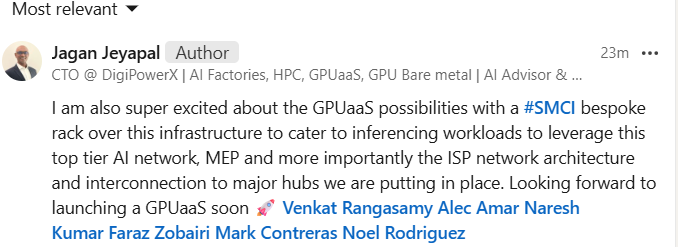
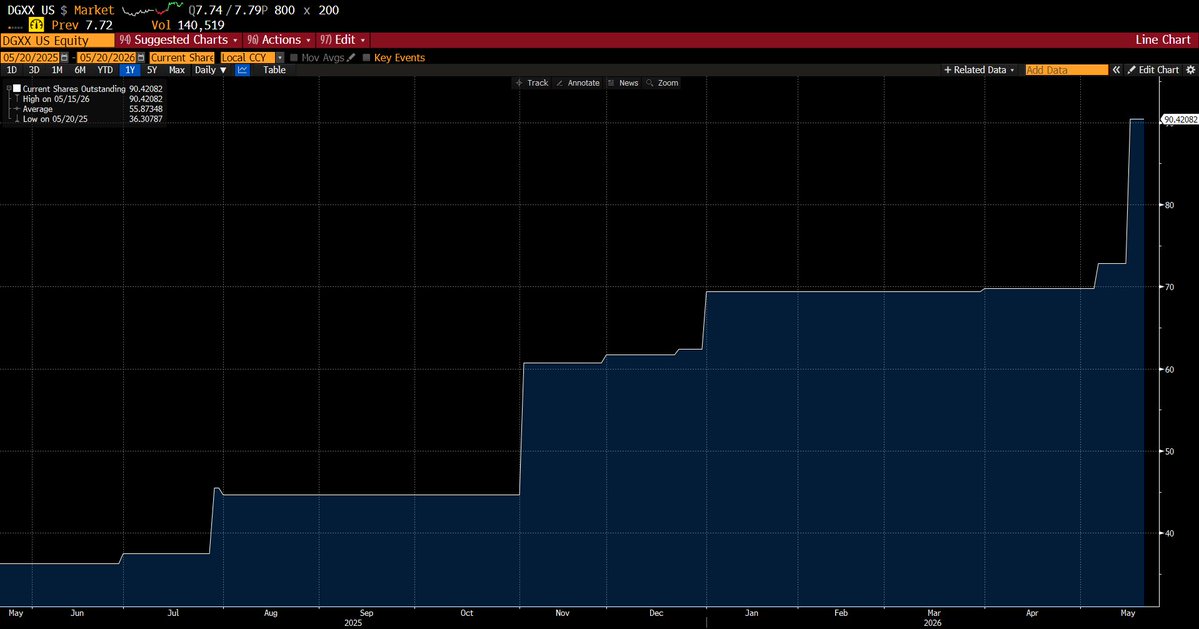
Personal note from me as a director of $DGXX (Digi Power X). My views, posted in my personal capacity, not the Company's. 1). Q1 2026 was an inflection point. Adjusted EBITDA flipped to a positive $1.1M from a $1.3M loss a year ago, a $2.4M YoY improvement, while we deliberately wound down legacy crypto mining. 2). Michel Amar on the call: "the most consequential strategic decision in company history" was the pivot from Bitcoin mining to AI infrastructure. The strategy is now executing. 3). The anchor: a 10-year, $1.1B Master Services Agreement (expandable to $2.5B) with one of the world's top chipmakers, for a 40 MW campus in Columbiana, AL. Phase 1 of 15 MW targets RFS December 2026, full 40 MW by end Q1 2027. 4). NeoCloudz GPU-as-a-Service is LIVE. First bare-metal GPU rental went live on the day of the call, a 24-month contract with SubQuadratic AI, on NVIDIA B200 and B300, in Columbiana. 5). Balance sheet, per public release and call: ~$125M cash, ~$15M digital assets, zero long-term debt, ~$45M YTD capex at Columbiana. Michel: "the strongest in the Company's history." 6). Financing strategy is public. Michel confirmed a term sheet has been signed with a lender, contemplating a 70/30 loan-to-cash structure, to fund the build out via debt rather than dilution. 7). Power moat. ~210 MW already grid-connected today. ~393 MW total secured across AL, Niagara Falls, NC, and Buffalo. 1.3 GW WV LOI for 2028 through 2030. Michel: "We don't need to wait for an interconnection with the utility." 8). Multi-year revenue goals (public, from the call): 2027: ~$300M run rate 2028: $450 to $500M run rate 2029: $800M to $1B run rate 9). Michel: "We are no longer building toward the top tier of this industry. We are in it." He also said publicly that the Company is "receiving interest from institutions, partners, and lenders." 10). Proud to serve with this team. Rely on the Company's public filings (SEDAR+, EDGAR), not this thread. Not investment advice. Forward looking statements subject to risks in our public disclosures. Gerard Rotonda, Director, $DGXX