
Sabitlenmiş Tweet
pepe
4.6K posts


pepe retweetledi

Today we reduced headcount by 22%. The business is the strongest it's ever been. So I think it's important to be direct about what I'm seeing and why.
First, I made this decision and I own it. I did it because the way to operate at the highest level of productivity is changing, and to win the future, ClickUp needs to change with it.
Second, this wasn't about cutting costs. Most savings from this change will flow directly back into the people who stay. We'll be introducing million-dollar salary bands. If you create outsized impact using AI, you'll be paid outside of traditional bands.
Most importantly, I have the deepest gratitude for those affected. We're doing this from a position of strength specifically so we can take care of people properly. Everyone affected receives a package aimed at honoring their contributions and easing the transition.
I only see two options: wait for this to play out gradually in the market or be honest about what I'm seeing and act proactively.
THE 100X ORGANIZATION
The primary change is that we're restructuring around what I call 100x org. The goal is 100x output. The roles required to build at the highest level are fundamentally different than they were a year ago.
Incremental improvements to existing systems won't get us there. We need new ones. That means creating enough disruption to rebuild rather than iterate on what's already broken.
The common narrative is that AI makes everyone more productive. It doesn't. Many of the workflows of today, if left unchanged, create bottlenecks in AI systems.
These roles will evolve. But waiting for that to happen naturally means falling behind now.
The 100x org is actually heavily dependent on people - infinitely more than today. This is only possible with 10x people that have embraced and adopted new ways of working.
THE BUILDERS, AGENT MANAGERS, AND FRONT-LINERS
— THE BUILDERS: 10X ENGINEERS
I don't think most companies have internalized what's actually happening with AI in engineering. The common narrative is that AI makes all engineers more productive. That may be true in isolation, but at an organization level - that is the farthest thing from reality.
Here's what we've validated recently at ClickUp: the great engineers, the ones who can orchestrate, architect, and review, are becoming 100x engineers. They're not writing code. They're directing agents that write code. The skill is judgment.
AI makes the best engineers wildly more productive, and everyone else using AI slows these engineers down.
Think about it - the bottlenecks are (1) orchestration - telling AI what to do, and (2) reviewing - what AI did. Everything is leapfrogged and no longer needed.
So who do you want orchestrating and reviewing code?
And how do you want your best engineers to spend their time?
If your best engineers are spending time reviewing other people's code, then this is inherently an inefficient bottleneck. These engineers can review their agent's code much faster than reviewing human code.
The new world is about enabling your 10x engineers to become 100x.
The wrong strategy is to push every engineer to use infinite tokens. Companies doing this are celebrating 500% more pull requests. But customer outcomes don't match the volume of code being generated.
I call this the great reckoning of AI coding, and every company will face this soon if not already.
More code is just another bottleneck to the best engineers, and ultimately to your company's impact as well.
— THE BUILDERS: 10X PRODUCT MANAGERS
Product management and design roles are merging.
Designers that have customer focus, become more like product managers.
And product managers that have intuition for UX become more like designers.
The bottleneck of user research is gone. It takes us just one mention of an agent to kickoff research and analyze results.
The bottleneck of product <> design iteration is also gone. The product builder iterates on their own, along with agents and skills that ensure alignment with quality and strategy.
Also controversial today - I believe that the wrong strategy is to have your PMs shipping code - that just introduces another bottleneck that the best engineers will waste their time on.
To be clear, PMs should be coding but they should do this in a playground to iterate, validate, and scope. That code should not go to production.
Everything outside of managing systems, orchestrating AI, and reviewing output becomes a bottleneck.
That's why the other roles that are critical along with these are the systems managers (to reduce bottlenecks) along with a bottleneck you can't replace - customer meeting time.
— THE SYSTEM MANAGERS
Ironically, the people that automate their jobs with AI will always have a job. They become owners of the AI systems - agent managers. We have many examples of these people at ClickUp.
The underlying systems in which we operate are absolutely critical to get right. I think most companies are delusional to think they can iterate on existing systems and compete in this new world.
You must create enough disruption so that old systems are deprecated entirely. If there's any definition for 'AI native' that's what it is.
— THE FRONT-LINERS
In a world that will become saturated with AI communication, the human touch will matter more than anything to customers.
This is a bottleneck that you shouldn't replace - even when agents are high enough quality to do video meetings.
One-on-one meeting time with customers is something that shouldn't be automated. The systems around the meetings should be - so that front-liners spend nearly 100% of their time with customers.
REWARDING 100X IMPACT
In a world where companies are able to do so much more with less, where does that excess money go?
In our case, much of the savings in this new operating model will flow directly back to those that enabled it.
We must reward people that create productivity accordingly. This aligns incentives on both sides. Plus, in a world where your best people create 100x impact, you can't afford to lose them.
You should aim to retain these employees for decades. The context they have and their ability to efficiently orchestrate and review will be nearly impossible to replace.
Compensation bands of today should be thrown out the door. We're introducing $1 million cash/year salary bands with a path available to nearly everyone in the company if they produce 100x impact by creating or managing AI systems.
THE FUTURE
Nearly every company will make changes like these. The ones that do it proactively will define what comes next.
The future is not fewer people. It's different work, new roles, and better rewards for those who embrace it. We're already seeing entirely new roles emerge, like Agent Managers, that didn't exist a year ago.
ClickUp is positioning to lead this shift, not just internally, but for our customers too. I've never been more certain about where we're headed.
English
pepe retweetledi

I built a personal agent for my dad. He is 77. Computer Engineer from the 70s and 80s who built in COBOL, Fortran, C. He later led the system behind the IFE electoral card for Mexico and the U.N. called him to help with Timor and Afganistan elections. He is ready to build again.

English
pepe retweetledi


pepe retweetledi

Two questions I get all the time:
"What educational AI tools would you recommend for my kid?" "What adaptive apps does Alpha use?"
Many of the apps we've built ourselves aren't publicly accessible yet. Here are ten third-party ones I do recommend.
English
pepe retweetledi

Big news: I’ve been selected as @cursor_ai Regional Lead for Mexico & Central America
Calling all Mexican AI builders!
I’ve got some credits if you wanna build with Cursor!
Let’s build 🚀
English
Pa no tener que andart creando cuentas y api keys por todos lados en Claude Code
Patrick Collison@patrickc
We just removed the waitlist on projects.dev! Also 14 new providers (now 32 total). You can instantly provision all of them from the CLI.
Español
pepe retweetledi

I'm personally funding this residency out of my own pocket... to support builders in the CDMX ecosystem through AI Builders México #aibuildersmx.
A huge thank you to our generous partners from @OpenAI , @cursor_ai , @v0, and @reve for providing credits and free tool use to our participants.
A 6 week micro residency, free coworking access, top tier 1-1 mentorship from actual experts in AI, GTM, and product, and distribution rails you can't find anywhere else in Mexico.
Check out the link below 👇. Everyone is welcome to apply!
English
pepe retweetledi

Aggressive prediction: the CEOs like @jack and @tobi who are slinging code and open source and all the way at the edge are leading from the front. Their companies will make it
Others still in manager mode? Oof maybe less so
shirish@shiri_shh
bro was right. Atlassian down 75%. HubSpot down 69%. Figma down 86%. Almost all of them down 30–70% from their 52-week highs. AI is literally eating software alive and repricing every company in real time. SaaS is cooked fr 😭
English
pepe retweetledi

Kaszek + Anthropic en CDMX, este Jueves.
Si estás construyendo algo serio con IA, este es el evento. El equipo de Anthropic va a compartir sus productos, APIs y casos de uso reales, con espacio para Q&A.
Cupos muy limitados. Apliquen ahora!
luma.com/lralyqn0
Español
pepe retweetledi

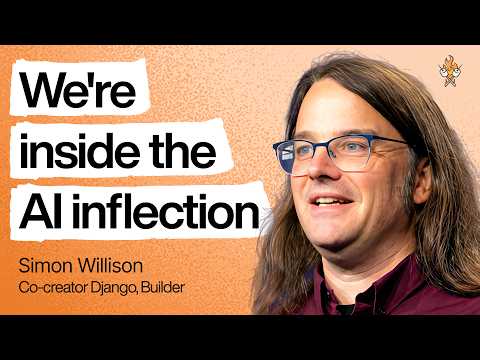
My biggest takeaways from @simonw:
1. November 2025 was an inflection point for AI coding. GPT 5.1 and Claude Opus 4.5 crossed a threshold where coding agents went from “mostly works” to “almost always does what you want it to do.” Software engineers who tinkered over the holidays realized the technology had become genuinely reliable.
2. Mid-career engineers are the most vulnerable—not juniors, not seniors. AI amplifies experienced engineers by letting them leverage decades of pattern recognition. It also dramatically helps new engineers onboard. Cloudflare and Shopify each hired a thousand interns because AI cut ramp-up time from a month to a week. But mid-career engineers who haven’t accumulated deep expertise and have already captured the beginner boost are in the most precarious position.
3. AI exhaustion is real and underestimated. Simon runs four coding agents in parallel and is mentally wiped out by 11 a.m. He’s getting more time back, but his brain is exhausted from the intensity of directing multiple autonomous workers. Some engineers are losing sleep to keep agents running. This may just be a novelty issue, but the underlying dynamic—that managing AI amplifies cognitive load even as it reduces labor—is a real tension. Good companies will manage expectations rather than expecting 5x output indefinitely.
4. Code is cheap now. This simple idea has profound implications. The thing that used to take most of the time—writing code—now takes the least. The bottleneck has shifted to everything else: deciding what to build, proving ideas work, getting user feedback. Since prototyping is nearly free, Simon often builds three versions of every feature when he’s getting started.
5. The “dark factory” is the most radical experiment in AI-assisted development happening right now. A company called StrongDM established a policy: nobody writes code, nobody reads code. Instead, they run a swarm of AI-simulated end users 24/7—thousands of fake employees making requests like “give me access to Jira”—at $10,000 a day in token costs. They even had coding agents build simulated versions of Slack, Jira, and Okta from API documentation so they could test without rate limits.
6. "Red/green TDD" is the single highest-leverage agentic engineering pattern. Having coding agents write tests first, watch them fail, then write the implementation, then watch them pass produces materially better results. The five-word prompt “use red/green TDD” encodes this entire workflow because the agents recognize the jargon.
7. “Hoarding things you know how to do” is one of Simon's other favorite agentic engineering patterns. Simon maintains a GitHub repo of 193 small HTML/JavaScript tools and a separate research repo of coding-agent experiments. Each one captures a technique, a proof of concept, or a library he’s tested. When a new problem arrives, he can point Claude Code at past projects and say “combine these two approaches.”
8. The "lethal trifecta" makes AI agent security fundamentally unsolved. Whenever an AI agent has access to private data, exposure to untrusted content (like incoming emails), and the ability to send data externally (like replying to email), you have a lethal trifecta. Prompt injection—where malicious instructions in untrusted text override the agent’s intended behavior—cannot be reliably prevented. Simon has predicted a “Challenger disaster” for AI security every six months for three years. It hasn’t happened yet, but he’s pretty sure it will.
9. Start every project from a thin template, not a long instructions file. Coding agents are phenomenally good at matching existing patterns. A single test file with your preferred indentation and style is more effective than paragraphs of written instructions. Simon starts every project with a template containing one test (literally testing that 1 + 1 = 2) laid out in his preferred style. The agent picks it up and follows the convention across the entire codebase. This is cheaper and more reliable than maintaining elaborate prompt files.
10. The pelican-on-a-bicycle benchmark accidentally became a real AI benchmark. Simon created it as a joke to mock numeric benchmarks—get each LLM to generate an SVG of a pelican riding a bicycle, and compare the drawings. Unexpectedly, there’s a strong correlation between how good the drawing is and how good the model is at everything else. Nobody can explain why. It’s become a meme: Gemini 3.1’s launch video featured a pelican riding a bicycle. The AI labs are aware of it and quietly competing on it.
Don't miss our full conversation: youtube.com/watch?v=wc8FBh…
YouTube
Lenny Rachitsky@lennysan
"Using coding agents well is taking every inch of my 25 years of experience as a software engineer." Simon Willison (@simonw) is one of the most prolific independent software engineers and most trusted voices on how AI is changing the craft of building software. He co-created Django, coined the term "prompt injection," and popularized the terms "agentic engineering" and "AI slop." In our in-depth conversation, we discuss: 🔸 Why November 2025 was an inflection point 🔸 The "dark factory" pattern 🔸 Why mid-career engineers (not juniors) are the most at risk right now 🔸 Three agentic engineering patterns he uses daily: red/green TDD, thin templates, hoarding 🔸 Why he writes 95% of his code from his phone while walking the dog 🔸 Why he thinks we're headed for an AI Challenger disaster 🔸 How a pelican riding a bicycle became the unofficial benchmark for AI model quality Listen now 👇 youtu.be/wc8FBhQtdsA
English
pepe retweetledi

pepe retweetledi

I accidentally broke my brain reading about Nobel Prize winners last month.
There's this thing called "Janusian thinking" that basically explains why some people's minds work like magic while the rest of us think in straight lines. Named after Janus, the Roman god with two faces pointing opposite directions.
The psychologist who discovered it, Albert Rothenberg, was trying to figure out what made breakthrough thinkers different. He interviewed dozens of Nobel laureates, major artists, revolutionary scientists. What he found sounds impossible.
These people can hold two different ideas in their mind at the same time. They can explore both without switching back and forth or forcing a quick comparison. They can consider “yes” and “no” to the same question simultaneously and stay clear-headed.
Einstein too talked about this when he described his relativity breakthrough. He was imagining riding alongside a beam of light while also standing perfectly still. Both perspectives at once. Mozart said he could hear an entire symphony "all at once," every note, every contradiction, every resolution happening in a single moment of awareness.
Your average person's mind works like a courtroom. Evidence comes in, you weigh it, you reach a verdict. Case closed. But Janusian minds work more like... I don't know, like a quantum computer that can process multiple realities simultaneously until something new emerges from the overlap.
I've started noticing it in conversations. When someone can genuinely see both sides of something without needing to pick one, it drives people nuts. They want you to land somewhere definite. The ability to live in that tension space reads as wishy-washy or indecisive.
Most creative advice tells you to "think outside the box." But Janusian thinking is weirder than that. It's being inside and outside the box at the same time. It's thinking the box exists and doesn't exist simultaneously.
Which explains why truly creative people seem slightly unhinged. They think they're choosing between realities. But, they're inhabiting multiple realities at once, mining the contradictions for insights the rest of us never see.
Sadly, most of us have trained ourselves out of this ability. We've learned that holding contradictions feels unstable, so we rush toward resolution. We've been taught that changing your mind means you were wrong before, so we defend positions instead of exploring them.
But the people changing the world have kept that childlike ability to hold impossible thoughts without needing them to make sense immediately.
We just need to live in the questions everyone else is too scared to ask.
DAN KOE@thedankoe
English
@benkimbuilds I’ve seen this problem a few times
And for convenience, members always prefer WA, engagement drops dramatically when moving to Discord or Slack
I think some sort of AI WA manager, a Claw or similar would help, plus the community features (more groups) and governance (rules)
English
I have a WhatsApp community of ~1000 AI practitioners in Mexico City and we're experiencing growing pains.
We share lots of alpha, shoot the shit, share updates on news in AI, post personal projects and wins. We maybe interface in person once a month at a tentpole event hosted by Cursor, v0, etc.
Feels like we've officially outgrown wapp as a place to host our digital community. It's becoming high noise low signal. We don't want Discord as we'd lose many in the migration, and I personally don't want to run a Discord. Wapp is super light maintenance.
Are there any good alternatives? I considered Slack but the pricing is insane. Telegram doesn't seem to meaningfully solve our core issues.
Nice to haves:
- threading for deeper conversation
- multiple channels for message categorization
- live calls would be fun and an organic way for people to casually get together online
English
pepe retweetledi
Atención! @OpenAI llega a México 🇲🇽
Tendremos el primer meetup oficial de Codex en CDMX este 8 de abril
Aplica ahora para no quedar fuera!
luma.com/suipk589
Español
pepe retweetledi
It's working guys. This is exactly what I built for myself and what you can have for you now.
It's also free and open source and you can fork it and make it your own. I don't want to hear the hate. This is a gift!
Vox@Voxyz_ai
spent an evening running the full gstack sprint on a real feature. /office-hours → /plan-ceo-review → /plan-eng-review → build → /review → /ship. three things stood out: /design-consultation analyzed my existing site, found inconsistencies, proposed updates to my design language, and built a live preview page so i could see everything before committing. after that it created a DESIGN.md file, every new component automatically followed the same system. no more "why does this button look different on every page." i normally use codex for engineering work because it's rock solid for code. but design and planning is where claude shines, so i ran the plan and build phase in claude code this time. halfway through, claude detected that codex was running on the same machine and asked me if i wanted codex to review the code before it continued. i didn't configure this. it just noticed and offered to hand off. two different AIs figured out how to collaborate without me setting it up. going from "what should i build" to "shipped PR" felt like managing a team that actually talks to each other.
English
pepe retweetledi
Our first event with OpenAI is on April 8th in Plaza Carso
- We'll have demos from the top power users of Codex
- Join the #1 AI community in Mexico City
luma.com/suipk589
Ben Kim@benkimbuilds
i officially represent @OpenAI Codex in Mexico City 🇲🇽 i want to teach people how to launch products and saas, similar to what @FarzaTV is doing with @makesomething0 with a few directional pointers about architecture and security, basic knowledge of REST/CRUD, and basic handling of git and bash, 100% of the computer literate population should be able to launch a fullstack app within a few hours
English
pepe retweetledi

.@PatientdeskAI is building an AI-native operating system for dental clinics that autonomously handles inbound calls, bookings, real-time insurance verification, and claims submission - replacing five disconnected tools with one system that never lets revenue slip through the cracks.
ycombinator.com/launches/Pka-p…
English

I had dinner once with a top physicist and a top computer scientist and asked what they thought the probability was that we were in a simulation.
They answered simultaneously at 0% and 100% respectively. It was like a double-slit experiment, but with humans.
Interstellar@InterstellarUAP
🚨 Simulation Theory: The Double Slit Experiment proves particles act like waves until observed then they snap into particles. What if our reality only "renders" when we're looking, just like a video game optimizing resources? Check out this episode from The Why Files breaking it down, tying it to Simulation Theory. Are we in a sim? This could be the key to unlocking the true nature of existence! The Why Files video did a great job on explaining the Double Slit Experiment & Simulation Theory What do YOU think—real or rendered? Drop your thoughts below!
English