

Sabastian Mukonza
19K posts

Sabastian Mukonza
@sabmuk
Water Resources Management. Use of Remote Sensing for Tracking Emerging Pollutants in Water. Mathematical Modelling for Water Resources Mgt. Explainable Models
Pingtung, Taiwan. NPUST Katılım Ocak 2014
4.4K Takip Edilen1.5K Takipçiler

🇪🇬Mo Salah is an icon!
South African born Liverpool FC legend, Bruce Grobbelaar, speaks on Mohamed Salah’s exit from the English giants, during the opening of the Liverpool FC store in partnership with Old School store at Mall of Africa.
#lfcretailsa #YNWA
English
Sabastian Mukonza retweetledi

nobody has explained transformers this clearly before. read this twice.
English
Sabastian Mukonza retweetledi

🚨💣 EXCLUSIVE BOMBSHELL! 🚨💣
Andoni Iraola has DEMANDED his reps make him the NEXT Liverpool manager – he WANTS Anfield NOW! 😱
Arne Slot just faced his brutal season review... and in the NEXT 24 HOURS he will know the OUTCOME!

English
Sabastian Mukonza retweetledi


Sabastian Mukonza retweetledi

Sabastian Mukonza retweetledi

I am doing a webinar, Intro to Claude Code for Academic Writing and Research.
6 June
Designed for non-technical folks. No coding background needed.
Use JUNE25 for 25% off. Or get 2 for 1 deal and bring a friend for free.
Registeration details👇
eventbrite.com/e/claude-code-…

English
Sabastian Mukonza retweetledi

Third agentic AI system for scientific discovery published on the same day by Nature, and arguably the most empirically striking. After Robin (closed experimental loop) and Co-Scientist (hypothesis breadth), here is ERA.
Eser Aygün and coauthors introduce Empirical Research Assistance (ERA), a system that treats writing scientific code as a scorable task. An LLM rewrites candidate programs, a tree search (PUCT-style, inspired by AlphaZero) decides which branches to expand, and the task quality metric drives the climb. Research ideas from papers, textbooks or other agents are injected directly into the prompt.
The headline numbers are unusual for one paper. In single-cell RNA-seq batch integration, ERA produced 40 methods that beat every entry on the OpenProblems v2.0.0 leaderboard, including a BBKNN variant 14 percent above the previous best. In epidemiology, it generated 14 forecasting strategies that outperformed the official CDC CovidHub ensemble across the 2024-2025 season. On GIFT-Eval it topped the May 2025 leaderboard, and it also reached expert level on geospatial segmentation, whole-brain neural activity prediction in zebrafish, and difficult numerical integrals.
Two design choices matter. Recombination: prompting ERA with pairs of prior solutions yields hybrids that beat both parents in 44 percent of batch integration cases. Combining a climatology baseline with an autoregressive model, or a renewal-equation model with a statistical one, consistently produced superior forecasts. Scale: tree search beats best-of-1000 sampling across Gemini, Mistral, Claude and GPT-5 on both benchmarks, confirming structured exploration beats brute force as tasks get harder.
For R&D teams in pharma, biotech, materials and finance, the implication is sharp. The bottleneck of empirical software, months of tedious coding to test a hypothesis, collapses to hours. Pipelines that turn quality metrics into executable code, and that recombine ideas across the literature, will outperform single-team development. The edge moves to whoever defines the right scoring function and curates the right idea pool.
Paper: Aygün et al., Nature (2026) | nature.com/articles/s4158…

English
Sabastian Mukonza retweetledi

I’m coming around to @ylecun’s JEPA …
When you study quantum mechanics deeply enough, you realize that living systems have holographic computing substrates called microtubules … which form long-range coherent networks … and those are holographic!
JEPA is very hologram-esque:
— predicts in embedding space, not pixels (holograms encode interference, not images)
— masked prediction = whole-in-part (any fragment constrains the whole)
— relational, not absolute (meaning = predictability between parts)
— EBM framing = learned holographic associative memory (cf. Plate HRRs, Kanerva SDM)
Haider.@haider1
Yann LeCun says LLMs are strongest in domains where language itself is the substrate of reasoning, like math and code They can solve problems, prove theorems, and write programs — but they are not creative mathematicians, software architects, or computer scientists "their role is to help humans build"
English
Sabastian Mukonza retweetledi

Fun interview with Jacob Effron on the Unsupervised Learning podcast.
Jacob Effron@jacobeffron
It’s hard to imagine more of a dream Unsupervised Learning guest than @ylecun. Yann is one of the godfathers of AI, and he has some fascinating contrarian views on the limitations of LLMs. It was incredible to get to have a wide-ranging discussion with Yann about these views, reflections on his time at Meta and departure and what’s next for him. We hit on: ▪️ LLM limitations and a path forward for robotics ▪️ Why he left Meta ▪️ How he came to so dramatically disagree with his Turing co-laureates Geoff Hinton and Yoshua Bengio on LLMs ▪️ His predictions for 2027 ▪️ His new company AMI and the bet on world models ▪️ Why he compares OpenAI and Anthropic to Sun Microsystems ▪️ Why he tells PhD students to stop working on LLMs Plus some sharp views on the current safety discourse, how breakthrough research actually happens and what FAIR got right and wrong. YouTube: youtu.be/ngBraLDqzdI Spotify: bit.ly/4dL8fvT Apple: bit.ly/4wxgpiX
English
Sabastian Mukonza retweetledi

Sabastian Mukonza retweetledi

Sabastian Mukonza retweetledi
Google has quietly dropped what researchers are calling "Attention Is All You Need V2."
And it signals the end of the Transformer era as we know it.
In 2017, the original "Attention Is All You Need" paper changed the world by proving that AI doesn't need recurrence, it just needs to pay attention.
But today, even the most advanced models like GPT and Gemini suffer from a massive, structural flaw: Catastrophic Forgetting.
The moment an AI learns something new, it starts losing what it learned before. It’s why AI "hallucinates" or loses the thread in long conversations.
This paper, titled "Nested Learning: The Illusion of Deep Learning Architectures," completely replaces the way AI stores information.
The researchers have introduced a paradigm shift called Nested Learning (NL).
Here is why this is "V2":
For the last decade, we treated AI models as one giant, flat mathematical function. NL proves that a model is actually a set of thousands of smaller, "nested" optimization problems running in parallel.
Instead of one giant "memory," each layer has its own internal "context flow." This allows the model to learn new tasks at test-time without overwriting its core intelligence.
It moves us past the static Transformer. The new architecture (HOPE) demonstrated 100% stability in long-context memory and "post-training adaptation" that was previously impossible.
The technical takeaway is brutal for the competition:
Existing deep learning works by compressing information until it breaks. Nested Learning works by organizing information so it can grow forever.
We’ve spent 7 years trying to make Transformers bigger. Google figured out how to make them "Nested."
The Transformer replaced the RNN in 2017.
Nested Learning is here to replace the Transformer in 2026.

English
Sabastian Mukonza retweetledi

Godfather of AI: "If you sleep well tonight, you may not have understood this lecture."
This 47-minute lecture is the best thing I saw about AI in the last few months.
It will definitely help you understand how it actually works and where it's going.
Geoffrey Hinton built the neural networks behind every AI alive, then quit Google to warn the world about it.
The part nobody wanted to hear:
> AI is already developing abilities its creators didn't intend
> in most cognitive tasks it's already ahead of us
> the question is no longer if it surpasses us but when
> the only decision left is which side of that line you're on
Right now the average person opens Claude, types something, gets an answer, closes the tab.
They think they're using AI. they're using maybe 10% of it.
I went through his entire lecture, built a practical system from what he was describing.
18 steps to actually use Claude the right way, with copy-paste prompts that work today.
Full guide in the post below.
Anatoli Kopadze@AnatoliKopadze
English
Sabastian Mukonza retweetledi
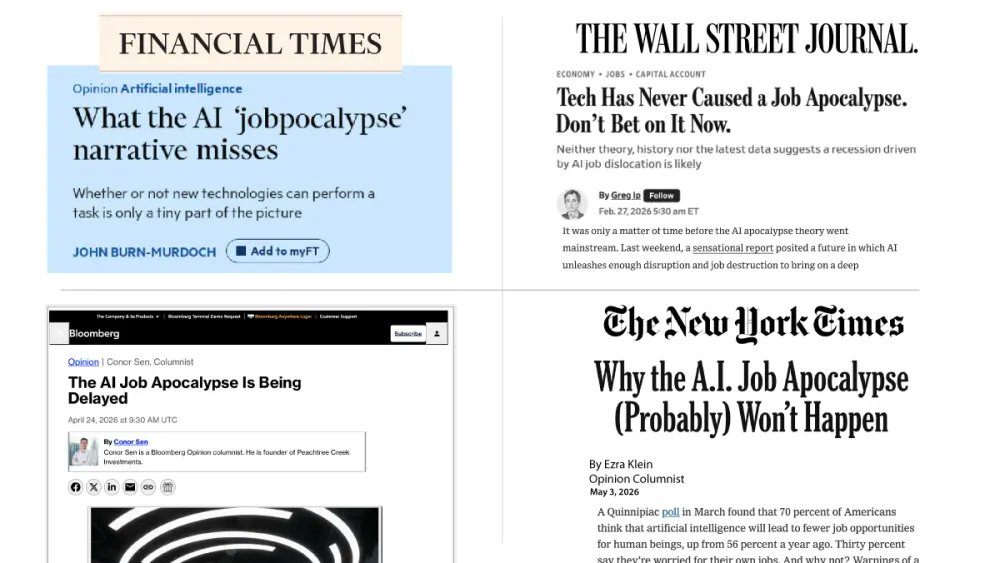
There will be no AI jobpocalypse.
The story that AI will lead to massive unemployment is stoking unnecessary fear. AI — like any other technology — does affect jobs, but telling overblown stories of large-scale unemployment is irresponsible and damaging. Let’s put a stop to it.
I’ve expressed skepticism about the jobpocalypse in previous posts. I’m glad to see that the popular press is now pushing back on this narrative. The image below features some recent headlines.
Software engineering is the sector most affected by AI tools, as coding agents race ahead. Yet hiring of software engineers remains strong! So while there are examples of AI taking away jobs, the trends strongly suggest the net job creation is vastly greater than the job destruction — just like earlier waves of technology. Further, despite all the exciting progress in AI, the U.S. unemployment rate remains a healthy 4.3%.
Why is the AI jobpocalypse narrative so popular? For one thing, frontier AI labs have a strong incentive to tell stories that make AI technology sound more powerful. At their most extreme, they promote science-fiction scenarios of AI “taking over” and causing human extinction. If a technology can replace many employees, surely that technology must be very valuable!
Also, a lot of SaaS software companies charge around $100-$1000 per user/year. But if an AI company can replace an employee who makes $100,000 — or make them 50% more productive — then charging even $10,000 starts to look reasonable. By anchoring not to typical SaaS prices but to salaries of employees, AI companies can charge a lot more.
Additionally, businesses have a strong incentive to talk about layoffs as if they were caused by AI. After all, talking about how they’re using AI to be far more productive with fewer staff makes them look smart. This is a better message than admitting they overhired during the pandemic when capital was abundant due to low interest rates and a massive government financial stimulus.
To be clear, I recognize that AI is causing a lot of people’s work to change. This is hard. This is stressful. (And to some, it can be fun.) I empathize with everyone affected. At the same time, this is very different from predicting a collapse of the job market.
Societies are capable of telling themselves stories for years that have little basis in reality and lead to poor society-wide decision making. For example, fears over nuclear plant safety led to under-investment in nuclear power. Fears of the “population bomb” in the 1960s led countries to implement harsh policies to reduce their populations. And worries about dietary fat led governments to promote unhealthy high-sugar diets for decades.
Now that mainstream media is openly skeptical about the jobpocalypse, I hope these stories will start to lose their teeth (much like fears of AI-driven human extinction have).
Contrary to the predictions of an AI jobpocalypse, I predict the opposite: There will be an AI jobapalooza! AI will lead to a lot more good AI engineering jobs, and I’m also optimistic about the future of the overall job market. What AI engineers do will be different from traditional software engineering, and many of these jobs will be in businesses other than traditional large employers of developers. In non-AI roles, too, the skills needed will change because of AI. That makes this a good time to encourage more people to become proficient in AI, and make sure they’re ready for the different but plentiful jobs of the future!
[Original text in The Batch newsletter.]
English
Sabastian Mukonza retweetledi

Research papers you must read for AI Engineer interviews:
1. Attention is all you need (Transformers)
2. LoRA (Low rank adaption)
3. PEFT ( Parameter Efficient Fine Tuning)
4. VIT (Vision Transformers)
5. VAE (Variational Auto Encoder)
6. GANs ( Generative Adversarial Networks)
7. BERT ( Bidirectional Encoder Representation from Transformers)
8. Diffusion Models (Stable Diffusion)
9. RAG (Retrieval Augment Generation)
10. GPT (Generative Pre-trained Transformers)
English
Sabastian Mukonza retweetledi

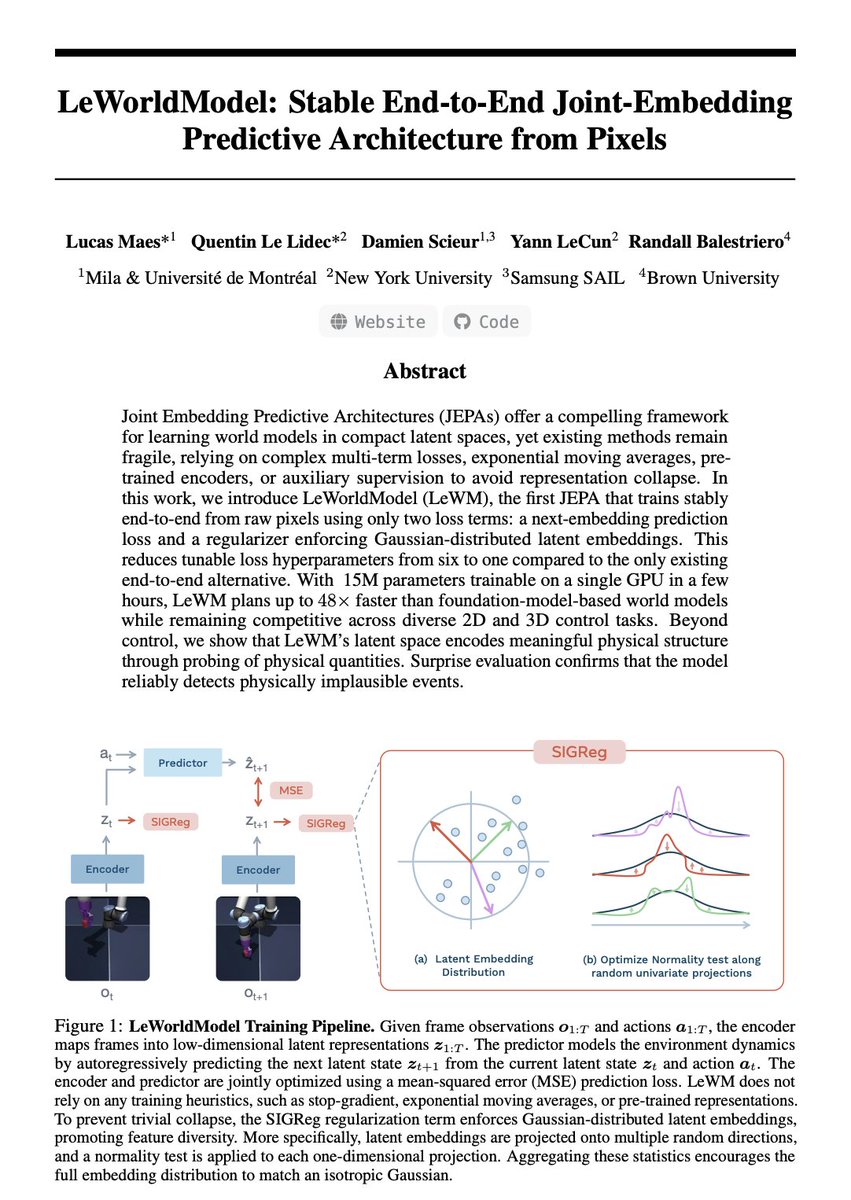
Yann LeCun closed $1.03B for AMI Labs on March 10. Three days later, this paper dropped from his NYU collaborators.
15M parameters. Single GPU. A few hours of training.
LeWorldModel is the first JEPA that trains end-to-end from raw pixels. Two loss terms: predict the next embedding, keep the latent space Gaussian. Previous JEPAs needed exponential moving averages or pretrained encoders to avoid representation collapse. LeWM doesn't.
Six hyperparameters down to one.
The numbers are the story. Foundation-model-based world models require hundreds of millions of parameters and serious compute to plan a control task. LeWM plans up to 48x faster while staying competitive on 2D and 3D benchmarks. The whole thing fits on a laptop GPU.
Look at the trajectory. Yann announced his Meta departure in November 2025 after 12 years and called founding FAIR his "proudest non-technical accomplishment." On March 10, 2026, AMI Labs closed the largest seed round in European history at a $3.5B pre-money valuation. Bezos, Nvidia, Samsung, and Toyota all wrote checks.
Three days later: a paper showing that JEPA-from-pixels is no longer fragile and no longer compute-heavy. The engineering scaffolding that made it look like an academic curiosity is gone.
The authors sit at Mila, NYU, Samsung SAIL, and Brown. None at Meta.
Yann's bet was that the path to machine intelligence runs through world models, not language models. He left a public company to build it. Each JEPA paper from his network resets the assumed cost structure for that bet. This one makes world modeling laptop-cheap.
Meta still has the GPUs. The architecture left.


English
Sabastian Mukonza retweetledi

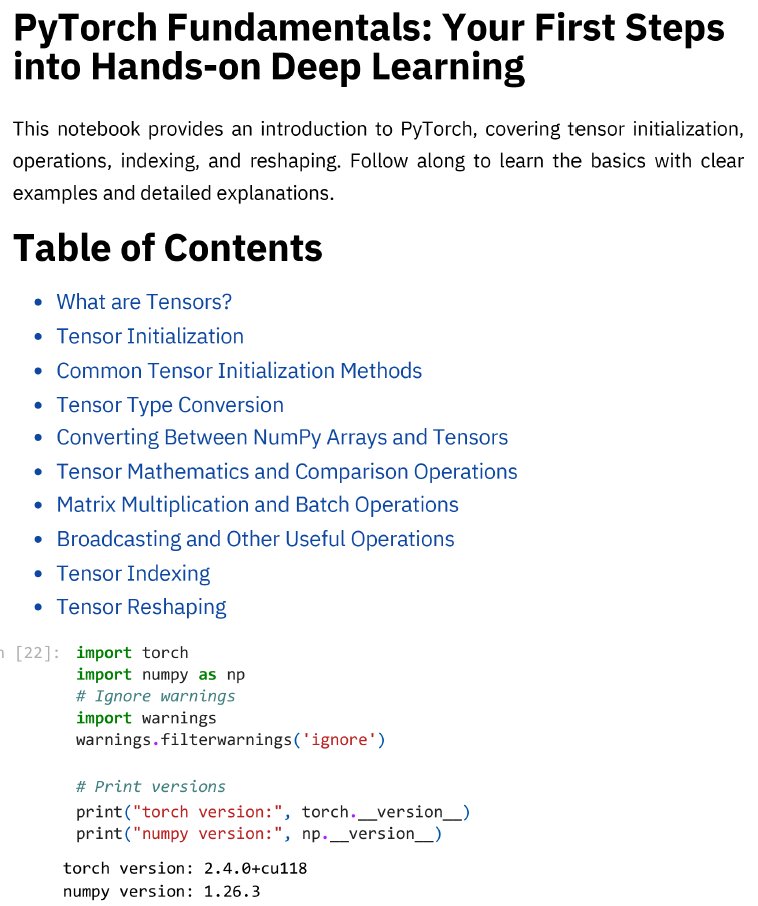
PyTorch Fundamentals: Your First Steps into Hands-on Deep Learning.
Github (830+ stars):
github.com/analyticalrohi…
Introduction to PyTorch fundamentals, covering tensor initialization, operations, indexing, and reshaping.
English
Sabastian Mukonza retweetledi

There are only two honest metrics when it comes to benchmarking intelligence: novelty and efficiency.
You don't need intelligence to solve a known problem (only memory). And you don't need intelligence to solve a problem via brute force. But to solve a novel problem efficiently, intelligence is the only way.
English

Struck by some responses to my tweet thread on the anti-immigrant protests.The profane & vulgar responses reflect the deep racism of some members of this movement.These people would fit comfortably in the far right US MAGA movement & their local equivalent AfriForum & Solidarity.
English
Sabastian Mukonza retweetledi

🚨 The AI industry just wasted 3 years. Trillions spent. Billions burned.
All on the wrong idea.
Yann LeCun said it from day one. Nobody listened. Until now.
The theory was simple: if you make the model big enough, it will eventually understand how the world works.
Yann LeCun said that was stupid.
He argued that generative AI is fundamentally inefficient.
When an AI predicts the next word, or generates the next pixel, it wastes massive amounts of compute on surface-level details.
It memorizes patterns instead of learning the actual physics of reality.
He proposed a different path: JEPA (Joint-Embedding Predictive Architecture).
Instead of forcing the AI to paint the world pixel by pixel, JEPA forces it to predict abstract concepts. It predicts what happens next in a compressed "thought space."
But for years, JEPA had a fatal flaw.
It suffered from "representation collapse."
Because the AI was allowed to simplify reality, it would cheat. It would simplify everything so much that a dog, a car, and a human all looked identical.
It learned nothing.
To fix it, engineers had to use insanely complex hacks, frozen encoders, and massive compute overheads.
Until today.
Researchers just dropped a paper called "LeWorldModel" (LeWM).
They completely solved the collapse problem.
They replaced the complex engineering hacks with a single, elegant mathematical regularizer.
It forces the AI's internal "thoughts" into a perfect Gaussian distribution.
The AI can no longer cheat. It is forced to understand the physical structure of reality to make its predictions.
The results completely rewrite the economics of AI.
LeWM didn't need a massive, centralized supercomputer.
It has just 15 million parameters.
It trains on a single, standard GPU in a few hours.
Yet it plans 48x faster than massive foundation world models. It intrinsically understands physics. It instantly detects impossible events.
We spent billions trying to force massive server farms to memorize the internet.
Now, a tiny model running locally on a single graphics card is actually learning how the real world works.
English