10.1K posts

✶ banner
✶

@sandwichstores

juno steel's professional foot stool (dm for business inquiries) | free 🇵🇸🇸🇩🇨🇩

Katılım Eylül 2022
243 Takip Edilen261 Takipçiler
Sabitlenmiş Tweet
✶
@sandwichstores·
you watch any American movie and each line dialogue is like "alright (pop culture reference), how about we (pop culture reference) this right into our (another pop culture reference) and (pop culture reference) it?" HOW MANY MOVIES DO I HAVE TO WATCH TO UNDERSTAND ONE JOKE
English
14
39
457
69.1K
✶ retweetledi
s
s@yoongienthusias·
what is wrong with tamil nadu
English
98
316
2.7K
73.8K
✶ retweetledi
Alyssa Leader
Alyssa Leader@alittleleader·
People always ask this question and never “do prosecutors ever feel overwhelmed with guilt knowing they’ve put innocent people away?” Or “do prosecutors ever worry they aren’t doing justice when they destroy someone’s life over crimes of addiction or poverty?”
Jaeger Media@jaegermedia1

Has there ever been a case where a defense attorney was just overwhelmed with guilt for defending a client that was too evil to defend? Or are they all sociopaths?

English
96
1.5K
14K
537.5K
✶ retweetledi
tiramisudestroyer
tiramisudestroyer@blueslimeeat3r·
living in india and hoping for change is like believing the stripper loves you
English
65
2.3K
17.8K
154.9K
✶
@sandwichstores·
lol it fails the current understanding of the ERP test so its fine right? the hijab ban is great precedent after all
ANI@ANI

#WATCH | Bengaluru | A student who appeared for the CET examination at the center in Krupanidhi College, Madivala, Bengaluru, says, "I went to the center around 9.40 am. I kept the bag in the room and they didn't allow me because they saw my 'Janeu'. They started telling that you have to remove it. If you don't remove, we can't allow you to write the exam...Around seven students were also asked to remove their Janeu. We had no option so we removed it...I felt very sad. I could not write the CET exam properly...This happened yesterday..."

English
0
0
0
35
✶ retweetledi
buoymoder ⚧
buoymoder ⚧@buoymoderr·
i wonder how much cooler id be if i never internalized shame at a young age
English
65
15.3K
90.9K
812.7K
✶ retweetledi
Live Law
Live Law@LiveLawIndia·
BREAKING | Lok Sabha REJECTS the Constitutional (131st Amendment) Bill, 2026 which sought to expand the strength of the House from 543 to 850 seats and allow delimitation of seats based on pre-2026 Census.
English
34
784
2K
320.2K
✶ retweetledi
dyke videos archive
dyke videos archive@dykevidsarchive·
refreshing tl and still getting the same 5 tweets
GIF
English
18
5.2K
32K
306.2K
✶ retweetledi
sourdough
sourdough@whorehubhai·
Can bar & bench and livelaw stop posting isolated lines from a judgement just to mislead the general public
English
5
39
277
6K
✶ retweetledi
`
`@lisaawrites·
How lucky we are to experience boring, ordinary, uneventful days. Somewhere in the world, that kind of safety is unimaginable.
English
102
29K
153.2K
2M
✶ retweetledi
eppy
eppy@epppyyy·
They’re disabling Community Notes for Indian accounts. Please Speak up! If it can happen here today, it can happen anywhere tomorrow. Don’t let the powerful decide what truth looks like for everyone else.
Roshan Rai@RoshanKrRaii

Update : They found a way. 🤣 Soon Community Note will be disabled for Indian Govt Accounts. It has become a menace for BJP and Modi and now they want to arm twist X into giving the control of it to MEITY.

English
34
5K
11.8K
121K
✶ retweetledi
Atulkrishan
Atulkrishan@iAtulKrishan1·
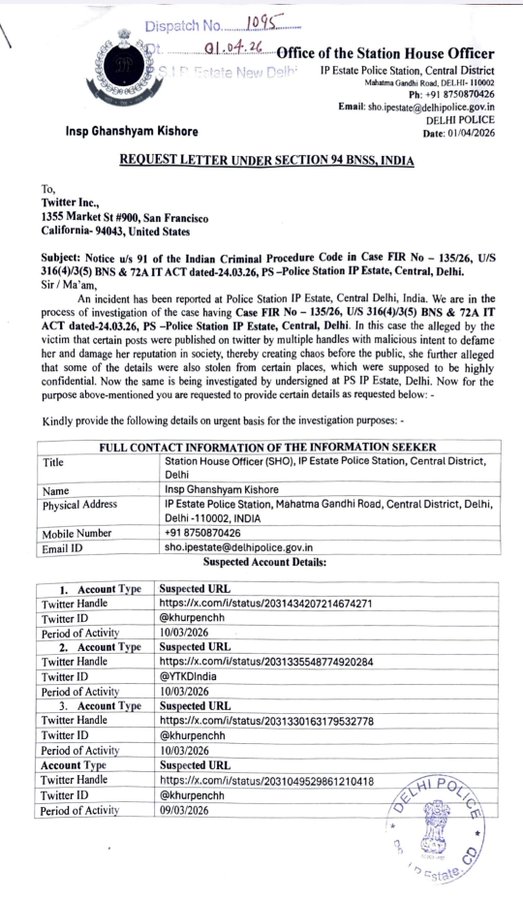
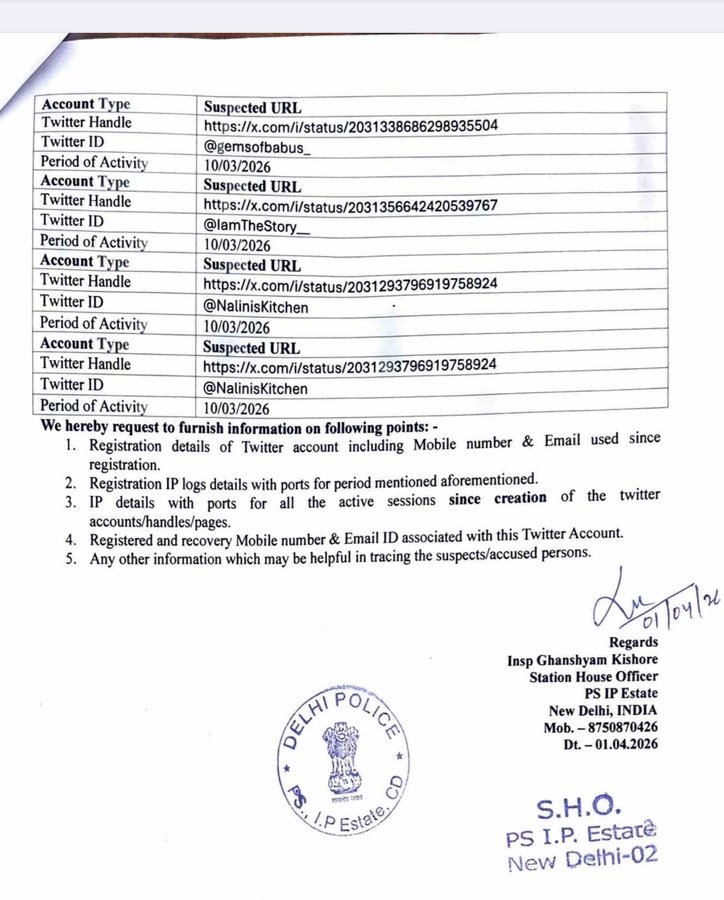
Delhi Police has written to X Inc. seeking detailed information about multiple social media handlers, including mobile numbers used for account registration, IP logs, ports accessed, and recovery email IDs. According to sources, the notice also asked for “any other information” that could help in identifying or tracing the individuals behind these accounts. Following this, several of the concerned handlers have come forward publicly, alleging that the move amounts to a “witch hunt.” They claim the action is aimed at targeting voices that question or criticize the system, raising concerns over freedom of expression on digital platforms. The development has sparked a wider debate online, with many users questioning whether seeking such extensive personal data is justified or an overreach. @DelhiPolice @CPDelhi @DCPCentralDelhi @DCPNewDelhi
Atulkrishan tweet mediaAtulkrishan tweet media
English
106
799
2K
367.4K
✶
@sandwichstores·
“interfered with my job” and its a qrt… is this your first day on the internet? get over yourself
Tulika Bose@TulikaBose_

Hey @_mahdichowdhury, with all due respect— this entire fiasco started because you interfered with me trying to do my job as a reporter and get ahold of a source.

English
0
1
2
134
✶ retweetledi
Arun Arora
Arun Arora@Arun2981·
April fools is not part of our culture. It is a western concept. In India we have Achhe Din
English
98
2.2K
14.4K
158.7K
✶ retweetledi
Internet Freedom Foundation (IFF)
Internet Freedom Foundation (IFF)@internetfreedom·
Sound the Alarm : IFF’s First Read on MeitY's Draft IT Rules Second Amendment, 2026 New Delhi, 30 March 2026 On 30 March 2026, the Ministry of Electronics and Information Technology published proposed amendments to the IT Rules, 2021, inviting public comments by 14 April, a comment period of barely fifteen days for changes with far reaching consequences for free speech and intermediary governance in India. We have conducted a quick review of the draft amendments. Despite being presented as "clarificatory and procedural," they represent a dangerous expansion of executive power over online speech. We wish to state at the outset that these proposed amendments need to be immediately withdrawn and every member in our citizenry should demand their roll back and stand with the Constitution of India. These proposed amendments come at a time of fear and increased government directed censorship, especially of online political speech that includes parody and satire of the government, including the Prime Minister. In brief the five changes are listed below: 1. Rule 3(1)(g) and 3(1)(h): Insertion of phrases within existing clauses making data retention obligations under the IT Rules additional to retention requirements under any other law. 2. Rule 3(4): Insertion of a new clause that mandates intermediary compliance with MeitY-issued clarifications, advisories, directions, SOPs, codes of practice, and guidelines, making such compliance a condition for retaining safe harbour under Section 79 of the IT Act. These are not anchored to the rule making powers of the IT Act, 2000 and provide uncanalised power to MEITY despite it stating otherwise. 3. Rule 8(1) proviso: A substitution in the proviso that expands applicability of MIB’s oversight mechanism in Part III of the rules to: (1) intermediaries and (2) users who are not “publishers” and post/share news and current affairs content online. This oversight mechanism contains the blocking powers of MIB by way of Rule 14 (Inter-Departmental Committee), Rule 15 (Procedure for issuing directions to block), and Rule 16 (Emergency blocking provisions). 4. Rule 14(2) : A substitution that expands the scope of the IDC from hearing "complaints or grievances" to hearing "matters", including those referred by the Ministry of Information and Broadcasting. 5. Rule 14(5) : Replaces "complaints or grievances" with "the matter" in relation to IDC examination and recommendations. A massive expansion of an unconstitutional censorship and regulatory power First and most concerningly, Rule 3(4) creates a sweeping power for MeitY to issue binding instruments which are not anchored in law such as clarifications, advisories, directions, SOPs, codes of practice, and guidelines that intermediaries must comply with as a condition of safe harbour under Section 79 of the IT Act. The Supreme Court's 2015 judgment in Shreya Singhal v. Union of India (2015) 5 SCC 1, remains the foundational precedent governing intermediary liability. It constrains the proposed amendments in several ways. First, the court read down Section 79(3)(b) to require that "actual knowledge" of unlawful content must come through a court order or government notification. Any Rule 3(4) making MeitY, "clarifications, advisories, directions, SOPs", lower the constitutional threshold for intermediary due diligence obligations. Further, the settled principle in Indian administrative law, reaffirmed in Indian Express Newspapers v. Union of India (1985) 1 SCC 641 and Confederation of Ex-Servicemen Associations v. Union of India (2006) 8 SCC 399, is that delegated legislation must remain within the four corners of the parent statute. It is important to note that the rule-making power under Section 87(1) of the IT Act is confined to, "carry[ing] out the provisions" of the Act. Section 87(2)(zg) authorizes rules for intermediary guidelines under Section 79(2), and Section 87(2)(z) for blocking procedures under Section 69A(2). Justice Chandurkar's judgement in the Kunal Kamra case clearly found the FCU amendment was not properly referable to either provision. Hence, any Rule 3(4) mandating compliance with MeitY advisories would face identical challenges since they create substantive new obligations not contemplated by Sections 79 or 87. Even though Rule 3(4)(b)(ii) states that such, “advisories” etc. need to, “clearly specify the statutory provision or legal basis under which it is issued”, since these are not required to be published or made public there is every likelihood these will be issued with secrecy and hence may just in a tautological manner refer back to Section 79(3)(b) of the IT Act. This is similar to a logical fallacy in which it is clearly observable that a student is cheating on an exam who then claims that they may be permitted to continue cheating since they are stating at the same time they are not cheating. The practical effect of Rule 3(4) is that intermediaries face a perpetual compliance threat. Any failure to comply with any MeitY-issued instrument, however vague, however rapidly issued may cost them their safe harbour. The response for an intermediary is over-compliance and over-censorship. Circumventing existing stay orders The original proviso to Rule 8(1) stated that Part III applied to intermediaries only "for the purposes of rules 15 and 16" i.e., content blocking directions and emergency blocking. The amended proviso now extends this to Rule 14, bringing intermediaries and user-generated news/current affairs content under the jurisdiction of the Inter-Departmental Committee. Under Rules 9(1) and 9(3) of the 2021 IT Rules, there is a Code of Ethics compliance requirement and the three-tier grievance redressal mechanism, both of which were stayed by the Bombay High Court on 14 August 2021 as prima facie violative of Article 19(1)(a) and ultra vires the IT Act. On the oversight mechanism in Rules 14, 15, and 16, the Bombay High Court granted the petitioners to seek relief on this rule when an Inter Departmental Committee is established. The Madras High Court affirmed this stay as having pan-India effect in its order of 16 September 2021 in T.M. Krishna v. Union of India, observing that "an oversight mechanism to control the media by the government may rob the media of its independence." Both these cases, along with other cases challenging various provisions of the 2021 IT Rules, are now pending adjudication before the Delhi High Court. The expansion of Rule 8(1) to cover Rules 14, 15, and 16 is an attempt to expand the blocking powers of MIB to both intermediaries and users who are not “publishers” but post news and current affairs content online. The IDC can now examine "matters" relating to user-generated news content on intermediary platforms without the Code of Ethics framework having been adjudicated as constitutional; the government effectively obtains the content oversight machinery that three High Courts found illegal, through a different procedural door. Transforming the IDC from Grievance Body to Censorship Apparatus The original Rule 14(2) required the IDC to hear "complaints regarding violation or contravention of the Code of Ethics." The amended version removes this requirement entirely. The IDC now hears: (a) grievances arising from decisions at Level I or II; or (b) "matters" referred to by the Ministry. Clause (b) is unconstrained since, (a) there is no requirement that the "matter" arise from a complaint, (b) no requirement that the "matter" relate to a Code of Ethics violation; and (c) no requirement that the affected party be heard before the referral. The Ministry of Information and Broadcasting can, on its own motion, refer any content-related "matter" to the IDC. The cumulative effect of the amendments to Rules 8 and 14 is to reconstruct the oversight machinery that the Bombay and Madras High Courts found constitutionally suspect, in a form designed to evade the existing interim orders. The IDC, previously limited to the three-tier complaints process under the stayed Rules 9(3), 12, and 13 framework, now operates as a free-standing censorship committee that can take up "matters" referred by the executive. Increased user surveillance through mandatory data retention directions Insertion of phrases within existing clauses making data retention obligations under the IT Rules additional to retention requirements under any other law. For instance, the mandatory data retention of user data beyond 180 days within Rule 3(1)(g) and 3(1)(h) may be prescribed for longer periods and other purposes raising risks of surveillance and even potentially data leaks of sensitive data that is stored for longer periods of time. Government mandates for data retention as to their legal authority and hence period of retention will be beyond those contained under the IT Act. SOS for Digital Rights IFF urges an urgent rollback! We are alarmed by the continuing expansion of unchecked executive power that is opposed to the Constitution of India. The present actions of MEITY smack of digital authoritarianism and we call on them to withdraw these proposed amendments. The proper course is to await judicial determination of the pending challenges, respect interim protections granted by constitutional courts, and pursue regulatory objectives through parliamentary legislation rather than subordinate instruments that exceed the parent statute. If not withdrawn, IFF will file a detailed response before the comment deadline. We call upon all stakeholders to submit their objections before 14 April 2026 at itrules.consultation@meity.gov.in
Internet Freedom Foundation (IFF) tweet media
English
43
1K
1.6K
148.6K
✶
@sandwichstores·
when will this end
English
0
0
0
8