

Sheik Ilderim
377 posts


The text that would become Section 132 of the Doctrine and Covenants was dictated by Joseph Smith in 1844, not long before his martyrdom. It did not find its way into the Doctrine and Covenants until 1876. That is 32 years later. During this time, the Church (members and corporate existence) moved from Nauvoo, IL to the Great Salt Lake. Brigham Young was anxiously engaged in building Zion, both in number and in area. And the best method of printing was the manual type-set.
The Family: A Proclamation to the World was first read in 1995 to the Relief Society. It is now 31 years later, and it still has not found its way into the Doctrine and Covenants, though the prophets and apostles have consistently declared it doctrine.
Help me understand the uproar over D&C 132 and the claims that it could not have come from Joseph because it was so far removed from his death, and yet it is no farther removed than is The Family from its first reading.
English
@alanliddell_ @surskitmaxxing And the Church officially discouraged affiliation for almost the whole of the 20th century.
English
@alanliddell_ @surskitmaxxing Well, I agree with B Young when he said masonry was an "apostate endowment" that deviated from the original rites given in Solomon's Temple
English

This 8th century silk hanging contains the same square and compass symbolism but predates Freemasonry by centuries and comes from a completely different part of the world than the one in which Freemasonry originated.

Ben Bird@BenBird53920553
@BlackBlessedLDS there are freemasonic symbols in the temple garments and that's my main problem with them.
English
@alanliddell_ @surskitmaxxing Ok so make one. How do you feel about his dabbling with witchcraft (which includes but not limited to scrying for non religious objects)?
English
@alanliddell_ @surskitmaxxing I think you’re playing a game here. Question: are you one of those people that says Joseph Smith’s dabbling in witchcraft is no big problem because it was preparatory to use in the Urim and Thummim?
English
@AlderNate I think the strongest position is revelation or inspiration. Then it is just a matter of faith and we can make claims like I believe.
English

Fair point, and I should clarify something. I was mixing together two separate discussions in my head — one about the Book of Mormon and one about the Book of Abraham.
With the Book of Abraham specifically, I agree the situation is more nuanced.
Joseph Smith and those around him absolutely referred to it as a “translation,” but he never left behind a detailed technical explanation of exactly how that process worked. Some faithful LDS scholars view it as a more direct translation tied to missing papyri, others see the papyri as a catalyst for revelation, and others see a combination of both.
So I don’t think it’s accurate to force Joseph into a modern 2026 secular Egyptology framework and then declare the whole thing disproven if it doesn’t fit that model perfectly.
At the same time, I also agree we should speak honestly and carefully about what we do and do not know historically.
That said, even within the “translation” framework, there are still substantial counterarguments to many of the common critical claims, which is why this debate continues after nearly 200 years.
What I know for certain is this:
Joseph Smith was a prophet of God, and the Book of Abraham is true.
English
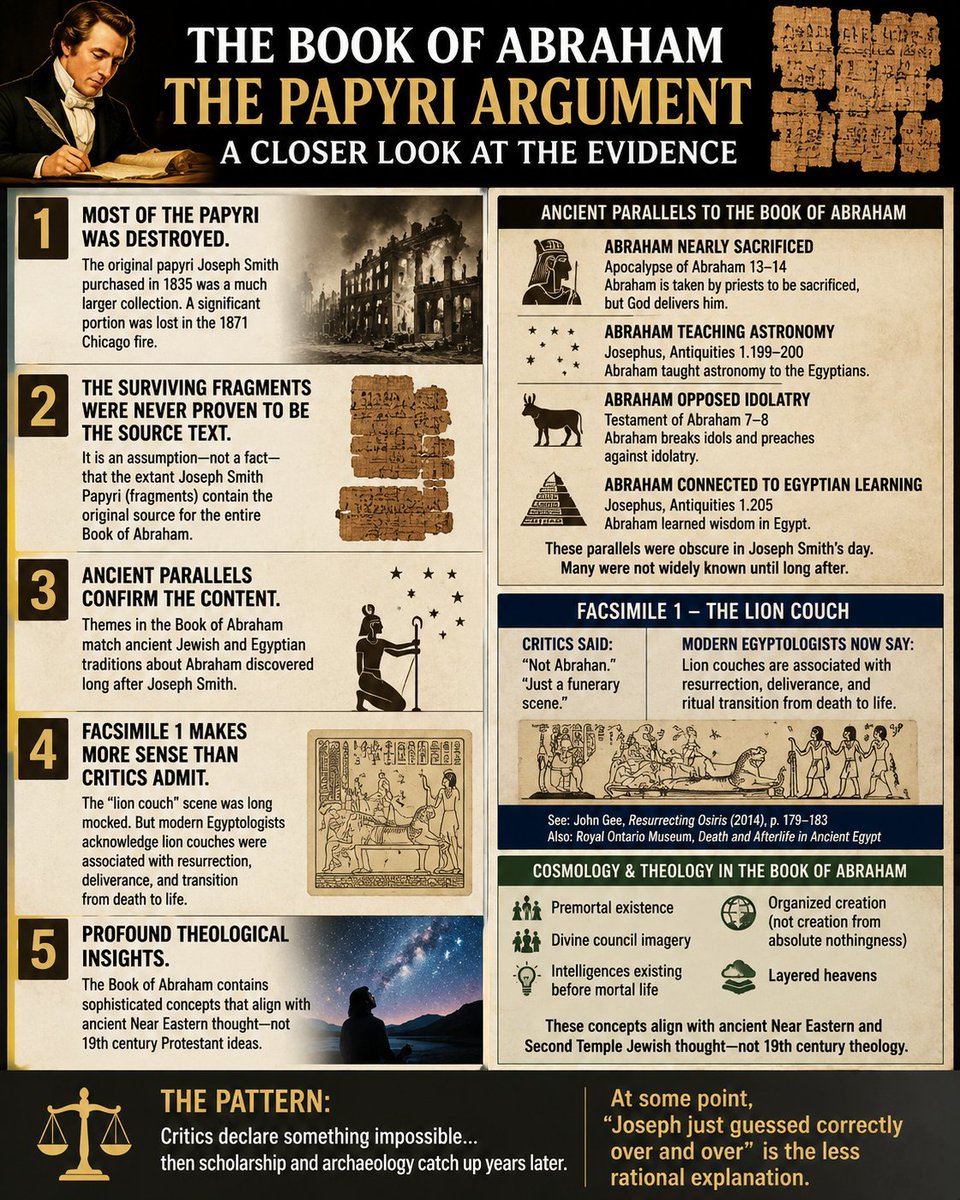
People keep repeating “the Book of Abraham was disproven by the papyri” without realizing how weak and outdated that argument actually is.
A few facts critics usually leave out:
1. Most of the original papyri collection was destroyed in the 1871 Chicago fire.
The fragments rediscovered in 1967 are only a small portion of what Joseph Smith originally possessed. Even LDS critics acknowledge this.
2. The surviving fragments were never definitively proven to be the direct source text for the entire Book of Abraham.
That is an assumption critics make, not an established fact.
3. Ancient traditions about Abraham discovered long after Joseph Smith closely parallel Book of Abraham material:
- Abraham nearly sacrificed by idol priests
- Abraham teaching astronomy
- Abraham opposing Egyptian idolatry
- Abraham connected with Egyptian learning
These themes appear in later-discovered Jewish and Egyptian texts like:
- Apocalypse of Abraham
- Testament of Abraham
- Josephus
- various Second Temple traditions
How exactly did a 19th century farm boy independently reproduce obscure ancient traditions scholars would not fully uncover until generations later?
4. Facsimile 1 is especially interesting.
The figure on the lion couch was long mocked by critics as “obviously not Abraham.”
Yet modern Egyptologists now acknowledge lion couch scenes were associated with themes of resurrection, deliverance, and ritual transition from death to life.
That suddenly makes Joseph’s interpretation far less ridiculous than critics once claimed.
5. The Book of Abraham also contains surprisingly sophisticated cosmological concepts:
- organized creation instead of creation from absolute nothingness
- premortal existence
- divine council imagery
- layered heavens
- intelligences existing before mortal life
Those ideas align far more closely with ancient Near Eastern and early Jewish thought than with mainstream 19th century Protestantism.
The pattern is becoming obvious:
Critics confidently declare something impossible…
then archaeology, textual discoveries, or scholarship complicates the narrative years later.
At some point, “Joseph just guessed correctly over and over” becomes the less rational explanation.
English
@AlderNate I don’t think or I most people are actually trying to put him into some sort of strict box or 2026 presentism. the concept of what translation means has been understood throughout all ages (as far as I know)..
English
@AlderNate LDS apologies are trying to find a solution to a problem, not trying to find the actual answer (missing papyri, etc).
English
@AlderNate Except the GAEL does leave some evidence of what he thinks he was doing. Again, I think the best argument for this is to say Joseph Smith had no idea what he was doing, and he wasn’t translating.
English
@AlderNate I appreciate the thoughtful responses (you do better at that than most), may be just a couple counter points, but I’ll have to spread it over a couple threads.
English
@AlderNate The word translate means to read a document or listen to a speech in one language, and then reproduce it essentially in another. I think our big error is continuing to use that word, it’s misleading as Joseph clearly did not do that with BoA.
English
@AlderNate So in this particular thread we were talking about Book of Abraham…
I’ll give you credit you bang out a lot of words per post, but to be honest I feel like you’re doing a lot of arm waving that is distracting.
English
@AlderNate Then you don’t have to explain anything at all, no more mental gymnastics just here’s a revelation from God. Just makes JS look a bit foolish
English
@AlderNate Since we’ve love to put out the whole Joseph Smith was an uneducated firm boy, why not just say that he was stupid and didn’t realize that he was doing a revelation and not a translation?
English
@Lew541207 @Primary_Pianist I am Pro-honesty. I support pro-LDS posts that don’t lie, exaggerate, obsfuscate, etc. I call out, mock, chide posts that do those things.
English

@sheik_ilderim @Primary_Pianist Your various posts and responses are not pro-LDS. You clearly don't accept or support the Church of Jesus Christ of Latter-day Saints. If it quacks like a duck...
English

The "Book of Mormon is obviously just 19th century Protestant America" argument gets repeated constantly online, but it falls apart pretty quickly with any sort of examination...
🧵
Rajah Manchou of Vorito@surskitmaxxing
Occam’s Razor defeats most Mormon apologetics Joseph Smith—a 19th century American Protestant with limited world knowledge outside of the Bible—created a pseudo historical ancient American setting that exactly resembled 19th century America Horses. Roads. Crops like barley…
English
@alanliddell_ @surskitmaxxing Free masonry is a fraternal society promotes a false priesthood.
Still, a dodge from my question.
English
@sheik_ilderim @surskitmaxxing Freemasonry is not a religion.
English
@realKellyKnight Why do we do this? Most recent prophet coins a phrase and we then invent its appearance in the past and suggest it’s always been there…
If Nephi or Mormon wanted to call it the covenant path, he would’ve done so
English
In chatting with one of our institute students today, he mentioned the covenant path. This is a term used with great abundance in the Church. But only today did it dawn on me that perhaps the path that Lehi and Nephi saw in vision is that very Covenant Path.
Hold to the rod...
English