Archaeo - Histories@archeohistories
In 2015, ISIL militants publicly beheaded Syrian Scholar and Archaeologists Khaled al-Asaad, (82), after he refused to disclose the location of valuable artefacts.
Beginning in 2015, the pace of such destruction accelerated dramatically as Islamic State in Iraq and the Levant (ISIL or ISIS) expanded its sphere of control in Middle East. ISIL fighters looted what treasures could be sold to support their military campaign, and they destroyed and defaced significant portions of the ancient cities of Nineveh and Hatra in Iraq.
Ancient Syrian city of Palmyra suffered perhaps most extensive damage. In August 2015 Temple of Baal Shamen, dedicated to the Phoenician storm god, was blown up. ISIL fighters followed by razing one of Palmyra’s largest surviving edifices, Temple of Bol, as well as site’s iconic Monumental Arch. Conservationists and scholars with UNESCO and other international groups worked to protect and preserve the affected sites even as battle lines in Syrian Civil War shifted, but they did so at great personal risk.
Syrian scholar Khaled al-Asaad, who had served as Palmyra’s chief archaeologist for 40 years, was publicly beheaded by ISIL for refusing to divulge the location of relics associated with the site. The highly-regarded archaeologist retired as the site's head of antiquities in 2003, but he continued to carry out research there until it fell to IS. Three of his sons and his son-in-law, who are also archaeologists, escaped to the capital with hundreds of valuable artefacts from the museum in nearby modern town of Tadmor as militants approached. But Asaad insisted that he would not leave his home.
"I am from Palmyra," he said, "and I will stay here even if they kill me."
Asaad was later detained by IS and interrogated about the locations of other artefacts that had been hidden. He was beheaded in a square in Tadmor that August after refusing to co-operate. Activists circulated a photograph purportedly showing his body tied to a pole, with a placard beside it accusing him of being Palmyra's "director of idolatry".
UNESCO Director General Irina Bokova said that; IS had killed Asaad "because he would not betray his deep commitment to Palmyra". She also characterized ISIL’s actions as a war crime, and she called upon the global community to unite around its shared heritage, saying, “We must respond to this criminal chaos that destroys culture with more culture.”
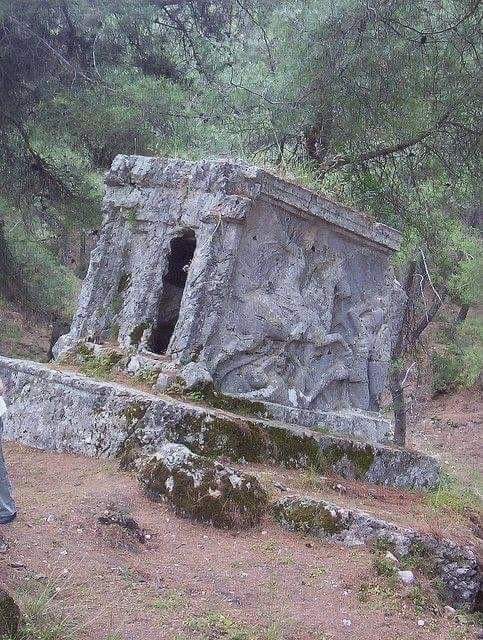
In weeks that followed the murder, IS destroyed several iconic parts of Palmyra from 1st-2nd Centuries CE, that it considered idolatrous. Temple of Baalshamin and cella and surrounding columns of Temple of Bel were blown up, as were the ancient city's triumphal arch and seven funerary towers at its necropolis.
After recapturing the site in late 2016, militants destroyed Tetrapylon - a group of four pillared structures and part of the Roman Theatre. Government forces have controlled the area since March 2017, but reconstruction work has been limited because of the ongoing civil war.
IS once held 88,000 sq km of territory stretching from western Syria to eastern Iraq and imposed its brutal rule on almost eight million people. The group was driven from its last part of land in 2019, but UN estimates that more than 10,000 militants remain active in Syria and Iraq. They are believed to be organised in small cells and they continue to carry out deadly attacks in both countries.
#archaeohistories