Wato

26 posts

Wato banner
Wato

Wato

@watolabs

Wato handles the orchestration layer for AI in institutions. Backed by @ycombinator

San Francisco, California Katılım Şubat 2026
6 Takip Edilen82 Takipçiler
Wato
Wato@watolabs·
We’re moving past the phase where “AI adoption” just means giving everyone access to more tools. The next phase is turning the best AI use cases people discover into repeatable workflows the whole company can trust. That means named workflows, shared context, connectors, permissions, review steps, and measurement. Wrote more here: blog.watolabs.com/becoming-ai-na…
Wato tweet media
English
1
0
2
45
Wato
Wato@watolabs·
I think we’ve all started to realize that AI spend is not the same thing as productivity. The first wave of AI adoption was about giving teams access to better models, more tools, and more tokens. The next wave is going to be about efficiency: understanding which AI work is actually creating business value, and which work is just adding cost. How can businesses be best suited for this transition? Wrote more here: blog.watolabs.com/ai-outcomes-ve…
Wato tweet media
English
1
2
7
58.1K
Wato
Wato@watolabs·
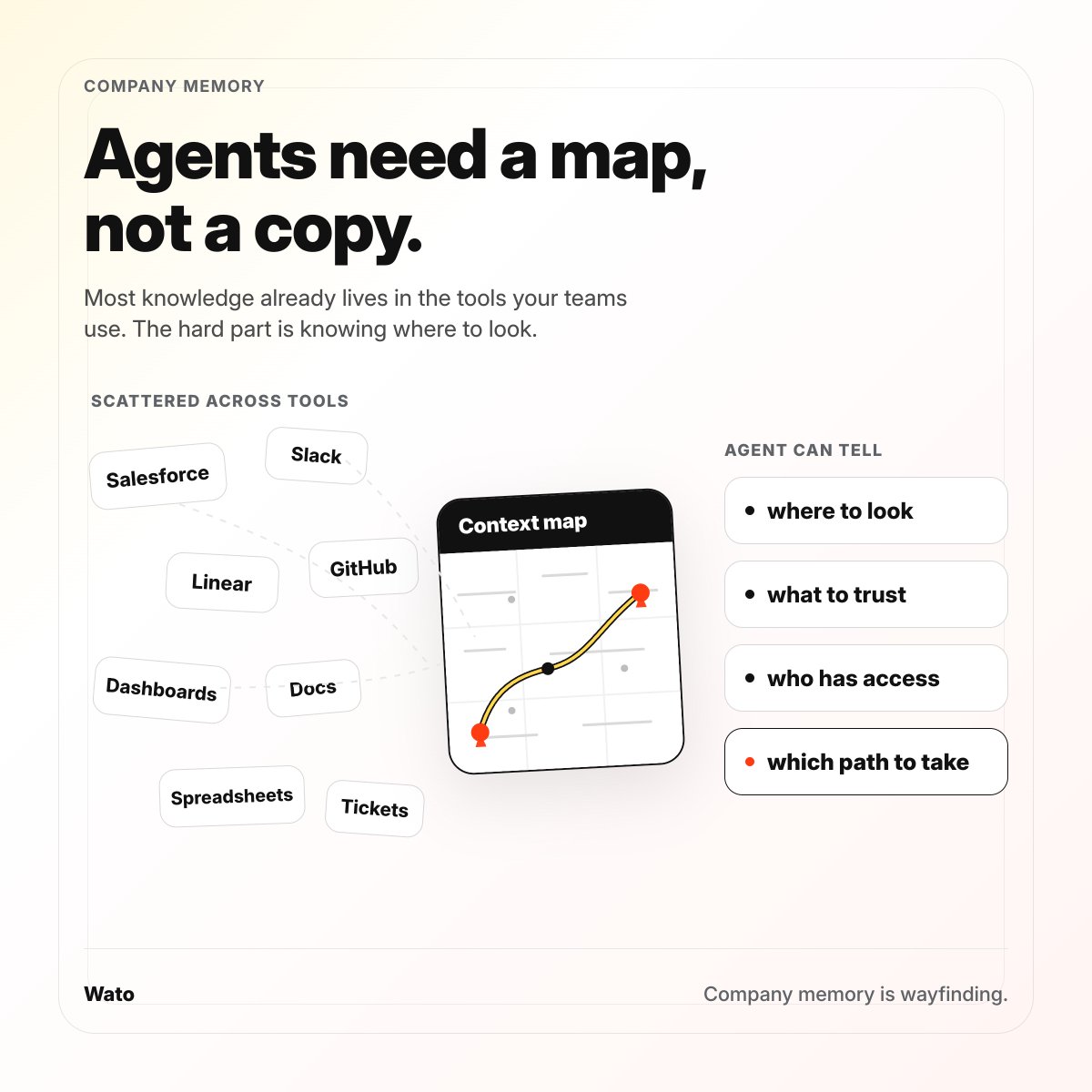
Most companies already have memory. It’s just scattered across Salesforce, Slack, Linear, GitHub, dashboards, docs, spreadsheets, and the people who know where to look. That’s why “company memory” for AI agents should be structured to help agents navigate this convoluted mess. Try to create a map: Write where knowledge lives, what sources to trust, who has access, and which workflows have been reviewed. Wrote more here: blog.watolabs.com/company-memory…
Wato tweet media
English
3
1
8
23.7K
Wato
Wato@watolabs·
Collaboration is changing. The next teammate in your Slack channel might be an agent: one that understands team context, uses approved tools, works in a sandbox, and keeps going while you move on. Wato Cloud Agents are our first step toward that future.
English
1
3
10
70.4K
Wato
Wato@watolabs·
Asked Wato one messy sales question: “What’s going on with BrightCart, why is the renewal at risk, where’s Eng on the fix, and what should I email them?” It pulled the account status, meeting context, technical blockers, stakeholder guidance, and drafted the follow-up. This is what happens when company context actually works.
English
1
1
14
284.9K
Wato
Wato@watolabs·
just like our memory system, everything is permissioned and version controlled as well!
English
0
1
6
120
Wato
Wato@watolabs·
Wato released the biggest update to artifacts for Claude and Codex. The flow is usually: prompt -> MCPs -> data -> HTML/CSS/JS -> static dashboard Then it becomes a static HTML file, a screenshot, or a Slack link nobody trusts two weeks later. Wato makes artifacts live: permissioned, versioned, shareable, connected to data, and reusable by agents. Here's a demo below.
English
1
3
13
220.9K
Wato
Wato@watolabs·
@mfucek_ The durable object is the reviewed memory file plus its provenance and links to decisions/dependencies/systems. Folders help people browse and govern. But you're right agents need typed connections to use memory safely.
English
0
0
1
22
Matija Fućek
Matija Fućek@mfucek_·
strong agree on being able to see where things came from. just my take: thinking folders are the memory is a trap; they're a good way for people to stay in control, but agents need clear links for owners, decisions, dependencies, and stale info. do you guys treat the folders as just a presentational layer and the connections as a bandaid, or is it the other way around (based on experience, I think the latter is the way to go)
English
1
0
0
34
Wato
Wato@watolabs·
We just built the most scalable company brain. Institutions are naturally noisy. Wato is built to solve for that. Most “AI memory” systems are solving the wrong problem. They treat memory as retrieval: put documents in a vector database, search across them, and hope the right context comes back. But company knowledge does not stay clean on its own. It gets stale, duplicated, contradictory, and hard to trust. Real memory needs structure: source of truth version history rollback permissions exact search human-readable records This is where a lot of graph RAG / embedding-first systems break down. They can retrieve plausible context, but they don’t answer the more important questions: Who said this? Is it still true? Which team owns it? What changed? At Wato, we think memory should work more like a versioned filesystem. Keep the source as readable Markdown, organized by teams and folders. Then layer search on top. You still get semantic search, keyword search, and exact search at scale, but the source stays inspectable and editable. The agent needs to both “remember" and the institution needs to know what it knows, keep it current, and make it safely usable.
English
3
1
12
361.9K
Wato
Wato@watolabs·
Introducing Wato: shared memory and living artifacts for AI in teams. Every team building with agents eventually hits the same wall: The work doesn’t compound. An agent will solve something useful, then the knowledge disappears. It found the right workflow. It found which source is trusted. It figured out the weird caveat. It built the useful dashboard. It wrote the playbook. Then the next agent starts from zero. So we built Wato. So your entire team can go from 0 -> 100 Wato lets agents read from team memory, push reusable knowledge back into memory, share skills across teams, and create refreshable artifacts like live dashboards. Every useful agent run should make the next one better. Private beta is open. Link in comments.
Wato tweet media
English
3
2
33
1.4M
Wato
Wato@watolabs·
Early access @ watolabs.com If you're working in credit, insurance, research, etc. Send us a dm!
English
0
0
2
193
Wato
Wato@watolabs·
What was said. What was priced. What changed. Research is scattered across datasets, articles, and notes. We made it searchable, citable, and trackable. Wato's macro research corpus: newsletters, FRED data, articles, prediction markets → unified and cited.
Wato tweet media
English
3
2
10
523