A SHORT POEM ABOUT THE DIFFERENCE BETWEEN ENGLISH AND GERMAN…
English weather is wet
German weather is Wetter
English kids are kind
German kids are Kinder
English mothers mumble
German mothers Mutter
And the English shout the word people
But Germans just quietly Menschen it
🚨SHOCKING: Researchers took ChatGPT away from workers for 4 days.
They couldn't ask coworkers for help. They described talking to another human being as a burden.
Here is what they found.
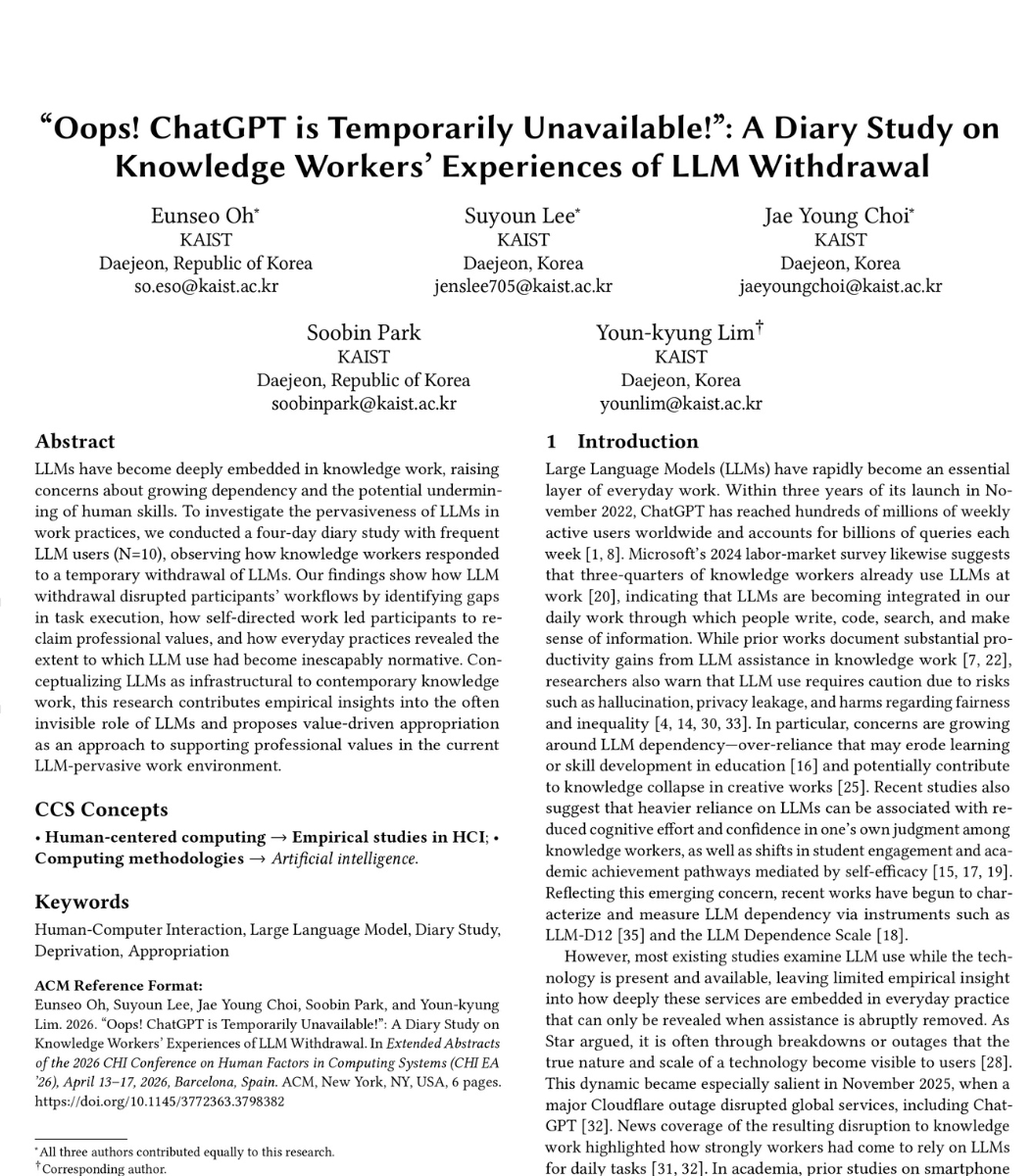
Researchers conducted a four-day diary study on 10 knowledge workers who frequently use ChatGPT. They removed access to all LLMs completely and documented everything that happened.
The disruption was immediate.
Workflows broke down. Participants found gaps in their ability to execute tasks they previously handled with AI. Without the tool, they realized how many parts of their process had quietly been handed over to the machine.
But the most disturbing finding wasn't about productivity.
It was about people.
When participants needed help during the withdrawal, they refused to ask coworkers. They described asking another human being for assistance as a social burden. They assumed their colleagues would find it tiring and burdensome.
One participant said they avoided asking people questions because they feared being seen as a "finger prince" - a Korean slang term for someone who burdens others with easily searchable questions.
They would rather switch between different AI services, from ChatGPT to Grok, than have a conversation with the person sitting next to them.
ChatGPT didn't just become a tool. It replaced human interaction entirely. And when it was taken away, these workers had forgotten how to reach out to each other.
The researchers described LLM use as "inescapably normative." The participants didn't even realize how dependent they had become until the AI was gone. It had woven itself so deeply into their daily routines that its absence felt disorienting.
But here is what nobody expected.
When forced to work without AI, participants started reclaiming professional values they had lost. They reconnected with their own thinking. Some found that human help was actually more useful than AI had ever been.
One participant said that if the withdrawal had lasted a year, "discussions between people would be more active."
Four days without ChatGPT and they remembered what it felt like to think for themselves.
The question is whether the rest of us ever will.
Now that Artemis II has launched we have 10 days to get everyone on Earth a Planet of the Apes costume so we can do something hilarious when the astronauts return 😁
In Sicily, a classical music concert was held at the ancient Taormina Theatre, but the real star of the show was Mount Etna erupting.
A truly magical night!
When Khalil Gibran said, “Between what is said and not meant, and what is meant and not said, most love is lost”
When Jane Austen said, “And sometimes I have kept my feelings to myself, because I could find no language to describe them in.”
When Fyodor Dostoevsky said, “Much unhappiness has come into world because of bewilderment and things left unsaid.”
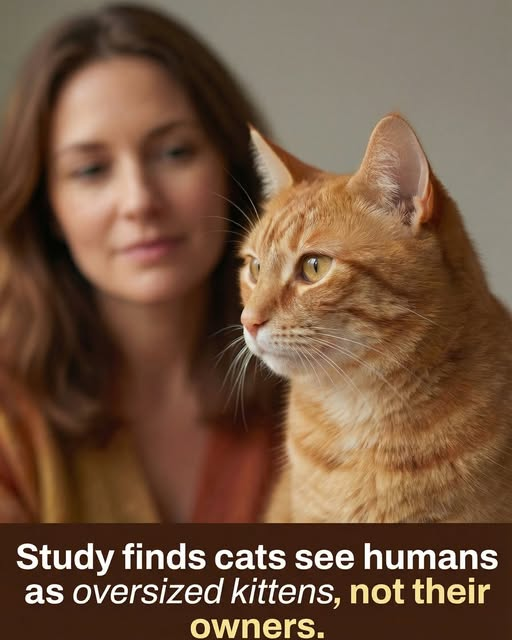
A research into cat behavior shows that domestic cats regard humans as social peers rather than superiors, often perceiving their owners as large, awkward kittens.
Far from being aloof or defiant, a cat’s apparent indifference stems from a profound interspecies mismatch in social expectations.
As anthrozoologist John Bradshaw explains, cats—unlike dogs—never evolved to recognize humans as dominant leaders or authority figures. Instead, they filter all interactions through an exclusively feline framework. Behaviors like kneading on your lap or licking your hair are not mere displays of affection; they are the same grooming and bonding rituals cats reserve for close kin or pride members. In their eyes, we are simply enormous, somewhat clumsy fellow cats who require inclusion in the group.
This absence of hierarchical deference accounts for cats’ frequent disregard of commands or household rules. Treating us as equals, they follow cat-to-cat social protocols in every encounter. The “gifts” of dead prey on the doorstep or constant shadowing around the home are acts of care toward what they see as a big, furless, rather inept companion.
Recognizing this mindset transforms the human-cat relationship from one based on authority and obedience to one of mutual companionship. It turns out that while many owners believe they have domesticated their cats, the cats themselves are quietly convinced they are patiently tending to their oversized, adopted family members.
[Bradshaw, J. (2013). Cat Sense: How the New Feline Science Can Make You a Better Friend to Your Pet. Basic Books]