Data Governance Framework

355.4K posts

Data Governance Framework banner
Data Governance Framework

Data Governance Framework

@gdprAI

Official news and insights. Top 10 influencer #gdpr, #privacy, #ai, #dataprotection, #ml, #cybersecurity, #ibm, #dataprivacy, #infosec, #security, #ChatGPT4

England, United Kingdom Entrou em Temmuz 2019
1 Seguindo9K Seguidores
Data Governance Framework retweetou
Lee Harris
Lee Harris@LeeHarris·
If you missed it. This is Kemi Badenoch's response to Rachel Reeves' disaster budget *in full*. I've never seen anything like it. Kemi tears her to shreds. This is absolutely brutal. Well worth a watch 🔥
English
1.1K
3.5K
21K
778.3K
Data Governance Framework retweetou
Pierre Ferragu
Pierre Ferragu@p_ferragu·
I am still struggling with the implications of Optimus watching it on YouTube, learning how to do it with RL in simulation and nailing it zero-shot. This is the most important AI breakthrough of the year, I’d say. Implications go well beyond humanoid robots.
English
313
700
6K
2.8M
Data Governance Framework retweetou
NASA Earth
NASA Earth@NASAEarth·
Have questions about extreme weather? Today at 3pm ET, @NASAClimate experts discuss shifts in the intensity of events such as heat waves, floods, wildfires, and hurricanes. Use #AskNASA to submit a question and watch live: go.nasa.gov/3Mena3f
NASA Earth tweet media
English
82
142
710
473.9K
Data Governance Framework retweetou
Marko Denic
Marko Denic@denicmarko·
Marko Denic tweet media
ZXX
27
301
2K
315.5K
Data Governance Framework retweetou
Python Coding
Python Coding@clcoding·
Pencil Sketch using Python
Python Coding tweet media
English
10
257
1.6K
241K
Data Governance Framework retweetou
NASA
NASA@NASA·
We have the answers to your most-asked #Starliner questions. Learn more about NASA's Boeing Crew Flight Test to the @Space_Station—and keep checking this page for the latest updates: nasa.gov/starliner-faq
NASA tweet mediaNASA tweet mediaNASA tweet media
English
414
767
5.8K
6.6M
Data Governance Framework retweetou
sysxplore
sysxplore@sysxplore·
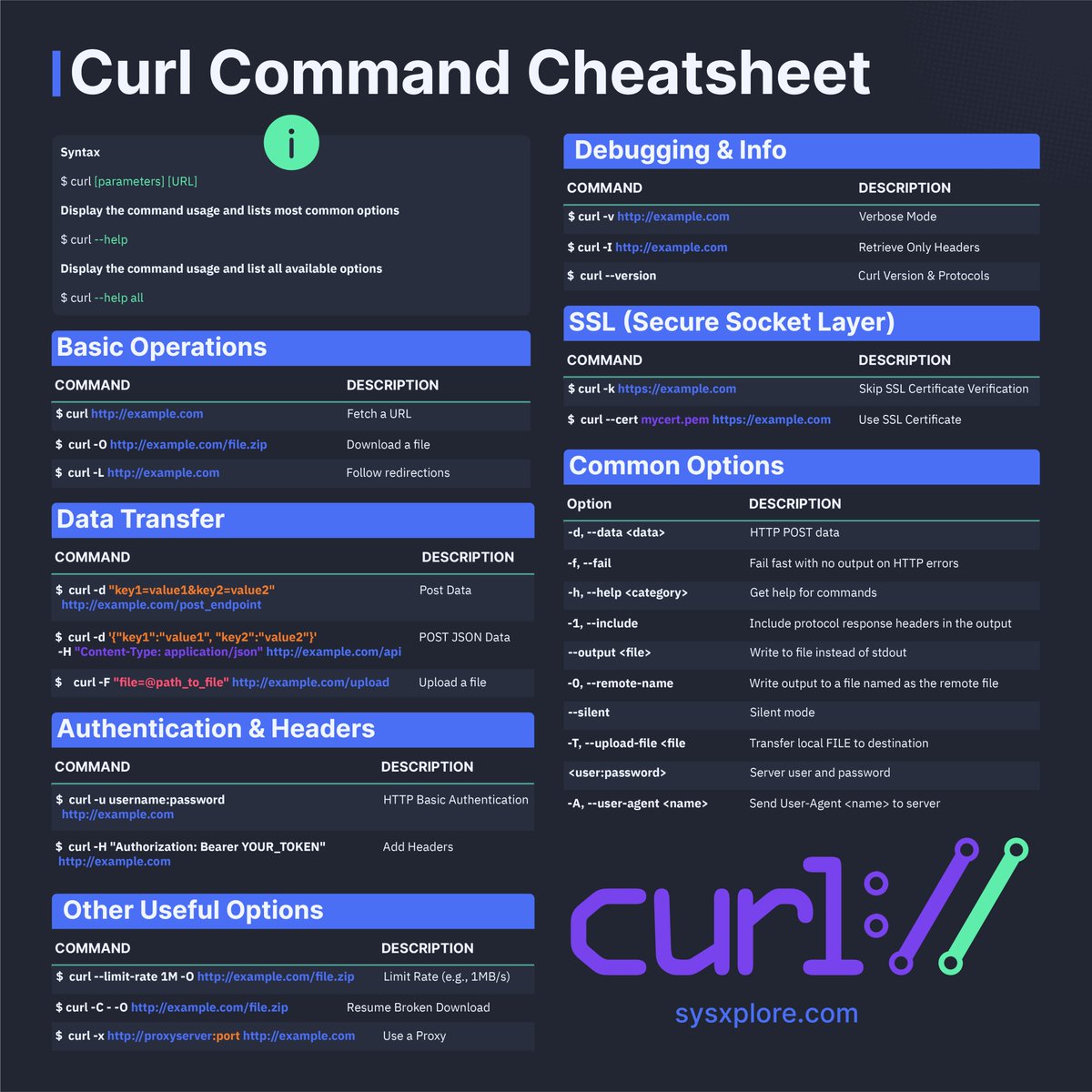
Linux curl command cheatsheet
sysxplore tweet media
English
4
199
1.1K
117.2K
Data Governance Framework retweetou
Matt Dancho (Business Science)
It took me 5 years to master all 24 of these machine learning concepts. In the next 24 days, I'll teach them to you one by one (with examples of how I've used them in business cases). Here's what's coming: 1. Linear Regression 2. Clustering 3. Decision Tree 4. Neural Networks 5. Reinforcement Learning 6. Logistic Regression 7. Naive Bayes 8. Supervised Learning 9. Support Vector Machine 10. Probability 11. Random Forest 12. Variance 13. Evaluation Metrics 14. Bagging 15. Data Wrangling 16. Dimensionality Reduction 17. K-nearest Neighbors Algorithm 18. Programming 19. Regularization 20. Statistics 21. Binomial Distribution 22. Bootstrap Sampling 23. Exploratory Data Analysis 24. Data Collection There you have it- my top 24 concepts on Machine Learning. The next problem you'll face is how to apply data science to business. I'd like to help. I’ve spent 100 hours consolidating my learnings into a free 5-day course, How to Solve Business Problems with Data Science. It comes with: 300+ lines of R and Python code 5 bonus trainings 2 systematic frameworks 1 complete roadmap to avoid mistakes and start solving business problems with data science, TODAY. 👉 Here it is for free: learn.business-science.io/free-solve-bus…
Matt Dancho (Business Science) tweet media
English
6
178
831
64.4K
Data Governance Framework retweetou
MIT CSAIL
MIT CSAIL@MIT_CSAIL·
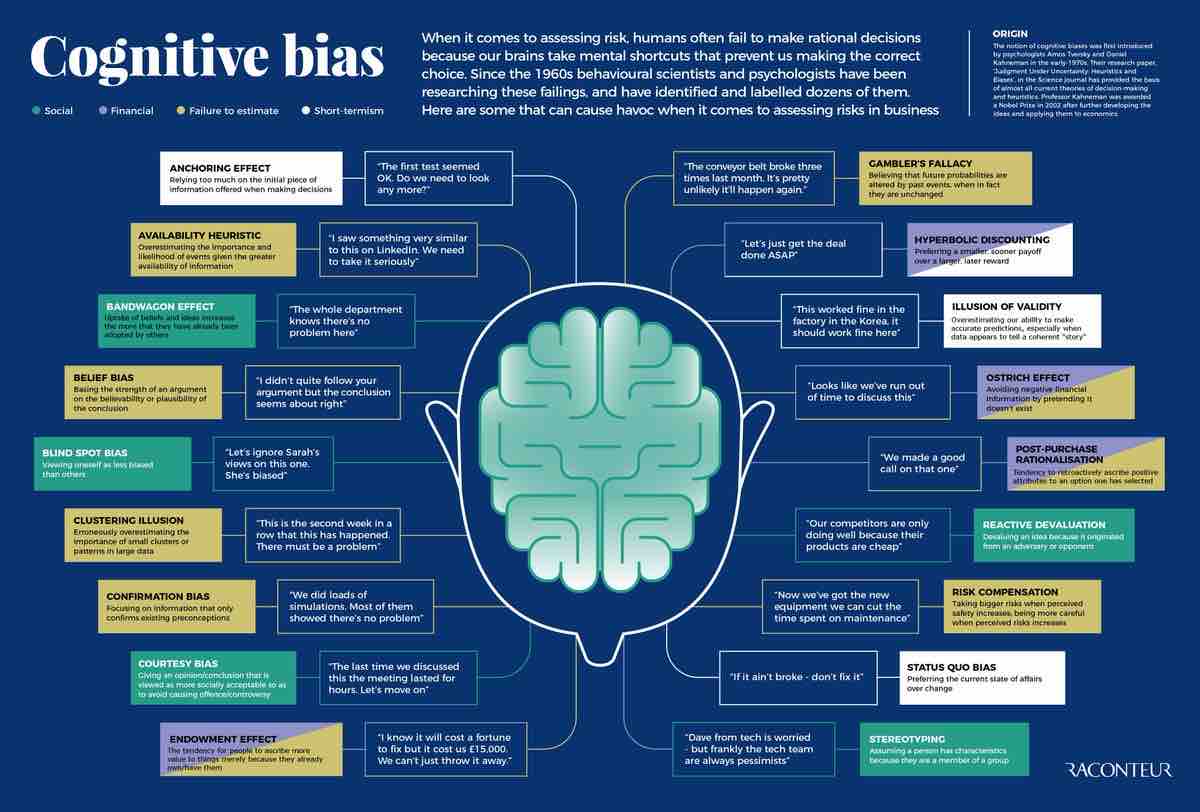
18 types of cognitive biases, explained. Credit: @jblefevre60
MIT CSAIL tweet media
English
3
107
315
31.5K
Data Governance Framework retweetou
Poonam Soni
Poonam Soni@CodeByPoonam·
Nvidia just launched Chat with RTX It leaves ChatGPT in the dust. Here are 7 incredible things RTX can do:
Poonam Soni tweet media
English
259
1.4K
8.5K
2.2M
Data Governance Framework retweetou
Matt Dancho (Business Science)
Logistic Regression is the most important foundational algorithm in Classification Modeling. In 2 minutes, I'll teach you what took me 2 months to learn. Let's dive in: 1. Logistic regression is a statistical method used for analyzing a dataset in which there are one or more independent variables that determine a binary outcome (in which there are only two possible outcomes). This is commonly called a binary classification problem. 2. The Logit (Log-Odds): The formula estimates the log-odds or logit. The right-hand side is the same as the form for linear regression. But the left-hand side is the logit function, which is the natural log of the odds ratio. The logit function is what distinguishes logistic regression from other types of regression. 3. The S-Curve: Logistic regression uses a sigmoid (or logistic) function to model the data. This function maps any real-valued number into a value between 0 and 1, making it suitable for a probability estimation. This is where the S-curve shape comes in. 4. Why not Linear Regression? The shape of the S-curve often fits the binary outcome better than a linear regression. Linear regression assumes the relationship is linear, which often does not hold for binary outcomes, where the relationship between the independent variables and the probability of the outcome is typically not linear but sigmoidal (S-shaped). 5. Coefficient Estimation: Like linear regression, logistic regression calculates coefficients for each independent variable. However, these coefficients are in the log-odds scale. 6. Coefficient Interpretation (Log-Odds to Odds): Exponentiating a coefficient converts it from log odds to odds. For example, if a coefficient is 0.5, the odds ratio is exp(0.5), which is approximately 1.65. This means that with a one-unit increase in the predictor, the odds of the outcome increase by a factor of 1.65. 7. Model evaluation: The evaluation metrics for linear regression (like R-squared) are not suitable for assessing the performance of a model in a classification context. For Logistic regression, I normally use classification-specific evaluation metrics like AUC, precision, recall, F1 score, ROC curve, etc. === Want help improving your data science skills? 👉Free 10 Skills Webinar: I put together a free on-demand workshop that covers the 10 skills that helped me make the transition to Data Scientist: learn.business-science.io/free-rtrack-ma… 👉ChatGPT for 10X Faster DS Projects: I have a live workshop where I'll share how to use ChatGPT for Data Science (so you can complete projects 10X faster): learn.business-science.io/registration-c… If you like this post, please reshare ♻️ it so others can get value.
Matt Dancho (Business Science) tweet media
English
12
461
1.9K
138K
Data Governance Framework retweetou
Santiago
Santiago@svpino·
Do not brush this off. Learn how these functions work when used as activation functions in a neural network: 1. Sigmoid 2. Tanh 3. ReLU 4. Leaky ReLU My recommendation is to focus on their trade-offs. Focus on answering when you should use one instead of the other.
Santiago tweet media
English
14
175
1K
73.1K
Data Governance Framework retweetou
Santiago
Santiago@svpino·
I love notebooks, and Visual Studio Code made them much better, but after using Zerve, they feel outdated. Zerve is a new web-based IDE. It's block-based like a notebook but follows a different philosophy, and the experience is much different. It's not a fork of Jupyter, and it's not an improvement. It's a completely reimagined experience. This comes with an important advantage: Zerve allows teams to collaborate on the same project without breaking each other's work. This is one of Jupiter's Achilles heels. Zerve's architecture solved it from the ground up. The team sponsored this post and gave me early access to the tool to try it. I imported some of my notebooks and reproduced some common scenarios I frequently use. I feel this can change how data scientists and machine learning practitioners write code. Here are a few notes: 1. It's web-based, so you can access your work anywhere. 2. Collaboration is a first-class citizen. 3. You can deploy your code without going anywhere. 4. It promotes code modularity by using blocks. 5. You can use multiple languages together. 6. You can run code blocks in parallel. Zerve organizes your code as a DAG. Each block inherits the state of every block before it. Everything runs in a serverless architecture. The tool just came out, so we don't know how the community will use it. It's free. You can start right now by visiting hubs.ly/Q02hBzgs0. I can't wait for more people to try it and share what they think!
Santiago tweet media
English
45
254
1.8K
271.6K
Data Governance Framework retweetou
C3 AI
C3 AI@C3_AI·
C3 Generative AI for Manufacturing is a unified knowledge source that provides fast and accurate answers to personnel in manufacturing operations.
English
159
334
3.9K
54.8M
Data Governance Framework retweetou
Santiago
Santiago@svpino·
Excellent upgrade for every Python developer. I've been using the following three libraries for years: • flake8 - Linting • black - Formatting • isort - Sorting imports Many people recommended a replacement: "ruff." I installed it, and I've been playing with it for a couple of days. First, ruff is a drop-in replacement for the three libraries I mentioned. You get feature parity out of the gate. Second, it's fast, and that's the first thing you'll notice. It scanned my repository in no time. If you come from Flake8, you'll see the difference. It has a Visual Studio Code extension. I installed it. It now automatically runs whenever I open a Python file or a notebook. So far, it's great. The Visual Studio Extension page has much more information about the extension and how to configure it. Their GitHub page will also help. This post is not sponsored.
GIF
English
18
172
1.2K
198.5K