L3

8.9K posts

L3 banner
L3

L3

@epi_longo

Geeky Guy in Marketing/Growth Land, ex Baomoi, VNG, Be, Tiki & another lands of Red Queen.

Sumali Kasım 2008
1.1K Sinusundan3.5K Mga Tagasunod
L3 nag-retweet
Lenny Rachitsky
Lenny Rachitsky@lennysan·
"Using coding agents well is taking every inch of my 25 years of experience as a software engineer, and it is mentally exhausting. I can fire up four agents in parallel and have them work on four different problems, and by 11am I am wiped out for the day. There is a limit on human cognition. Even if you're not reviewing everything they're doing, how much you can hold in your head at one time. There's a sort of personal skill that we have to learn, which is finding our new limits. What is a responsible way for us to not burn out, and for us to use the time that we have?" @simonw
Lenny Rachitsky@lennysan

"Using coding agents well is taking every inch of my 25 years of experience as a software engineer." Simon Willison (@simonw) is one of the most prolific independent software engineers and most trusted voices on how AI is changing the craft of building software. He co-created Django, coined the term "prompt injection," and popularized the terms "agentic engineering" and "AI slop." In our in-depth conversation, we discuss: 🔸 Why November 2025 was an inflection point 🔸 The "dark factory" pattern 🔸 Why mid-career engineers (not juniors) are the most at risk right now 🔸 Three agentic engineering patterns he uses daily: red/green TDD, thin templates, hoarding 🔸 Why he writes 95% of his code from his phone while walking the dog 🔸 Why he thinks we're headed for an AI Challenger disaster 🔸 How a pelican riding a bicycle became the unofficial benchmark for AI model quality Listen now 👇 youtu.be/wc8FBhQtdsA

English
562
695
6.8K
1.9M
L3 nag-retweet
TBPN
TBPN@tbpn·
Alex Karp: "Everybody's worried about their future, but there are basically two ways to know you have a future." "One, you have some vocational training, or two, you're neurodivergent. And when I say 'neurodivergent,' I mean broadly defined." "It's really an inversion [for people] with the 'normal-shaped skills'... Meaning the thing they can do that used to be valuable is not so valuable." "The thing they need to learn to do is be more of an artist, look at things from a different direction, be able to build something unique."
English
93
302
3.6K
791.7K
L3 nag-retweet
neira
neira@borjaneira_·
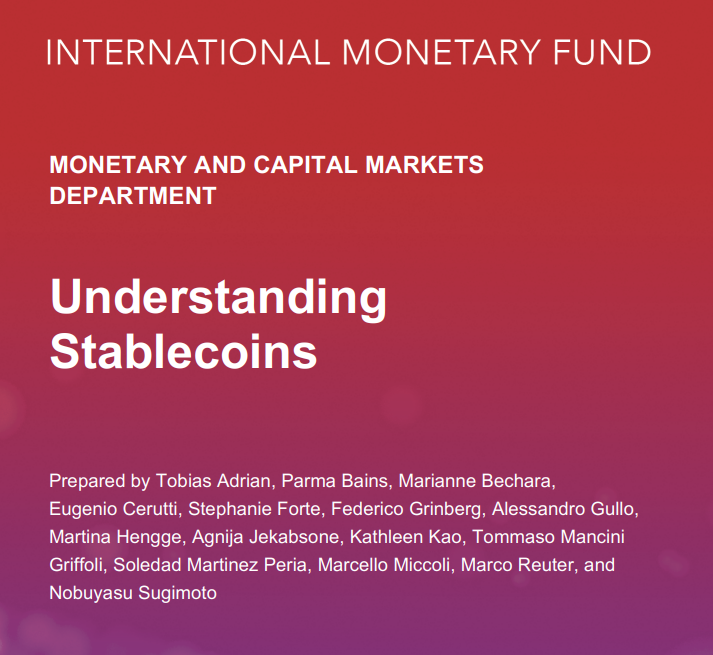
Understanding Stablecoins - IMF (December 2025) Stablecoins have evolved into Shadow Banking 2.0 They are effectively "M+" assets, tokenized government Money Market Funds (MMFs), that extend the US dollar’s hierarchy offshore However, they operate as rigid pass-through vehicles, devoid of the shock-absorbing capacity or official liquidity backstops inherent to systemic intermediaries They function as liquidity sinks for T-Bills, compressing yields and extracting seigniorage rents without generating credit, while global regulatory fragmentation invites massive jurisdictional arbitrage 1. Structure and Plumbing The stablecoin business model relies on a specific incentive arbitrage that separates them from traditional MMFs The "Float" Capture: Unlike traditional MMFs, stablecoin issuers generally do not directly remunerate holders This creates a distinct economic model where issuers capture the full carry (yield) of the reserve assets, primarily T-Bills and Repos, while offloading counterparty and liquidity risk to the user Settlement Friction (technical vs legal): While blockchain settlement appears instantaneous, the IMF highlights a critical disconnect Finality on a blockchain is probabilistic (based on consensus mechanisms) rather than absolute. This decouples technical transfer from legal finality, introducing existential litigation risk during insolvency. Hierarchy Placement: Stablecoins sit as "M+" assets. They are backed 1:1 by liquid assets, positioning them above unbacked crypto but structurally below commercial bank money (M1) due to the absence of public backstops like deposit insurance 2. Market Dynamics: The Evidence of Flow The data reveals stablecoins are less about retail payments and more about systemic financial plumbing The market is a technological extension of the US dollar, with 97% of issuance pegged to the USD Algorithmic Arbitrage vs Real Utility: Approximately 80% of stablecoin transactions are conducted by bots and automated systems for arbitrage. However, the "plumbing" is leaking into the real economy: cross-border stablecoin flows ($1.5T in 2024) have now surpassed unbacked crypto flows Yield Curve Impact: Stablecoins are becoming systemic holders of short-term debt. The IMF notes that a $3.5 billion increase in issuance compresses short-term T-Bill yields by approximately 2 basis points At projected growth rates (up to $3.7T by 2030), this sector could significantly distort short-end demand Capital Flight 2.0: In Emerging Markets and Developing Economies (EMDEs), specifically Latin America and Africa, stablecoins are utilized to circumvent Capital Flow Management measures (CFMs) They act as a friction-free vehicle for capital flight, bypassing traditional banking rails via unhosted wallets 3. The Regulatory Arbitrage Map Global implementation shows a structural divergence that encourages issuers to jurisdiction shop EU (MiCA) Issuers: Credit and E-Money Institutions (requires establishing an EU entity) Reserves: 30% to 60% must be held in liquid deposits. Interest: Strictly prohibited USA (Genius Act Proposal) Issuers: Banks (via a subsidiary) and Non-Banks are permitted Reserves: T-Bills, Repos, and Cash Interest: Implicitly Not Applicable (based on the payment model) Japan Issuers: Restrictive; limited to Banks, Trust Companies, and Fund Transfer Service Providers (FTSPs) only Reserves: Government Bonds and Bank Deposits Interest: Not Applicable (N/A) UK (Proposed) Issuers: Dual Regime split between the Bank of England (for Systemic stablecoins) and the FCA Reserves: Systemic issuers must hold more than 40% in Central Bank deposits Interest: Potential holding limits may apply The UK proposes the safest but most capital-intensive model, effectively converting systemic stablecoins into "Synthetic CBDCs" backed by central bank reserves. Japan has opted for total "bancarization", while the US and EU frameworks legitimize a regulated shadow banking model 4. Tail Risks and Blind Spots The Liquidity Trap: Without formal access to liquidity backstops, a systemic run creates a fire-sale dynamic for T-Bills There is currently no international consensus on whether Central Banks should extend liquidity facilities to these entities to protect the sovereign debt market Regulators are effectively flying blind regarding the residency of holders. Due to pseudonymous architectures and unhosted wallets, Balance of Payments statistics are currently based on "estimations" and assumptions rather than hard data Conclusion: Current global regulation is designed to contain contagion risk by forcing issuers into ultra-liquid assets (T-Bills) However, by doing so, regulators are inadvertently cementing a parasitic economic model: The private sector captures the "float" on digital dollars while relying on the depth of public sovereign debt markets for stability The ultimate regulatory endgame will likely hinge on whether states allow this rent extraction to continue or force a migration toward the UK model, where backing returns to the Central Bank balance sheet
neira tweet media
English
16
27
196
50.2K
L3 nag-retweet
Brian Armstrong
Brian Armstrong@brian_armstrong·
One of my favorite lessons I’ve learnt from working with smart people: Action produces information. If you’re unsure of what to do, just do anything, even if it’s the wrong thing. This will give you information about what you should actually be doing. Sounds simple on the surface - the hard part is making it part of your every day working process.
English
1.3K
6.2K
46.9K
4.8M
L3 nag-retweet
Suhail Kakar
Suhail Kakar@SuhailKakar·
prediction markets: explain like i'm five
Suhail Kakar tweet media
English
34
32
299
20K