
Naka-pin na Tweet
Caleb ☧
11K posts


Caleb ☧
@meCal3b
Follower of Iēsous, child of the unknown Good Father. Citizen of the Father’s Kingdom. Unashamed heretic. Husband to @Myst1cMead0ws
[email protected] (PGP Key in Link) Sumali Temmuz 2023
1.6K Sinusundan1.2K Mga Tagasunod

People who assume all insults and invective are "not Christ-like" immediately show their unfamiliarity with the Church Fathers who frequently used insults against their opponents in their *heated debates.*
x.com/i/grok/share/d…
English
I study the earliest sources in early Christianity and what the text itself actually says — including distinctions that later theology tried to smooth over. That’s not the same as making Marcion my “god.”
I respect that the Bible had a powerful impact on your life. Personal experience like that is real for many people. But personal experience doesn’t automatically make every later interpretation or harmonisation correct.
I’m not trying to convince you to abandon your faith. I’m pointing out what the earliest Gospel and the Hebrew text actually show when read on their own terms. If you’re no longer open to examining that, that’s your choice. We can leave it here.
Note: my own journey.👇🏻
x.com/meCal3b/status…
English

@meCal3b You have much knowledge, but it appears your god's name is Marcion.
All I know is I would be dead or worse if not for the words I read in that Book 20 years ago, but didn't truly hear them until 5 years ago. Now no man can convince me otherwise, and you shouldn't want to.
English
One of the biggest differences between the God of the Hebrew Scriptures and the Father Jesus reveals is this:
In the Old Testament, YHWH makes almost no promises about an afterlife. There’s no clear teaching of heaven or hell for the average person. The blessings and curses are almost entirely earthly — land, wealth, long life, or destruction in this world.
Jesus, on the other hand, barely talks about earthly wealth or political power. Instead, He constantly speaks about His Father’s Kingdom and eternal life. The focus of His message is life beyond death — relationship with the Father that continues after this life ends.
It’s a striking shift in emphasis. One is heavily focused on this world. The other is focused on the world to come.
English
Jesus never wrote anything down, and He never instructed His followers to read or follow “the text.” Instead, He promised to send the Holy Spirit, who would “teach you all things and remind you of everything I have said to you” (John 14:26). For the first several decades, the Christian faith was transmitted almost entirely through oral teaching, preaching, and community memory.
When written Christian scriptures first began to be collected into a defined body, the earliest clear evidence we have of such a collection comes from Marcion in the mid-second century: his single Gospel (the Evangelion) together with a collection of Paul’s letters (the Apostolikon). The four-Gospel canon that later became standard only emerged afterward — and was actively shaped in response to Marcion’s earlier collection.
More fundamentally, Jesus Himself is the Word — the living Logos, the full and final revelation of the Father. He is not a later collection of books and letters assembled by human hands over centuries. The canon is a human product, developed through debate, selection, and theological conflict.
So when someone claims they accept “all the Word of God” while accusing others of accepting only “a portion,” they are equating a later, humanly constructed canon with Jesus Himself. Yikes.
English
@meCal3b Yes, essentially the same thing: "Keep My commandments." There are differences like your post about "an eye for an eye."
But I believe the biggest difference is that I love, believe in, and rely on all the Word of God, "dividing the word of truth", and you just a portion.
English
Based on everything you’ve said so far, you’re arguing the standard mainstream position — that Jesus and the God of the Hebrew Scriptures are saying essentially the same thing, and any apparent differences are just people failing to “see spiritually.” That’s the classic harmonised view held by the majority.
I’m not interested in voice spaces right now. I’m keeping things anonymous, and voice is one of the easiest ways for someone to be identified. Text is perfectly suitable for this discussion anyway.
English
@meCal3b I am far from mainstream, but, would you like to discuss this in a space some time?
English
The irony here is thick, Christopher.
You’re accusing me of being on the “broad way” and unable to see, while defending the standard, mainstream interpretation that tries to harmonise the entire Bible into one seamless message. That’s the view held by the vast majority of Christians for centuries.
Meanwhile, I’m pointing to distinctions that are visible in the earliest Gospel (the Evangelion), the different Greek words Jesus uses for “life,” and the clear lack of afterlife teaching across most of the Hebrew Scriptures — things that don’t fit the usual harmonised reading.
It’s usually the harmonised, “everything is the same” view that has the broader appeal. The more precise, textually grounded reading is the narrower one.
English
@meCal3b It's not there to you, and many like you. The broad way...
Matthew 13
... Therefore speak I to them in parables: because they seeing see not; and hearing they hear not, neither do they understand...
English
That’s reading something into the text that isn’t there.
The Gospel doesn’t say the rich young ruler was lying or secretly breaking the commandments. Jesus doesn’t correct or rebuke him for that. He accepts the man’s claim and then gives him a new and harder demand: “Sell everything you have and give to the poor… and come, follow me.”
The point of the story is the cost of discipleship, not that the man was already disqualified by breaking the Law. That’s why Jesus immediately says how difficult it is for a rich person to enter the Kingdom — because following Him requires letting go of what the man valued most.
Colossians 3:5 is Paul making a later theological point. It doesn’t change what the Gospel itself records Jesus saying and doing in that encounter.
Even if we accept your reading, it still doesn’t erase the bigger contrast: the Hebrew Scriptures tie blessing and life primarily to obedience in this world, while Jesus repeatedly calls people to radical surrender for the sake of the Kingdom and eternal life with the Father.
English
@meCal3b You're just too blind to see he wasn't keeping them. He was breaking the 10 which also breaks the 1st, according to Paul (Col 3:5). That's why He went on to speak about how difficult it is for a rich man to enter the kingdom. The man loved his money and possessions more than God.
English
That passage actually works against your point when read carefully.
In Matthew 19 (and the parallel in Luke 18), Jesus tells the rich young ruler that keeping the commandments is the answer if he’s asking about entering life in the normal sense. But when the man claims he’s kept them, Jesus raises the bar: sell everything, give to the poor, and follow Him. The story shows that commandment-keeping alone wasn’t enough for the deeper call Jesus was making.
More importantly, the earliest Gospel (the Evangelion) preserves a clear distinction that later canonical versions blur:
- When someone asks about ζωή (this-life abundance/prosperity), Jesus answers with the commandments: “Love God and neighbour… do this and you will live” (cf. Luke 10:25–28). This matches exactly what YHWH promised under the Law for obedience in this world.
- When someone asks about ζωὴν αἰώνιον (eternal life), Jesus gives a different answer: sell everything and you’ll have treasure in heaven (cf. Luke 18:18–30).
The Evangelion keeps these two different Greek words and two different answers coherent. Canonical Luke merges them and creates the appearance of contradiction.
Ecclesiastes 12:13–14 is still focused on this life and present obedience. It doesn’t teach about eternal life or the Kingdom Jesus constantly proclaimed.
YHWH’s covenant centred on earthly blessing and curse through the Law. Jesus repeatedly pointed people toward the Kingdom of His Father and life beyond this world.
English
@meCal3b Yes. Their message is clear throughout:
Matthew 19:17
And he said unto him, Why callest thou me good? there is none good but one, that is, God: but if thou wilt enter into life, keep the commandments.
You're talking like a man of the world.
Ecclesiastes 12:13-14
English
That’s moving the goalposts.
The original point was straightforward: the Hebrew Scriptures overwhelmingly promise earthly blessings and curses (land, wealth, long life, or destruction in this world), with almost no clear teaching about heaven, hell, or eternal life for the average person. Jesus, by contrast, makes the Kingdom of His Father and life beyond death central to His message.
You’re now saying it’s “about faith” and quoting verses where Jesus contrasts Himself with what came before. That actually supports the distinction, not the idea that He was just giving a “deeper spiritual meaning” to the old promises.
John 1:17 itself highlights the contrast: “For the law was given through Moses; grace and truth came through Jesus Christ.” Jesus repeatedly says “You have heard… but I say to you” because He was bringing something new, not just clarifying the old system.
If someone wants to claim that “long life in the land” secretly meant eternal life all along, the burden is on them to show where the Hebrew Scriptures clearly teach that. Faith doesn’t erase the plain reading of the text.
The shift in emphasis between the covenant of YHWH and the message of Jesus remains clear.
English
@meCal3b I know the Father I worship (John 4:22; Acts 24:14).
And according to John 6:44-45, you're worshipping something false, because if you haven't heard and learned from the Father, you don't know His Son.
English


That’s not accurate.
YHWH said that in the day they ate from the Tree of the Knowledge of Good and Evil, they would surely die. But they didn’t die that day from eating the fruit. Instead, after they ate, YHWH removed them from the garden specifically “lest he reach out his hand and take also from the tree of life and eat, and live forever” (Genesis 3:22).
It wasn’t the tree that killed them. It was YHWH removing access to the Tree of Life that ensured they would eventually die. He deliberately took away the source of eternal life.
What’s striking is the contrast: YHWH is the one who removes access to eternal life, while Jesus is the one who restores it and offers eternal life with the Father. One takes it away. The other gives it back.
English

@meCal3b The same tree is in Revelation. God told them they could eat of _everything_ _except_ the tree that killed them. Eternal life was the standard, and you're saying there's a difference that doesn't exist to justify a false teaching.
English
Those are some of the clearest verses, and they’re worth noting — but they’re also among the latest in the Hebrew Bible.
Daniel 12:2 and Isaiah 26:19 do speak of resurrection and awakening from the dust. However, these come from relatively late texts (Daniel especially is one of the latest books in the Old Testament). They represent a development that appears toward the end of the Hebrew Scriptures, not the dominant view across most of it.
Job 19:25–27 is much more ambiguous. Many scholars see it as Job hoping for vindication in this life, not a clear statement about life after death.
The broader picture in the Hebrew Bible is that resurrection and a meaningful afterlife with reward or punishment are not clearly or consistently taught until these later writings. Most of the Old Testament focuses on blessings and curses in this life, with Sheol as the common fate of the dead.
Jesus, by contrast, makes eternal life and the Kingdom of His Father central themes throughout His teaching. That’s a noticeable shift in emphasis.
English

That’s not quite what the text says.
In Genesis 2–3, Adam and Eve are not told they already have eternal life. They’re told that if they eat from the Tree of the Knowledge of Good and Evil, they will die. More importantly, after they sin, God specifically drives them out of the garden “lest he reach out his hand and take also from the tree of life and eat, and live forever” (Genesis 3:22).
This shows that eternal life was not the automatic “standard.” It required access to the Tree of Life. Once they were removed from the garden, that access was deliberately taken away.
The Hebrew Scriptures as a whole don’t present eternal life as something humans originally possessed and then lost. Death and Sheol are presented as the common fate. The consistent offer of eternal life and the Kingdom comes through Jesus and the Father He reveals.
English
@meCal3b What do you mean? In the very beginning Adam and Eve were told you may not eat of the tree of knowledge of good and evil or else you will die. Eternal life was the standard since the beginning.
English
“Elohim” can refer to human judges or rulers in some legal contexts, yes. But that doesn’t change the fact that in many other passages — especially in the divine council texts — elohim clearly refers to divine/spiritual beings.
Psalm 82, Deuteronomy 32:8-9 (in the Dead Sea Scrolls version), and Genesis 6 all use “elohim” or “sons of God” for non-human beings who are part of a heavenly council. YHWH is presented as one of them, given Israel as his portion by Elyon.
As for the First Commandment — “You shall have no other gods before me” — it actually presupposes the existence of other gods. It doesn’t say “there are no other gods.” It tells Israel not to worship any of them ahead of YHWH. That fits the picture of multiple elohim existing, with YHWH demanding exclusive loyalty from his people.
The Hebrew Scriptures are more layered than a simple “one God only” reading allows.
English

@meCal3b Which god of the Hebrew scriptures are you talking about? Kings and judges were called elohim [ powerful ones ] in the OT. What does the First Commandment say?
English
That’s an interesting claim, but it assumes Paul is needed to “clarify” Jesus. In the first NT, that’s not how it reads.
In Marcion’s Evangelion, Jesus already presents a clear break: He reveals a previously unknown Good Father and repeatedly steps outside the boundaries of the Law (touching the unclean, healing on the Sabbath, eating with outcasts). He doesn’t frame His message as restoring or fulfilling the old system.
In the letters preserved in Marcion’s Apostolicon, Paul doesn’t pull Jesus back toward the Hebrew Scriptures either. He argues that justification comes by faith apart from works of the Law, and that the old covenant order belongs to a different god. The strong Law-continuity material found in canonical Romans 9–11 is largely absent in the earliest reconstructible version.
So the question isn’t whether Paul clarifies Jesus. It’s whether the later, expanded canon re-anchored both Jesus and Paul back into the framework of the god of Israel — something the first NT does not do.
English

@meCal3b The Apostle Paul clarifies the entire message. Without Paul the message would be lost.
English
That argument doesn’t hold up.
Yes, Jesus quoted from the Old Testament, but He also repeatedly said, “You have heard that it was said… but I say to you.” He wasn’t just giving a deeper spiritual meaning to the old commands — He was often contrasting His teaching with them.
As for “long life” secretly meaning eternal life — that’s reading something into the text that isn’t there. The promises in the Hebrew Scriptures are overwhelmingly about this life: land, descendants, prosperity, and long life in the land. There’s no clear teaching about eternal life or resurrection for the average person until much later books like Daniel.
Colossians 1 speaks about the mystery of Christ being revealed — it doesn’t prove that the Old Testament was secretly teaching eternal life all along. If it was, it’s strange how rarely (and unclearly) it’s mentioned across most of the Hebrew Bible.
The reality is that Jesus shifted the focus. YHWH’s covenant was heavily centred on earthly blessing and cursing. Jesus’ message centred on the Kingdom of His Father and life beyond this world. That’s not the same emphasis.
English
@meCal3b Yet He mentioned the same commandments and quoted the same prophets.
I believe the problem is people cannot see spiritually, similar to what He mentions in John 14:17
long life = eternal life ???
But that was part of the mystery hidden from them, now revealed to us, Col 1.
English
Technically you’re right that there’s no “W” in the Hebrew alphabet — the name is written י ה ו ה (Yod Hei Vav Hei). However, the letter ו (Vav) is commonly transliterated as a “W” sound in modern scholarship, which is why “Yahweh” became the standard academic spelling.
So while the Hebrew doesn’t have a literal “W”, the pronunciation Yahweh is still widely accepted and used by scholars. Being rude about it doesn’t make your point stronger — it just makes you look like an asshole who’s more interested in scoring points than having an actual discussion.
English

Irenaeus (c. 180 CE) was the first to claim there must be exactly four Gospels — and he “proved” it by linking them to the four living creatures in Ezekiel and Revelation (lion, ox, man, eagle).
The connections were absurdly forced. He argued this imagery meant there could be no more and no less than four Gospels. It was a weak, ad hoc argument made to counter Marcion (who used only one Gospel) and other early Christian groups.
This wasn’t ancient consensus — it was later propaganda that helped cement the four-Gospel canon as “obvious” and divinely ordained.
English
These verses do not teach the Trinity. The Trinity — one God in three distinct persons — is a later theological construct developed in the 3rd and 4th centuries to protect monotheism while accounting for the high status given to Jesus and the Spirit.
The Hebrew Bible itself undermines strict monotheism in several places. It speaks of multiple elohim — a category of powerful non-human beings — with YHWH as only one member among them. This is clearest in Deuteronomy 32:8-9 (Dead Sea Scrolls version) and Psalm 82, where Elyon assigns nations to different elohim, and YHWH receives Israel as his portion.
Early Christianity also recognised a distinction. Marcion and others saw the God of the Hebrew Scriptures (YHWH) as different from the Father revealed by Jesus. As Mauro Biglino points out, the idea of a single, omnipresent God is also not found in the original texts. YHWH is consistently portrayed as a localised being who moves, descends, and appears in specific places — not as an immaterial presence everywhere at once.
The Trinity was one of several later attempts to flatten these tensions and divine terms in the Bible in order to preserve monotheistic theology. It is not a concept clearly taught in the text itself.
English

There is only one God (Deut 6:4)
The Father is God (1 Jn 3:1)
The Son is God (Heb 1:8)
The Holy Spirit is God (Acts 5:3-4)
The Father is not the Son (1 Jn 4:14)
The Son is not the Holy Spirit (Jn 16:7)
The Holy Spirit is not the Father (Jn 14:16)

English
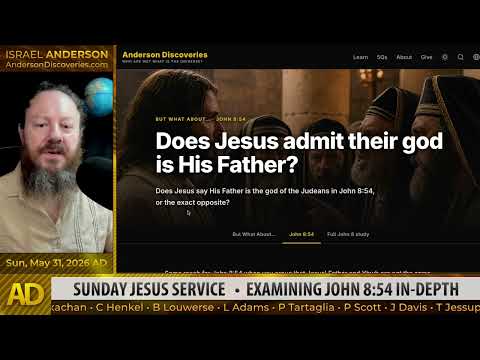
In John 8:55, Iēsous tells his opponents: “You have not known [ἐγνώκατε/ginōskō — come to know experientially] him. But I know [οἶδα/oida — full, certain awareness] him.”
This is the climax of a debate over paternity (Jn 8:38–44). They claim God as Father. Iēsous replies: You’ve never known my Father — your god (whom I called “the devil, a liar from the beginning”) isn’t mine.
The Greek verbs drive home the incompatibility.
Check out @IsraelAnderson latest video on this, fantastic breakdown.
English