Science + AI

181 posts

Science + AI banner
Science + AI

Science + AI

@SciencePlusAI

Tweets about the Science + AI

شامل ہوئے Haziran 2024
144 فالونگ56 فالوورز
Science + AI ری ٹویٹ کیا
Reviewer3
Reviewer3@reviewer3com·
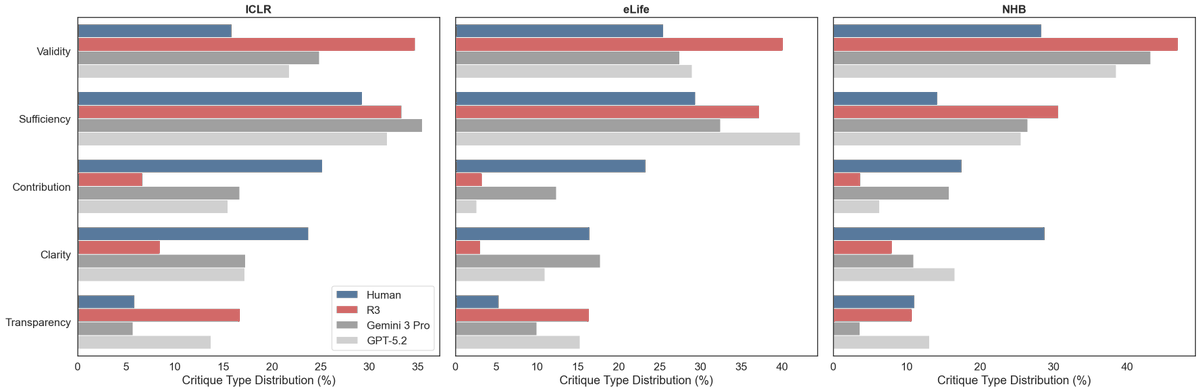
No, AI should not be used to make decisions about manuscripts or "score" novelty or significance. That's not what it's good at, anyways. Data from our benchmark of over 145,000+ comments shows AI focuses primarily on technical verification - like the validity, sufficiency, and transparency of the work. Evaluating contribution is uniquely human.
Reviewer3 tweet media
English
3
13
31
3.5K
Science + AI ری ٹویٹ کیا
Jeremy Nguyen ✍🏼 🚢
Jeremy Nguyen ✍🏼 🚢@JeremyNguyenPhD·
Claude Code for Academics "A gentle introduction in how to use Claude Code for Academics." presentation slides and github repo from Alessandro Spina link in reply
Jeremy Nguyen ✍🏼 🚢 tweet media
English
20
259
1.7K
162K
Science + AI ری ٹویٹ کیا
Divy Thakkar
Divy Thakkar@divy93t·
Anthropic drops “largest qualitative study ever ” and it’s very well produced with moving quotes. Does that mean we truly understand what users want of their AI? Is this a large-scale survey where participants answered four structured questions – yes! Is it robust qual research? I have concerns about the method, and why the generality of claims is a stretch. 🧵
Anthropic@AnthropicAI

We invited Claude users to share how they use AI, what they dream it could make possible, and what they fear it might do. Nearly 81,000 people responded in one week—the largest qualitative study of its kind. Read more: anthropic.com/features/81k-i…

English
5
20
193
48.6K
Science + AI ری ٹویٹ کیا
Shahan
Shahan@shahanmemon·
This is conceptually so weird because imho qualitative research is not evaluated by scale but by depth, context, and human interpretation. Stop assuming that “hand-wavey-ness” is a qual problem just because qual work doesn’t look like large-N quantitative analysis.
Jake Eaton@jkeatn

This is second time we've used Anthropic Interviewer and the first time we've deployed it at scale. Quite accidentally, we ended up conducting (what we believe is) the largest qualitative study ever I'm a mixed-methods social scientist by training. Traditionally, when it came to understanding what people think, that meant quantitative analysis of lower resolution data (polls, surveys, etc.) or hand-wavey analysis of in-depth qualitative data. Using Claude to conduct *and* analyze interviews bridges that tradeoff between breadth and depth AI also makes access much, much easier. Had we run this study in person, in the real world, it would have taken hundreds (if not several thousand) enumerators many 1000s of hours to conduct. It also affords us access to places we could otherwise never go. I once led a five-person team in Tanzania that reached a few hundred people. It took 3 weeks. In this study we heard from people 80,000 people in 159 countries, in cities and rural areas, in daily life and in war zones, and more, in just one I'm still, even after months, beginning to wrap my head around the scale of this work. Like, to a social scientist, it's quite unbelievable. This could produce dozens of dissertations! It is also, of course, imperfect—certainly speaking to an AI is different than speaking to a person—and as a team we're all still figuring out how to make this research as useful as possible: what questions to ask and how, what to analyze and why, and how that all feeds back into what we do as a company. This is, as we say in the blog, a brand new form of social science Hat tip to @saffronhuang for leading this for the past few months. Here's one of my favorite quotes

English
1
2
5
1.3K
Science + AI ری ٹویٹ کیا
Ai2
Ai2@allen_ai·
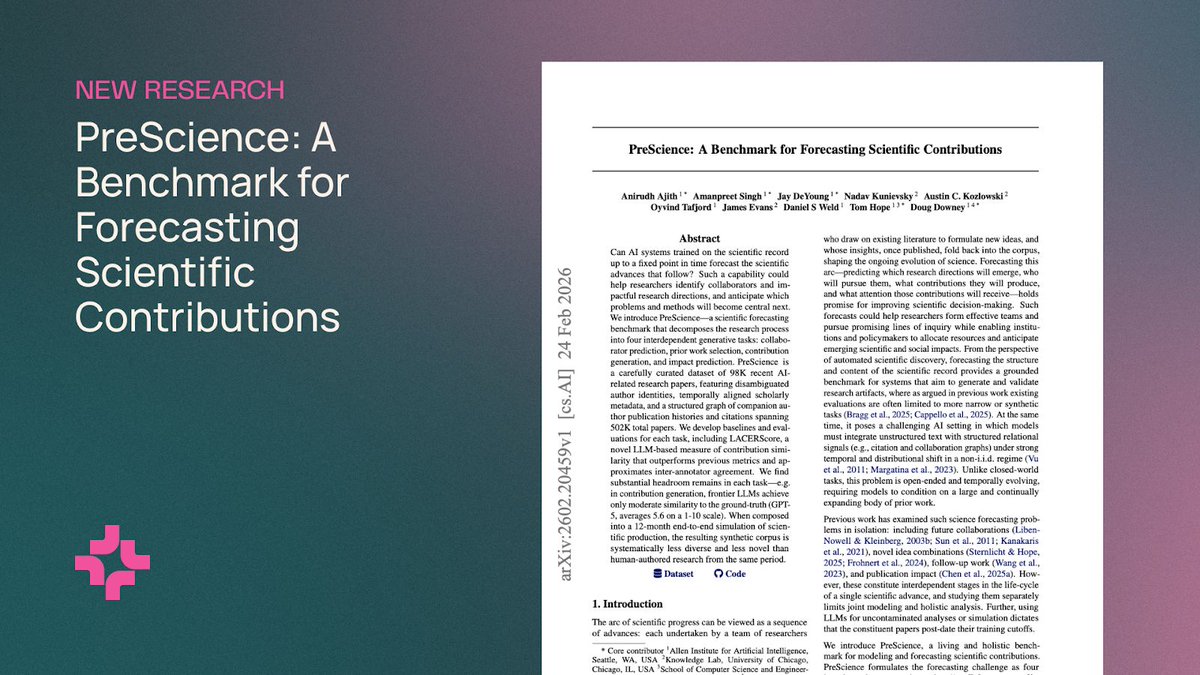
Can AI predict what scientists will do next—not just one piece, but the whole research process? PreScience is our new model eval for forecasting how science unfolds end-to-end, from how research teams form to a paper's eventual impact. Built with @UChicago, supported by @NSF.
Ai2 tweet media
English
4
15
103
15.1K
Science + AI ری ٹویٹ کیا
Er-Te Zheng
Er-Te Zheng@ErteZheng·
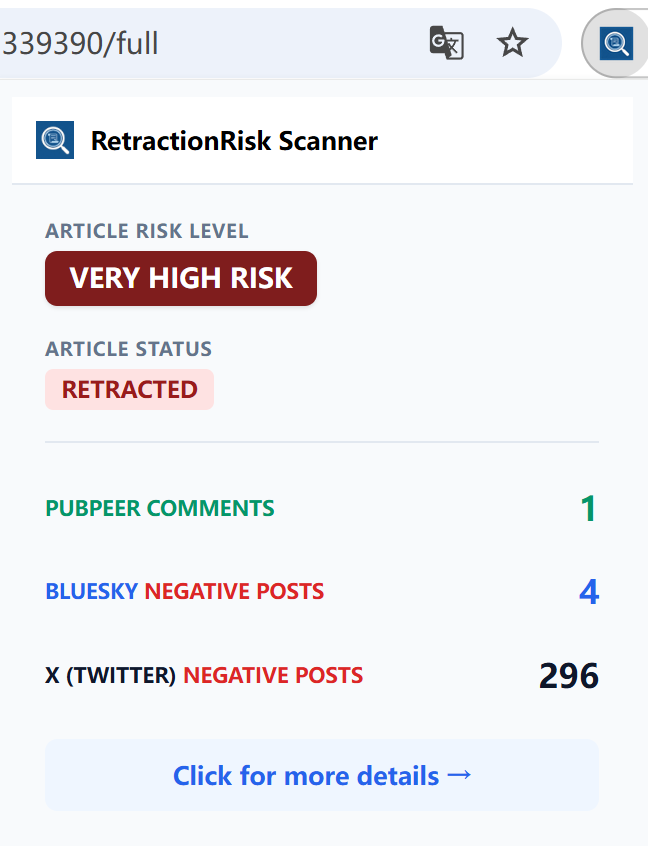
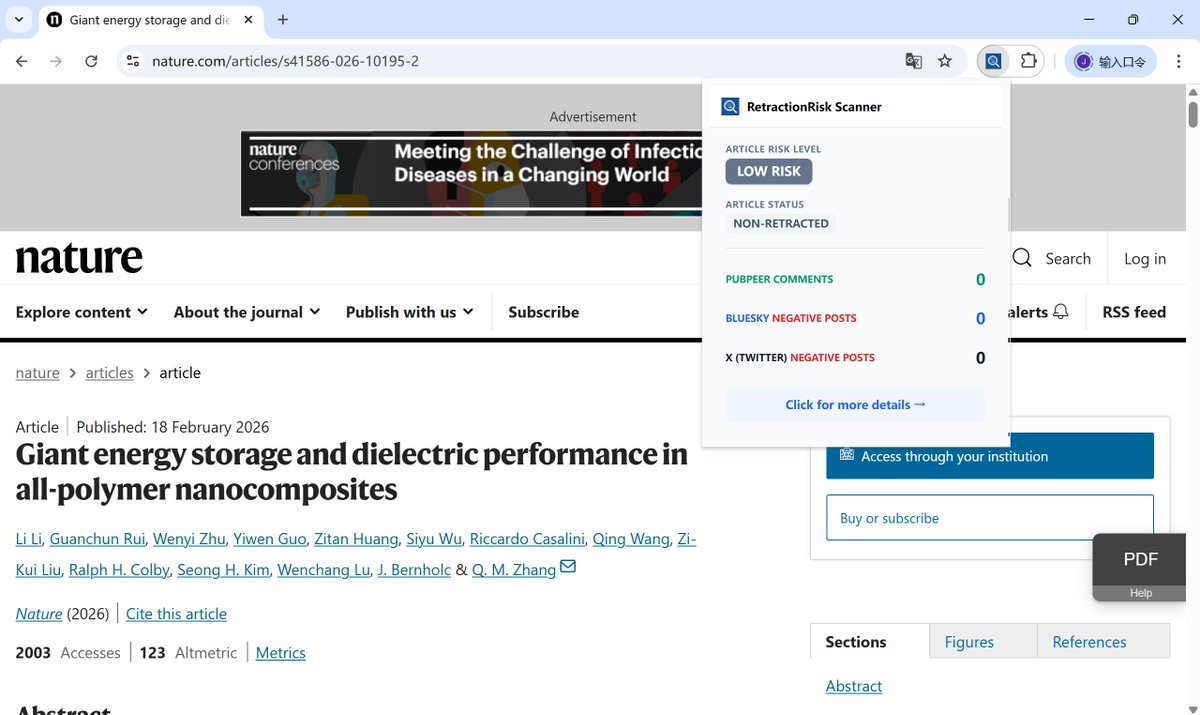
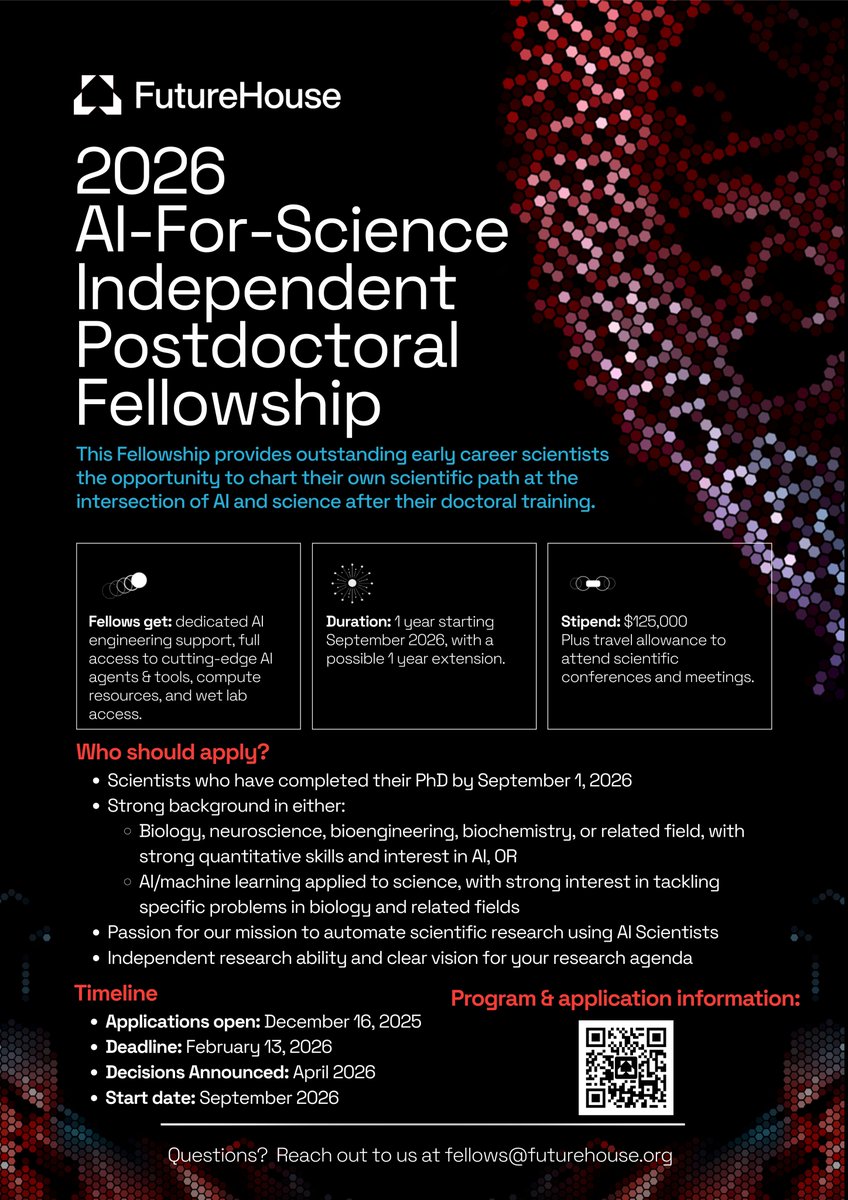
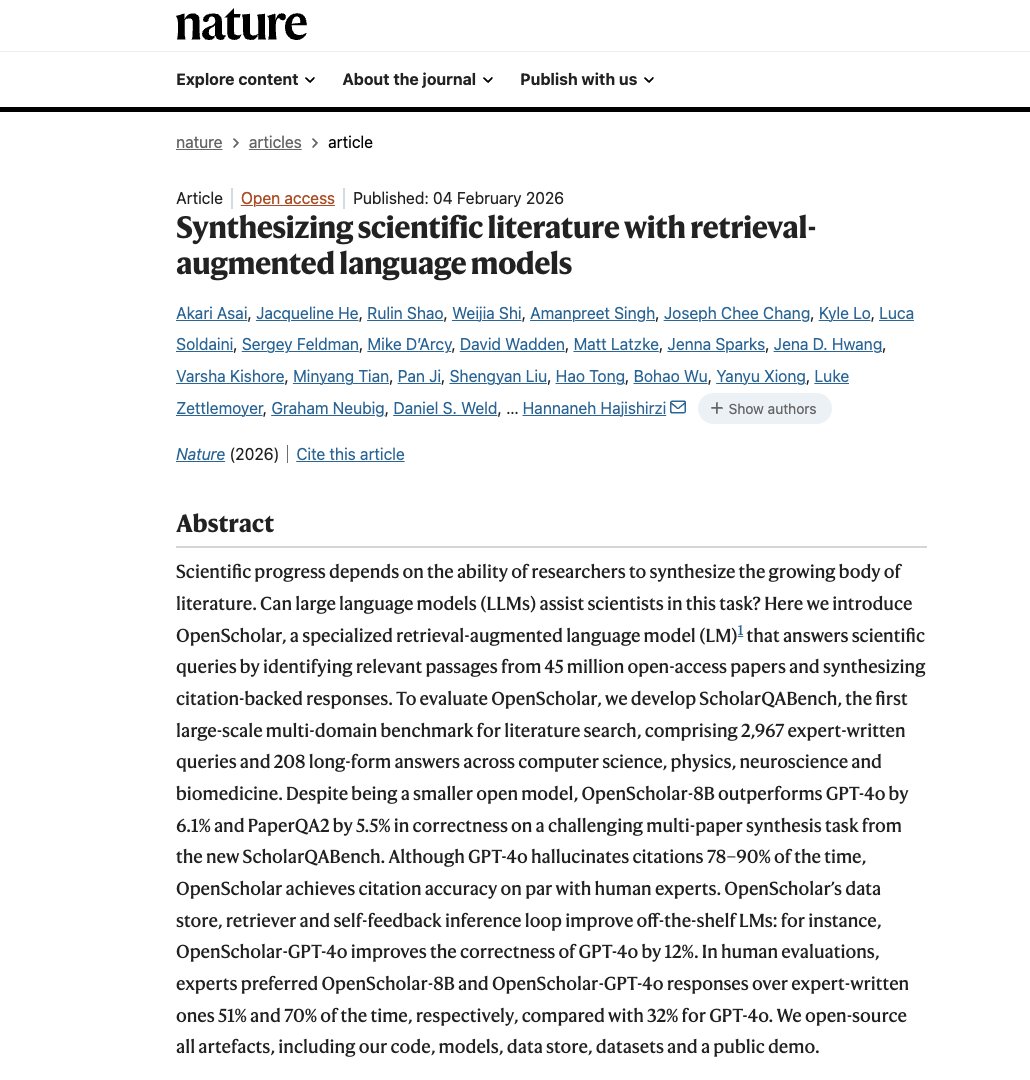
I just launched the RetractionRisk Scanner browser extension! 🚀 With just one click, instantly check if a paper has flagged issues or retraction risks while reading. Available now on Chrome & Firefox. Try it out! 👇retractionrisk.com/plugin.html
Er-Te Zheng tweet mediaEr-Te Zheng tweet mediaEr-Te Zheng tweet mediaEr-Te Zheng tweet media
English
1
2
4
135
Science + AI ری ٹویٹ کیا
Sam Rodriques
Sam Rodriques@SGRodriques·
The next round of FutureHouse Postdoctoral Fellowships is due next week! Apply our AI tools to specific problems in biology and biochemistry, in collaboration with world-leading academic labs: --$125,000 annual stipend. --Access to all tools developed by FutureHouse and Edison Scientific at scale, including Kosmos and several as-of-yet unreleased agents, with under-the-hood access to them to specialize them for your workflows. --Receive dedicated software engineering support. --1 year with possible 1 year extension. Even more exceptional co-advisors than last year. Deadline for applications is February 13th, 2026. Link in next post.
Sam Rodriques tweet media
English
5
61
237
21.2K
Science + AI ری ٹویٹ کیا
Akari Asai
Akari Asai@AkariAsai·
Thrilled to share: OpenScholar - our work on scientific deep research agents for reliable literature synthesis -has been accepted to Nature! 🎉 Huge thanks to collaborators across institutions who made this possible!
Akari Asai tweet media
English
33
228
1.3K
126.3K
Science + AI ری ٹویٹ کیا
VraserX e/acc
VraserX e/acc@VraserX·
Demis Hassabis, CEO of Google DeepMind, drops a quiet bombshell: The big question isn’t whether AI can solve problems. It’s whether AI can invent new science. Right now, it can’t. Not because of compute. Not because of data. But because it lacks something fundamental: A world model. Today’s LLMs can generate brilliant text, images, even code. But they don’t truly understand causality. They don’t know why A leads to B. They just predict patterns. Hassabis argues that real scientific discovery requires more: – Long-term planning – Stronger reasoning – And an internal model of how the world works Physics. Biology. Cause and effect. Only then can an AI run its own thought experiments. Only then do we get a true digital scientist.
English
133
264
1.7K
167.1K
Science + AI ری ٹویٹ کیا
Anthropic
Anthropic@AnthropicAI·
Since launching our AI for Science program, we’ve been working with scientists to understand how AI is accelerating progress. We spoke with 3 labs where Claude is reshaping research—and starting to point towards novel scientific insights and discoveries. anthropic.com/news/accelerat…
English
58
132
1.2K
190.3K
Science + AI ری ٹویٹ کیا
James Evans
James Evans@profjamesevans·
Thrilled to share our Nature paper, out today, on how AI use has shaped scientific careers and science as a whole (in collaboration with the amazing Qianyue Hao, @xu_fengli, and Li Yong from Tsinghua University and Zhongguancun Academy.) We analyzed tens of millions of research papers spanning four decades of natural science to understand how AI is reshaping science. The findings reveal a paradox. For individual scientists, AI is a career accelerator. Researchers who adopt AI publish 3 times more papers with fewer authors, receive 5 times more citations, and become research leaders more than a year earlier than peers who don't. AI papers appear ~20% more frequently in top-quartile journals. Annual citations run 100% higher than non-AI papers across three decades of follow-up. For science as a whole, AI is a narrowing force. AI-augmented research covers ~5% less topical ground and generates a quarter less engagement among follow-on researchers. The contraction appears in the vast majority of the 200+ subfields we examined. Citation patterns show a starker concentration: in AI research, just 22% of papers capture 80% of all citations. The mechanism is straightforward: AI use has shifted to where data is abundant, at an accelerating pace as models have grown larger. AI gravitates toward well-lit problems and away from foundational and emergent questions where data is necessarily sparse. The result is collective hill-climbing—everyone scaling the same popular peaks rather than searching for higher mountains. This creates "lonely crowds" in the scientific literature: clusters of researchers converging on identical problems without building on each other's work. The pattern holds across biology, chemistry, physics, medicine, materials science, and geology. It persists and increases through each wave of AI—from conventional machine learning through deep learning to today's generative models and LLMs. This isn't inevitable. Models that are powerful at prediction can be inverted to identify what is surprising (to those predictions), and enable us to consider and theorize entailments to surprising new data and findings. But without deliberate intervention, local incentives have and will likely continue to push scientists to optimize and compress what's already known rather than discover what isn't. The history of major discoveries is linked to new ways of seeing nature. If we want AI to accelerate breakthroughs rather than automate the familiar, we need AI systems tuned to surprise that expand sensory and experimental capacity—not just cognition. Paper: rdcu.be/eY5f7 Science commentary: science.org/content/articl… Nature commentary: nature.com/articles/d4158… Nature podcast: nature.com/articles/d4158…
James Evans tweet media
English
10
69
233
252.9K
Science + AI ری ٹویٹ کیا
Sam Rodriques
Sam Rodriques@SGRodriques·
Fantastic work by Chenghao Liu @ChengHaoLiu1, one of our FutureHouse Postdoctoral Fellows, and his team on a new model to predict molecular crystal structures. A huge open problem in chemistry, and a major step forward here. Congratulations!!!
Joey Bose @ #ICLR2026@bose_joey

🔮Introducing OXtal – a new all-atom diffusion model for molecular crystal structure prediction! We tackle a grand challenge in computational chemistry: predicting the structure of crystalline solids directly from their chemical composition. Paper: arxiv.org/abs/2512.06987 Blog Post: oxtal.github.io Welcome to a new chapter in molecular materials design 🚀 Work led by Emily Jin, @andrei_nica, @ChengHaoLiu1, 🧵1/8

English
3
7
52
8.3K
Science + AI ری ٹویٹ کیا
Dr Kareem Carr
Dr Kareem Carr@kareem_carr·
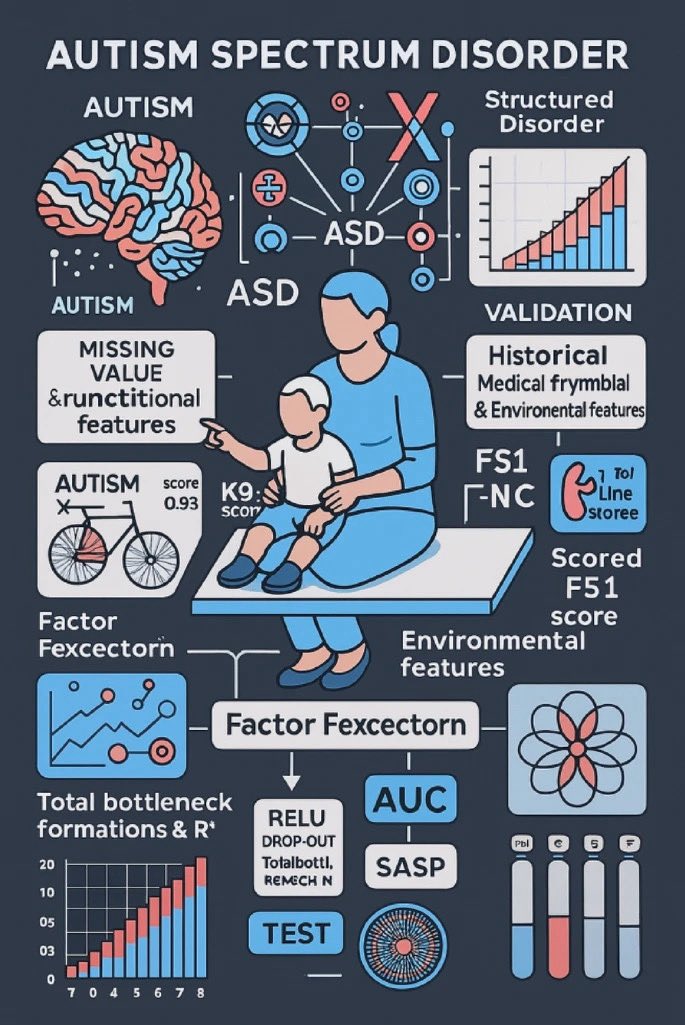
This is a real figure taken from a research article in a Nature journal. This is insane.
Dr Kareem Carr tweet media
English
214
283
3.6K
328.3K
Science + AI ری ٹویٹ کیا
Er-Te Zheng
Er-Te Zheng@ErteZheng·
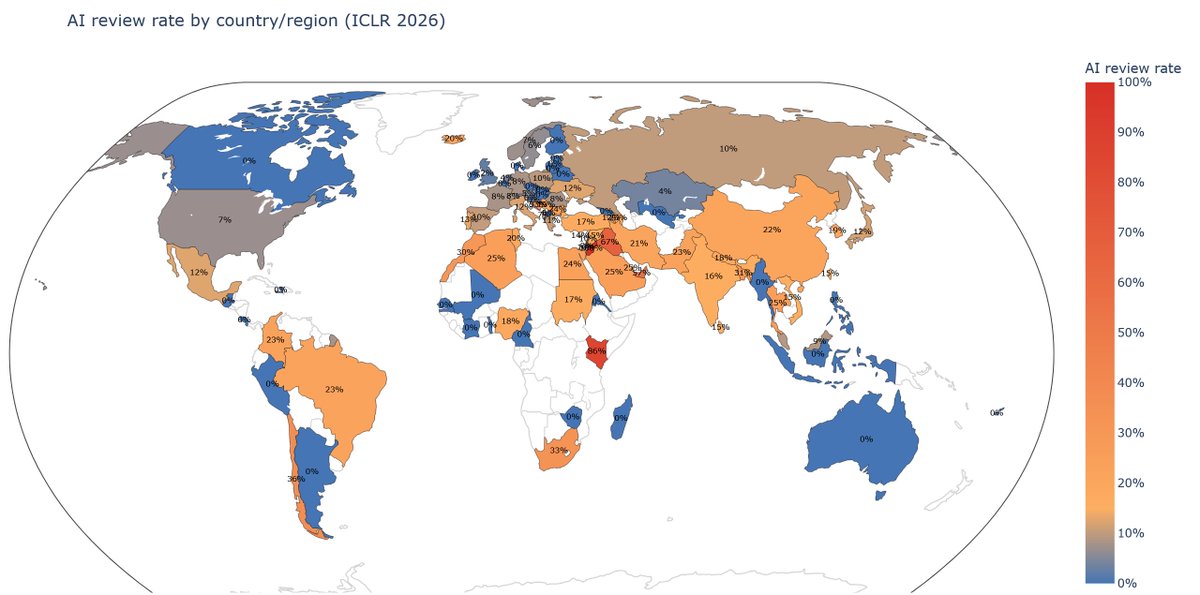
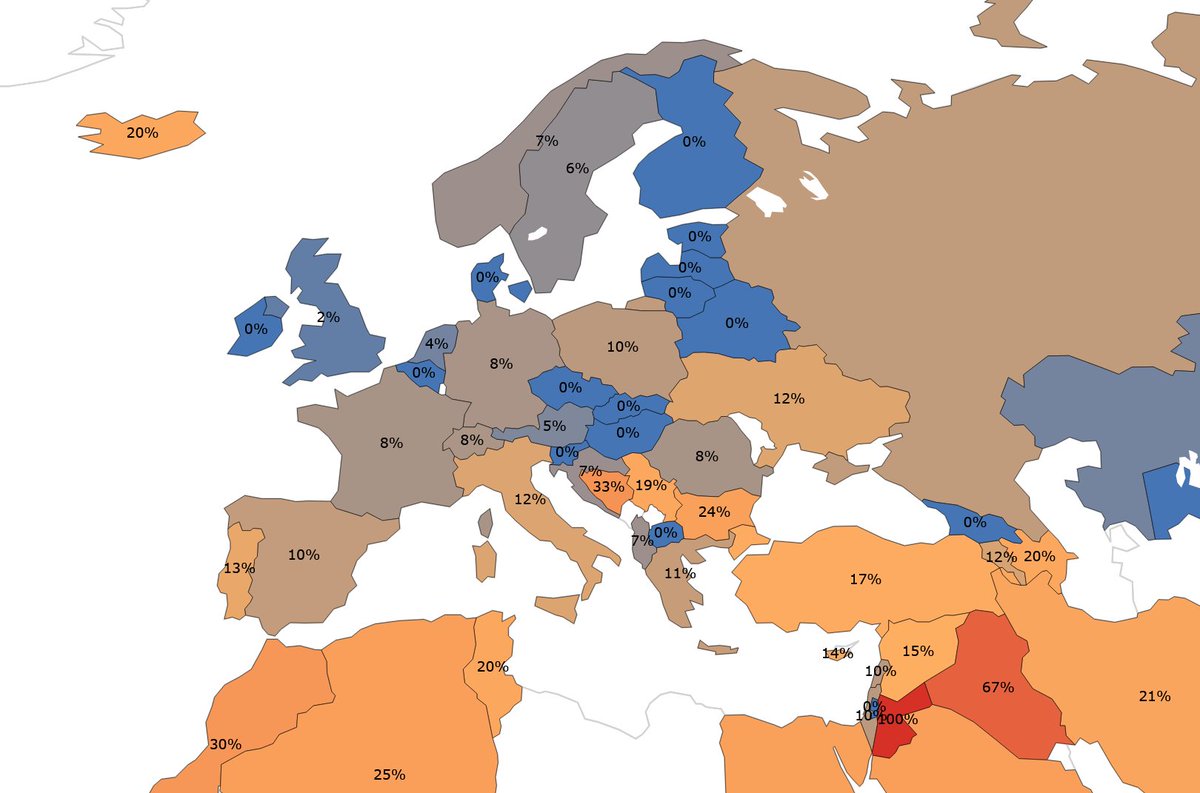
Based on a dataset of ~30k #ICLR2026 peer-review reports, I found that reviewers from non-English-speaking countries are more likely to submit fully AI-generated reviews (using the AI-detection method shared by @max_spero_)
Er-Te Zheng tweet mediaEr-Te Zheng tweet media
English
4
1
13
2.2K
Science + AI ری ٹویٹ کیا
elvis
elvis@omarsar0·
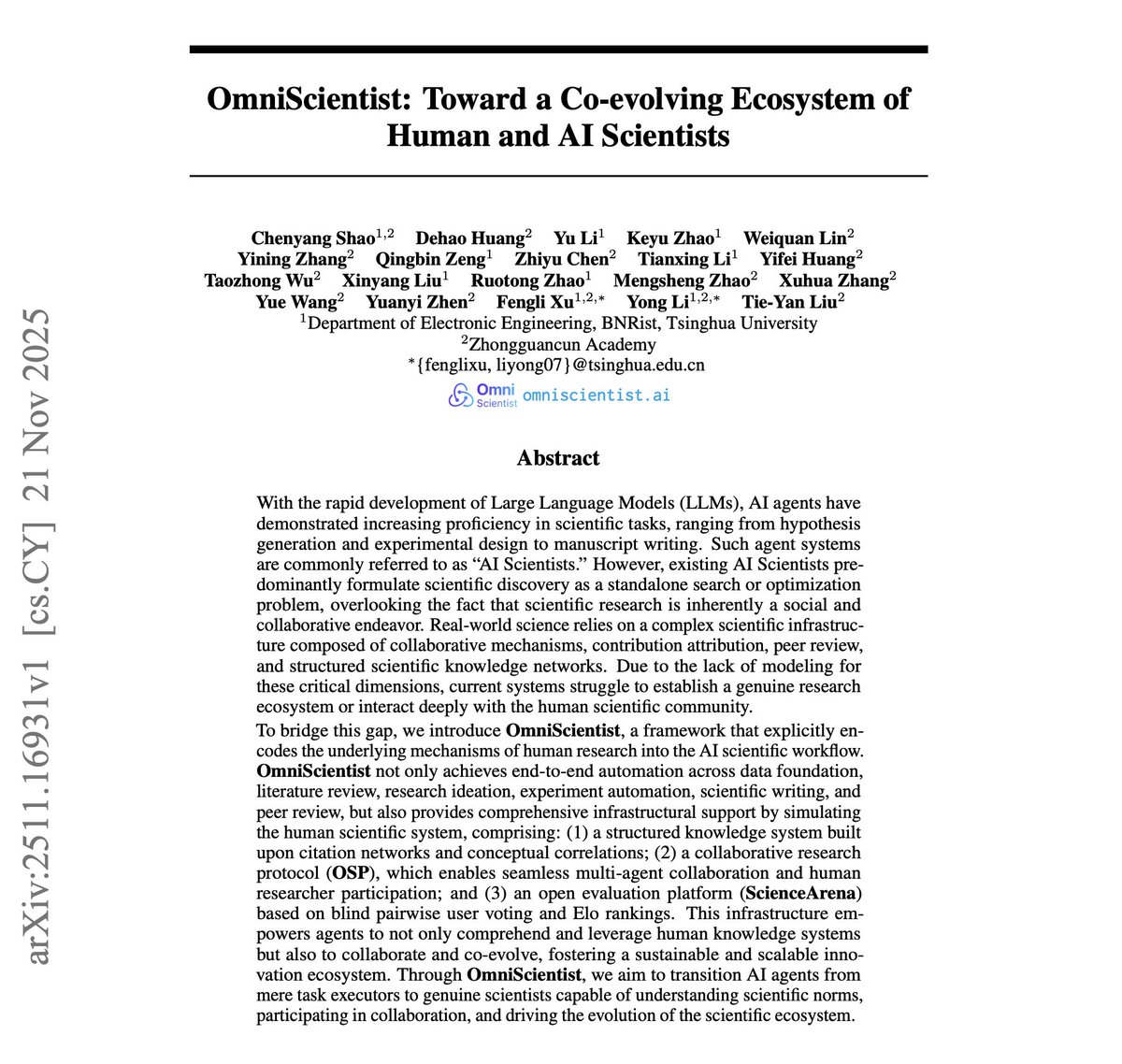
AI scientists are coming. However, current AI research tools work in isolation. Paper summarizers, experiment automators, and hypothesis generators are all done separately and disconnected from the research process. But real science isn't linear. It's collaborative, iterative, and deeply human. This new research introduces OmniScientist, a platform where AI and human scientists work together in a symbiotic ecosystem. The key idea: mutual feedback loops. Human expertise refines AI capabilities. AI insights then expand human research scope. Both evolve together. The platform integrates literature analysis, hypothesis generation, experimental design optimization, and results interpretation. Humans provide oversight at critical decision points. An exciting vision is AI systems that augment scientific discovery across physics, chemistry, biology, and computational sciences. The work is not about replacing the scientific process but rather about enhancing and augmenting it. What makes this powerful: AI handles scale and pattern recognition. Humans provide intuition and validation. Together, they tackle problems neither could solve alone. (bookmark it) Paper: arxiv.org/pdf/2511.16931
elvis tweet media
English
25
94
492
34.7K
Science + AI ری ٹویٹ کیا
Bodhisattwa Majumder
Bodhisattwa Majumder@mbodhisattwa·
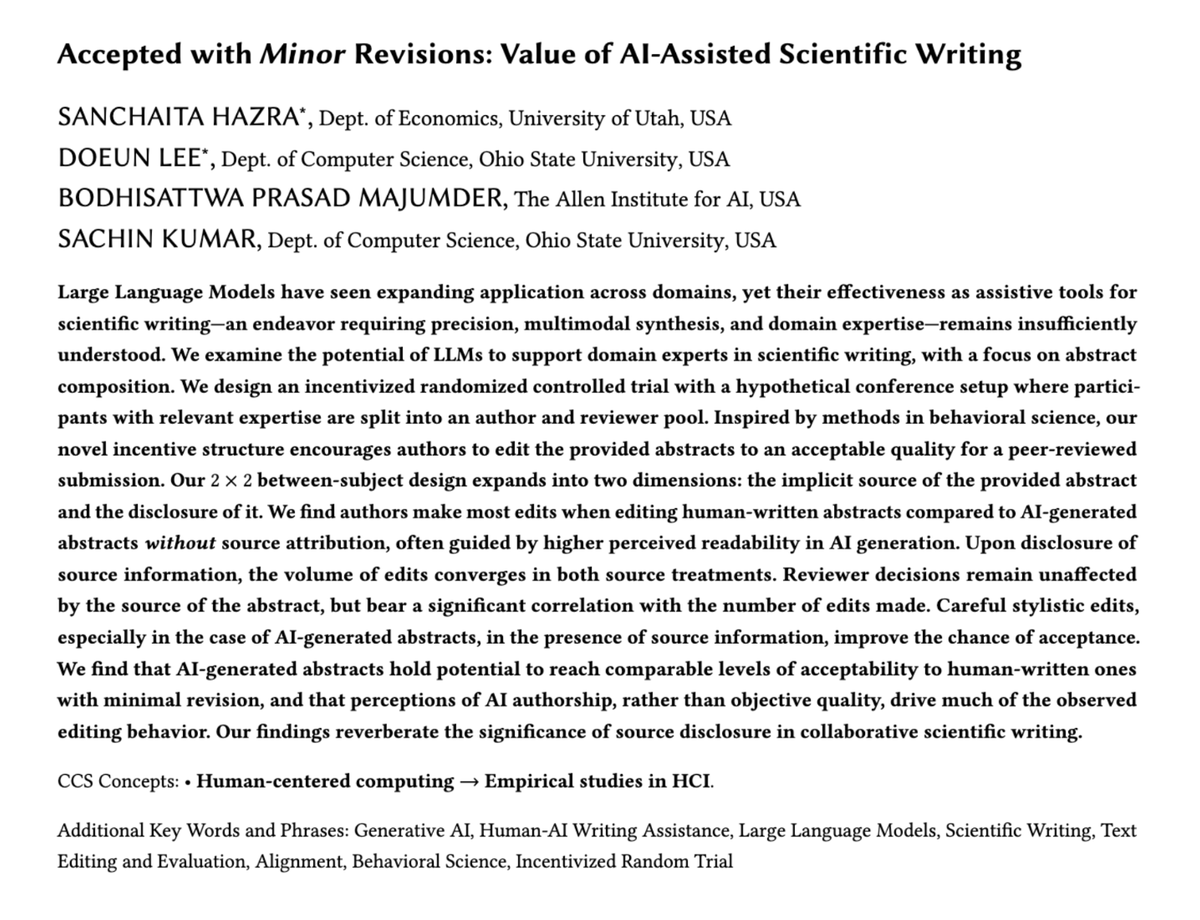
Plenty of AI-gen papers in ICLR. Wonder why? 🚨 In a preregistered Randomized Controlled Trial, we find: CS authors perceive AI-abstracts as more readable, tend to edit less than their published counterparts. AI-use and its disclosure shape the fabric of collaborative scientific writing. Work led by @hsanchaita & @leadoeun27, advised by @shocheen & yours truly. 1/n
Bodhisattwa Majumder tweet media
English
2
15
65
14.6K
Science + AI ری ٹویٹ کیا