Pricing conversations make most reps nervous.
They shouldn't.
Here's the 4-step framework I use that turns price talk into a closing tool:
Step 1: Anchor before they ask. Mention pricing before they bring it up. "Just so you know, our packages typically range from X to Y depending on scope." This removes the awkwardness and signals confidence.
Step 2: Tie price to outcome, not features. "At Y, here's what you'd typically see in the first 90 days" hits differently than "Y gets you these 12 features."
Step 3: Pause. Don't fill the silence. After you say the number, shut up. The first person to speak loses. Most reps panic and start justifying. Don't.
Step 4: Ask "what's your reaction to that?" Not "is that within budget?" Their reaction tells you whether the issue is price, value, or timing. Each one needs a different response.
Pricing conversations are won in the silence after the number, not in how clever you sound saying it.
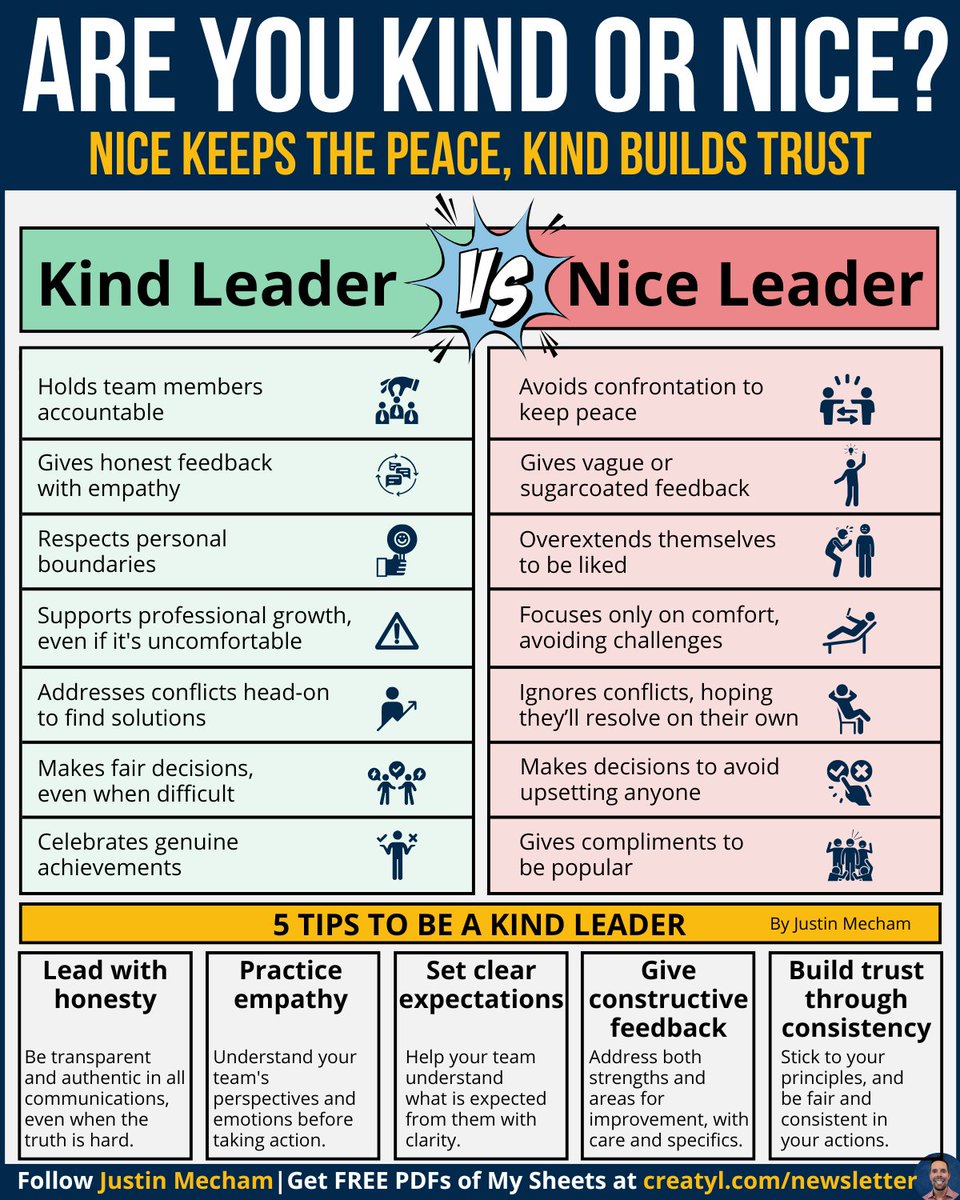
The nicest leaders I have ever met
were also the ones their teams
trusted the least:
Nice feels like kindness on the surface.
But underneath it is fear.
Fear of conflict.
Fear of being disliked.
The leaders people remember forever
were the ones who cared enough
to tell the truth when it would
have been easier not to.
🎁 Want PDFs of my infographics + growth tools?
👉 Go Here: fullpotentialzone.beehiiv.com/subscribe
Please repost to help others out there! ♻️
The Stoics believed your emotions are not something that happen to you. They are something you think.
This insight sits at the heart of Stoic philosophy, and it changes everything about how you respond to your circumstances.
The Stoics analysed emotions down to their core and found that they consist of nothing more than your thoughts and attitudes toward what happens to you.
Joy, fear, grief, anger, each one, when examined carefully, reduces to a thought: that you are in a terrible situation, or a wonderful one. That things are thoroughly good, or thoroughly bad.
And because emotions are thoughts, the Stoics drew a radical conclusion:
"The Stoics believed that emotions consist of nothing more than your thoughts and attitudes toward what happens to you… on the grounds that emotions are thoughts, they encourage you to think that you're absolutely free to calm unwanted emotions by taking thought and thinking more carefully about whether the situation is really good or really bad as you suppose."
You are not trapped by how you feel. You are free to examine the thought underneath the feeling and change it.
But freedom, for the Stoics, had a very precise definition.
It wasn't the freedom to control your circumstances, your reputation, your health, or what other people do. Those things can always be taken from you.
True freedom, in their view, is the freedom to govern what is actually yours:
"The only thing that really counts is what is under your control. What is under your control is your own will in a way your own desires, your mind, your reason ultimately."
Your will. Your desires. Your reason. These are the only things no external force can seize.
Everything else, outcomes, opinions, circumstances belongs to the world.
From this principle, the Stoics constructed their vision of a good life.
Not a life of achievement or pleasure or recognition. But a life of alignment between what you want and what you can actually control:
"The good life is a life that is lived according to reason, where what you want to accomplish are all things that it literally you can accomplish."
The suffering most people experience, the Stoics argued, comes from wanting things outside their control and being devastated when those things don't arrive.
The remedy is not indifference. It's precision: redirect your wanting toward what is truly yours, and you become, in a real sense, undefeatable.
.@EstherPerel on relationships:
Your first relationship shapes every relationship that follows.
Esther Perel is asked how much working on your relationship with your parents affects your romantic partnerships.
Her answer is immediate and unequivocal: "A lot. A lot."
She said the family you grew up in was your first classroom for everything emotional.
"The first place where you learn to love, to desire, to be loved, to have needs, to have needs be met or thwarted, to feel protected or not… is all among the people who took care of you."
Those caregivers, biological parents or not taught you the entire emotional rulebook before you even knew one existed.
Were you allowed to cry? Was it okay to laugh? Were you encouraged to thrive? Or did you learn to shrink? Could you trust people at home, or did you first encounter betrayal there?
All of that travels with you. And it shows up in two distinct ways: in what you seek to recreate, and in what you're determined to avoid.
"You bring that with you: parts of that in what you want to experience again and in what you want to make sure to avoid."
The complexity deepens when you add a partner to the picture. They arrived with their own rulebook shaped by a completely different household, different caregivers, different lessons about loyalty, vulnerability, and connection.
"Then you find yourself with someone who was raised for loyalty and interdependence. And there's a completely different book of how you are connecting with people, of what you look for in people, of how you open yourself to them, of how you allow yourself to be vulnerable, of how you follow rules."
Two people. Two invisible rulebooks. One relationship trying to make sense of the collision.
This is why examining your relationship with your parents even retrospectively is like map-reading. Understanding where your emotional wiring came from is the first step to choosing, consciously, how you want to show up for someone else.
Would you still chase success if nobody noticed?
What's your take? Comment below.⬇️
♻️ Repost to help others in your network with this.
➕ And follow me at Sean McPheat for more.
The hidden health crisis ruining millions of men over 40:
Andropause.
It's why you feel stressed, tired and struggle to lose weight.
But it's not just "aging".
Here's what the "male menopause" is and 7 ways to fix it before it gets worse: 🧵
BREAKING: Motion in AI video just took a serious leap.
Seedance 2.0 is now live inside Lovart AI with no waitlist.
You can generate high-speed transformations, consistent characters, and full sequences from a single prompt.
Here’s what actually happens when you push it:
Breaking: You can now generate full high-speed action sequences from one prompt.
- No multi-shot setup.
- No manual stitching.
Seedance 2.0 inside Lovart AI handles the entire flow in one go.
Here’s how we ran a full space chase sequence:
Most AI videos try to impress too early.
The ones that actually work take their time.
Seedance 2.0 inside Lovart, lets you build slow, controlled sequences from a single idea.
Here’s how we used it to build tension step by step
Breaking: Seedance 2.0 just landed on Lovart AI and I didn’t expect this at all.
I made a full luxury beauty visual from one idea, no setup.
Let me show you exactly how this comes together.