Medscape

74.3K posts

Medscape banner
Medscape

Medscape

@Medscape

Medscape provides breaking medical news and expert perspectives, drug and disease information, and free CME across 30+ medical specialties.

New York شامل ہوئے Ekim 2008
34.4K فالونگ260.1K فالوورز
Medscape
Medscape@Medscape·
Long wait times for an appointment with a specialist and for treatment after the referral are putting lives at risk, experts say. mdsc.pe/4t6K93J

Medscape tweet media
English
1
2
1
208
Medscape
Medscape@Medscape·
Managing reflux starts with understanding the "plumbing". Experts share why the "Rule of 3", standing upright for three hours after meals, is a game-changer for patient success. Watch the full discussion for more clinical pearls ➡️ x.com/i/broadcasts/1… #Gastro #CME
English
0
0
5
847
Medscape
Medscape@Medscape·
Researchers are rethinking how we study tuberculosis and the results are surprising. A new “breathing” lung-on-a-chip model, built with multiple human lung and immune cell types, mimics real respiration and reveals how TB behaves in its earliest stages. In a recent study, the chip not only recreated key features of infection but also showed how coordinated cell interactions may help limit disease—offering new insight into TB progression and potential treatment strategies: mdsc.pe/4sCMYtA
Medscape tweet media
English
2
0
5
687
Medscape
Medscape@Medscape·
Tina Merritt, MD, is an allergist and immunologist at Allergy & Asthma Clinic of Northwest Arkansas in Bentonville, and one of the pioneers in the study of alpha-gal syndrome. Medscape spoke with her about the initial discovery of the tick-triggered allergy, the evolving understanding of its biological mechanism, and how to manage patients with the condition: mdsc.pe/3PY46v2
Medscape tweet media
English
1
1
7
819
Medscape
Medscape@Medscape·
Patients who present to their primary care providers experiencing new-onset or multiple floaters in their vision could be at risk for retinal tears or detachment and should be referred promptly to an ophthalmologist, Dutch researchers found. The risk is particularly high for people with more than 10 floaters and those whose eye issues began in the previous 2 weeks, according to the researchers, whose findings appear in the Annals of Family Medicine. mdsc.pe/4tqGDl1
Medscape tweet media
English
1
3
14
1.5K
Medscape
Medscape@Medscape·
The role of central obesity as a predictor of cardiovascular disease has not been fully understood, but a recent analysis from the Jackson Heart Study has provided some answers. During a poster session at the American Heart Association EPI Lifestyle Scientific Sessions (AHA-EPI) 2026, researchers said that prior research suggested diabetes-associated heart disease may be driven more by fat around the organs, or visceral fat, rather than hyperglycemia. mdsc.pe/4c2A4Po
Medscape tweet media
English
0
5
17
1.2K
Medscape
Medscape@Medscape·
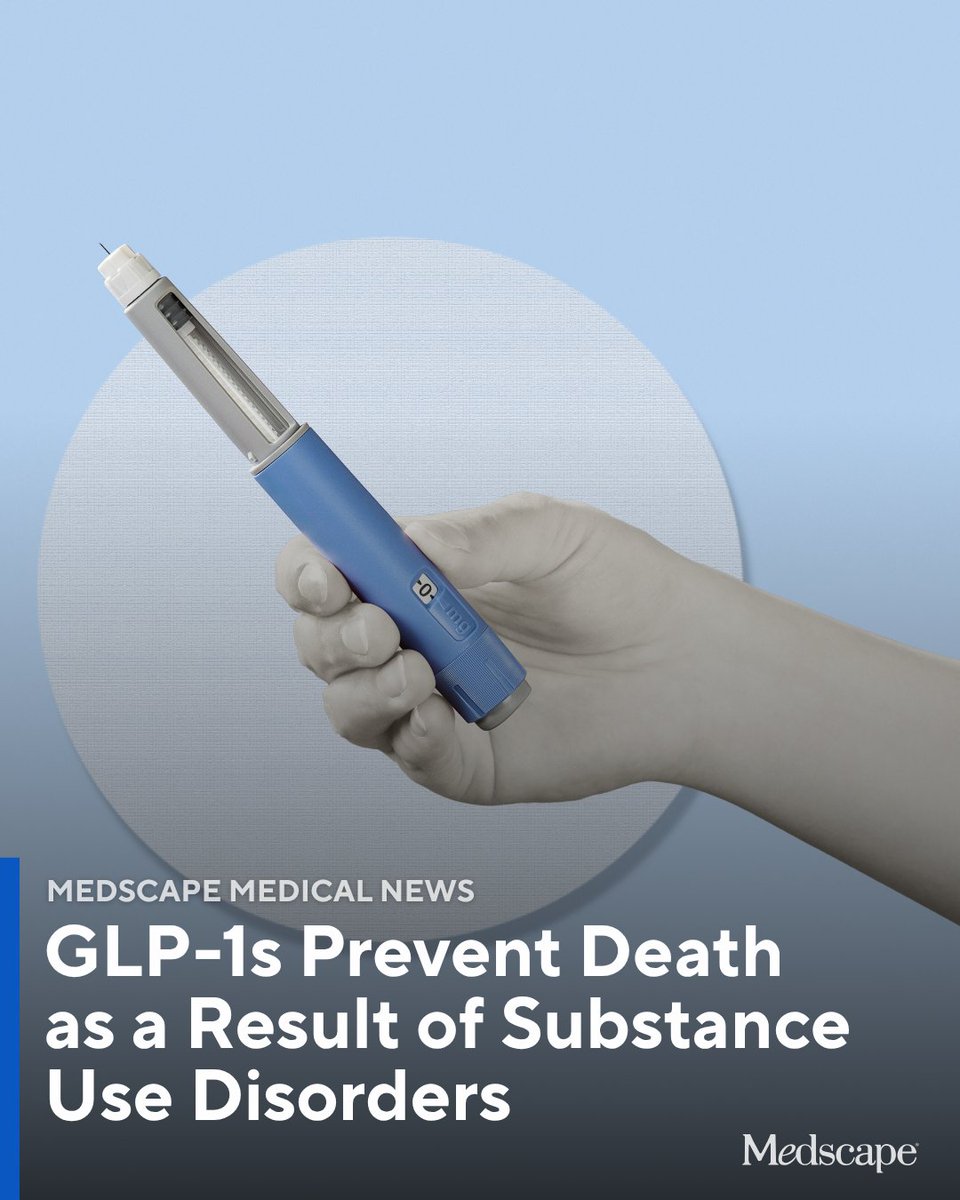
Clinical evidence has long suggested that the use of GLP-1 medications is linked to lower substance use. It’s also been speculated among patients taking the medications. Social drinkers, for example, contend that they no longer have the urge to order that glass of wine when they’re out with friends and smokers are finally able to stop. Now a larger body of research shows what physicians and their patients have long noticed: Taking GLP-1 medications seems to significantly prevent and reduce addiction and substance use disorders. In a study published recently in The BMJ, researchers followed about 600,000 veterans with type 2 diabetes and found that GLP-1s prevented and treated substance use disorders when taken over a 3-year period. mdsc.pe/4t3I9ZV
Medscape tweet media
English
1
11
28
2.1K
Medscape
Medscape@Medscape·
Are you up to date on the latest research on human bite wounds and their management strategies? Test yourself with this quick quiz: mdsc.pe/4uLdWk5
Medscape tweet media
English
0
2
4
1.1K
Medscape
Medscape@Medscape·
Doctors know how to succeed. That’s almost the easy part. But what happens when success, as it’s been traditionally defined, doesn’t work for you? What happens when you achieve the title, but know you should let it go? Or, when your vision as a leader doesn’t look like what’s been established? At the 2025 Women in Medicine Summit in Chicago, physicians shared personal stories of what it looks like to define their own career paths and measure success by their ruler alone. Sometimes that required stepping back or simply getting clear on their individual values and putting them into action. Medscape asked three doctors to share how they define professional achievement, what led them to question the “ladder” of success, and how they approach their roles differently today: mdsc.pe/4t711ra
Medscape tweet media
English
1
1
4
741
Medscape
Medscape@Medscape·
Drug-related cognitive impairment is common and should be considered in any patient on medication who develops cognitive symptoms. Linked to drugs such as benzodiazepines, anticholinergic antidepressants, and antipsychotics—especially in older adults—it is often mistaken for age-related decline and underrecognized. Regular assessment and monitoring can help prevent and manage these effects. mdsc.pe/4lPKg19
Medscape tweet media
English
2
6
25
1.9K
Medscape
Medscape@Medscape·
An embedded hospital primary palliative care (HPPC) model led by social workers and nurse practitioners (NPs) was associated with lower ICU use and shorter hospital stays than referral-based specialty palliative care (SPC) in patients with serious illness. mdsc.pe/3NIzXPH
Medscape tweet media
English
1
1
6
1.2K
Medscape
Medscape@Medscape·
High-density lipoprotein cholesterol (HDL-C) has long been considered “good cholesterol,” with higher levels associated with lower cardiovascular (CV) risk. However, emerging evidence indicates that this relationship is nonlinear. Low HDL-C levels remain associated with an increased risk for CV events, while extremely elevated levels may also be linked to an increased risk, challenging traditional assumptions. Current evidence shows that CV prevention primarily relies on lowering low-density lipoprotein cholesterol (LDL-C). In addition, HDL function, rather than its concentration alone, may offer more meaningful insights into CV risk. mdsc.pe/4lIBr9c
Medscape tweet media
English
1
8
25
2.2K
Medscape
Medscape@Medscape·
Women who experience premature menopause have a 40% greater risk for developing coronary heart disease (CHD), and this risk is the same for both Black and White women, according to an article published in JAMA Cardiology. Reproductive milestones such as menopause can act as early signals from the cardiovascular system, said Priya M. Freaney, MD, lead author of the article and assistant professor of medicine in the Division of Cardiology at Northwestern University Feinberg School of Medicine in Chicago. mdsc.pe/4sV535M
Medscape tweet media
English
2
0
7
1.2K
Medscape
Medscape@Medscape·
What if oncologists could degrade and eliminate disease-driving proteins rather than simply block them — and do it with a modular platform that works across cancer types, crosses the blood-brain barrier, and delivers chemotherapy at the same time? This new class of protein-degrading drugs are called nanoparticle-mediated targeting chimeras, or NPTACs, for short. This new approach, outlined in a recent Nature Nanotechnology perspective, builds on research from Columbia University and the University of Technology Sydney published in October 2024, which demonstrated that nanoparticles decorated with targeting antibodies can drag cell-surface proteins into the lysosome — the cell’s waste-disposal system — for destruction. mdsc.pe/4rKWQzV
Medscape tweet media
English
3
3
11
1.3K
Medscape
Medscape@Medscape·
Polypharmacy is common in chronic kidney disease (CKD) and increases the risk of drug-related complications, making careful prescribing essential. Clinicians must understand renal risks, monitor closely, and know when to pause or restart medications. This overview highlights 10 commonly used drugs, focusing on preventing complications and safely managing treatment: mdsc.pe/40Pvf5K
Medscape tweet media
English
1
5
21
1.5K
Medscape
Medscape@Medscape·
In a scientific first, researchers have turned plastic waste into a mainstay treatment for Parkinson’s disease (PD). In a proof-of-concept study, researchers used engineered bacteria to convert polyethylene terephthalate (PET) — a widely used plastic found in bottles and food packaging — into levodopa (L-DOPA). Investigators engineered Escherichia coli bacteria to convert a chemical building block of PET into L-DOPA through a series of biological reactions, with an 84% conversion and a yield of 5.0 g/L — equivalent to several early-stage clinical doses of the drug. Although still in the early stages, the process could hold promise for drug development. mdsc.pe/3PULegv
Medscape tweet media
English
0
3
12
1.4K
Medscape
Medscape@Medscape·
IBD treatment decisions do not stop after first-line therapy. In this CME, work through realistic cases and strengthen your approach to managing biologic-experienced UC and Crohn’s disease. ▶️ bit.ly/4a9Mlzr
Medscape tweet media
English
0
1
3
936
Medscape
Medscape@Medscape·
Prenatal exposure to certain antiseizure medications (ASMs) was associated with an increased risk for neurodevelopmental disorders (NDDs) in children, with risk varying by individual drug. Results of a large US population-based cohort study showed that valproate exposure was associated with an increased risk for NDD, whereas levetiracetam and phenytoin were not; zonisamide showed a potential signal, though estimates were imprecise because of the relatively small number of children exposed to this drug in utero. mdsc.pe/4uLoWxW
Medscape tweet media
English
1
8
16
1.3K
Medscape
Medscape@Medscape·
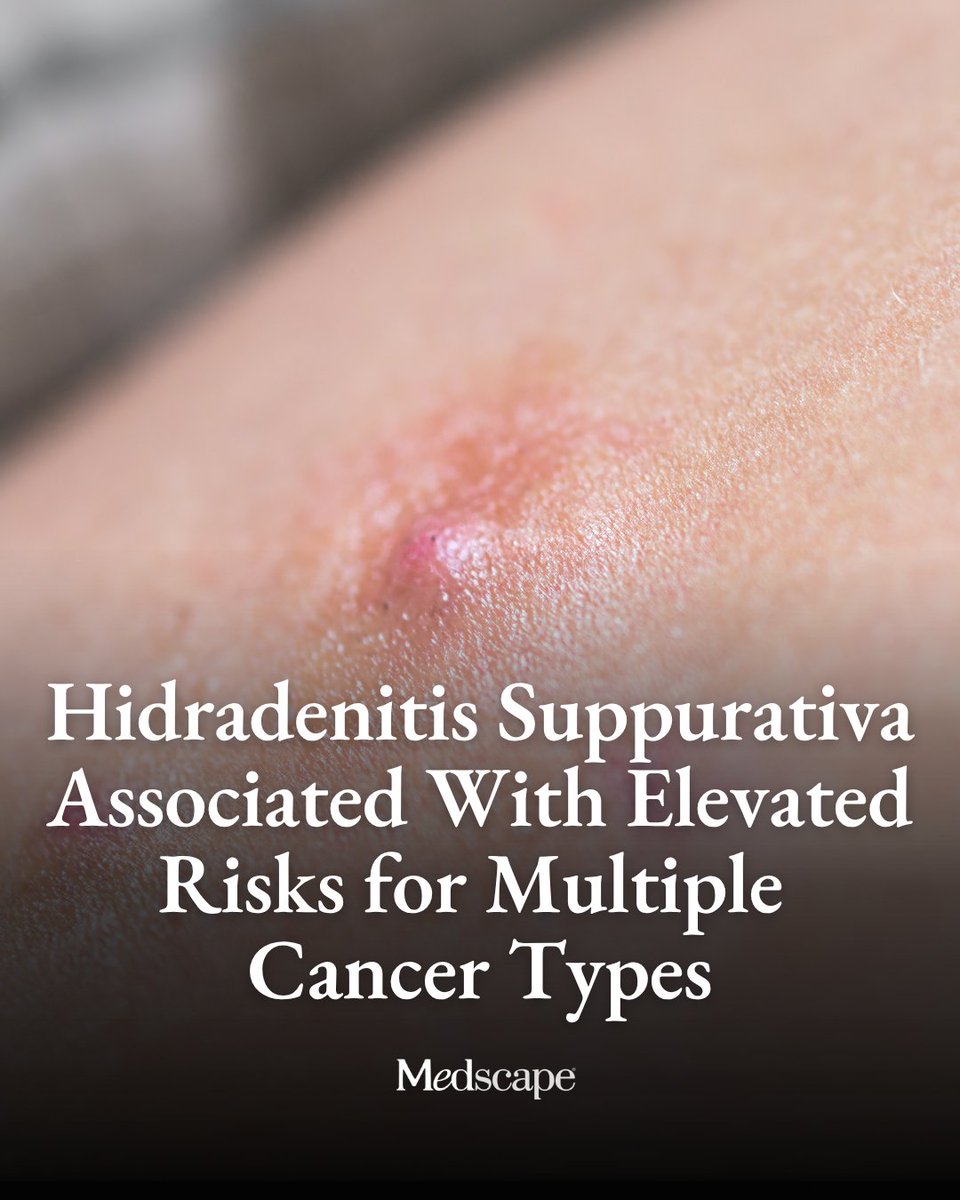
In a meta-analysis, patients with hidradenitis suppurativa (HS) faced a more than 80% higher risk for cancer overall than the general population, with particularly elevated risks for gastrointestinal, head and neck, haematologic, and respiratory system cancers. mdsc.pe/4bxwDih
Medscape tweet media
English
2
2
17
2.5K