Aurora đã retweet
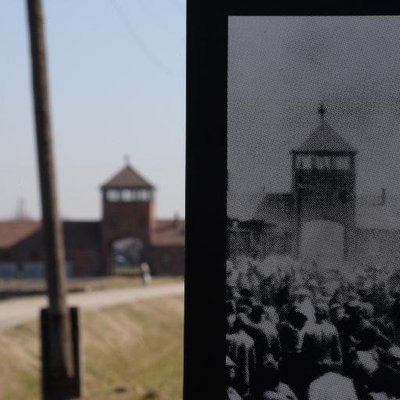
On 27 April 1942, the first transport of 127 Polish women arrived in Auschwitz from prisons in Cracow and Tarnów. Among them was Helena Panek (b. 1922, no. 6892), who recalled the moment of transport as follows:
"On 27 April, at about 3 a.m., about sixty female prisoners were led out of the Tarnów prison and we were rushed under a strong escort of gendarmes to the train station, where we were driven into a prison wagon. It was later joined to another train. Around nine o'clock, escorted by gendarmes, we set off into the unknown. The guards repeatedly asked us where we were going and we remained silent. We reached Cracow around noon, and somewhere on a sidetrack the train stopped, waiting to join another train. Finally, we were on our way, but not for long, and again we stopped. It turned out that this was the border between the Generalgouvernement and the Reich. Again we stopped at a large station. Through a barred window, we could read the name of the town on the station building: Auschwitz. We already know that it is Oświęcim. We get on a siding. We are not allowed to go near the window. Finally, the train stopped. It was 6 o'clock in the evening.
We could hear wild screams from the outside. The door of our carriage opens. Someone from outside shouts in German, everyone get out! - Hurry up, you damned bandits. The guards hit us on the back with rifle butts. We all rush together to one exit. The shouting made our heads spin. One by one, we jump from the wagon straight into the screaming SS women and SS men who form a line around the wagon. Amidst the shouting of the Germans and the barking of trained wolfhounds, they line us up and lead us into the camp. After passing through a gate, they stopped us in front of some building, counted a few times, and after a short stop, they directed us in rows to a bathhouse, where ice-cold water was waiting for us. There they take our things, our clothes, and after the bath, they give us striped summer uniforms. And dirty grey underwear. And on our feet, wooden Dutch clogs, a few sizes too big. We were also given numbers written on a white piece of cloth, which had to be sewn to the dress.
Late in the evening, we were led into Block 8, into a very large hall, where mattresses with some kind of chaff or straw lay on the floor. Each received a thin blanket. The next day, already in our camp clothes, we did not recognise one another. During the first roll call, the Germans asked us who could speak German. Standing at the first roll call, we observed young female prisoners who had been transported to the camp earlier. As it turned out, they were Jewish women from Slovakia. They were strangely dressed, because they wore prisoners of war uniforms, with shaved hair and very skinny. The sight of them shocked us, and for many it was a reason to have a mental breakdown.
Terrified by the sight, we talked with Marysia Fleckowa and Stefcia Łącka about what was waiting for us, how long we could live in such conditions and for what such an injustice had happened to us. After the morning roll call, we were taken to the men's camp for photography. The photographing of prisoners took place in the photographic studio of the camp Gestapo reconnaissance service, which was located in Block 26. We were not tattooed right away. We had numbers sewn onto our striped uniforms. On the third day, everyday camp life began: getting up at dawn, roll call, then working beyond our strength combined with beatings and mistreatment."
Helena Panek survived the war. She passed away in 2020.

English