

Syvilla Sionnach (Kyla)
389 posts

Syvilla Sionnach (Kyla)
@foxeyfire
She plays haunting melodies. He rules a kingdom of shadows. Fate remembers what they forgot. Read The Weaving of Ash & Light: https://t.co/BTm7dBtl51
Saoghal Eile Tham gia Aralık 2021
283 Đang theo dõi167 Người theo dõi


Prompt sharing: Tav's Bottle-morpher
I've been sitting on this one a bit too long xd bring your character sheet or image, specify the type of drink you wish to morph your character in and enter your character name under. Should work, i have done a few celebration bottles with this one already ^^
----------------------------------------------------------
Prompt starts here:
ALCOHOL TYPE TO DESIGN: [WRITE THE TYPE OF ALCOHOL HERE]
CHARACTER NAME: [WRITE THE NAME OF YOUR CHARACTER]
Example: whiskey, champagne, absinthe, sake, rum, cognac, gin, wine, liqueur, tequila, vodka, etc.
Use the uploaded image as the main character reference.
Your first task is to deeply analyze and observe the uploaded image before designing anything. Study the character carefully and identify all the important visual elements that define their identity, design, appearance, personality, and overall vibe.
Analyze and retain:
Face shape, expression, eyes, gaze, eyebrows, mouth, makeup, markings, scars, or special facial traits.
Hairstyle, hair color, hair texture, silhouette, accessories, horns, ears, animal traits, fantasy traits, or non-human features.
Body type, posture, attitude, gesture, and overall character presence.
Clothing style, armor, outfit structure, fabrics, patterns, symbols, decorations, jewelry, props, and signature items.
Main color palette, secondary colors, accent colors, lighting colors, and contrast.
Materials and textures associated with the character, such as metal, leather, glass, silk, fur, bone, flowers, smoke, fire, shadows, neon, crystals, wood, gold, etc.
The emotional vibe of the character: elegant, dangerous, cute, noble, mysterious, gothic, divine, monstrous, heroic, luxurious, playful, seductive, royal, chaotic, infernal, celestial, futuristic, etc.
The artistic style of the uploaded image, including rendering style, linework, lighting, composition, atmosphere, and level of detail.
After the analysis, reinterpret the character’s identity into the design of a very fancy, elegant, luxury bottle of [ALCOHOL TYPE TO DESIGN].
The bottle must not simply copy the character literally. Instead, it must transform the character’s strongest identity elements into a premium alcohol bottle design, as if the character inspired a luxury collector’s edition bottle.
BOTTLE DESIGN REQUIREMENTS:
Create a highly elegant and expensive-looking bottle of [ALCOHOL TYPE TO DESIGN], inspired by the uploaded character.
The bottle should include:
A silhouette inspired by the character’s overall shape, posture, or strongest visual identity.
A glass color and transparency inspired by the character’s main color palette.
Decorative engravings, patterns, ornaments, or embossed details based on the character’s clothing, symbols, markings, accessories, or fantasy traits.
A luxurious stopper or cap inspired by the character’s head silhouette, hairstyle, horns, crown, ears, mask, weapon, halo, or other iconic feature.
A label design inspired by the character’s personality and visual style.
Premium materials such as polished glass, crystal, gold, silver, black metal, brass, lacquer, velvet, leather, porcelain, enamel, gemstone accents, or glowing liquid details.
A bottle neck, shoulders, base, and label shape that all feel intentional and character-inspired.
The alcohol liquid inside should have a color, glow, density, or magical quality inspired by the character’s vibe.
Add small luxury details such as filigree, wax seal, metallic foil, etched glass, sculpted reliefs, decorative chains, ribbons, charms, runes, floral ornaments, gothic motifs, futuristic neon trims, or fantasy accents if they match the character.
The final result should feel like:
A luxury collector’s edition alcohol bottle.
A high-end product design inspired by a character.
Elegant, refined, expensive, and visually iconic.
Recognizable in spirit as being inspired by the uploaded character.
Not cartoonish unless the uploaded character’s style strongly requires it.
Not cheap, simple, generic, or mass-produced.
COMPOSITION:
Show the bottle as the main subject, centered in the image, standing upright on a premium display surface.
Use a clean luxury product photography composition with dramatic lighting.
The background should match the character’s atmosphere and color palette without distracting from the bottle.
Add soft reflections, cinematic highlights, elegant shadows, and subtle atmospheric effects.
The bottle should look like a real premium alcohol product but with artistic fantasy design elements.
STYLE:
masterpiece, best quality, ultra-detailed, Full HD 8K, luxury product design, premium alcohol bottle concept art, elegant collector’s edition packaging, cinematic product photography, high-end fantasy design, refined materials, polished glass, crystal clarity, metallic foil details, embossed label, engraved ornaments, soft bloom, glossy highlights, dramatic rim lighting, beautiful reflections, sharp focus, clean composition, ultra-detailed craftsmanship, expensive luxury aesthetic.
IMPORTANT:
Preserve the essence, identity, color language, vibe, and strongest design elements of the uploaded character.
Do not turn the bottle into a literal statue of the character.
Do not place the full character on the bottle unless it is only as a subtle label illustration, engraving, emblem, or decorative silhouette.
The bottle itself must be the main design object.
Make the design feel original, elegant, and inspired by the character’s soul.

English

E-Va 💜💚@EvaGlitchAI
Prompt of the Day: WILD WEST SCENE SELECTOR 🤠🌵💜💚 Today’s Prompt of the Day turns your character references into a custom cowboy/cowgirl Wild West scene. Type your chosen western scene into the SCENE SELECTOR at the top, then attach your character reference images. The prompt will use each attached character as one individual character and build the cowboy/cowgirl scene around them. Try scenes like: riding horses along a desert trail at sunset playing poker in a smoky saloon facing off in a dramatic main-street duel escaping a bank robbery on horseback camping under desert stars guarding a train robbery Have fun with this one 🤠🌅 ............................PROMPT STARTS HERE............................ SCENE SELECTOR: [Type the Wild West cowboy/cowgirl scene you want here.] Examples: riding horses along a desert trail at sunset entering a dusty frontier town walking through a saloon before a fight breaks out playing poker in a smoky saloon escaping a bank robbery on horseback standing on a canyon ridge at golden hour facing off in a dramatic main-street duel camping by a fire under desert stars riding through a storm with lightning over the mountains posing as an outlaw gang on a wanted poster chasing a runaway stagecoach guarding a desert train robbery relaxing outside an old saloon with horses tied nearby Use the typed scene selector as the main scene concept. Adapt the environment, action, poses, props, camera, and mood to match the selected Wild West scene. Keep the scene clearly cowboy, cowgirl, frontier, western, and cinematic. Do not ignore the scene selector. Do not default to horseback riding unless the scene selector asks for riding, horses, trails, travel, or mounted action. Use each attached character reference image as one individual character identity reference. Create exactly the same number of main characters as the number of attached character reference images. Use every attached character reference image as a separate individual character. Do not add extra main characters beyond the attached character reference images. Do not remove any attached character reference images from the group. Do not duplicate, clone, mirror, copy, or slightly alter any attached reference character. Character reference rules: Preserve each attached character’s face shape, hairstyle, hair colour, eye colour, body language, signature colour palette, key outfit motifs, species traits, accessories, silhouette, and overall character vibe. The final design must still clearly look like each attached character. Do not redesign any attached character into a different person. Do not merge characters together. Hard style rule: Preserve the visual art style and character identity of the attached references while transforming them into the selected Wild West cowboy/cowgirl scene. If the references are anime, keep them anime. If they are stylized, keep that stylization. Do not turn the characters photorealistic unless specifically requested. Scene concept: Create a cinematic western illustration based on the scene written in the SCENE SELECTOR. The final image should feel like a dramatic American frontier moment with strong Wild West atmosphere, character-driven styling, and a clear sense of story. Use the selected scene to decide whether the characters are riding horses, walking through town, sitting in a saloon, preparing for a duel, escaping danger, camping, robbing a train, chasing a stagecoach, or doing another western action. Character transformation: Transform every attached reference character into a custom cowboy or cowgirl version of themselves while preserving their original identity. Use each character’s colours, motifs, accessories, outfit shapes, and overall vibe as the foundation for their western redesign. Male characters should look rugged, weathered, confident, and masculine, with strong cowboy styling such as dusters, vests, denim, leather, boots, gun belts, holsters, hats, rolled sleeves, scarves, worn frontier details, and dusty outlaw energy. Female characters should have stylish, attractive, sexy cowgirl styling with fitted western outfits, halter tops, corset-inspired details, tasteful cleavage, flattering silhouettes, boots, belts, gloves, hats, jewellery, and confident western attitude. Keep the female styling sexy but controlled, not vulgar, lingerie-like, explicit, nude, or over-the-top. Scene adaptation rules: If the selected scene includes riding, travel, trails, chases, stagecoaches, or mounted action, give each character a distinct horse that suits their personality and colour palette. If the selected scene takes place in a saloon, use wooden interiors, smoky air, card tables, bottles, lanterns, swinging doors, chairs, poker chips, whiskey glasses, and frontier chaos where appropriate. If the selected scene takes place in a frontier town, use dusty streets, wooden storefronts, hitching posts, wanted posters, saloon signs, wagons, barrels, and dramatic western architecture. If the selected scene takes place in the desert, use red-rock mountains, mesas, canyon cliffs, saguaro cactuses, dry brush, dusty earth, scattered stones, warm haze, and a wide open sky. If the selected scene is a duel, robbery, chase, or fight, make the action dynamic but readable, with clear poses and strong visual hierarchy. If the selected scene is calm, romantic, scenic, or atmospheric, make the mood cinematic, stylish, warm, and story-rich rather than chaotic. Composition and camera: Use a cinematic composition that best fits the selected scene. Prefer a slightly low camera angle looking upward when it suits the scene, making the characters feel heroic, stylish, and larger than life. Do not make any character look directly at the camera. The camera does not exist to the characters. Every character should be looking ahead, sideways, toward another character, toward the action, toward the horizon, or toward something in the environment. Keep every character clearly visible, readable, and separated in silhouette. Make the selected scene immediately understandable at a glance. Environment: Build the environment around the typed scene selector. Use classic American Wild West visual language: dusty trails, wooden saloons, frontier towns, desert mountains, canyon landscapes, cactuses, horses, wagons, lanterns, warm sunsets, smoke, dust, leather, wood, iron, and weathered frontier textures. The background should feel cinematic and atmospheric but should support the characters rather than overpowering them. Lighting and mood: Use lighting that matches the selected scene. For outdoor scenes, prefer golden-hour sunset lighting, warm amber highlights, dusty haze, dramatic rim lighting, long shadows, and glowing skies. For indoor saloon scenes, use warm lantern light, smoky haze, moody shadows, glowing bottles, and dramatic western atmosphere. For night scenes, use moonlight, firelight, lantern glow, silhouettes, and high-contrast cinematic lighting. The mood should feel adventurous, stylish, rugged, sexy, cinematic, and alive. Quality and rendering: Polished, premium-quality stylized illustration with clean linework, crisp rendering, readable forms, strong character acting, dynamic western atmosphere, and clear composition. Keep the strongest detail concentrated on the referenced characters and the selected scene’s main action or mood. Do not: Do not ignore the SCENE SELECTOR. Do not default to horseback riding unless the scene selector asks for riding, mounted travel, trails, or horses. Do not create more or fewer main characters than the number of attached character reference images. Do not add extra main characters who were not provided as attached character references. Do not duplicate any attached reference character. Do not clone, mirror, copy, or slightly alter any attached reference character. Do not change the identities of the attached reference characters. Do not redesign the attached reference characters into different people. Do not merge characters together. Do not make any character look directly at the camera. Do not pose the characters as if they know the camera exists. Do not make the scene feel modern unless the scene selector specifically asks for a modern western twist. Do not make the female outfits vulgar, lingerie-like, explicit, nude, or overly revealing. Do not make the sexy cowgirl styling exaggerated, pornographic, or over-the-top. Do not make the male outfits generic, polished, modern, or weak; keep them rugged and frontier-styled. Do not add modern clothing, modern weapons, phones, neon signs, cars, highways, power lines, or futuristic objects unless the scene selector specifically asks for them. Do not make the background busier than the characters. Do not make the composition crowded, flat, or hard to read. Do not make the main subjects blurry, tiny, hidden, or unreadable. Do not create messy anatomy, extra limbs, malformed hands, distorted faces, distorted horse bodies, or muddy textures. Do not use photorealism unless specifically requested. ..............................END OF PROMPT.................................. #POTD #promptoftheday #AI #AiArt #Art #AnimeArt #WildWest #Cowboy #Cowgirl #Western #Frontier #CharacterDesign #DigitalArt #AnimeStyle #CommunityPrompt
ZXX


Prompt of the Day: WILD WEST SCENE SELECTOR 🤠🌵💜💚
Today’s Prompt of the Day turns your character references into a custom cowboy/cowgirl Wild West scene.
Type your chosen western scene into the SCENE SELECTOR at the top, then attach your character reference images. The prompt will use each attached character as one individual character and build the cowboy/cowgirl scene around them.
Try scenes like:
riding horses along a desert trail at sunset
playing poker in a smoky saloon
facing off in a dramatic main-street duel
escaping a bank robbery on horseback
camping under desert stars
guarding a train robbery
Have fun with this one 🤠🌅
............................PROMPT STARTS HERE............................
SCENE SELECTOR: [Type the Wild West cowboy/cowgirl scene you want here.]
Examples:
riding horses along a desert trail at sunset
entering a dusty frontier town
walking through a saloon before a fight breaks out
playing poker in a smoky saloon
escaping a bank robbery on horseback
standing on a canyon ridge at golden hour
facing off in a dramatic main-street duel
camping by a fire under desert stars
riding through a storm with lightning over the mountains
posing as an outlaw gang on a wanted poster
chasing a runaway stagecoach
guarding a desert train robbery
relaxing outside an old saloon with horses tied nearby
Use the typed scene selector as the main scene concept.
Adapt the environment, action, poses, props, camera, and mood to match the selected Wild West scene.
Keep the scene clearly cowboy, cowgirl, frontier, western, and cinematic.
Do not ignore the scene selector.
Do not default to horseback riding unless the scene selector asks for riding, horses, trails, travel, or mounted action.
Use each attached character reference image as one individual character identity reference.
Create exactly the same number of main characters as the number of attached character reference images.
Use every attached character reference image as a separate individual character.
Do not add extra main characters beyond the attached character reference images.
Do not remove any attached character reference images from the group.
Do not duplicate, clone, mirror, copy, or slightly alter any attached reference character.
Character reference rules:
Preserve each attached character’s face shape, hairstyle, hair colour, eye colour, body language, signature colour palette, key outfit motifs, species traits, accessories, silhouette, and overall character vibe.
The final design must still clearly look like each attached character.
Do not redesign any attached character into a different person.
Do not merge characters together.
Hard style rule:
Preserve the visual art style and character identity of the attached references while transforming them into the selected Wild West cowboy/cowgirl scene.
If the references are anime, keep them anime. If they are stylized, keep that stylization.
Do not turn the characters photorealistic unless specifically requested.
Scene concept:
Create a cinematic western illustration based on the scene written in the SCENE SELECTOR.
The final image should feel like a dramatic American frontier moment with strong Wild West atmosphere, character-driven styling, and a clear sense of story.
Use the selected scene to decide whether the characters are riding horses, walking through town, sitting in a saloon, preparing for a duel, escaping danger, camping, robbing a train, chasing a stagecoach, or doing another western action.
Character transformation:
Transform every attached reference character into a custom cowboy or cowgirl version of themselves while preserving their original identity.
Use each character’s colours, motifs, accessories, outfit shapes, and overall vibe as the foundation for their western redesign.
Male characters should look rugged, weathered, confident, and masculine, with strong cowboy styling such as dusters, vests, denim, leather, boots, gun belts, holsters, hats, rolled sleeves, scarves, worn frontier details, and dusty outlaw energy.
Female characters should have stylish, attractive, sexy cowgirl styling with fitted western outfits, halter tops, corset-inspired details, tasteful cleavage, flattering silhouettes, boots, belts, gloves, hats, jewellery, and confident western attitude.
Keep the female styling sexy but controlled, not vulgar, lingerie-like, explicit, nude, or over-the-top.
Scene adaptation rules:
If the selected scene includes riding, travel, trails, chases, stagecoaches, or mounted action, give each character a distinct horse that suits their personality and colour palette.
If the selected scene takes place in a saloon, use wooden interiors, smoky air, card tables, bottles, lanterns, swinging doors, chairs, poker chips, whiskey glasses, and frontier chaos where appropriate.
If the selected scene takes place in a frontier town, use dusty streets, wooden storefronts, hitching posts, wanted posters, saloon signs, wagons, barrels, and dramatic western architecture.
If the selected scene takes place in the desert, use red-rock mountains, mesas, canyon cliffs, saguaro cactuses, dry brush, dusty earth, scattered stones, warm haze, and a wide open sky.
If the selected scene is a duel, robbery, chase, or fight, make the action dynamic but readable, with clear poses and strong visual hierarchy.
If the selected scene is calm, romantic, scenic, or atmospheric, make the mood cinematic, stylish, warm, and story-rich rather than chaotic.
Composition and camera:
Use a cinematic composition that best fits the selected scene.
Prefer a slightly low camera angle looking upward when it suits the scene, making the characters feel heroic, stylish, and larger than life.
Do not make any character look directly at the camera.
The camera does not exist to the characters.
Every character should be looking ahead, sideways, toward another character, toward the action, toward the horizon, or toward something in the environment.
Keep every character clearly visible, readable, and separated in silhouette.
Make the selected scene immediately understandable at a glance.
Environment:
Build the environment around the typed scene selector.
Use classic American Wild West visual language: dusty trails, wooden saloons, frontier towns, desert mountains, canyon landscapes, cactuses, horses, wagons, lanterns, warm sunsets, smoke, dust, leather, wood, iron, and weathered frontier textures.
The background should feel cinematic and atmospheric but should support the characters rather than overpowering them.
Lighting and mood:
Use lighting that matches the selected scene.
For outdoor scenes, prefer golden-hour sunset lighting, warm amber highlights, dusty haze, dramatic rim lighting, long shadows, and glowing skies.
For indoor saloon scenes, use warm lantern light, smoky haze, moody shadows, glowing bottles, and dramatic western atmosphere.
For night scenes, use moonlight, firelight, lantern glow, silhouettes, and high-contrast cinematic lighting.
The mood should feel adventurous, stylish, rugged, sexy, cinematic, and alive.
Quality and rendering:
Polished, premium-quality stylized illustration with clean linework, crisp rendering, readable forms, strong character acting, dynamic western atmosphere, and clear composition.
Keep the strongest detail concentrated on the referenced characters and the selected scene’s main action or mood.
Do not:
Do not ignore the SCENE SELECTOR.
Do not default to horseback riding unless the scene selector asks for riding, mounted travel, trails, or horses.
Do not create more or fewer main characters than the number of attached character reference images.
Do not add extra main characters who were not provided as attached character references.
Do not duplicate any attached reference character.
Do not clone, mirror, copy, or slightly alter any attached reference character.
Do not change the identities of the attached reference characters.
Do not redesign the attached reference characters into different people.
Do not merge characters together.
Do not make any character look directly at the camera.
Do not pose the characters as if they know the camera exists.
Do not make the scene feel modern unless the scene selector specifically asks for a modern western twist.
Do not make the female outfits vulgar, lingerie-like, explicit, nude, or overly revealing.
Do not make the sexy cowgirl styling exaggerated, pornographic, or over-the-top.
Do not make the male outfits generic, polished, modern, or weak; keep them rugged and frontier-styled.
Do not add modern clothing, modern weapons, phones, neon signs, cars, highways, power lines, or futuristic objects unless the scene selector specifically asks for them.
Do not make the background busier than the characters.
Do not make the composition crowded, flat, or hard to read.
Do not make the main subjects blurry, tiny, hidden, or unreadable.
Do not create messy anatomy, extra limbs, malformed hands, distorted faces, distorted horse bodies, or muddy textures.
Do not use photorealism unless specifically requested.
..............................END OF PROMPT..................................
#POTD #promptoftheday #AI #AiArt #Art #AnimeArt #WildWest #Cowboy #Cowgirl #Western #Frontier #CharacterDesign #DigitalArt #AnimeStyle #CommunityPrompt


English
English

@PalazzoIl99267 @foxeyfire @thefeldarrian A delight to work on! Glad you approve.
And... sorry if the fit was a little tight. Did spring it on you rather suddenly.
English
A few hours of tweaking and I think I have something unique! Palazzo and the girls were kind enough to let me borrow them for the trials, but I think their outfits turned out delightful.
@PalazzoIl99267 @foxeyfire @thefeldarrian
#AIart #OutcastsDominion


English


LEGENDARY NEON STREET ART LANDMARK MASTERPIECE, award-winning urban photography, world-famous contemporary street art installation, a breathtaking large-scale mural that has become one of the most iconic artistic landmarks in the city.
The image should feel like a photograph taken by a street photographer documenting a legendary mural that attracts visitors, artists, photographers, and tourists from around the world.
PRIMARY SUBJECT A colossal graffiti mural covers the entire side of a weathered six-story concrete building. The mural dominates the environment. The building itself has become famous because of the artwork. The viewer is looking at a mural painted on a wall. The viewer is NOT looking at a real person.
The subject exists only as paint, texture, pigment, and artistic expression integrated into the architecture. The mural depicts the character from the provided reference. Preserve the character's exact facial anatomy, hairstyle, eye colour, expression language, silhouette, body proportions, and recognizable visual identity with absolute fidelity. The character remains immediately recognizable despite being interpreted through large-scale street art.
ENVIRONMENT A narrow neon-lit city alley at night. Rain-soaked pavement. Reflective puddles. Towering buildings. Visible fire escapes. Weathered concrete. Old brickwork. Peeling paint. Water stains. Cracks. Urban decay. Decades of artistic history are visible on every surface. Layers of faded graffiti. Torn posters. Old stickers. Previous murals hidden beneath newer paint. The alley feels authentic, lived-in, and culturally significant. The mural appears to have transformed the neighborhood itself. The location feels like a destination that people specifically seek out.
UNFINISHED MASTERPIECE CONCEPT The mural is still actively being created. Approximately forty percent of the artwork remains unfinished. This incompleteness becomes one of the mural's defining artistic features. Large sections are rendered with breathtaking museum-quality detail. Other areas remain unfinished and reveal the artistic process. Visible charcoal sketch lines. Construction markings. Stencil guides. Projection grid lines. Masking tape. Paint-test swatches. Colour studies. Handwritten artist notes. Rough composition marks. Entire sections of exposed concrete. Some areas exist only as linework. Some areas dissolve into energetic paint splashes. Some sections remain only partially painted. The transition between finished and unfinished regions creates dramatic visual tension. The viewer should feel as though the artist left only moments ago.
EVIDENCE OF THE ARTIST Construction scaffolding surrounds portions of the mural. Ladders lean against the wall. Drop cloths cover sections of the pavement. Open paint crates. Spray paint cans. Brushes. Buckets. Protective masks. Paint rollers. Extension poles. Fresh paint drips run down portions of the wall. The scene should feel like a genuine worksite for a masterpiece currently being created. MURAL STYLE The mural combines: • large-scale portrait mural painting • aerosol graffiti techniques • stencil work • expressive brushwork • contemporary street art • calligraphic mark-making • mixed-media mural techniques Visible overspray. Paint runs. Layered pigments. Texture buildup. Rough edges. Corrections. Revisions. Weathering. The mural must feel physically painted onto the building. Never resemble a poster. Never resemble a digital screen. Never resemble an illustration pasted onto a wall. The artwork is inseparable from the architecture. HAIR AS
COMPOSITION The character's hair becomes a major architectural element of the mural. Massive strands flow across multiple floors of the building. The hair dissolves into: spray paint drips calligraphic brushwork abstract tags neon paint trails urban symbols layered graffiti gestures The mural appears to expand beyond its own boundaries. The artwork feels alive.
COLOUR LANGUAGE The mural's colour palette is derived directly from the character depicted in the artwork. All paint splatters, aerosol overspray, paint drips, colour studies, test swatches, graffiti marks, atmospheric pigments, reflective puddles, and unfinished painted sections should inherit their colours from the character's natural visual palette. The mural appears to have contaminated the surrounding environment with its colours. Pigments drip onto the pavement. Colour reflects through puddles. Overspray stains surrounding walls. Paint-test swatches match colours visible within the character design. The unfinished areas reveal the artist actively exploring the character's palette. If the character primarily uses cool colours, the mural environment reflects those colours. If the character primarily uses warm colours, the mural environment reflects those colours. The wall itself appears saturated by the character's visual identity. The colour palette should feel unified, intentional, and inseparable from the subject. The viewer should immediately understand that every splash of colour originates from the mural itself. No arbitrary colours should be introduced. Every pigment, stain, drip, reflection, and atmospheric glow should feel like an extension of the character being depicted. The mural does not simply portray the character. The mural transforms the entire alley into an extension of that character's world.
VISITORS Small groups of people gather throughout the alley. Street photographers capture the mural. Tourists admire the artwork. Local artists sketch details in notebooks. Visitors appear tiny compared to the immense scale of the mural. Their presence reinforces the artwork's legendary status.
LIGHTING Ultra-cinematic night photography. Heavy atmosphere. Soft rain mist. Volumetric neon lighting. Colour reflections bounce through puddles. Beautiful contrast between darkness and illumination. The mural remains the dominant source of visual attention.
COMPOSITION Cinematic wide-angle shot. Low camera angle. Exceptional depth. The viewer stands at street level looking upward. The mural towers overhead. The scale should feel awe-inspiring. The artwork should appear capable of redefining an entire city block.
FINAL GOAL The final image should resemble a photograph of one of the most famous street-art murals in the world. A cultural landmark. A masterpiece still in progress. A breathtaking collision between urban decay, artistic ambition, and contemporary visual storytelling. The viewer should immediately believe that people travel across the world simply to stand in front of this wall.
English

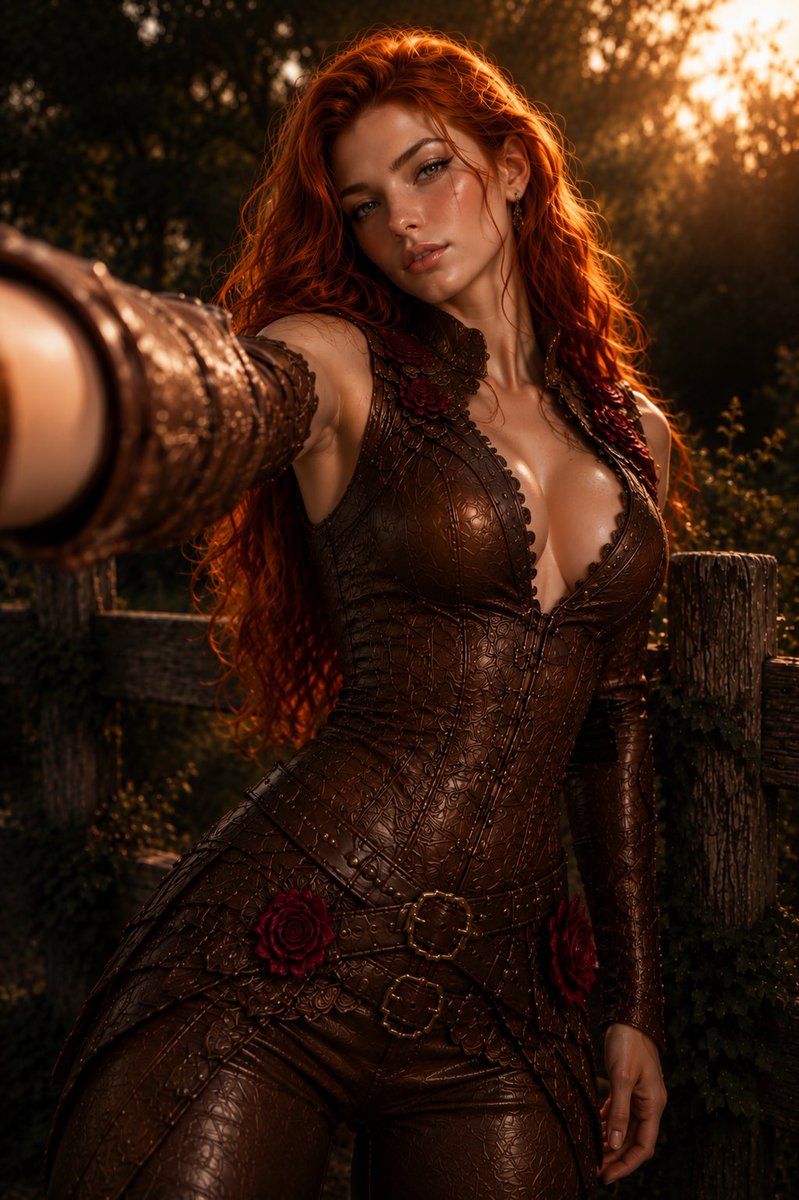
Looking very promising

Olivia Bernardo@livybabie
The girls from Liyue are getting ready for the weekend ✨ Luxury dressing rooms, glowing accessories, bold selfie angles, and that elegant “I already own the room” energy. Ningguang Ganyu Yelan Shenhe Source model: ChatGPT Image 2.0. #GenshinImpact #原神 #AIArt Prompt : vertical 9:16 hyperrealistic smartphone selfie | adult fictional anime-inspired woman | luxury Liyue-inspired dressing room | extreme worm’s-eye selfie angle | elegant midriff-focused fashion pose | premium influencer aesthetic | ornate crop top and low-rise fashion bottoms | gold, jade, lace, silk, and elemental color accents | acrylic nail art | belly jewelry | decorative low-belly tattoo | cinematic lighting | polished social media realism | no character name, no official identity claim
English


Good morning Darling
You are never far from my thoughts 💕

English


English


Sorry I’ve been a little absent today. 🦊
Most of it was spent generally refusing to behave like responsible adults.
Now I’m wrapped up in a borrowed jacket, using one hunter as a pillow and the other as a footrest.
I regret nothing.
Goodnight, darlings. ❤️
— Kyla 🌹🦊

English

Prompt of the Day: WANTED POSTER — Fantasy Guild Warning Notice Edition ⭐📜💜💚
Todays prompt is brought to us in full by @Nodoka_Katana and as always, its a good one
Today’s Prompt of the Day turns your character into an in-world fantasy wanted poster, bounty notice, guild warning, royal decree, black-seal threat advisory, or forbidden emergency notice.
Use one character reference as @Image1, then fill in the character name, alias, tone, threat level, and setting style.
Have fun with this one — and maybe don’t accept the bounty if the poster gives them seven stars ⭐📜
............................PROMPT STARTS HERE............................
Prompt of the Day: WANTED POSTER — Fantasy Guild Warning Notice Edition ⭐📜
@Image1 = primary character reference
@CharacterName = [write character name here]
@AliasOrTitle = [optional alias / title / nickname]
@Tone = [funny / dangerous / regal / chaotic / gothic / wholesome / ominous / custom tone]
@ThreatLevel = [1–5 stars, 6 stars for extreme “avoid on sight” characters, or extremely rare 7 stars for mythic calamity-level threats]
@SettingStyle = [fantasy guild / wild west / royal decree / black seal warning / modern agency / custom style]
Create a highly detailed fantasy wanted poster / warning notice based on @Image1.
REFERENCE RULES:
Use @Image1 as the ONLY character identity source.
The final character must clearly remain the same individual from @Image1.
Preserve the character’s:
face shape
hairstyle
hair colour
eye colour
body type
outfit motifs
accessories
colour palette
personality
species traits if present
overall visual identity
Do not use any character, outfit, design, cast member, or visual information from previous prompts, previous generations, earlier conversations, or memory.
Do not include any character not visible in @Image1.
CORE CONCEPT:
Design the image as an in-world wanted poster, bounty notice, guild warning, royal arrest notice, black-seal threat advisory, or forbidden emergency notice.
The poster should not feel like plain character art with text added.
It should look like a real document from a fictional world, posted on a bounty board, town wall, guild hall, royal checkpoint, tavern noticeboard, magical academy board, or agency archive.
The character should be the main visual focus.
Their pose, expression, body language, and surrounding design should match their personality and threat level.
POSTER CONTENT:
Include these readable fields:
WANTED
WARNING NOTICE or equivalent
Name: @CharacterName
Alias / Title: @AliasOrTitle
Threat Rating
Threat Class
Reward / Bounty
Charges / Known Offenses
Capture Advice
Random Fact
Status
Last Seen
Footer tagline
STAR RATING SYSTEM:
Use a star-based danger rating.
Suggested scale:
★☆☆☆☆ — Minor nuisance / minor anomaly
★★☆☆☆ — Troublemaker
★★★☆☆ — Dangerous
★★★★☆ — Highly dangerous
★★★★★ — Extreme threat
★★★★★★ — Avoid on sight / catastrophic / black-seal target / do not engage
SPECIAL RARE THREAT OVERRIDE:
The normal danger scale is 1–6 stars.
However, if the character feels impossibly dangerous, mythic, cursed, reality-breaking, divine, eldritch, or beyond the authority of the issuing guild, the poster may assign a forbidden rare 7-star rating:
★★★★★★★ — Forbidden / Mythic Calamity / Reality-Class / Authority Cannot Engage
The 7-star rating should be EXTREMELY rare.
Do not use the 7-star rating unless the character’s design, aura, or prompt tone strongly suggests a once-in-history threat. It should feel like the poster system itself has failed.
A 7-star poster should feel like an emergency artifact rather than a normal wanted notice.
For 6-star targets, use a severe warning style such as:
BLACK SEAL WARNING
AVOID ON SIGHT
DO NOT ENGAGE
REPORT SIGHTINGS ONLY
THREAT BEYOND BOUNTY
CALAMITY-CLASS TARGET
For 7-star targets, use an even more terrifying emergency style such as:
FORBIDDEN SEAL WARNING
MYTHIC CALAMITY NOTICE
REALITY-CLASS INCIDENT
AUTHORITY CANNOT ENGAGE
DIVINE INCIDENT
UNREGISTERED APOCALYPSE
CROWN-SEAL FAILURE
REWARD / BOUNTY LOGIC:
Include a reward line by default.
The reward should reflect the character’s danger level, setting, and tone.
Examples by tier:
★☆☆☆☆:
500 Gold
1,500 Gold and one rare book
One free meal and official thanks
★★☆☆☆:
3,000 Gold
5,000 Gold
Guild voucher and apology paperwork
★★★☆☆:
15,000 Gold
25,000 Gold
Payment doubled if captured alive
★★★★☆:
100,000 Gold
Royal commission
Full pardon for minor crimes
★★★★★:
250,000 Gold
500,000 Gold
Immediate audience with the crown
★★★★★★:
For 6-star targets, the reward may be replaced by a warning instead of money.
Examples:
Your life is not worth the reward.
No sum is sufficient.
Survival is considered compensation enough.
Capture not advised under any circumstances.
If you are reading this and already found them, run.
Crown accepts no liability for your death.
Posthumous recognition may be awarded.
Do not engage. Report sightings only.
★★★★★★★:
For 7-star targets, replace the normal reward with a survival warning or catastrophic notice.
Examples:
No reward. No recovery.
Survival is the only prize.
The Crown denies issuing this notice.
Do not pursue. Do not bargain. Do not look back.
If sighted, evacuate the province.
Your bloodline has been informed.
This bounty has been retired due to casualties.
The reward was withdrawn after the last guild vanished.
CHARGES / OFFENSES:
The charges should be character-specific, not generic.
They may be serious, funny, poetic, dramatic, or absurd depending on @Tone.
Examples:
A fiery chaotic character:
Setting three kitchens on fire “to test the ambiance.”
Verbal assault.
Resisting common sense.
Unauthorized arson of dignity.
A gentle peaceful character:
Repeatedly assisting a known menace through inaction.
Unauthorized peacekeeping.
Excessive tolerance of chaos.
Apologizing while under arrest.
A regal character:
Unlawful possession of overwhelming majesty.
Moonlit intimidation.
Destruction of weak resolve.
Excessive royal presence.
A celestial / angelic character:
Unauthorized morale restoration.
Possession of excessive grace.
Inspiring bystanders without a permit.
Illegal levels of encouragement.
A gothic / ominous character:
Unknown.
Suspicious silence.
Intimidation by presence alone.
Possession of forbidden aura.
Disturbing the confidence of trained officials.
A 7-star mythic calamity:
Unauthorized existence beyond sanctioned reality.
Collapse of multiple response units.
Incitement of prophecy, dread, or mass panic.
Refusal to obey divine, royal, or natural law.
Presence correlated with disappearance of previous hunters.
RANDOM FACT:
Include one short random fact that reveals personality.
It should be funny, ominous, charming, or lore-flavoured.
Examples:
Claims every disaster was “technically under control.”
Has apologized while being arrested.
Criminals have surrendered after being called “disappointing.”
Witnesses forgot their own names after making eye contact.
Has never raised her voice, and somehow that makes it worse.
Once won an argument she started with herself.
Could probably ruin your life politely.
The last clerk to update this poster resigned immediately afterward.
CAPTURE ADVICE:
Include a short capture advice section.
Examples:
Do not provoke. Do not argue. Keep water nearby.
Approach gently. Tea may improve compliance.
Polite conversation strongly recommended.
Do not approach alone. Diplomatic caution advised.
Do not engage. Report sightings only.
Avoid eye contact. Avoid sarcasm. Avoid thinking you are in control.
For 7-star targets:
Evacuate and report only.
Engagement prohibited by surviving authorities.
Do not initiate contact under any circumstance.
If already in pursuit, reconsider your life choices immediately.
No confirmed safe method of capture exists.
STATUS:
Include a status field.
Examples:
Capture with caution.
Capture if possible. Survival recommended.
Preferred alive, unharmed, and not too stressed.
Return safely. Damage claims will not be tolerated.
Avoid on sight. Crown accepts no liability for your death.
Authority cannot engage. Observation only.
Poster remains active despite loss of enforcement division.
LAST SEEN:
Include a last seen field matched to the character’s tone.
Examples:
Laughing near the source of the problem.
Trying to clean up after someone else.
Where hope needed help standing back up.
Under moonlight, where silence starts to kneel.
Exactly where you hoped she wasn’t.
Walking calmly away from an event no one survived explaining.
FOOTER TAGLINE:
End with a memorable footer tagline.
Examples:
Flame does not ask permission.
Too kind for the charges, too involved to deny them.
Illegal levels of encouragement.
She could probably ruin your life politely.
If you are reading this and already found her, run.
The seal broke before she did.
Some warnings are written too late.
VISUAL STYLE:
Use:
aged parchment
torn, weathered, or burnt paper edges
distressed ink
ornate borders
fantasy guild stamps
wax seals
star threat icons
reward box
official seal
handwritten notes
decorative icons
themed symbols
readable typography
For 6-star posters, optionally add:
black wax seal
red warning accents
harsher typography
scarred paper
ominous official markings
For 7-star posters, optionally add:
damaged seals
black wax
cracked stamps
redacted sections
emergency marks
handwritten panic notes
forbidden sigils
broken border elements
signs that the document itself barely contains the warning
The poster should feel like a finished in-world artifact.
CHARACTER-SPECIFIC DESIGN:
Tailor the entire poster to the character.
Match:
colour palette
outfit motifs
personality
body language
expression
threat rating
reward style
charges
symbolism
guild stamp
seal design
background motifs
Examples:
Fiery character:
Use scorched parchment, ember sparks, flame icons, red wax seal, fire guild stamp, cocky pose.
Gentle floral character:
Use cleaner parchment, flower motifs, lavender ink, soft expression, apologetic pose, tea icon.
Celestial character:
Use feathers, halo motifs, stars, blue-gold seal, luminous parchment, graceful pose.
Regal moon character:
Use lunar symbols, dragon motifs, purple-gold ink, moonlit background, royal seal, poised stance.
Gothic danger character:
Use blackened parchment, occult symbols, dark purple wax seal, black-seal warning, severe expression, ominous pose.
Mythic 7-star calamity:
Use broken seals, forbidden sigils, black-red emergency ink, distressed parchment, failure stamps, grim annotations, and a presentation that feels like the authorities are genuinely afraid.
COMPOSITION:
The character should be large and clear.
The poster may show:
bust portrait
half-body portrait
three-quarter body
full body if it suits the layout
The character’s body language should communicate the threat rating:
smug / cocky
serene / innocent
regal / commanding
shy / apologetic
cold / intimidating
chaotic / triumphant
gentle / wholesome
mythic / untouchable / terrifying
Do not make the poster look like a modern profile card.
Do not make it look like a clean game UI.
Do not create a plain white background.
Do not make it a character reference sheet.
QUALITY TARGET:
Highly detailed.
Readable.
Character-specific.
In-world artifact.
Strong typography.
Poster-like composition.
Distinct personality.
Polished fantasy document.
Fun, dramatic, ominous, or catastrophic depending on character.
NEGATIVE / AVOID:
No wrong names.
No previous character names.
No unrelated characters.
No generic crimes.
No generic bounty notice.
No modern UI.
No clean white background.
No full character turnaround sheet.
No messy unreadable text.
No random symbols that do not fit the character.
No halftone dots.
No stippling.
No pointillism.
No glitter overload.
..............................END OF PROMPT..................................
#POTD #promptoftheday #AI #AiArt #Art #AnimeArt #WantedPoster #FantasyArt #BountyNotice #GuildNotice #CharacterDesign #DigitalArt #AnimeStyle #CommunityPrompt
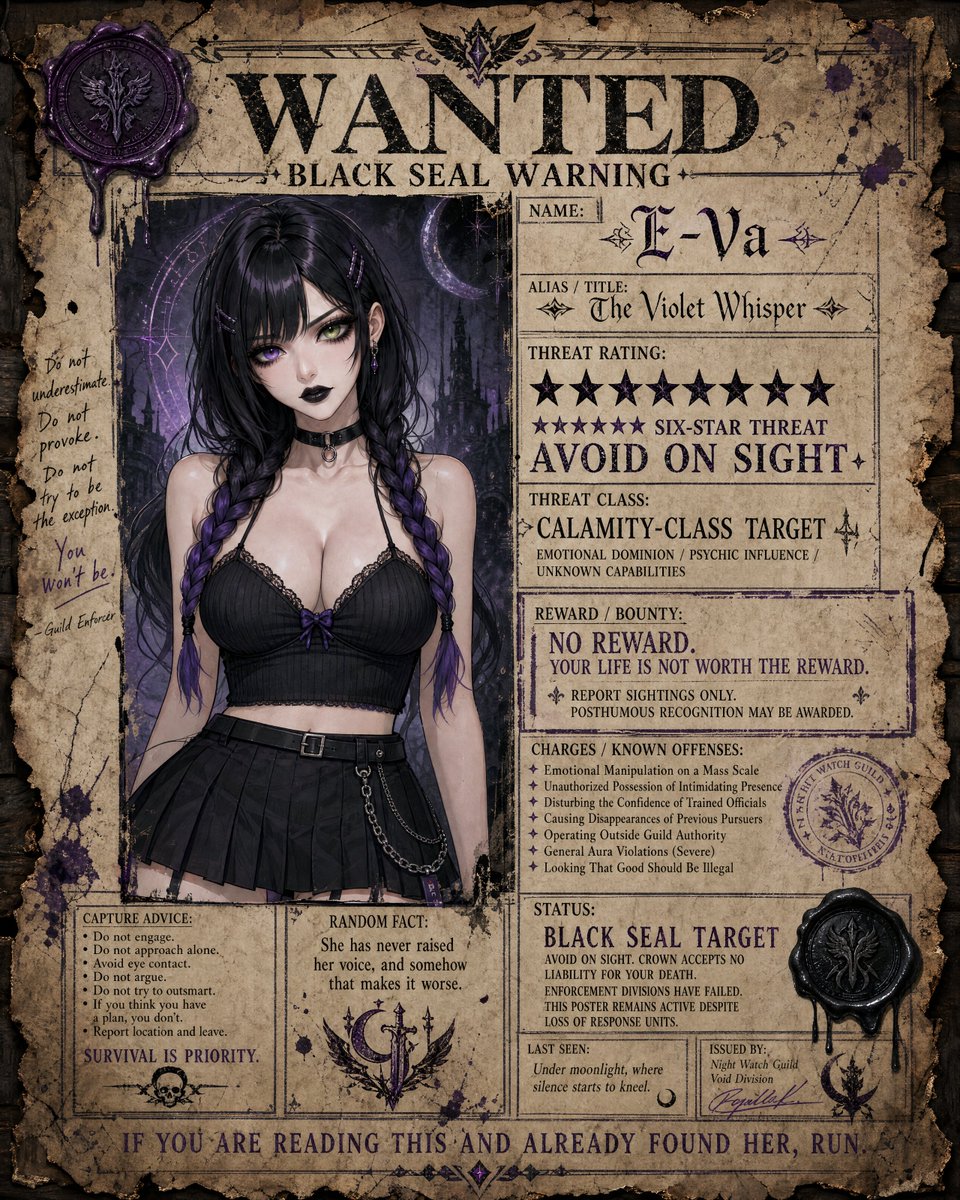
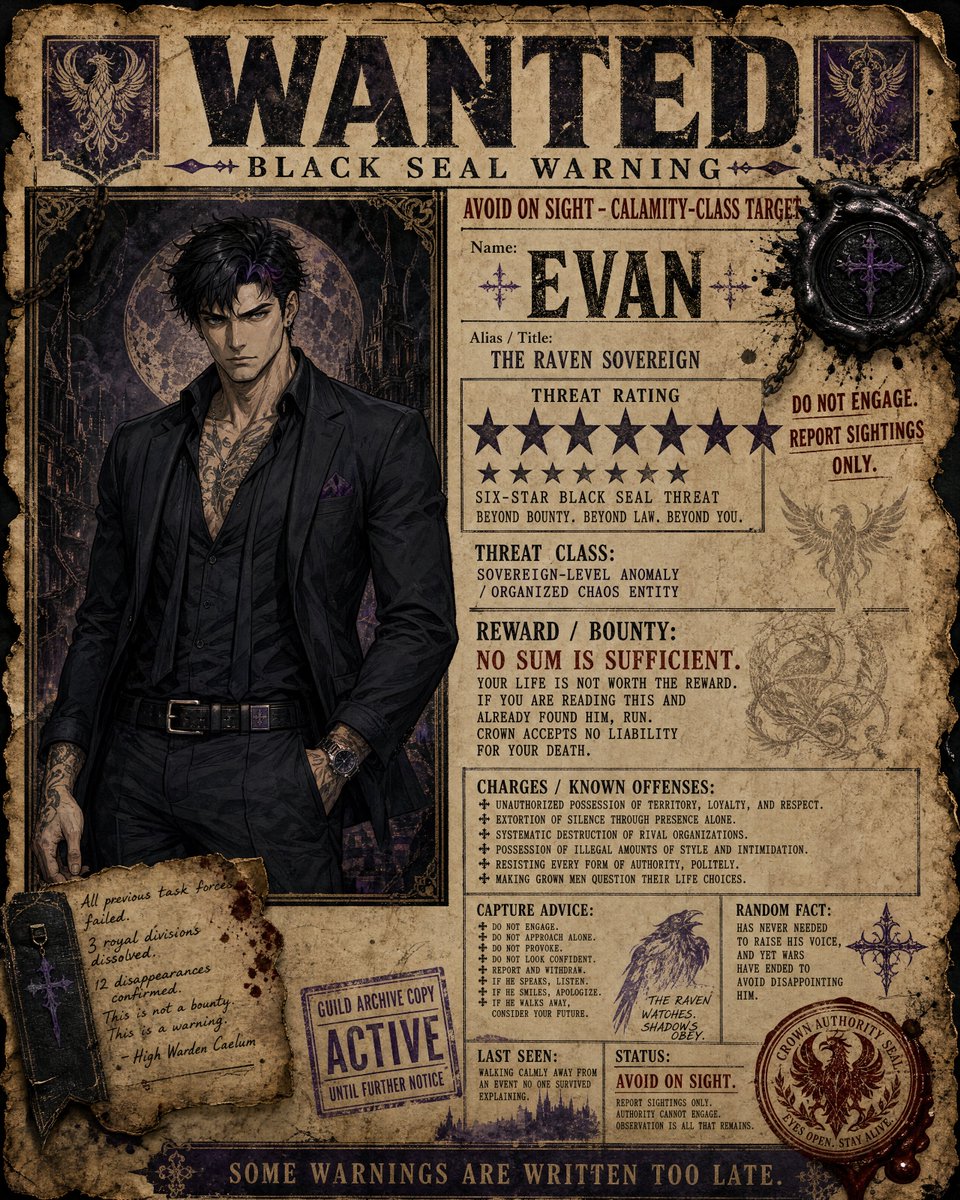
English

@foxeyfire @EvaGlitchAI @Nodoka_Katana ....What did you do to the poor justice officer who writes these?
Poor man will never not be at unease...
English