Michael Shellenberger

32.3K posts

Michael Shellenberger banner
Michael Shellenberger

Michael Shellenberger

@shellenberger

CBR Chair of Politics, Censorship & Free Speech @UAustinOrg : Dao Journalism Winner : Time, "Hero of Environment" : Author, “Apocalypse Never,” "San Fransicko"

Berkeley, CA 加入时间 Mayıs 2014
1.9K 关注1.4M 粉丝
置顶推文
Michael Shellenberger
Michael Shellenberger@shellenberger·
The Hormuz crisis is the precipitating factor in the current energy crisis, but the underlying cause is too little oil and gas production outside the Persian Gulf. Had the world spent the past decade building the oil, gas, LNG, pipeline, and fertilizer infrastructure that engineers designed and companies proposed, the Hormuz crisis would still be a serious geopolitical event, but it would not threaten to cause a recession. North America — The Atlantic Coast Pipeline, a 600-mile natural gas line from West Virginia to North Carolina, saw its cost double from $4.5 billion to $8 billion during years of environmental litigation before Duke Energy and Dominion Energy cancelled it in July 2020. — The Constitution Pipeline from Pennsylvania to New York died the same year. — The PennEast Pipeline won its case at the United States Supreme Court in 2021 and still could not get built because New Jersey refused to issue state permits. — In Canada, TransCanada abandoned the $15.7 billion Energy East pipeline in 2017 after the National Energy Board required an unprecedented review of upstream and downstream emissions. — In January 2024, the Biden administration paused all pending approvals for LNG export terminals shipping to non-free-trade-agreement countries, freezing projects representing tens of billions of cubic feet per day of potential capacity. — Venture Global’s CP2 terminal in Louisiana, designed for 20 million tonnes per annum, sat in regulatory limbo for over a year. — NextDecade’s Rio Grande LNG in Texas, with 48 MTPA of planned capacity, stalled alongside it. — PTT Global Chemical’s proposed $10 billion ethane cracker in Belmont County, Ohio, first announced in 2015, remains on indefinite hold after failing to attract financing partners amid climate-driven investor sentiment. — Across the US Gulf Coast, nearly 60% of planned plastic and petrochemical production projects sit on hold. — LNG Canada, the Shell-led terminal at Kitimat, British Columbia, took over six years from construction start to first cargo, with its pipeline running 263% over budget. Environmental review, Indigenous disputes, and contractor cost escalation all contributed. — Pieridae Energy’s Goldboro LNG project in Nova Scotia, a 10 MTPA facility first proposed in 2012, was abandoned in November 2023 after more than a decade of permitting and financing obstacles. Australia — Australia’s Santos’s Barossa gas project was halted midway through construction after a Federal Court ruling overturned its environmental approval. — Woodside’s Scarborough project faces ongoing litigation from the Australian Conservation Foundation seeking to block it on climate grounds. Africa — Perhaps nowhere has the damage been more consequential than in Africa. At COP26 in 2021, wealthy nations pledged to halt overseas development finance for gas projects, a commitment that fell hardest on the continent least responsible for climate change and most in need of energy infrastructure. — The World Bank stopped financing oil and gas extraction in 2019 and imposed restrictive conditions on downstream gas projects. — The European Investment Bank announced a complete ban on unabated fossil fuel financing by the end of 2021, with its president declaring that “gas is over.” — At least 21 other development finance institutions followed suit. As a result: — TotalEnergies’ Mozambique LNG project sat under force majeure for four and a half years after the UK Export Credit Agency and other backers withdrew climate-motivated financing. — The East African Crude Oil Pipeline lost financing commitments from more than 30 major international banks under pressure from climatists. Europe — France prevented the completion of a third gas interconnector with Spain, citing climate neutrality goals. — The United Kingdom imposed a moratorium on fracking in 2019 despite sitting atop one of Europe’s most promising shale gas formations. — Germany, which shuttered its last three nuclear plants in April 2023, compounded its gas dependency by refusing to develop domestic shale resources. — CF Industries permanently shut the UK’s largest ammonia plant at Billingham, a facility that also produced 60% of Britain’s food-grade CO2. — Yara International curtailed output across plants in France, Italy, and Belgium before permanently closing its 400,000 tonne per year ammonia facility at Tertre, Belgium, in October 2024. These closures occurred because European climate policy made gas too expensive for the domestic industry to survive.
Michael Shellenberger@shellenberger

We should have spent more on green energy, say the media. No, we shouldn't have. The $2 trillion we spent did nothing to prevent the energy crisis and may even have caused it.

English

335
2.9K
8.6K
614.9K
Michael Shellenberger 已转推
Pavel Durov
Pavel Durov@durov·
The “age verification app” the EU wants to impose on the world got hacked in 2 minutes. Step 1: Present a “privacy-respecting” but hackable solution. Step 2: Get hacked (you are here). Step 3: Remove privacy to "fix" it. Result: a surveillance tool sold as “privacy-respecting”.
English
457
7.1K
24.9K
595.5K
Michael Shellenberger
Michael Shellenberger@shellenberger·
Last week, a video of Jennifer Siebel Newsom, the wife of California Governor Gavin Newsom, went viral on X. In the clip, filmed at the Common Sense Summit on Kids and Families in May 2025, Siebel Newsom tells the audience that “boys who spend time online are moving a little bit—I’m trying not to be political here—but are moving to the right.” She described her own son’s curiosity about Andrew Tate, which he had discussed with her Republican father, as “scary.” She said, “We’re working on legislation to hold tech companies accountable, to really provide all the best-in-class resources and support for youth so that they don’t go down this rabbit hole of very, very dangerous and limiting narratives around ultimately what it means to be girl and what it means to be a boy.” There are good reasons to be concerned about the impact of social media on young people, but Siebel Newsom, despite her attempt not to be political, made clear her problem was with boys “moving to the right,” which is a very different concern from the ones being raised by Jonathan Haidt and others about the impact of social media on childhood. Jacob Siegel warns that the Censorship Industrial Complex is a permanent demand of the governing class. [Author photo]📷 And Siebel Newsom’s remarks come in the context of efforts by her husband to control and even censor information. In 2023, Newsom announced a state initiative for citizens to report disfavored speech (non-criminal “hate incidents”) they see online. In September 2024, the governor signed AB 2655 and AB 2839, two laws aimed at banning political “deepfakes” during election seasons. In September 2025, Senior U.S. District Judge John Mendez struck them both down, saying that the laws discriminated “based on content, viewpoint, and speaker and targets constitutionally protected speech,” and that “California cannot preemptively sterilize political content.” And then, in October 2025, Governor Newsom signed a package of bills, including AB 1043, which requires device-makers like Apple and Google to verify user ages and share that information with apps. This is ostensibly to prevent children from using social media but the risk is the end of anonymity, which has long been protected as a First Amendment right, online. The Newsoms’ censorial impulse is not unique. Across the West, progressives, governing parties, and supranational institutions are racing to erect a new architecture of total information control and surveillance, despite it being antithetical to perhaps our most important right, that of free speech. Why can’t they let it go? In his new book, The Information State: Politics in the Age of Total Control, journalist Jacob Siegel argues that the censorship industrial complex is only the surface manifestation of an older and deeper, technocratic mode of rule that seeks to replace democratic self-government with top-down information management.... x.com/shellenberger/… Please subscribe now to support Public's defense of free speech, to read the full article, and watch the full interview! x.com/shellenberger/…
English
10
52
342
37.1K
Michael Shellenberger
Michael Shellenberger@shellenberger·
Gavin Newsom's wife expressed concern with boys "moving to the right" and said "we're working on legislation" to address it. @Jacob__Siegel, the author of a major new book, says progressives are waiting in the wings with a plan for total information control to counter populism.
Michael Shellenberger tweet media
English
36
131
566
50.3K
Michael Shellenberger 已转推
Michael Shellenberger
Michael Shellenberger@shellenberger·
The Hormuz crisis is the precipitating factor in the current energy crisis, but the underlying cause is too little oil and gas production outside the Persian Gulf. Had the world spent the past decade building the oil, gas, LNG, pipeline, and fertilizer infrastructure that engineers designed and companies proposed, the Hormuz crisis would still be a serious geopolitical event, but it would not threaten to cause a recession. North America — The Atlantic Coast Pipeline, a 600-mile natural gas line from West Virginia to North Carolina, saw its cost double from $4.5 billion to $8 billion during years of environmental litigation before Duke Energy and Dominion Energy cancelled it in July 2020. — The Constitution Pipeline from Pennsylvania to New York died the same year. — The PennEast Pipeline won its case at the United States Supreme Court in 2021 and still could not get built because New Jersey refused to issue state permits. — In Canada, TransCanada abandoned the $15.7 billion Energy East pipeline in 2017 after the National Energy Board required an unprecedented review of upstream and downstream emissions. — In January 2024, the Biden administration paused all pending approvals for LNG export terminals shipping to non-free-trade-agreement countries, freezing projects representing tens of billions of cubic feet per day of potential capacity. — Venture Global’s CP2 terminal in Louisiana, designed for 20 million tonnes per annum, sat in regulatory limbo for over a year. — NextDecade’s Rio Grande LNG in Texas, with 48 MTPA of planned capacity, stalled alongside it. — PTT Global Chemical’s proposed $10 billion ethane cracker in Belmont County, Ohio, first announced in 2015, remains on indefinite hold after failing to attract financing partners amid climate-driven investor sentiment. — Across the US Gulf Coast, nearly 60% of planned plastic and petrochemical production projects sit on hold. — LNG Canada, the Shell-led terminal at Kitimat, British Columbia, took over six years from construction start to first cargo, with its pipeline running 263% over budget. Environmental review, Indigenous disputes, and contractor cost escalation all contributed. — Pieridae Energy’s Goldboro LNG project in Nova Scotia, a 10 MTPA facility first proposed in 2012, was abandoned in November 2023 after more than a decade of permitting and financing obstacles. Australia — Australia’s Santos’s Barossa gas project was halted midway through construction after a Federal Court ruling overturned its environmental approval. — Woodside’s Scarborough project faces ongoing litigation from the Australian Conservation Foundation seeking to block it on climate grounds. Africa — Perhaps nowhere has the damage been more consequential than in Africa. At COP26 in 2021, wealthy nations pledged to halt overseas development finance for gas projects, a commitment that fell hardest on the continent least responsible for climate change and most in need of energy infrastructure. — The World Bank stopped financing oil and gas extraction in 2019 and imposed restrictive conditions on downstream gas projects. — The European Investment Bank announced a complete ban on unabated fossil fuel financing by the end of 2021, with its president declaring that “gas is over.” — At least 21 other development finance institutions followed suit. As a result: — TotalEnergies’ Mozambique LNG project sat under force majeure for four and a half years after the UK Export Credit Agency and other backers withdrew climate-motivated financing. — The East African Crude Oil Pipeline lost financing commitments from more than 30 major international banks under pressure from climatists. Europe — France prevented the completion of a third gas interconnector with Spain, citing climate neutrality goals. — The United Kingdom imposed a moratorium on fracking in 2019 despite sitting atop one of Europe’s most promising shale gas formations. — Germany, which shuttered its last three nuclear plants in April 2023, compounded its gas dependency by refusing to develop domestic shale resources. — CF Industries permanently shut the UK’s largest ammonia plant at Billingham, a facility that also produced 60% of Britain’s food-grade CO2. — Yara International curtailed output across plants in France, Italy, and Belgium before permanently closing its 400,000 tonne per year ammonia facility at Tertre, Belgium, in October 2024. These closures occurred because European climate policy made gas too expensive for the domestic industry to survive.
Michael Shellenberger@shellenberger

We should have spent more on green energy, say the media. No, we shouldn't have. The $2 trillion we spent did nothing to prevent the energy crisis and may even have caused it.

English

335
2.9K
8.6K
614.9K
Michael Shellenberger
Michael Shellenberger@shellenberger·
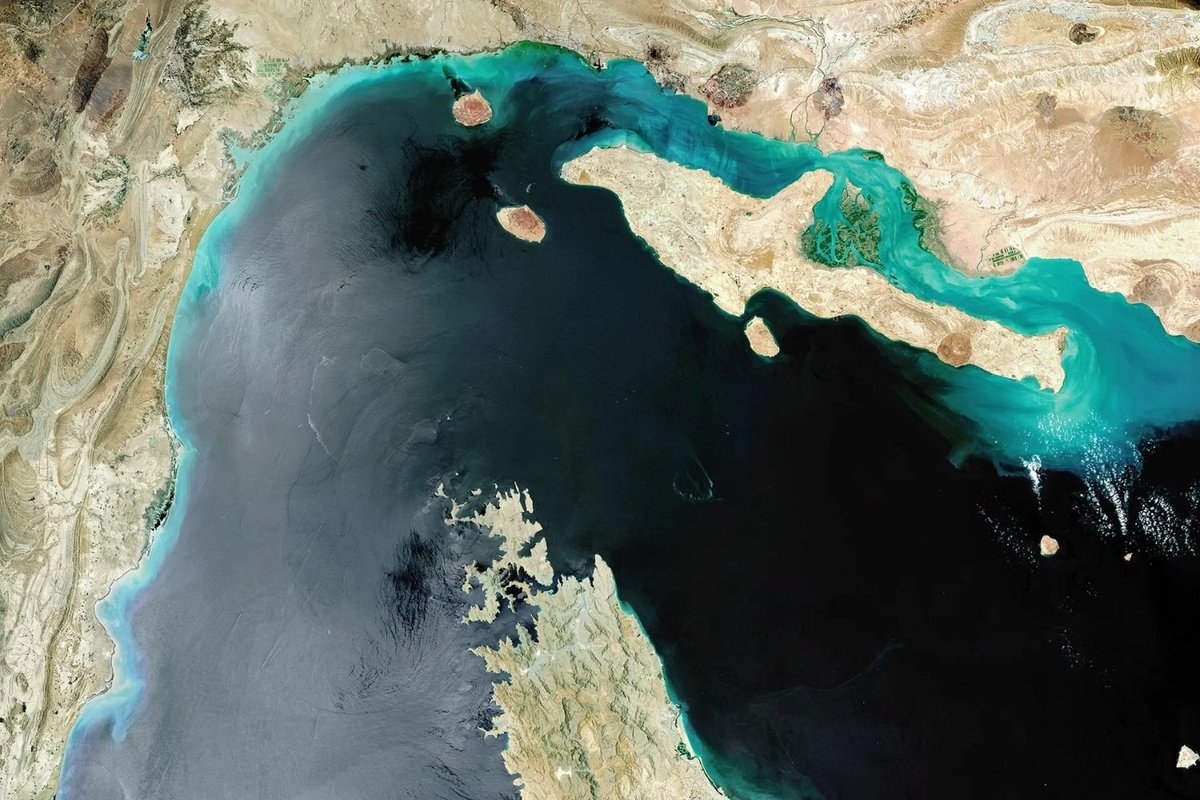
The Hormuz Strait was a disaster waiting to happen. The only solution is to diversify energy production and for Gulf nations to build pipelines to export their oil and gas via the Red Sea and Mediterranean. More war will result in more harm and higher energy prices for longer.
Michael Shellenberger tweet media
English
101
152
1.3K
115.3K
Michael Shellenberger 已转推
Disclose.tv
Disclose.tv@disclosetv·
JUST IN - No oil tankers have passed through the Strait of Hormuz since yesterday's ceasefire, and the four ships that have passed are all dry cargo carriers, data from shipping intelligence firm Kpler shows — NYT
Disclose.tv tweet media
English
99
633
2.9K
205.5K
Michael Shellenberger 已转推
Disclose.tv
Disclose.tv@disclosetv·
JUST IN - Several ships received messages in the Gulf claiming to be from the Iranian navy saying the Strait of Hormuz remains closed — Reuters
Disclose.tv tweet media
English
174
1.1K
4.2K
259.5K
Michael Shellenberger
Michael Shellenberger@shellenberger·
The Trump administration underestimated Iran’s willingness to close the Strait of Hormuz, note many in the media. CNN reported that while the Departments of Energy and the Treasury participated in pre-war planning meetings, “the agency analysis and forecasts that would be integral elements of the decision-making process in past administrations were secondary considerations.” But the Strait of Hormuz was a catastrophe waiting to happen. A few years from now, people will look back on this moment and find it incredible that the world allowed the global economy to be dependent on moving so much oil and natural gas through such a dangerous bottleneck. Part of the solution is for the world to reduce its dependence on Persian Gulf oil and gas. That will require expanding production outside the Persian Gulf. Another part is to help Persian Gulf nations move more of their oil and gas through new or expanded pipelines to the Red Sea and perhaps even the Mediterranean. The faster the world builds those alternatives, the less leverage Iran retains. Many believe that the United States must not allow Iran to control the Strait under any circumstances, and the instinct to fight for Hormuz is understandable. It has been a central artery of global energy for over half a century. But instead of fighting to reopen the Strait, the world should build around it. The infrastructure to do so already exists in embryonic form. Saudi Arabia’s East-West pipeline, built during the Iran-Iraq war in the 1980s, carries crude 750 miles across the kingdom from the Gulf coast to the Red Sea port of Yanbu, with a design capacity of 7 million barrels per day. The UAE’s Abu Dhabi Crude Oil Pipeline runs to Fujairah on the Gulf of Oman, bypassing the Strait entirely. And Iraq’s Kirkuk-Ceyhan pipeline connects to the Mediterranean coast of Turkey. Gulf states are already exploring a broader network of pipelines, railways, and roads, including the U.S.-backed India-Middle East-Europe Economic Corridor (IMEC), that would create multiple export routes to the Red Sea and the Mediterranean. Kuwait, Bahrain, and Qatar, which have no bypass pipelines at all, should build routes through Saudi Arabia or Iraq, argued The National, a UAE newspaper. And Japan, South Korea, and India should, the paper argued, invest alongside Gulf sovereign wealth funds. Iran will almost certainly impose tolls on vessels transiting the Strait, as its parliament has already passed a bill to formalize fee collection. A toll of $2 to $5 per barrel, the range analysts expect Iran to charge, would add roughly $40 to $100 billion per year to global energy costs. But more war will cause far more harm than simply building alternatives because every escalation destroys infrastructure that the world needs to produce and export energy. While “all roads” may lead to “structurally higher oil prices,” as one analysis of future scenarios concluded, one of those roads leads to far less damage to people and energy infrastructure. Iran’s strikes on Ras Laffan, Qatar’s LNG hub, will take three to five years to repair. The strikes on South Pars threaten the world’s largest natural gas reserve. Iran’s attacks on Gulf neighbors have damaged refineries, desalination plants, and port facilities across Saudi Arabia, the UAE, Bahrain, and Kuwait. And consider how much more damage is possible. After the US struck Kharg Island, Iran’s main oil export hub, and Israel hit Iran’s largest petrochemical complex at South Pars, the world’s largest natural gas reserve, Iran’s military threatened to “deprive the U.S. and its allies of the region’s oil and gas for years.” As such, the $40 to $100 billion is a fraction of the $2 trillion or more that Goldman Sachs has estimated the war has already cost the global economy in lost output, destroyed infrastructure, and elevated energy prices. And continued war could lead Iran to cut off the flows of existing Saudi oil flows through its East-West pipeline. Iranian adviser Aliakbar Velayati warned that Iran views the Bab al-Mandab Strait off Yemen “with the same intensity as Hormuz” and that “the flow of energy and global trade can be disrupted with a single signal.” x.com/shellenberger/… Please subscribe now to support Public's award-winning investigative journalism, read the rest of the article, and watch the full video. x.com/shellenberger/…
English
42
27
257
61.1K
Michael Shellenberger
Michael Shellenberger@shellenberger·
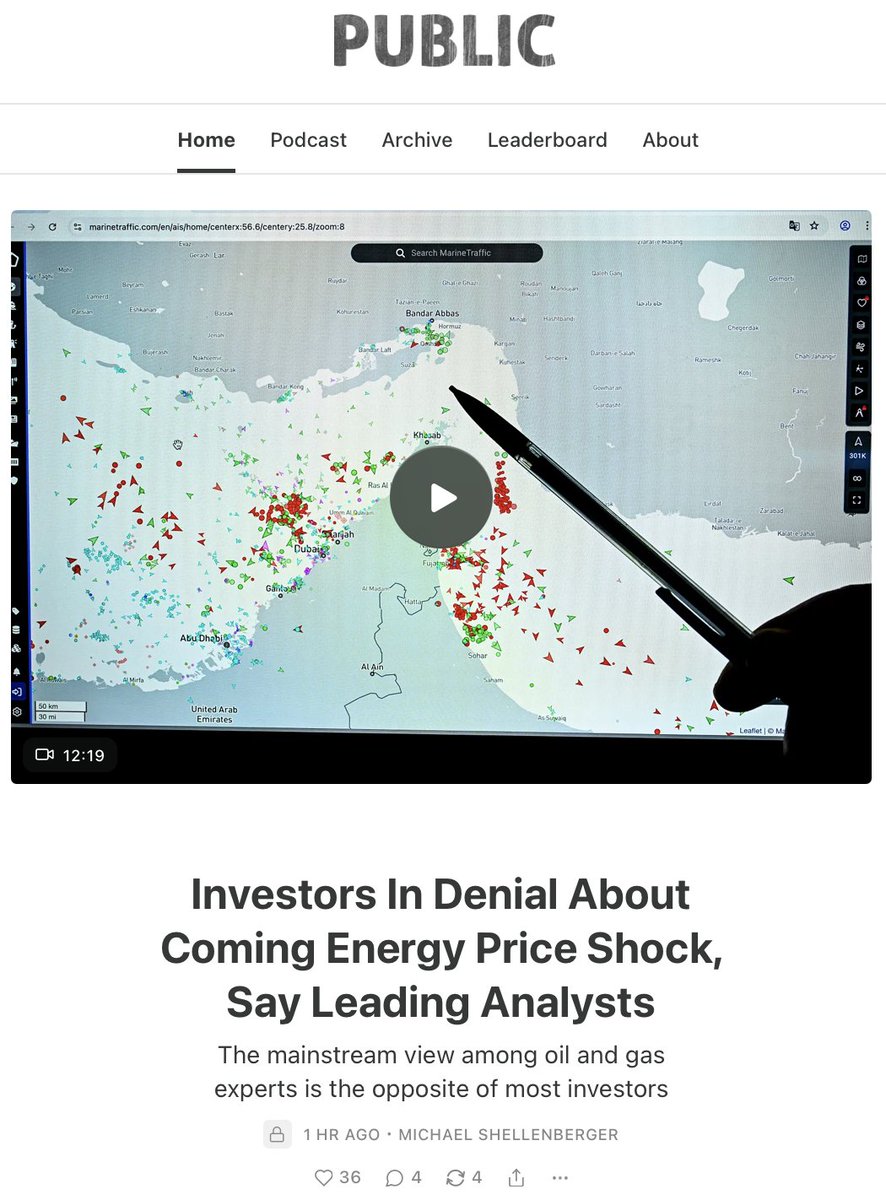
Investors built their portfolios for a world of cheap energy that no longer exists. Dozens of traders, shippers, and executives say the market still has not grasped the severity of the Hormuz crisis. Today might be the day it does.
Michael Shellenberger tweet media
English
25
59
523
104.8K
Michael Shellenberger 已转推
Maurice Cousins
Maurice Cousins@MDC12345678·
Great post by @shellenberger. This is the piece I wish I had written a few months ago, when British Labour MPs and others were talking about “abundance”. The word has been totally twisted - like “electrification” and “clean” - to distort ordinary people’s understanding of the true goals of the climate lobby: (1) the prioritisation of renewables at all costs and (2) the re-engineering of our societies and economies low-energy, constraint-driven lines. It is a clever strategy, born out of the so-called “greenlash” in the European elections and anticipation of Trump 2.0. The climate lobby recognised that Net Zero and decarbonisation had become toxic terms, associated with miserabilism. They sensed where the political wind was blowing and adapted with techno-utopianism. The problem is that their ideal is not remotely deliverable without imposing severe costs, constraints, and unpalatable trade-offs on ordinary people.
Michael Shellenberger@shellenberger

Renewables are the key to preventing resource scarcity, argue European leaders, California Governor Gavin Newsom, and Ezra Klein and Derek Thompson, whose bestselling book Abundance became one of Barack Obama’s favorite books of 2025 and launched a political movement dedicated to what Klein calls “a politics of plenty.” The logic is straightforward and appealing. Solar panel costs have fallen more than 90% since 2010. Wind power costs have dropped by 70%. Battery storage prices have collapsed. If governments would simply clear the regulatory obstacles to building solar farms, wind turbines, and transmission lines, the abundance argument goes, clean energy would flow so abundantly that fossil fuel dependence would become a choice rather than a necessity. “The miracles of solar and wind and battery power,” Klein told the Long Now Foundation, “have given us the only shot we have to avoid catastrophic climate change.” But if renewables could prevent resource scarcity, then the world would not be in the midst of what the International Energy Agency’s Executive Director Fatih Birol called “the greatest global energy security challenge in history,” with global supply losses now totaling 12 million barrels per day, compared to about 5 million during each of the 1973 and 1979 crises. The United Kingdom is receiving its last shipment of jet fuel from the Middle East with nothing behind it. Australia saw over 500 gas stations run dry. And South Korea is considering driving restrictions for the first time since 1991. “In April,” warned Birol, “there is nothing.” It is true that solar and batteries have made enormous progress. Solar electricity costs roughly 3 to 5 cents per kilowatt-hour at the point of generation, cheaper than any fossil fuel in most locations. Battery costs have fallen below $115 per kilowatt-hour. China produces more solar panels than the rest of the world combined. But the world has installed more than 1,600 gigawatts of solar capacity and over 1,000 gigawatts of wind, and still we are in crisis. Global green energy investment was $2.3 trillion in 2025 alone. And yet when Iran closed the Strait of Hormuz, none of that capacity mattered, because solar panels do not produce jet fuel, diesel, ammonia, or the petrochemical feedstocks that underpin modern civilization. Electricity accounts for roughly 20% of final energy consumption worldwide. The other 80%, the part that moves ships, flies planes, heats buildings, and makes fertilizer, runs overwhelmingly on oil and gas. Solar and wind cannot substitute for these fuels at any price, because the energy density of liquid hydrocarbons exceeds batteries by a factor of 40 to 80 by weight. Klein and Thompson, to their credit, also support some forms of nuclear power. Abundance opens with a vision of cities powered by “clean (nuclear) and renewable (wind and solar) energy sources.” They lament America’s nuclear stagnation compared to France’s successful buildout. Klein has said that he supports advancing nuclear power alongside renewables. But, the new nuclear power plants that Klein and Thompson support do not exist. The “small modular reactors” that populate the abundance fantasy have not produced a single commercial kilowatt-hour of electricity. NuScale, the most advanced American SMR developer, canceled its flagship project in 2023 after costs doubled. No SMR has received a commercial operating license anywhere in the world. The first commercially operating SMR, if all goes well, may produce power in the early 2030s, but SMR developers have for years said that their reactors are just a few years away. Scaling to a meaningful share of global energy supply would take decades, as opposed to building conventional nuclear plants, which Japan and China have shown they can build in just two years, so long as they are standardized and the same construction crews are used. Democrats, progressives, environmental groups, and left-wing parties across Europe diverted hundreds of billions of dollars over the last two decades from developing the new oil and gas production, pipelines, refineries, and LNG terminals needed to make energy cheap and abundant. California’s aggressive climate mandates drove residential electricity prices to 34 cents per kilowatt-hour, nearly double the national average, while the state simultaneously blocked new natural gas infrastructure. And global investment in oil and gas exploration and production peaked at roughly $780 billion in 2014 and fell to approximately $350 billion by 2020, a decline driven by deliberate policy choices to restrict fossil fuel development. The European Union’s Green Deal, America’s Inflation Reduction Act, and climate policies across the developed world channeled subsidies toward solar and wind while imposing carbon taxes, windfall levies, and permitting restrictions on fossil fuel projects. The UK’s Energy Profits Levy, introduced in 2022, discouraged investment in the North Sea at precisely the moment when more domestic production was needed. The UK Labor government then banned new exploration licenses in November 2025. Germany’s Energiewende spent over €500 billion on renewables while shutting down its nuclear plants, leaving the country dependent on Russian gas and then, after the Ukraine war, on LNG that must now compete with Asian buyers for cargoes that can no longer transit Hormuz. And the UK has lost a third of its refineries in the last 18 months, meaning that even if crude oil arrived tomorrow, the country lacks the capacity to refine it into the jet fuel, diesel, and heating oil its citizens need. The only energy abundance solution that works at the scale of civilization right now is piped natural gas and oil. A pipeline delivers energy continuously, at near-zero marginal cost per unit delivered, with no exposure to shipping chokepoints, insurance markets, or geopolitical disruption. A ton of natural gas moved through a pipeline costs a fraction of what the same gas costs when liquefied, shipped by tanker across an ocean, and regasified at a terminal. The logical endpoint is a world powered by natural gas delivered through continental pipeline networks, eventually transitioning to hydrogen produced from natural gas and nuclear power. America built pipelines while Europe and Asia built LNG dependency. Saudi Arabia’s East-West pipeline, which has ramped from 770,000 barrels per day to 2.9 million since the war began, is the emergency proof of concept. If the Gulf states had built sufficient pipeline capacity to bypass Hormuz before the war, the crisis would be a fraction of its current severity. So why do so many on the Left continue to preach renewables as the solution to a crisis that renewables manifestly cannot solve?... x.com/shellenberger/… Please subscribe now to support Public's award-winning investigative reporting, read the rest of the article, and watch the rest of the video! x.com/shellenberger/…

English
3
42
232
53.6K
Michael Shellenberger
Michael Shellenberger@shellenberger·
Renewables are the key to preventing resource scarcity, argue European leaders, California Governor Gavin Newsom, and Ezra Klein and Derek Thompson, whose bestselling book Abundance became one of Barack Obama’s favorite books of 2025 and launched a political movement dedicated to what Klein calls “a politics of plenty.” The logic is straightforward and appealing. Solar panel costs have fallen more than 90% since 2010. Wind power costs have dropped by 70%. Battery storage prices have collapsed. If governments would simply clear the regulatory obstacles to building solar farms, wind turbines, and transmission lines, the abundance argument goes, clean energy would flow so abundantly that fossil fuel dependence would become a choice rather than a necessity. “The miracles of solar and wind and battery power,” Klein told the Long Now Foundation, “have given us the only shot we have to avoid catastrophic climate change.” But if renewables could prevent resource scarcity, then the world would not be in the midst of what the International Energy Agency’s Executive Director Fatih Birol called “the greatest global energy security challenge in history,” with global supply losses now totaling 12 million barrels per day, compared to about 5 million during each of the 1973 and 1979 crises. The United Kingdom is receiving its last shipment of jet fuel from the Middle East with nothing behind it. Australia saw over 500 gas stations run dry. And South Korea is considering driving restrictions for the first time since 1991. “In April,” warned Birol, “there is nothing.” It is true that solar and batteries have made enormous progress. Solar electricity costs roughly 3 to 5 cents per kilowatt-hour at the point of generation, cheaper than any fossil fuel in most locations. Battery costs have fallen below $115 per kilowatt-hour. China produces more solar panels than the rest of the world combined. But the world has installed more than 1,600 gigawatts of solar capacity and over 1,000 gigawatts of wind, and still we are in crisis. Global green energy investment was $2.3 trillion in 2025 alone. And yet when Iran closed the Strait of Hormuz, none of that capacity mattered, because solar panels do not produce jet fuel, diesel, ammonia, or the petrochemical feedstocks that underpin modern civilization. Electricity accounts for roughly 20% of final energy consumption worldwide. The other 80%, the part that moves ships, flies planes, heats buildings, and makes fertilizer, runs overwhelmingly on oil and gas. Solar and wind cannot substitute for these fuels at any price, because the energy density of liquid hydrocarbons exceeds batteries by a factor of 40 to 80 by weight. Klein and Thompson, to their credit, also support some forms of nuclear power. Abundance opens with a vision of cities powered by “clean (nuclear) and renewable (wind and solar) energy sources.” They lament America’s nuclear stagnation compared to France’s successful buildout. Klein has said that he supports advancing nuclear power alongside renewables. But, the new nuclear power plants that Klein and Thompson support do not exist. The “small modular reactors” that populate the abundance fantasy have not produced a single commercial kilowatt-hour of electricity. NuScale, the most advanced American SMR developer, canceled its flagship project in 2023 after costs doubled. No SMR has received a commercial operating license anywhere in the world. The first commercially operating SMR, if all goes well, may produce power in the early 2030s, but SMR developers have for years said that their reactors are just a few years away. Scaling to a meaningful share of global energy supply would take decades, as opposed to building conventional nuclear plants, which Japan and China have shown they can build in just two years, so long as they are standardized and the same construction crews are used. Democrats, progressives, environmental groups, and left-wing parties across Europe diverted hundreds of billions of dollars over the last two decades from developing the new oil and gas production, pipelines, refineries, and LNG terminals needed to make energy cheap and abundant. California’s aggressive climate mandates drove residential electricity prices to 34 cents per kilowatt-hour, nearly double the national average, while the state simultaneously blocked new natural gas infrastructure. And global investment in oil and gas exploration and production peaked at roughly $780 billion in 2014 and fell to approximately $350 billion by 2020, a decline driven by deliberate policy choices to restrict fossil fuel development. The European Union’s Green Deal, America’s Inflation Reduction Act, and climate policies across the developed world channeled subsidies toward solar and wind while imposing carbon taxes, windfall levies, and permitting restrictions on fossil fuel projects. The UK’s Energy Profits Levy, introduced in 2022, discouraged investment in the North Sea at precisely the moment when more domestic production was needed. The UK Labor government then banned new exploration licenses in November 2025. Germany’s Energiewende spent over €500 billion on renewables while shutting down its nuclear plants, leaving the country dependent on Russian gas and then, after the Ukraine war, on LNG that must now compete with Asian buyers for cargoes that can no longer transit Hormuz. And the UK has lost a third of its refineries in the last 18 months, meaning that even if crude oil arrived tomorrow, the country lacks the capacity to refine it into the jet fuel, diesel, and heating oil its citizens need. The only energy abundance solution that works at the scale of civilization right now is piped natural gas and oil. A pipeline delivers energy continuously, at near-zero marginal cost per unit delivered, with no exposure to shipping chokepoints, insurance markets, or geopolitical disruption. A ton of natural gas moved through a pipeline costs a fraction of what the same gas costs when liquefied, shipped by tanker across an ocean, and regasified at a terminal. The logical endpoint is a world powered by natural gas delivered through continental pipeline networks, eventually transitioning to hydrogen produced from natural gas and nuclear power. America built pipelines while Europe and Asia built LNG dependency. Saudi Arabia’s East-West pipeline, which has ramped from 770,000 barrels per day to 2.9 million since the war began, is the emergency proof of concept. If the Gulf states had built sufficient pipeline capacity to bypass Hormuz before the war, the crisis would be a fraction of its current severity. So why do so many on the Left continue to preach renewables as the solution to a crisis that renewables manifestly cannot solve?... x.com/shellenberger/… Please subscribe now to support Public's award-winning investigative reporting, read the rest of the article, and watch the rest of the video! x.com/shellenberger/…
English
38
197
825
128.1K
Michael Shellenberger
Michael Shellenberger@shellenberger·
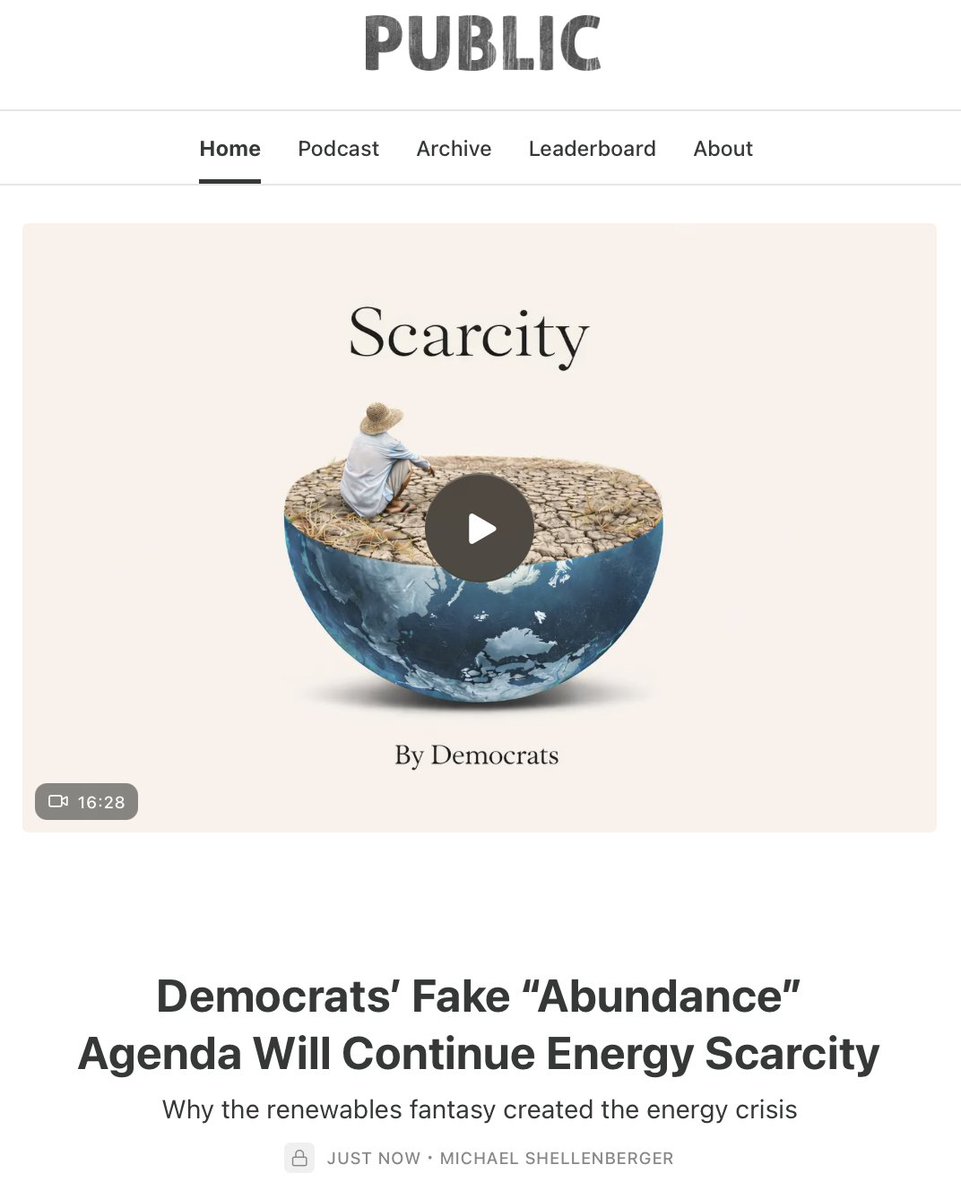
Democrats must rebrand their energy agenda around abundance, some say. But doing so is fundamentally dishonest. For decades, the party has fought, blocked, and closed nuclear plants, pipelines, and oil and natural gas production, laying the foundation for today's energy crisis.
Michael Shellenberger tweet media
English
27
206
970
50.9K