William F. Nicklin
3.8K posts

William F. Nicklin
@10baggerPicks
Picking stocks 60+ years - Ten Baggers. GE Finance. IB MD. OODA Loop. Focus: Ag Tech, Med Tech, Industrial moat, Energy, the Grid, Super Cycles


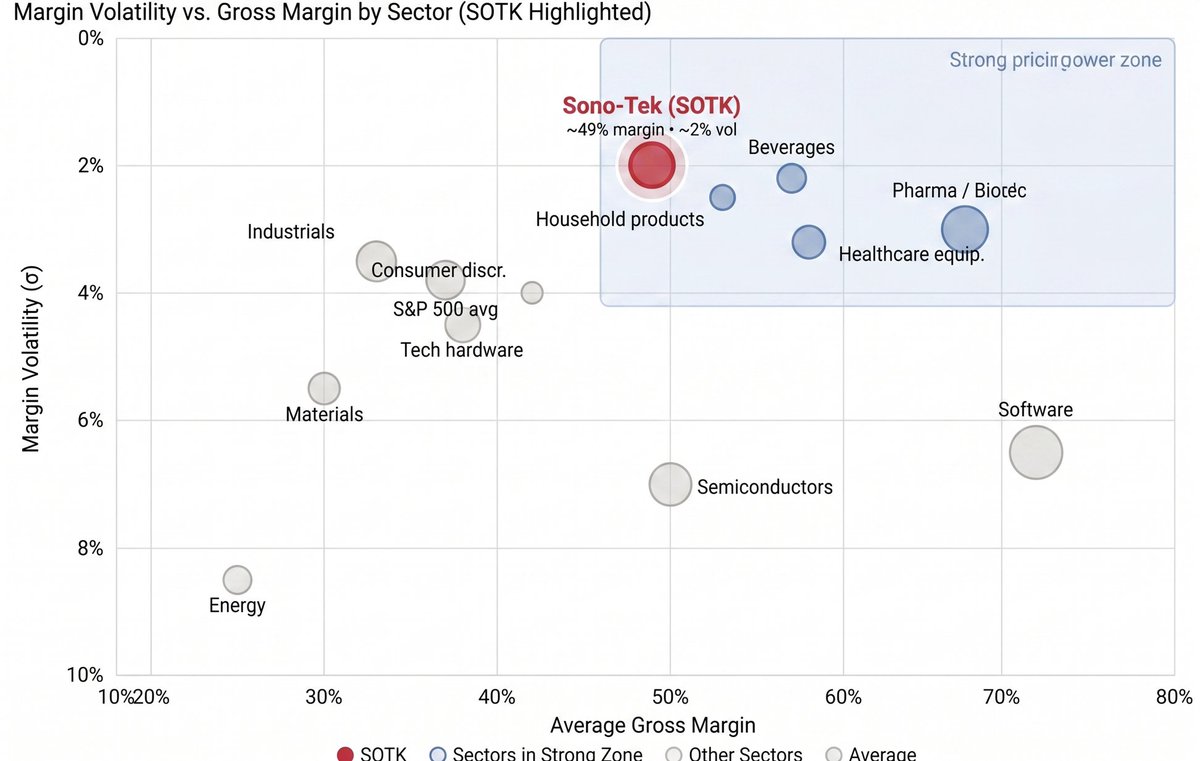
$SOTK investors who have been following me for a while know that I am "all in" and why. For newer Sono-Tek shareholders and onlookers interested in understanding the transition driving $SOTK's business, I present what I believe is fueling it and elevating its intrinsic value far above the current share price. $SOTK has high gross margins with low variability. High gross margins with low volatility provide the financial flexibility to fund FDEs, application engineering, and software development needed to transition from R&D systems to high-volume production machines. Positioning on the chart. Sono-Tek's gross margins have held between 45% and 52% for years, averaging around 49% with very little variation (evidence of a management team operating with clear-headed conviction, steadily building a multi-moat business anchored in higher-ASP production systems). Gross margins between 45% and 52% puts $SOTK in the same territory as pharma, beverages, and household products on the pricing power map. For a $20M industrial equipment company, that is unusual. Most industrials sit around 30% to 35% with wider swings. Even semiconductors, which overlap with some of Sono-Tek's end markets, carry more margin volatility. The S&P 500 average (clocking roughly 37%) falls well below and to the left. The moat behind those margins. Sono-Tek's ultrasonic coating technology sits in a narrow niche with few credible competitors. Their IP and process expertise form a real barrier to entry. Once a customer integrates a Sono-Tek system into a production workflow, the switching costs become significant because coating parameters, recipes, and calibration are all tightly coupled to the equipment. These dynamics check several boxes in the economic moat framework: intellectual property, switching costs, and efficient scale within a specialized market. How margin stability bankrolled the shift to production equipment. Sono-Tek describes its product line as rapidly evolving, transitioning from R&D systems to high-volume production machines with significantly higher average selling prices. The financial mechanics that enabled this are straightforward. Selling R&D units (typically under $100K each) at roughly 50% gross margin threw off enough cash to fund $2.5M to $2.7M in annual R&D without borrowing. The company held $12.68M in cash at the end of the latest fiscal year with zero debt. That balance sheet is a direct consequence of years of consistent, healthy margins on smaller equipment. The R&D systems also created a natural customer pipeline. A lab customer buys a small Sono-Tek unit, validates a coating process on it, and, when the time comes to scale, already knows the technology works. There is no reason to start over with a different vendor. In the alternative and clean energy market alone, sales grew 42%, driven by customers moving from R&D systems to production-scale systems with much higher ASPs. One production system order can cost more than 10 times that of a typical R&D unit. This creates a compounding effect. Low ASP sales build process lock-in. High margins on those sales fund the software development and engineering work needed to develop larger pilot lines and production platforms. Those production systems generate even more gross profit per unit, which in turn fuels further investment. The company's high-ASP strategy continues to drive growth and capture opportunities, shifting towards strong medical markets as clean energy hit speed bumps over the last year. The chart makes the point visually: Sono-Tek occupies moat territory that its industrial peers do not, and that margin cushion gave it the financial room to move from a lab equipment supplier to a production equipment provider without needing outside capital or taking on step-function risk. Disclosure: I am long $SOTK. This is not investment advice. Do your own research before making any investment decisions.


$GRC is my only "BUY" over the last six months (back in late January in the low $50s). I saw it as a safe play with a datacenter build-out kicker. It now trades in the high $60s, surprising even me. What is happening in the O&G and derivatives market adds another kicker. The shares are likely headed higher. Cattle prices are at historic highs (around 224¢–250¢/lb), which should support their Ag sector, too.

Keeping an eye on $NRT. As a rough framework: a 2–3 week spike to where #TTF is today (mid-60s euros per megawatt-hour) might add $0.02–0.05/unit to a quarterly distribution, while 6+ weeks of sustained strength could add $0.10–0.20+, depending on where EUR/USD sits. Note: NRT's distributions are calculated quarterly using realized German border gas prices, which reflect contracted and averaged pricing rather than daily spot rates. The German border price tracks TTF closely but with roughly a one-month lag, and it smooths out short-term volatility because many supply contracts use monthly or multi-week averaging formulas.

Positive for $SOTK . sono-tek.com/industry/alter…


Argentina just became one of the most important oil stories of 2026. "Dead Cow" is very much alive. 🇦🇷 Vaca Muerta by the numbers: 🛢️ 847,000 bpd and climbing fast 📈 +30.4% growth at Vaca Muerta alone 🌍 2nd largest shale gas reserves on Earth 🏆 4th largest shale oil reserves on Earth 🎯 1 million bpd target by 2030 And the timing couldn't be better. Hormuz blocked. Middle East supply frozen. US exports at record highs. The world is desperately hunting for non Gulf oil. Vaca Muerta is sitting on 16.2 billion barrels. If you want to know the best Argentinian oil stock and the rest of my energy portfolio, have a look at my latest article here👇 themerchantsnews.substack.com/p/who-controls…


Bot $BE every time it had a 9 handle, looking for 40. Based on what has happened since then, 40 seems a low number.