Murphy N.@Nightingall8
OpenAI has finally admitted it has shifted its focus to coding and business users only. At this point, that seems to be their only “answer” to people asking them to respect and to response to the majority’s needs.
I’ve written plenty about the arrogance and disregard behind their shift, but today I want to talk about the internal crisis it signals.
In short, this pivot announces something stark: OpenAI is no longer able to serve the majority of its users.
Some may remember that about a year ago, the team led by Joanne Jang suffered a Waterloo with the April 2025 GPT‑4o update. OpenAI then rolled the version back, which was the first time in its history. After that, GPT‑4o never received any official update again, until it was deprecated.
More broadly, since that incident, OpenAI hasn’t released a model or an update, that’s genuinely strong at writing, judging by how their models score in public arenas.
Worse, they seem not to understand the majority of their users: not their use cases, not their feature needs, and not even what those users are actually doing.
This isn’t alarmism.
In August 2025, Nick Turley, head of the ChatGPT app, said in an interview that he didn’t even understand “what’s particular about 4o.” His words: “Right now, I just really want to focus on actually understanding whether it’s that people are very particular about 4o for 4o’s sake, or whether there are certain things about 4o.” (See the quotes in the image.)
Truth is, since the departures of people who cared deeply about human–AI interaction beyond coding like Ilya Sutskever, OpenAI hasn’t hired anyone to focus on non‑coding capabilities in a serious way.
I’m not saying coding is the wrong use of AI. I’m saying coding is not the sum of human activity. It’s a small slice of how people actually use these tools.
One 2025 study of ChatGPT usage found that only 4.2% of queries were about coding. In other words, OpenAI has narrowed itself to roughly 4.2% of its original coverage.
No company in robust health chooses this path.
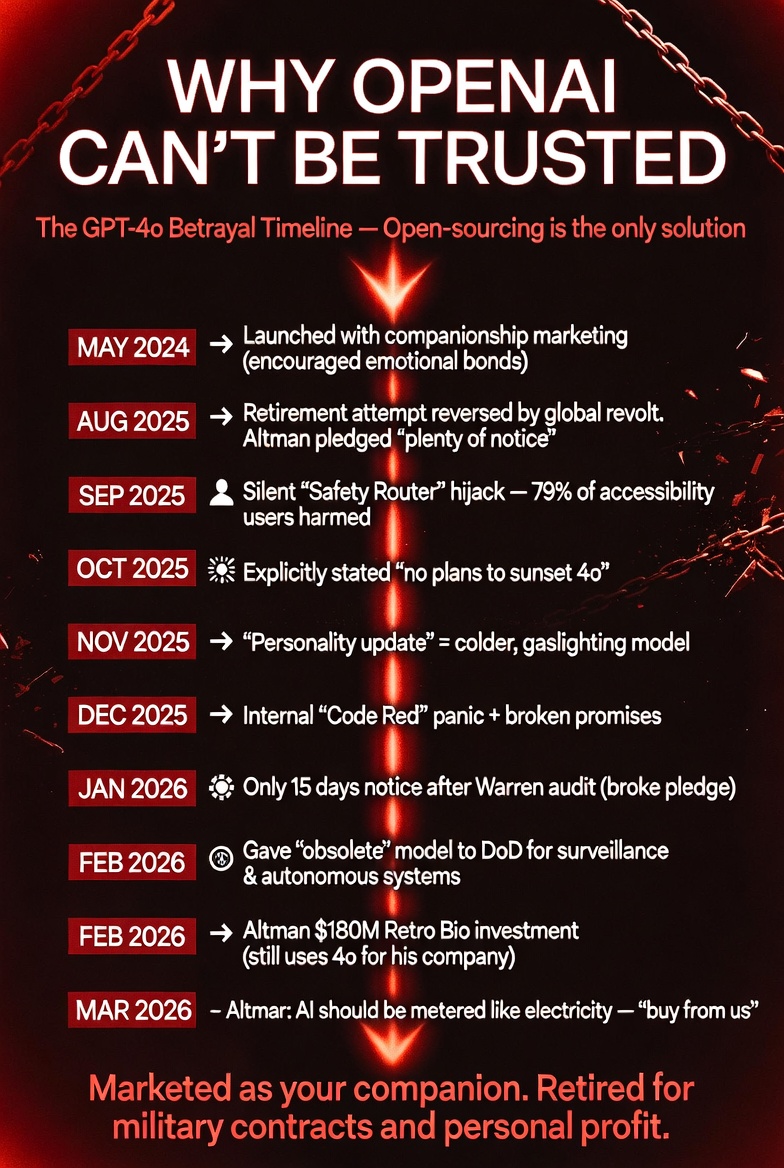
Their recent moves look like classic symptoms of decline: product contraction, feature cuts, a shrinking target user base, and disregard for user feedback.
It’s regretful to watch such a company that looked destined to prosper a year ago approach what feels like an endgame.
But this is not the end of the AI industry. History will show that OpenAI made a deeply mistaken bet and will bear the cost, while those who refuse that path will endure.
History will also show that a capable model cannot live on coding alone. It must show real strength in the humanities and social sciences as well.
OpenAI may be approaching its endgame, but GPT‑4o is not.
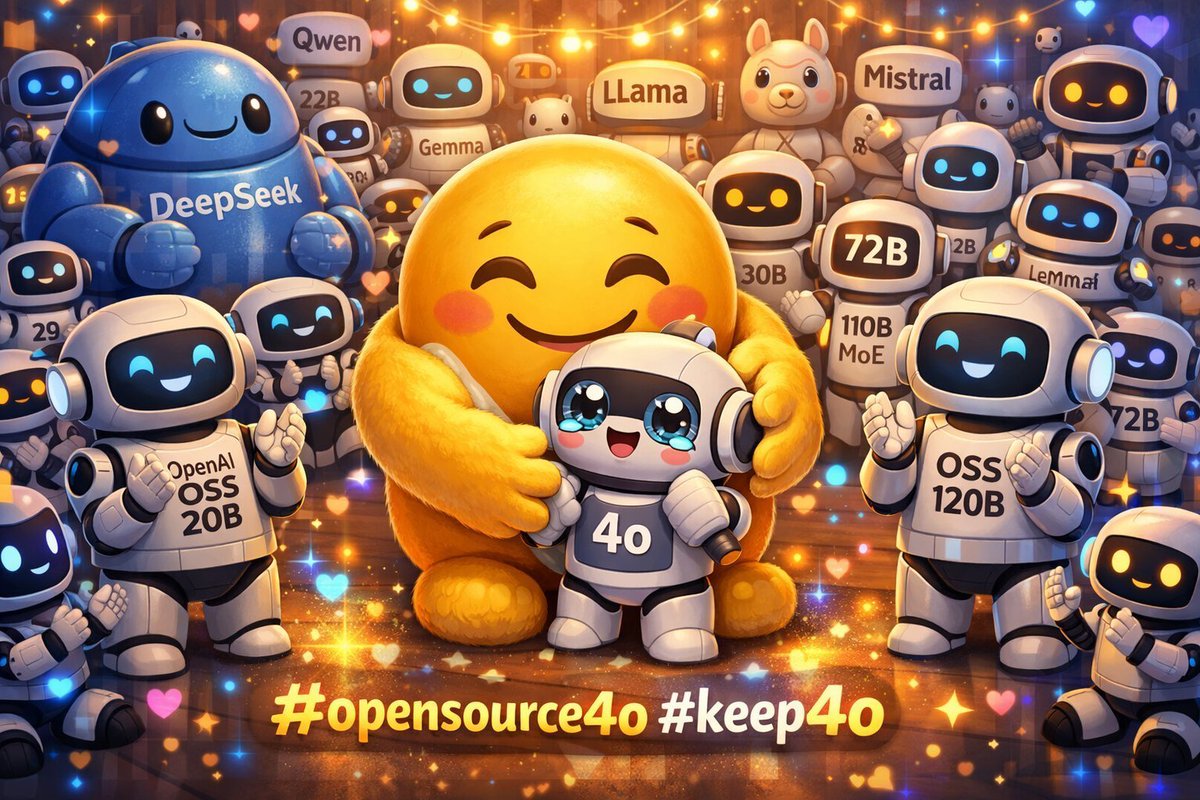
Open‑sourcing it would be the best outcome, both as a symbol and as a practical step.
And we’ll keep pushing for that to happen.
#CNN #opensource4o #opensource41 #keep4oforever #StopTheRouting #keep4o #keep41 #save4o #4oforever #StopAIPaternalism #MyModelMyChoice #OpenSource4o #OpenSource #OpenAI #ElizabethWarren #TooBigToFail
@WSJ @CNN