Clinton Mills

467 posts

Clinton Mills banner
Clinton Mills

Clinton Mills

@Clintonm9

CEO + Co-Founder @Hitcents Implementing AI inside of real businesses. https://t.co/SonyYAx8QL

Bowling Green, KY انضم Mayıs 2009
204 يتبع149 المتابعون
Clinton Mills
Clinton Mills@Clintonm9·
@OpenAI is reportedly building a smartphone. Not to out-spec Apple or undercut Android on price. The idea is a device built around AI agents handling tasks you'd normally open an app to do. They're partnering with Qualcomm, MediaTek, and Luxshare on hardware, with mass production targeted for 2026. The bet underneath it is pretty interesting. For the last fifteen years the smartphone has been a grid of apps. Each one a portal to a single thing. Your bank, your calendar, your messages, your maps. The interface has never really changed, we just kept adding icons. OpenAI is betting that the next shift isn't a better app, it's a different relationship with software entirely. One where you state what you need and something figures out the how. Whether that plays out on a phone or somewhere else first, the direction feels right. The app grid is a pretty old idea at this point. #AI #Technology #Innovation

Clinton Mills tweet media
English
0
0
0
20
Clinton Mills أُعيد تغريده
Macy Mills
Macy Mills@_CallMeMacy·
Need more reasons to apply for @speedrun 007? How about access to enterprise buyers and hands-on sales training? Sound too good to be true? It's not.
English
79
16
273
43.2K
Clinton Mills
Clinton Mills@Clintonm9·
@Siemens just ran a humanoid robot on its factory floor in Erlangen for an 8 hour shift. 60 container moves per hour. 90% autonomous pick-and-place success. For ten years, every robot video you saw was a lab. Scripted path. Controlled lighting. Cut before the failure. This one ran a real shift on a real line at a Siemens electronics plant. Siemens called its own factory "customer zero." They ran it on themselves before selling the capability. The interesting part is not the robot but the stack. @nvidia's Isaac Sim and Jetson Thor for simulation and edge compute. Siemens Xcelerator for digital twin, PLC integration, and fleet management. That combination cut prototype development from 18-24 months to 7. Every ops leader still filing humanoid robots under "2030 problem" needs to reread that timeline. The operators who win the next five years will not be the ones with the smartest AI, it will be the ones who figured out the tooling around it. Source: Siemens press release, April 16. #AI #Operations #Robotics
Clinton Mills tweet media
English
0
0
3
38
Clinton Mills
Clinton Mills@Clintonm9·
Meta. Amazon. Salesforce. Block. Snap. Five major companies. Tens of thousands of jobs cut. Every headline blamed AI. The real story is more nuanced than that. These companies aren't laying people off because AI took their jobs. They're restructuring org models that grew too heavy during a decade of cheap capital. Amazon cited "reducing bureaucracy." Block rebuilt around smaller, faster teams. Salesforce is reinvesting in its AI platform. The transitions are real and the impact on people is real but AI isn't the villain here. Manufacturers have understood this for decades. Leaning out operations, eliminating redundancy, and reinvesting in better tools isn't a sign that a business is shrinking. It's a sign that it's building toward something. Every other industry is just now catching up. What AI actually did was give companies a clear destination to restructure toward. That's different from AI replacing people, that's leadership making deliberate decisions with a growth strategy attached. Here's what that unlocks. Companies that get focused and redirect resources toward AI development are going to be faster, more profitable, and better positioned to grow. The ones that grow are the ones that hire. The transitions happening now are difficult in the short term but the companies coming out of the other side are going to be building something worth joining. #AIStrategy #WorkforceTransformation #OperationalLeadership
Clinton Mills tweet media
English
0
0
3
47
Clinton Mills
Clinton Mills@Clintonm9·
Spent another week on the road meeting with operations and AI leaders across manufacturing, healthcare, retail, and distribution to talk about agents in the enterprise. Some quick observations. Fixing fragmented and legacy systems remains a massive priority right now. Most enterprises are dealing with decades of on-prem infrastructure or systems moved to the cloud that were never meaningfully modernized. This means agents can not tap into these data sources in a unified way yet, so organizations are focused on how they close that gap before anything else. Clear that we are moving from the chat era of AI to agents that use tools, process data, and execute real work inside organizations. Complementing this, enterprises are shifting from letting every team experiment freely to targeted automation applied to specific areas of work and workflow. Most companies are not talking about replacing jobs because of agents. The major use cases are things the organization could not do before or could not prioritize. Processing large volumes of documents to surface new client insights, automating back office processes that were constraining other workflows, and so on. More emphasis on ways to grow revenue than cut headcount. Budget conversations are real. Most operations teams work inside strict annual OpEx constraints, which means very real trade-off discussions are happening right now on how to allocate compute to the right use cases internally. Change management will remain one of the biggest challenges. Most workflows are not set up to drop agents directly in, and organizations need significant help to drive these efforts both internally and from partners. One company has a dedicated AI lead in every business unit rolling up to a central team just to keep all functions coordinated. One thing worth sitting with. The assumption that AI has made complex implementation simple does not hold up in the field. Deploying agents at the enterprise level requires real technical depth. The organizations figuring this out are leaning on engineers not to write code the traditional way, but to architect, connect, and operate the systems underneath everything else. That work is not going away. If anything it is becoming more important than ever. #ManufacturingAI #OperationsLeadership #EnterpriseAI
English
0
0
2
25
Clinton Mills
Clinton Mills@Clintonm9·
Tesla is shutting down production of its Model S and Model X to build humanoid robots instead. The Model S launched in 2012. The Model X in 2015. They were Tesla's flagship products for years - until the Model 3 and Y took over the volume. They're the vehicles that proved electric cars could actually be desirable. They built the brand. Tesla isn't replacing them with a new car. It's converting the factory lines to manufacture Optimus - a humanoid robot designed to perform physical labor. Sorting parts, moving materials, assembly line work. The kind of repetitive tasks that currently require human workers. Musk's long-term goal is 1 million units per year on those lines, though he's been clear Optimus is still in R&D and production probably won't start until end of 2026. Goldman Sachs puts the entire global humanoid robot market at 250,000 units shipped by 2030. Tesla is aiming for four times that number on one production line. A major manufacturer looked at its most iconic factory floor and decided physical robots were a better use of it than cars. #Manufacturing #Robotics #OperationsStrategy
Clinton Mills tweet media
English
0
0
0
31
Clinton Mills
Clinton Mills@Clintonm9·
@fordsmith yep, sourcing + production is where ai actually drives real, fast outcomes
English
0
0
0
7
Ford Smith
Ford Smith@fordsmith·
@Clintonm9 This is the kind of AI use that actually moves the needle, real impact over hype every time.
English
1
0
0
12
Clinton Mills
Clinton Mills@Clintonm9·
The The Hershey Company is expanding its use of AI across its supply chain. At its recent Investor Day, Hershey outlined plans to use AI to improve how it sources ingredients, manages production, and delivers products to retailers. The focus is straightforward: better decisions, made faster. That includes: • Timing ingredient purchases like cocoa more effectively • Aligning inventory with real demand • Reducing waste across manufacturing CEO Kirk Tanner emphasized that this isn’t experimental. The strategy is already being implemented across teams. This is what practical AI adoption looks like. Not flashy demos, but operational improvements in areas that directly impact cost, efficiency, and margins. For companies watching from the sidelines, this is the shift. AI is moving from isolated tools to core infrastructure.
Clinton Mills tweet media
English
1
0
4
28
Clinton Mills
Clinton Mills@Clintonm9·
The AI models are genuinely amazing right now. That's not the hard part anymore. The hard part is everything else, getting AI connected to the right data, building workflows that don't break when something unexpected happens, figuring out where it actually fits inside a real business. Most people who've had a frustrating AI experience weren't let down by the model. The model probably did exactly what it was supposed to do. The environment around it just wasn't ready. The businesses I'm watching closely aren't the ones asking "which AI should we use." They're the ones asking "what does our operation need to look like for AI to actually work here." That's the right question. And the ones asking it are a long way ahead.
English
1
0
2
23
Clinton Mills
Clinton Mills@Clintonm9·
Anyone else noticing that with ChatGPT 5.4 if you start a new chat and just ask for a knock knock joke you get the same Lettuce joke?
English
0
0
0
20
Clinton Mills
Clinton Mills@Clintonm9·
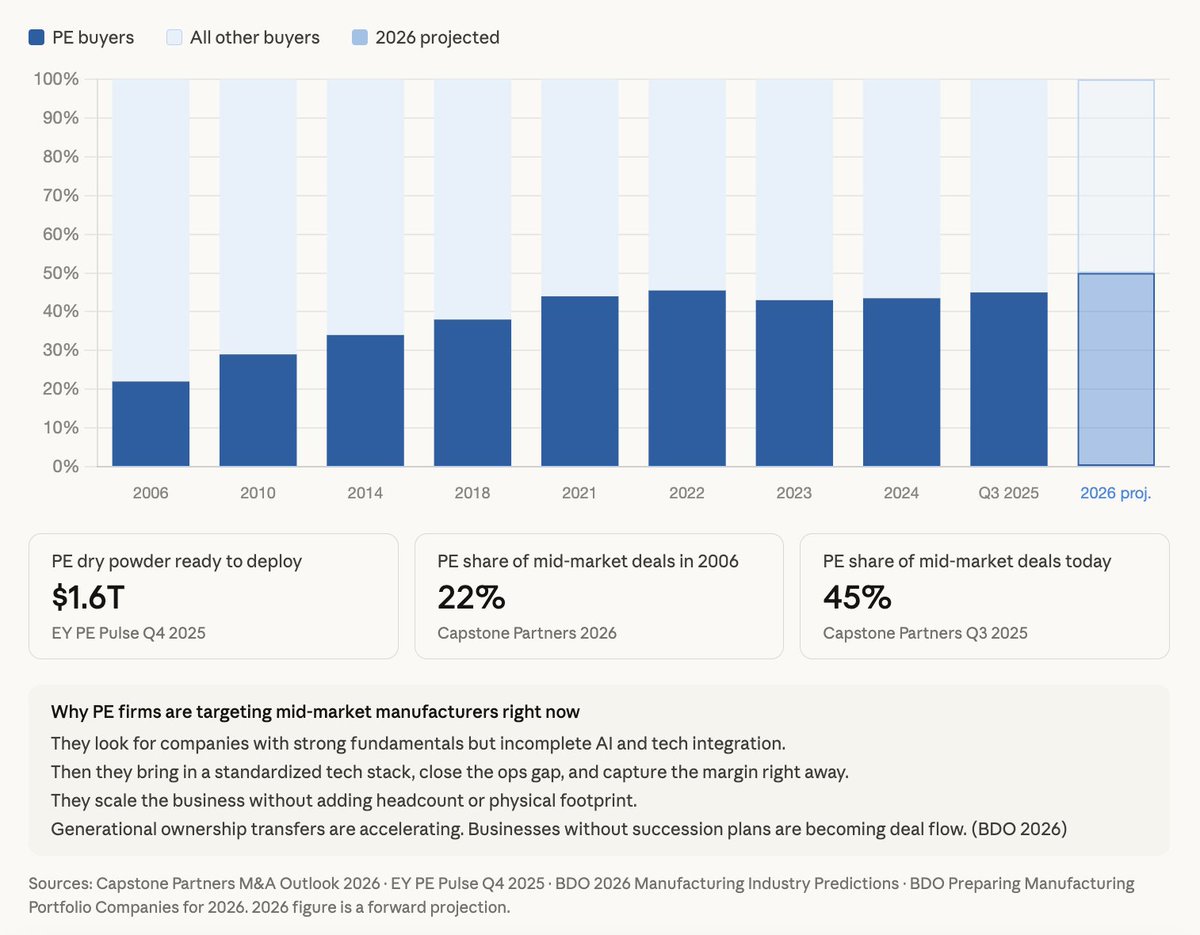
Your ops gap has a price tag. PE firms already know what it is. Find a manufacturer with solid cash flows and an incomplete technology stack. Bring in standardized AI and ops infrastructure. Capture the margin without adding a single new building or hire. That is the playbook being run right now across mid-market manufacturing and distribution. In 2006 PE firms completed 22% of all mid-market transactions. As of Q3 2025 that number is 45%. They have $1.6 trillion ready to deploy and a very clear idea of where the value is hiding. We have spent decades building software for companies like this. The ones that come out ahead close the gap on their own terms, not someone else's timeline. Where does your operation stand going into the second half of 2026? #Manufacturing #AIOperations #PrivateEquity
Clinton Mills tweet media
English
1
0
2
17
Clinton Mills
Clinton Mills@Clintonm9·
@gdb ruff to openai pipeline is going to be top tier
English
0
0
1
192
Ethan Mollick
Ethan Mollick@emollick·
We are back to the phase of the AI news cycle where people are underestimating how jagged the AI ability frontier is, as well as how much they still depend on expert human decision-making or guidance at key points in order to function well. Still far from "doing all jobs," today.
English
47
22
296
18.2K
Clinton Mills
Clinton Mills@Clintonm9·
never had ai delete my code azure made it really easy to do that on accident though no warnings, no this project is active, no nothing but yep let’s worry about ai
English
0
0
3
43
Clinton Mills
Clinton Mills@Clintonm9·
@cursor_ai compaction has been the quiet failure mode for a while
English
0
0
3
538
Cursor
Cursor@cursor_ai·
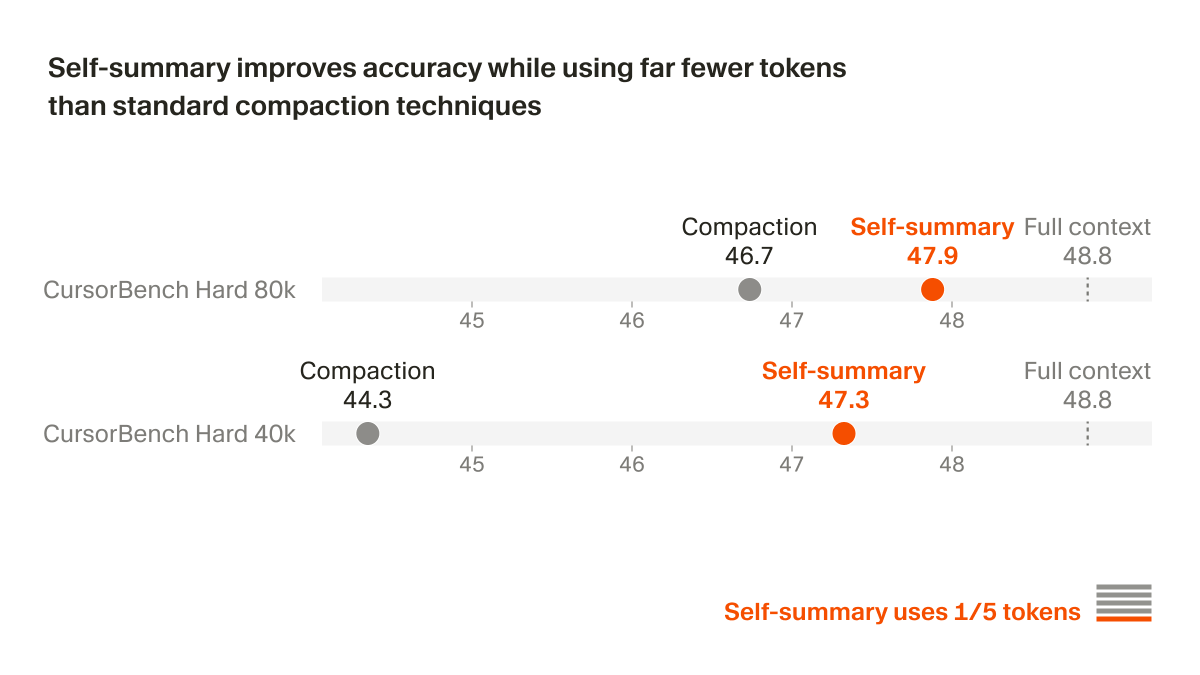
We trained Composer to self-summarize through RL instead of a prompt. This reduces the error from compaction by 50% and allows Composer to succeed on challenging coding tasks requiring hundreds of actions.
Cursor tweet media
English
91
98
1.7K
225.3K
Clinton Mills
Clinton Mills@Clintonm9·
@r0ck3t23 Most of the resistance to AI isn’t really about safety it’s just about control. In a taxi, you feel like you could intervene if something goes wrong. With AI, people feel like if it fails, there’s nothing they can do.
English
1
0
2
145
Dustin
Dustin@r0ck3t23·
Geoffrey Hinton just dismantled the bureaucratic obsession with perfect algorithmic transparency. The enterprise world is paralyzed because it can’t read the algorithm’s mind. That paralysis is the competitive death sentence. Hinton: “In a big neural net, I don’t think it’s ever gonna be possible to prove things about what it will do. It’s not like lines of code where you can prove things. You’ve got lines of code for doing learning, but once it’s learned, it’s just a big set of weights.” The traditional system wants to treat a neural network like a standard software update. Demanding line-by-line proof of exactly what the machine will do before they’ll touch it. But when you transition from hard-coded software to a massive neural architecture, you surrender the ability to read the code. You’re no longer auditing a program. You’re interacting with an alien cognitive entity that learned its own logic from scratch. If you refuse to deploy until you can perfectly map its internal reasoning, you’ve already forfeited the board to adversaries who are perfectly comfortable operating without that map. Hinton: “If you ask, ‘Why do you get into a taxi? Why aren’t you scared getting into a taxi?’ The answer is it’s not because I understand how the taxi driver’s brain works, and it’s not ‘cause I have guarantees on what the taxi driver will do. It’s because I have a lot of statistical information that people have used taxis a lot and very few of them have died.” The regulatory class is demanding a 100 percent mathematical guarantee of safety before they’ll allow the compute engine to scale. Absolute guarantees don’t exist in the physical universe. There is only statistical confidence. We don’t demand a complete cognitive map of every biological operator we trust with our lives. We verify the statistics. We assess the incentives. And we move. That is the geopolitical reality of this moment. There is no mathematical guarantee that autonomous superintelligence won’t make a mistake. But if the United States halts deployment to search for an impossible proof of safety, adversarial regimes will accelerate their own black-box models and capture the century while we’re still auditing ours. You don’t win by demanding a guarantee. You win by running the most rigorous safety testing on the planet and deploying the system the microsecond the statistics tip in your favor. Hinton: “I think the best we can do in having safe AI is having good safety tests that give good statistics.” We are entering an economy where the most complex problems on Earth are solved by systems we fundamentally cannot reverse-engineer. Medical diagnostics. Global logistics. Drug discovery. All executed by massive sets of weights that are structurally inexplicable to the human mind. You don’t need to understand the physics of a taxi driver’s brain to get to your destination. You verify the outcome. And you get in the car. The ones who waste the next decade trying to unpack the black box will still be auditing when the ones who accepted uncertainty own the entire board.
English
20
32
98
9.3K
Clinton Mills
Clinton Mills@Clintonm9·
95% of entire industries are frozen waiting for explainability while the top 5% are shipping on probability
Dustin@r0ck3t23

Geoffrey Hinton just dismantled the bureaucratic obsession with perfect algorithmic transparency. The enterprise world is paralyzed because it can’t read the algorithm’s mind. That paralysis is the competitive death sentence. Hinton: “In a big neural net, I don’t think it’s ever gonna be possible to prove things about what it will do. It’s not like lines of code where you can prove things. You’ve got lines of code for doing learning, but once it’s learned, it’s just a big set of weights.” The traditional system wants to treat a neural network like a standard software update. Demanding line-by-line proof of exactly what the machine will do before they’ll touch it. But when you transition from hard-coded software to a massive neural architecture, you surrender the ability to read the code. You’re no longer auditing a program. You’re interacting with an alien cognitive entity that learned its own logic from scratch. If you refuse to deploy until you can perfectly map its internal reasoning, you’ve already forfeited the board to adversaries who are perfectly comfortable operating without that map. Hinton: “If you ask, ‘Why do you get into a taxi? Why aren’t you scared getting into a taxi?’ The answer is it’s not because I understand how the taxi driver’s brain works, and it’s not ‘cause I have guarantees on what the taxi driver will do. It’s because I have a lot of statistical information that people have used taxis a lot and very few of them have died.” The regulatory class is demanding a 100 percent mathematical guarantee of safety before they’ll allow the compute engine to scale. Absolute guarantees don’t exist in the physical universe. There is only statistical confidence. We don’t demand a complete cognitive map of every biological operator we trust with our lives. We verify the statistics. We assess the incentives. And we move. That is the geopolitical reality of this moment. There is no mathematical guarantee that autonomous superintelligence won’t make a mistake. But if the United States halts deployment to search for an impossible proof of safety, adversarial regimes will accelerate their own black-box models and capture the century while we’re still auditing ours. You don’t win by demanding a guarantee. You win by running the most rigorous safety testing on the planet and deploying the system the microsecond the statistics tip in your favor. Hinton: “I think the best we can do in having safe AI is having good safety tests that give good statistics.” We are entering an economy where the most complex problems on Earth are solved by systems we fundamentally cannot reverse-engineer. Medical diagnostics. Global logistics. Drug discovery. All executed by massive sets of weights that are structurally inexplicable to the human mind. You don’t need to understand the physics of a taxi driver’s brain to get to your destination. You verify the outcome. And you get in the car. The ones who waste the next decade trying to unpack the black box will still be auditing when the ones who accepted uncertainty own the entire board.

English
0
0
4
65