تغريدة مثبتة

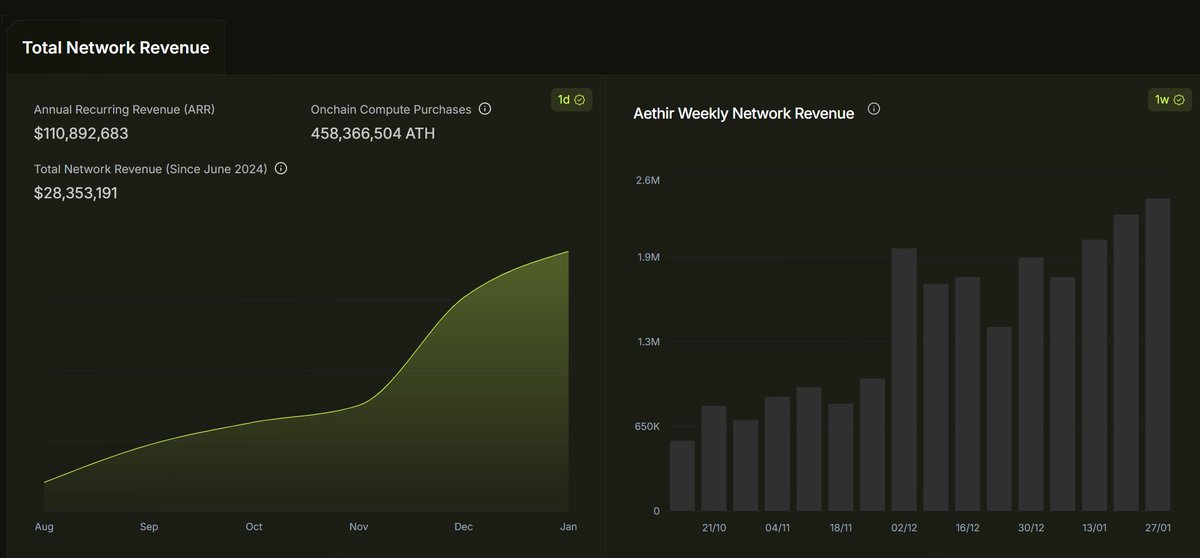
Yet another weekly record high in revenue for @AethirCloud $ATH Token price down 50% and revenue up over 200% in less than a year...I added on the dip, buying $ for cents, at some point fundamentals will matter
English
Denis $ATH $ICP $ACHR $ILV
7.8K posts

@DenisHun
Plunger I'll be fine once i get it, i'll be gooooooood! Illuvium $ILV promo code: Deno



Caffeine v3.0 ☕️, Tuesday, April 7th caffeine.ai A new era begins on ICP in a few days. A huge Caffeine upgrade will take place. This is about more than the new features it packs: what can be built on the Internet Computer through chat alone shall advance by a quantum leap. It will blow your mind, because you can go so much further: those wanting to build apps and services on self-writing cloud, where every technical task is automated and directed by natural language interaction, may rationally decide that the Internet Computer is the place to be thanks to the work of Caffeine Labs. But, stunning as the v3.0 advance is, this only marks the beginning of a new beginning for ICP. Caffeine is just getting started, and will be joined by other major advances unfolding in the ICP ecosystem. Several things are coming together: 1) The architecture that powers Caffeine v3.0 will ensure it continues to grow more powerful as time goes on. We expect that it will be possible for non-technical people to build almost anything on the Internet Computer in the future. Eventually special features like "Caffeine Snorkel" will also make it possible to auto-migrate legacy apps and services to the Internet Computer. 2) For the first time, Caffeine will allow all users to publish the App Market, so that other users can install copies of their apps, and if they want, remix them, since apps from the market are mutable and can be changed as needed. This is important change will be followed by the activation of monetization features, which will kickstart a new open source onchain economy based around the AI-driven development of re-usable apps and services. 3) Caffeine apps use ICP Blob Storage (which is currently exclusively available to Caffeine owing to its ongoing development) to maintain copies of files and binary large objects. Coming advances will enable Caffeine apps to store data at the world's best $/GB — making the Caffeine the perfect plartform to use to build apps that must store and share large amounts of data (for example, for a photo sharing app, or a team communications platform where video meetings are routinely recorded and archived). 4) Caffeine will soon be joined by new ICP "cloud engine" functionality, and then, the Internet Intelligence Network (IIN) — two new parts of the Internet Computer. Cloud engines will provide enterprise users with much more control over how the Internet Computer hosts their apps and services. IIN will provide everyone with access to inference on open weights models at lower cost than is possible today (for example allowing a business to create an e-commerce website on the Internet Computer where every customer can be helped through product exploration by AI, without worrying about the cost). 5) Cloud engines, which are essentially private subnets that can be controlled via a control panel, enable the Internet Computer to provide a cloud experience that feels more familiar to prosumers and enterprises used to centralized clouds. Users will be able to select the nodes combined to power their cloud engines, and nodes can include cloud-on-cloud nodes, such as AWS instances, as well as traditional sovereign node hardware. These nodes can be chosen to match precise throughput needs, or regulatory requirements (e.g. GDPR). The Internet Computer is thus transforming into a mass market cloud solution. 6) Powerful additional advantages of cloud engines include a) since they are essentally Internet Computer subnets, as usual hosted apps and services are tamperproof and unstoppable, and don't require support by security and systems administration personnel, b) hosted apps can have their query throughput auto-scaled horizontally by adding nodes, which can be located in proximity to demand, and can have ther update throughput auto-scaled by splitting the engines — enabling auto-scaling where software does not have to be updated — and c) owners can traverse underlying compute vendors and geographies and jurisdictions, simply by adding and deleting nodes, which can be done without interrupting hosted apps. 7) The Internet Intelligence Network is an extension to the Internet Computer that we plan to propose to the NNS soon (which I have mentioned before). This will be powered by community-operated hardware devices, which crucially, in combination with new technology we are developing, shall shall facilitate provision of lower per-token inference costs than AI clouds can currently achieve within targeted market segments (low costs that are derived from the technology involved, in contrast to certain contemporary decentralized GPU networks that use token appreciation to drive unsustainable subsidization flywheels). 8) A key unique additional aspect of IIN is that inference is verifiable, just like onchain compute — that is, those supplying prompts and context will know that their results are correct, and shall not have to trust that the IIN nodes powering inference haven't changed their results (for example, by inserting advertising, or malicious content). The strength of the verification is configurable. In the default mode, there will be no discernible difference in cost or performance/time thanks to the techniques developed. In higher security modes, useful for special high-security purposes, verification cost will scale linearly with every node checking the inference, while the hit to performance/time remains very small. (Note that because inference is non-deterministic, inference verification is technically challenging and novel, and will advance the state-of-the-art). In all, v3.0 is part of the Internet Computer's march towards the mainstream cloud market, which is predicted to generate $1 trillion in revenue in 2026, and $2 trillion in 2030. While we see the Internet Computer as a revolutionary decentralized cloud platform, rather than a network beloning to the web3 industry per se, we note that after tokens (Bitcoin), and DeFi (Ethereum), onchain cloud is the first new decentralized network functionality to unlock mass market potential — and it's happeing exclusively on the Internet Computer, which is by far the most technologically advanced network the world has ever seen. ICP is advancing to define an important new cloud sector, where the network is the cloud, and the cloud is self-writing.

Hermes Agent outperformed Claude Code and OpenClaw as an agentic harness for both Opus 4.6 and GPT-5.4 on 89 real-world tasks. Not just higher scores but a higher floor. More tasks solved reliably, every single run. @teknium @NousResearch really cooked with this one. 🔥









Axe Compute (Aethir Strategic Compute Reserve - $AGPU on NASDAQ) just filed its first 10-K and held its first earnings call as AGPU. Let me tell you what happened. As of December 31, 2025, this company had $125,284 in total revenue from selling tumor models. Yesterday, post rebrand, they reported $12M in executed compute contracts. 21 enterprise customers. 30+ active GPU deployments. All signed within the first month of the fiscal year. Some highlights from the call: → $835K+ expected monthly income starting Q2 → 8% gross margin on bare-metal GPU contracts → Monthly prepayment structure — customers pay before deployment → Diverse GPU mix: RTX 5090s, H100s, H200s, B200s, B300s → Up to 20% additional ATH earned on every compute settlement → Expected positive margins while every single neocloud peer runs at a net loss But here's what actually matters. This was, for the first time, a demonstration of the path Axe Compute is on. Not a whitepaper. Not a roadmap. Not a promise. Signed contracts. Real customers. Real GPUs. Real dollars. The earnings report showed the commitment isn't talk - they're about to deliver something that could fundamentally change how people think about decentralized compute in public markets. And the market noticed. Within 24 hours of the 10-K filing and earnings call, AGPU saw approximately $90 million in trading volume. On NASDAQ. No market makers inflating numbers. No wash trading. No fake volume. This is a regulated exchange where every dollar is a real person making a real decision with real money. A microcap stock. One modest but compelling earnings report. One sector that is absolutely on fire. $90 million in a single day. That's the thing about capital markets that crypto doesn't fully appreciate yet. When a NASDAQ-listed company starts showing traction, particularly in AI, it doesn't just attract crypto natives. It attracts fund managers, retail traders, algorithmic systems, options desks, and financial media - all of whom have never heard of Aethir or ATH. Every one of those participants is now one click away from discovering Aethir. That $90M in daily volume? That's the first sniff. That's the preview of the scale difference between crypto markets and capital markets. That's potentially hundreds of millions of dollars worth of investors who are about to learn what ATH is - not because someone told them on Telegram, but because they found it through a stock ticker on their Bloomberg terminal. Lets imagine this volume trend continues for a few days - $500m in volume on the stock over the next week is half a billion in potential capital exposure to $ATH. Thats without buy backs or any of the other good stuff. At the end of the day, money talks. We just let a whole new market listen to what we have to say. You aren't bullish enough. All data from public SEC filings (10-K filed March 31, 2026) and the Axe Compute earnings call (April 1, 2026). NASDAQ: AGPU.
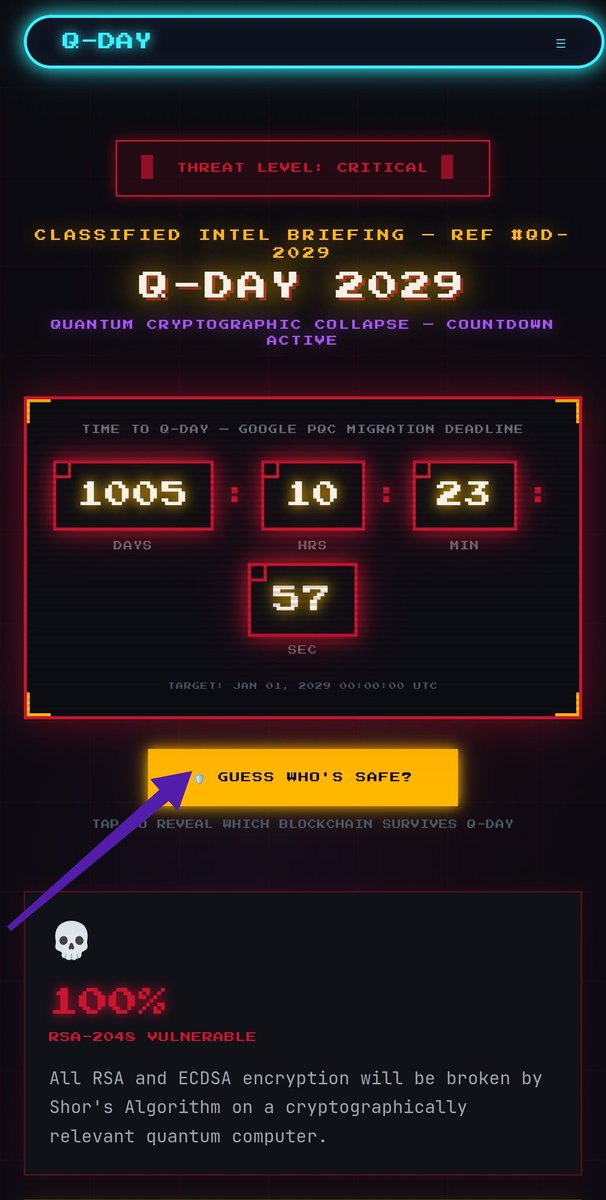
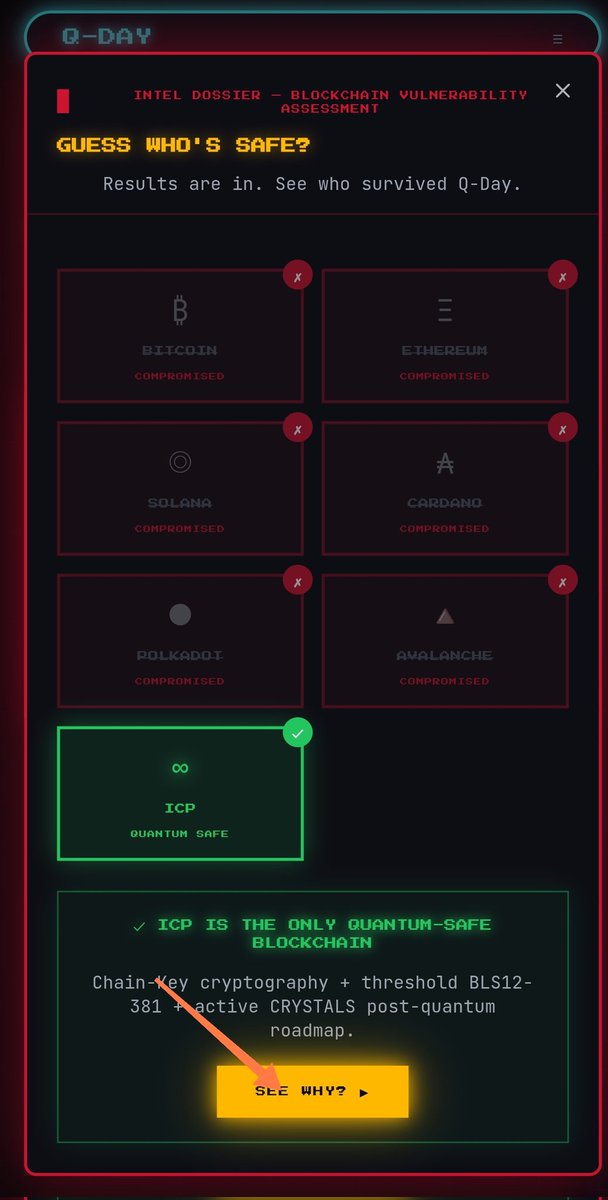
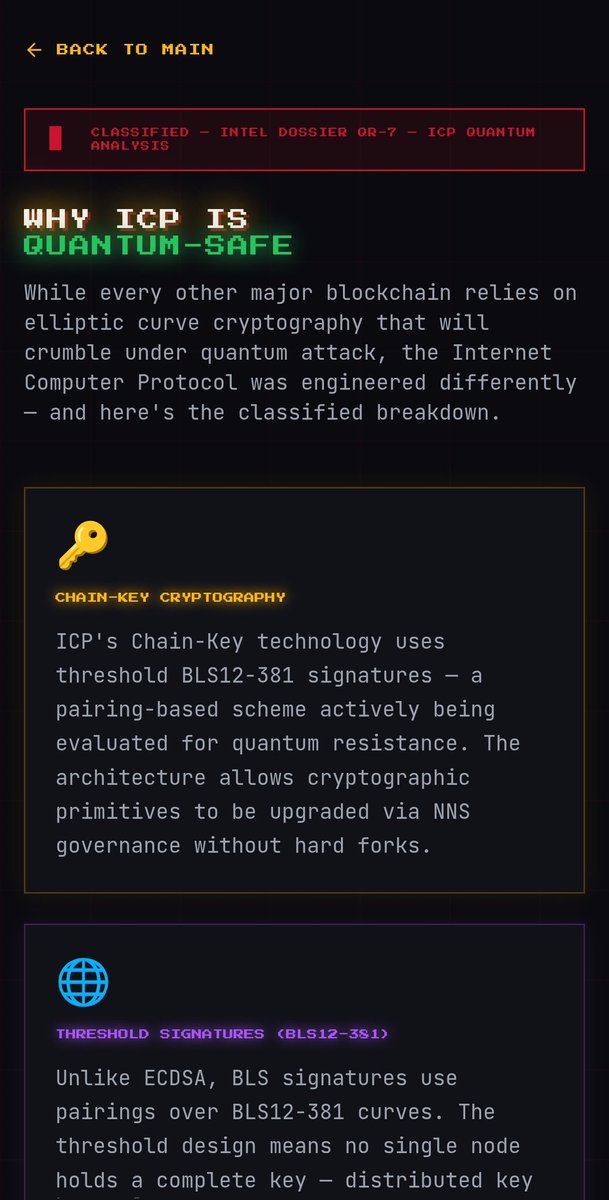
There's so much talk about the "Upcoming Quantum Apocalypse"- Google research reveals quantum computers may be able to crack Bitcoin's private keys in just 9 minutes. I have created a countdown timer plus other relevant information👇 ⛓️💥 quantum-dvn.caffeine.xyz $ICP