EF Protocol Support

48 posts

EF Protocol Support

EF Protocol Support

@EFprotocol

the Protocol Support team @ethereumfndn We are currently experiencing high volumes (of code). Please stay on the line for the next hard fork.

127.0.0.1:8545 انضم Ocak 2026
9 يتبع825 المتابعون
EF Protocol Support أُعيد تغريده
Derek Chiang | ZeroDev
Due to EIP-8141 (native AA), I've been deeply engaging with the ACD process, and there's some truth to what Dankrad is saying in that it feels like the people with decision making powers -- the client devs -- are somewhat detached from real-world usage of Ethereum. However, I found that it's not that those people don't care -- it's just that their day-to-day job as client devs simply don't provide them with the opportunities to interact with application-layer builders and end users as much as, say, someone like me whose job is to build and sell commercial solutions do. So how do we bridge the gap between 1) Ethereum's major decisions are made by client devs, and 2) client devs don't get to learn much from application builders and users? That's the key question the EF has to solve. On the other hand, I also feel that application-layer builders need to take matters into their own hands more. You can criticize the ACD process all your want, but it IS open. All the meetings are announced in advance (github.com/ethereum/pm/is…), free for all to join, and recorded for all to watch. When you do engage with the process, like I've been for the past month for native AA, you find that the client devs DO LISTEN. They are not crazy people with evil agendas -- they just don't know what they don't know, just like the rest of us. So yes, EF should keep improving the process, but before you complain about Ethereum heading in the wrong direction, ask yourself if you have ever TRIED to engage. Ethereum is for all of us and we all share responsibilities for making it better.
Dankrad Feist@dankrad

EF, last year: Hey, we want to listen to you users to make Ethereum better. EF, now: Jk, we looked at the real world. We don't like building for it after all, we'll go back to building cypherpunk stuff only. This is the EF going back to its old ways, undoing the changes from last year. I have feared this would happen because Vitalik clearly wasn't in with his heart. But whatever they say about the "ecosystem" being able to take care of this, the fundamental problems remain: - there are very few voices in ACD caring about real world Ethereum usage - there is nobody doing Ethereum BD (everyone else who is doing this also has their own separate interests)
English
13
15
137
10.3K
EF Protocol Support
EF Protocol Support@EFprotocol·
9/ If you're building on Ethereum and gas repricing affects your contracts, make yourself heard. Survey @ gasrepricing.com
English
0
0
6
131
EF Protocol Support
EF Protocol Support@EFprotocol·
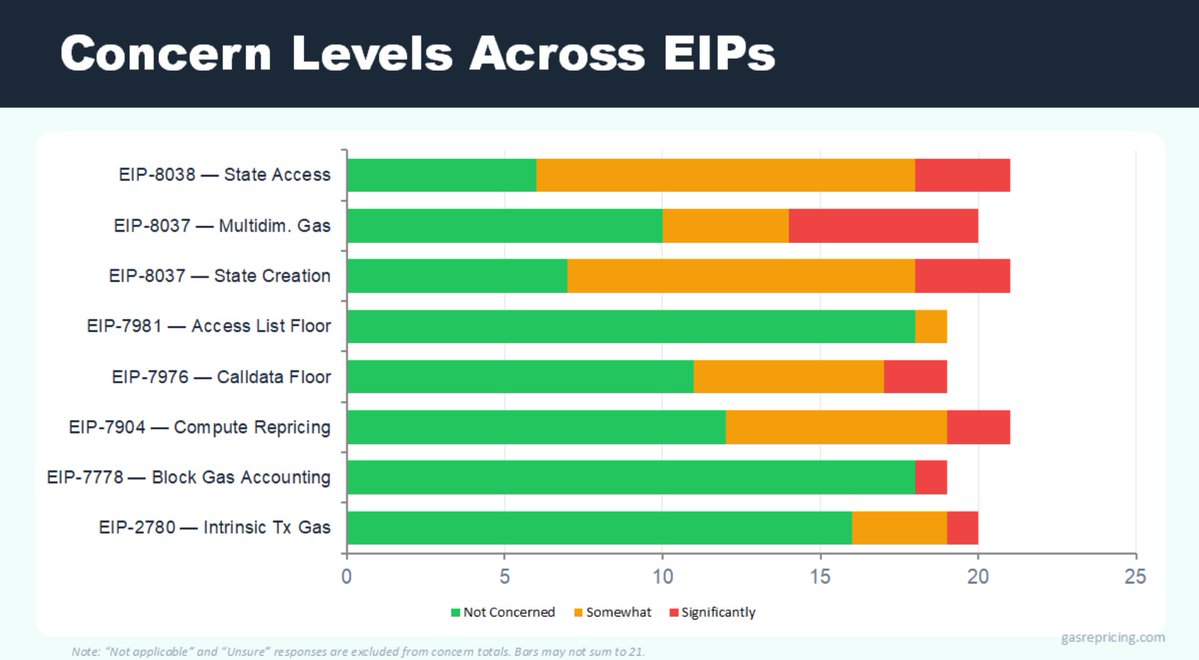
8/ Takeaways → Complexity over cost: builders fear the unknown optimization surface more than higher fees → Tooling gaps: Asks for devnet testing and framework integration → Tx gas limit pressure: the limit isn't rising alongside these changes → Aggregate interaction risk: ship separately to reduce risk surface
EF Protocol Support tweet media
English
1
0
5
164
EF Protocol Support
EF Protocol Support@EFprotocol·
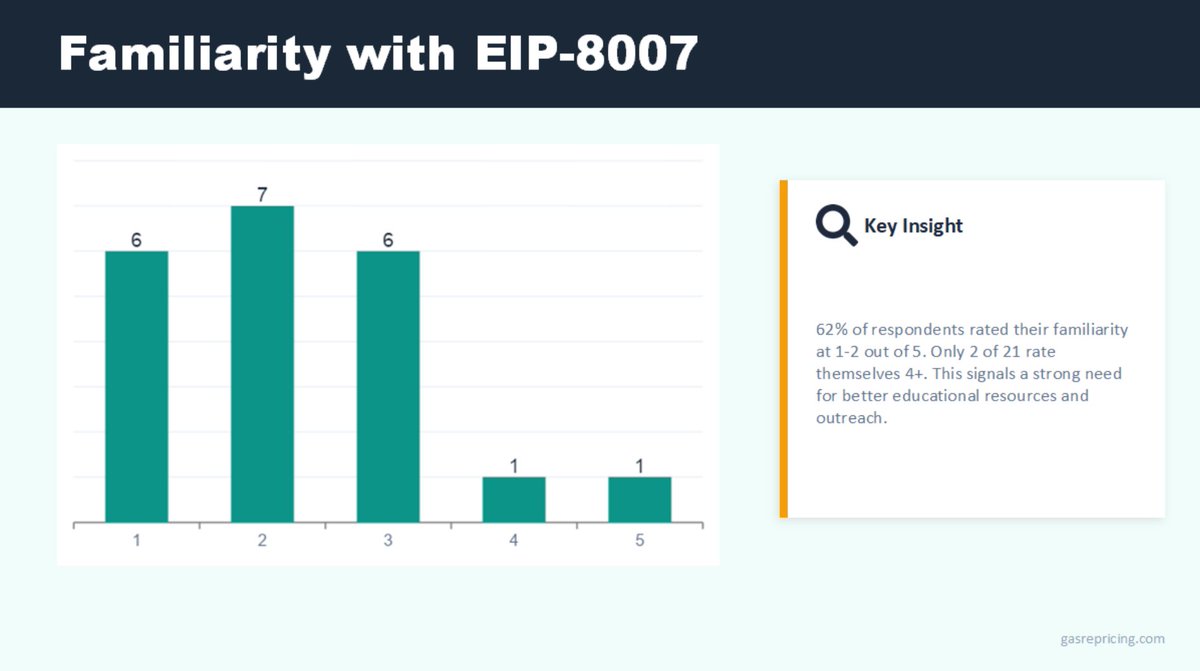
1/ We surveyed 21 stakeholders across 16 major DeFi & protocol teams on Ethereum's gas repricing meta EIP-8007 Here's what builders actually think about each proposal👇
EF Protocol Support tweet media
English
5
12
36
5.2K
EF Protocol Support أُعيد تغريده
terence
terence@terencechain·
gloas / epbs devnet0 is live, it finalized but ran into hicpus nodes disagree on whether to build on empty or full. making tons of progress and precisely what these devnets are for 🚀
terence tweet media
English
8
9
51
2.3K
EF Protocol Support
EF Protocol Support@EFprotocol·
2 H* breakout calls this week to better understand the technical merits of LUCID Encrypted Mempools and Frame Transactions. The goal is to make a confident headliner decision by next ACDE call, so add to each agenda by commenting on the github issue below with what you would like to see addressed.
English
4
6
34
1.6K
EF Protocol Support أُعيد تغريده
Justin Drake
Justin Drake@drakefjustin·
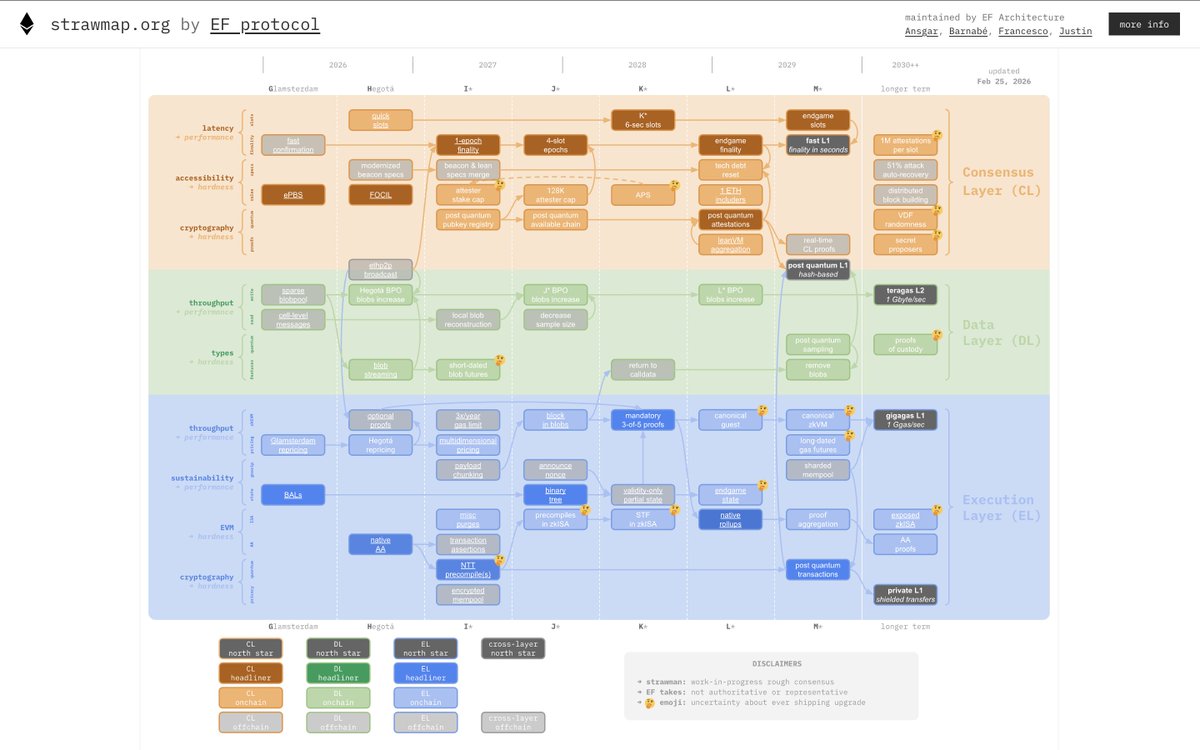
Introducing strawmap, a strawman roadmap by EF Protocol. Believe in something. Believe in an Ethereum strawmap. Who is this for? The document, available at strawmap[.]org, is intended for advanced readers. It is a dense and technical resource primarily for researchers, developers, and participants in Ethereum governance. Visit ethereum[.]org/roadmap for more introductory material. Accessible explainers unpacking the strawmap will follow soon™. What is the strawmap? The strawmap is an invitation to view L1 protocol upgrades through a holistic lens. By placing proposals on a single visual it provides a unified perspective on Ethereum L1 ambitions. The time horizon spans years, extending beyond the immediate focus of All Core Devs (ACD) and forkcast[.]org which typically cover only the next couple of forks. What are some of the highlights? The strawmap features five simple north stars, presented as black boxes on the right: → fast L1: fast UX, via short slots and finality in seconds → gigagas L1: 1 gigagas/sec (10K TPS), via zkEVMs and real-time proving → teragas L2: 1 gigabyte/sec (10M TPS), via data availability sampling → post quantum L1: durable cryptography, via hash-based schemes → private L1: first-class privacy, via shielded ETH transfers What is the origin story? The strawman roadmap originated as a discussion starter at an EF workshop in Jan 2026, partly motivated by a desire to integrate lean Ethereum with shorter-term initiatives. Upgrade dependencies and fork constraints became particularly effective at surfacing valuable discussion topics. The strawman is now shared publicly in a spirit of proactive transparency and accelerationism. Why the "strawmap" name? "Strawmap" is a portmanteau of "strawman" and "roadmap". The strawman qualifier is deliberate for two reasons: 1. It acknowledges the limits of drafting a roadmap in a highly decentralized ecosystem. An "official" roadmap reflecting all Ethereum stakeholders is effectively impossible. Rough consensus is fundamentally an emergent, continuous, and inherent uncertain process. 2. It underscores the document's status as a work-in-progress. Although it originated within the EF Protocol cluster, there are competing views held among its 100 members, not to mention a rich diversity of non-EFer views. The strawmap is not a prediction. It is an accelerationist coordination tool, sketching one reasonably coherent path among millions of possible outcomes. What is the strawmap time frame? The strawmap focuses on forks extending through the end of the decade. It outlines seven forks by 2029 based on a rough cadence of one fork every six months. While grounded in current expectations, these timelines should be treated with healthy skepticism. The current draft assumes human-first development. AI-driven development and formal verification could significantly compress schedules. What do the letters on top represent? The strawmap is organized as a timeline, with forks progressing from left to right. Consensus layer forks follow a star-based naming scheme with incrementing first letters: Altair, Bellatrix, Capella, Deneb, Electra, Fulu, etc. Upcoming forks such as Glamsterdam and Hegotá have finalized names. Other forks, like I* and J*, have placeholder names (with I* pronounced "I star"). What do the colors and arrows represent? Upgrades are grouped into three color-coded horizontal layers: consensus (CL), data (DL), execution (EL). Dark boxes denote headliners (see below), grey boxes indicate offchain upgrades, and black boxes represent north stars. An explanatory legend appears at the bottom. Within each layer, upgrades are further organized by theme and sub-theme. Arrows signal hard technical dependencies or natural upgrade progressions. Underlined text in boxes links to relevant EIPs and write-ups. What are headliners? Headliners are particularly prominent and ambitious upgrades. To maintain a fast fork cadence, the modern ACD process limits itself to one consensus and one execution headliner per fork. For example, in Glamsterdam, these headliners are ePBS and BALs, respectively. (L* is an exceptional fork, displaying two headliners tied to the bigger lean consensus fork. Lean consensus landing in L* would be a fateful coincidence.) Will the strawmap evolve? Yes, the strawmap is a living and malleable document. It will evolve alongside community feedback, R&D advancements, and governance. Expect at least quarterly updates, with the latest revision date noted on the document. Can I share feedback? Yes, feedback is actively encouraged. The EF Protocol strawmap is maintained by the EF Architecture team: @adietrichs, @barnabemonnot, @fradamt, @drakefjustin. Each has open DMs and can be reached at first.name@ethereum[.]org. General inquiries can be sent to strawmap@ethereum[.]org.
Justin Drake tweet media
English
198
410
1.6K
595.1K
EF Protocol Support
EF Protocol Support@EFprotocol·
the Protocol Support team at the @ethereumfndn now has a website, thanks to the EF's phenomenal Digital Studio team! Particularly excited for this because it helps you navigate & understand the resources we maintain to support Ethereum core development: ⑅ Forkcast ⑅ the Project Management repo ⑅ ACD calls ⑅ breakout calls ⑅ the Ethereum Protocol Fellowship ⑅ the Ethereum Study Group (which kicked off with 150+ participants today!) you no longer have to navigate a Github repo to find a list of active breakout calls! ⏦ link in next tweet ⏦
EF Protocol Support tweet media
English
20
28
111
13.4K
EF Protocol Support أُعيد تغريده
EF Protocol Support
EF Protocol Support@EFprotocol·
Glamsterdam Gas Repricing is around the corner. ⛽️ If you’re building dapps or running infrastructure, your service might be affected. Core developers want to hear how this impacts you. 👇 1/2
EF Protocol Support tweet media
English
11
53
114
34.1K