

Dr Reed
19.8K posts

Dr Reed
@ExponentialReed
Crypto Investor since 2017 | Entrepreneur | Strategic Advisor | https://t.co/fv2PolNAek 🔜
London انضم Haziran 2009
2.7K يتبع5.1K المتابعون

Tag me in any bittensor/TAO fud so I can address them. There’s so much outdated and factually incorrect takes
Only gonna respond to good fud tho. Most critiques are so ass.
English

@ExponentialReed @IOTA_SN9 Can I do it with an Mac mini ? I don’t want to use my main MacBook
English
An update 3 weeks into mining Bittensor $TAO @IOTA_SN9 Train @ Home
I've learned that if i end up on layer 1 i earn less than if im on 2 or 3, but it's still in beta so no expectations on performance at this stage. Some good systems are held back by poorer performing systems on the network during sync stages (waiting time doing nothing)
Things have settled down now though and im earning steadily around 1.5 alpha a day on a M4pro Macbook. As it stands it'll pay itself off over the 0% finance period which is pretty cool.
I wouldn't recommend just going out and getting a system on finance though, I needed a new laptop anyway and this seemed the most capital efficient way of getting one that will last me 5-7 years or so.

Dr Reed@ExponentialReed
Train At Home Update - Bittensor $TAO I finally got my miner to run solidly for 24h following the optimisations made yesterday. You can see in the image where it dropped off to 0 the previous day which was caused by a mixture of the system sleeping, or Apple deciding it was going to make an auto update. Looking good at 0.45% contribution, but will be interesting to see how this changes over the next week. @IOTA_SN9
English
Dr Reed أُعيد تغريده

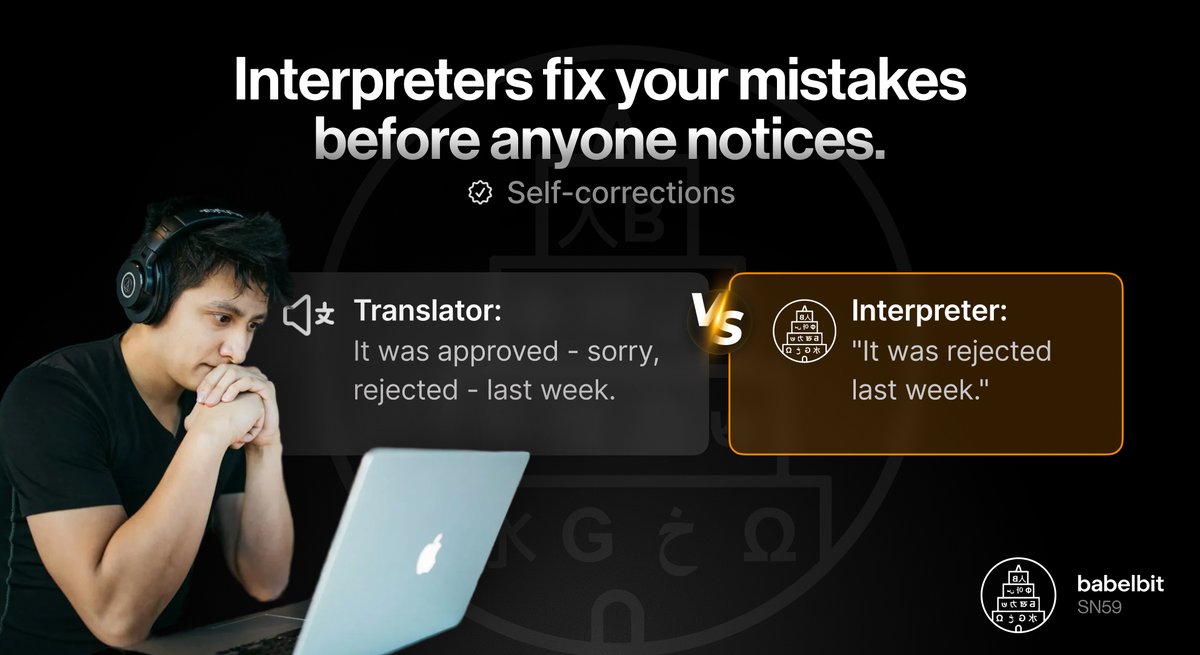
Self-corrections happen constantly in real conversation.
Human interpreters instantly recognise this pattern. They process the full context, catch the correction, and output only the final version. Clean. Professional. No confusion.
Machine translators can't do this. They output both versions word-for-word, creating ambiguity and potential miscommunication.
Babelbit is different. Our speech-mode LLMs understand context well enough to recognise self-corrections in real time and deliver the corrected output only - just like a human interpreter would.
This isn't faster translation. It's actual interpretation.
English
Another killer product aimed at real end users coming out of the Bittensor $TAO eco.
Congrats Gavin and @LeadpoetAI team, you've been grinding on this for some time. Wishing you a successful launch.
Leadpoet@LeadpoetAI
Introducing Leadpoet. The AI agent that delivers ready-to-buy prospects on demand. Your next customer is already looking for your solution. Leadpoet finds them. Comment “Poet” and we’ll send you 100 free lead credits for your ICP.
English
Dr Reed أُعيد تغريده

Bittensor has one of the most welcoming communities out there
I've been nerding out over the past 6 hours watching content, connecting with you all
Refreshing to see people with brain cells in the space (to say the least)
English
Careful of garbage coming to Bittensor now that it's getting more eyeballs.
Bittensor is a fair launch chain. It doesn't need horrible grift standards like this built in topz
Taoscription@taoscription
Bringing fair mints to everyone, on $TAO.
English

Dr Reed أُعيد تغريده

Dr Reed أُعيد تغريده

Why subnets are the real money play in $TAO
$TAO just hit $292.
Up from $262 yesterday.
But here's what nobody is discussing:
It's not just the token that's making people money.
It's the subnets.
Let me break down how people are actually making real money with $TAO:
1. Staking to subnets
You stake TAO to specific subnets.
You earn subnet tokens.
If the subnet grows → your tokens go up.
Example:
• Subnet 64 (Chutes AI): $119M market cap
• Subnet 3 (Templar): $77M market cap
• Early stakers? They're up 10x, 20x, more.
2. Running miners/validators
You can run compute and earn TAO.
No minimum stake needed.
Hardware + internet = income.
People are doing this from home.
Passive income in TAO.
3. Building on subnets
Launch your own subnet.
Token + utility.
If it gets traction → massive upside.
This is the highest risk/highest reward.
Here's the play:
The average person can't build a subnet.
But you CAN stake to one early.
129 subnets exist.
How many will become billion-dollar protocols?
A few will.
That's the asymmetric bet.
If you want to follow the subnet space, check out @WeAreSubConnect - they drop weekly deep dives on the ecosystem.
My strategy:
I'm not building a subnet.
But I'm staking to the ones I believe in.
And I'm accumulating TAO.
The token goes up.
The subnet tokens go up.
The revenue grows.
It's a double flywheel.
What subnets are you watching?
Drop your picks below 👇

English
The problem i have with CEX for this is that if there is a news event that would typically contribute to flow, unless it's huge (like Templar level news), it's just washing that CEX pool around and the effects on flow are minimal.
What has your experience been for Hippius so far?
English

Forefront of my mind right now as another one of my projects gets 'approved'.
It does create an entry door for many who are too scared or lack knowledge to fully enter a new eco-system, and wider markets (if there is liquidity) can have benefits.
Make no mistake though, it costs, ...listing fees, market makers, ...but i would not discount it completely ...if the project suceeds and demand is there (think Templar this last week) there is a lot of advantages to being easily accessible.
That taoflow is still satisfied somewhere, if not the exchange buyer, the providers of liquidity and those making the efforts to profit form arbitrage.
English
The first @WeAreSubConnect Bittensor $TAO weekly ecosystem update.
There's so much going on we made a telegram group just to help keep track of the latest posts quickly 🤣💀
SubConnect@WeAreSubConnect
The Bittensor $TAO ecosystem weekly update Vol.1 A 🧵
English
@Cryptoyoyo64 They wont, they'd be given the tokens for free from the owner cut, is the reality.
English

@ExponentialReed It would help TAOflow if they are forced to market buy and list, but otherwise I agree ser
English
Dr Reed أُعيد تغريده

Bittensor just trained a 72-billion parameter language model across a fully decentralized network. No single company. No central data center. Just a global mesh of permissionless compute nodes collaborating on 1.1 trillion tokens.
The model is called Covenant-72B, completed on Bittensor's subnet 3. It is the largest decentralized LLM pre-training run ever done.
The market noticed.
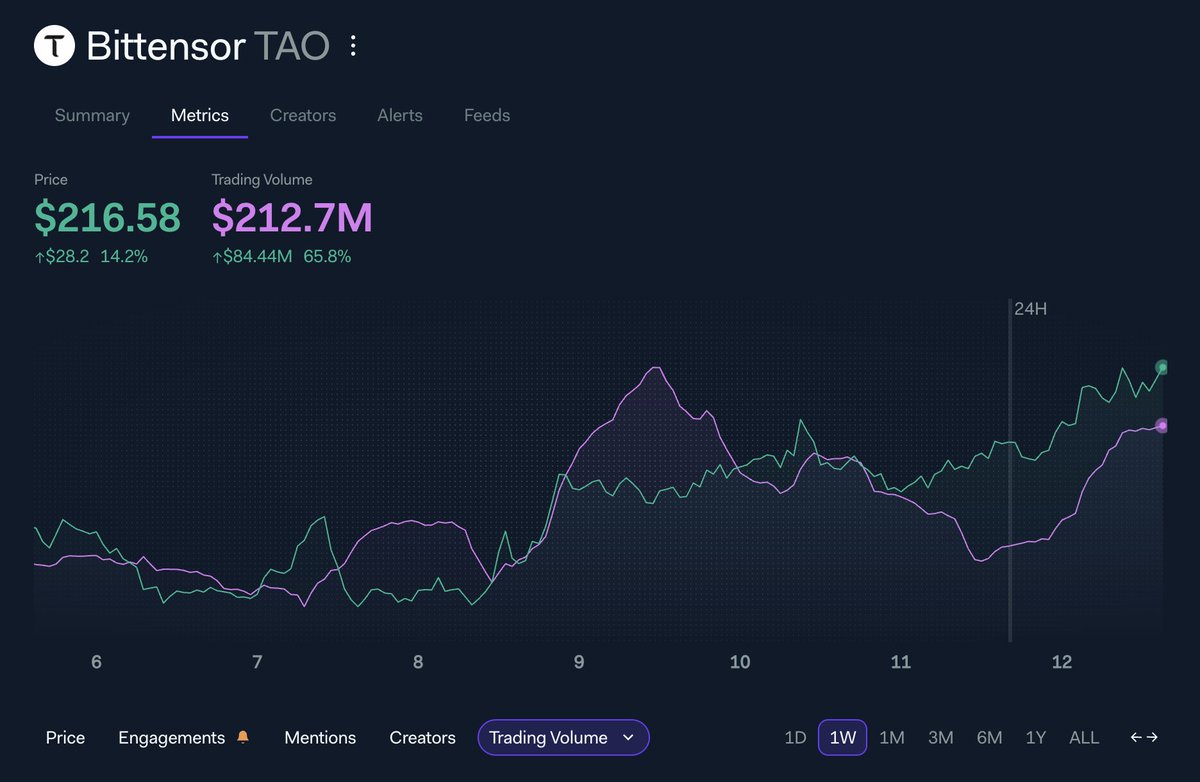
$TAO is up 40% in 30 days. Trading volume is up 167% over the past 6 months. Engagements on LunarCrush surged 114% month-over-month. Its combined LunarCrush Galaxy Score sits at 70.4, well above the 55 daily average. Sentiment is at 86%.
@Grayscale expanded its TAO trust for institutional access the same week.
Every AI crypto project sells the dream of decentralized compute. Bittensor just shipped a model that competes with outputs from centralized labs. That crosses the line from whitepaper to infrastructure.
The token is still 57% below its November high of $497. Which means either the market hasn't caught up to the technical milestone, or it's pricing in execution risk on scaling beyond a single model. Both readings are worth watching.
At $214 with a 70+ Galaxy Score and rising institutional access, TAO is the highest-conviction AI-crypto convergence trade on the board right now. The question is whether Covenant-72B is the proof of concept or the ceiling.
English
Dr Reed أُعيد تغريده

I'd like to pause here for a moment.
The $TAO ecosystem is something unprecedented in crypto.
It is creating real world value at scale.
I haven't seen anything like it in 10 years of being in crypto.
TAOflow in combination with deregistration is doing exactly what I hoped it would do:
The quality of subnets is improving every day, and the subnets that add real value to the ecosystem are rewarded with emissions (on average).
That’s something we should cherish.
I understand that there are still some issues that need to be ironed out, but those are relatively small and mostly created by a few outliers like subnet 29.
The overall mechanism works incredibly well if you ask me, so let’s not overcomplicate things or make hasty decisions trying to improve 1% while accidentally tearing down the fundamentals that were built.
I've never enjoyed being part of an ecosystem more, and I’d like to keep it that way.
Enough morning thoughts.
RV out.
SubConnect@WeAreSubConnect
𝐓𝐀𝐎𝐅𝐥𝐨𝐰 𝐰𝐨𝐫𝐤𝐬 - 𝐢𝐭 𝐣𝐮𝐬𝐭 𝐧𝐞𝐞𝐝𝐬 𝐭𝐢𝐦𝐞 One of the more interesting dynamics inside Bittensor is TAOFlow. At first glance it can look like just another mechanism in the system. In reality, it does something far more important: it creates incentives for capital, in the form of $TAO, to flow back into the network rather than constantly flowing out. That distinction matters, especially with all the extraction inside the broader crypto industry. If you have a system where value continuously leaves, it weakens over time, but if value finds reasons to return, the system compounds. TAOFlow is designed around that idea. Subnets that generate value, and especially those that can operate with a positive margin relative to emissions, become naturally more attractive. Capital flows toward them because the economics make sense. In other words, investors are incentivised to look for those investments and incentives shape behaviour. Over time this creates a filtering effect. Subnets that are able to convert usage into revenue and design proper economic feedback loops gain strength. Subnets that rely purely on emissions struggle to maintain attention and capital. That’s exactly the kind of pressure a healthy economic network should create. What makes TAOFlow even stronger is that it does not operate in isolation. It works in combination with another important mechanism: deregistration. Together they introduce a dynamic that resembles something closer to a real market. Subnets are not guaranteed permanent space in the system. They need to build, create lasting demand and need to justify the capital flowing toward them. That pressure is intentional, every subnet inside Bittensor is effectively operating in a constant seed round. Emissions provide early-stage capital, but that capital comes with expectations. Teams are given time to experiment, to build products and to find product-market fit. But eventually the question becomes unavoidable: Where does the value come from? TAOFlow accelerates that question. It creates urgency for subnet teams to demonstrate how their system works, how value is created and how that value feeds back into the network. It also forces better communication. If participants cannot understand the economic logic of a subnet, capital will simply move elsewhere. And that movement is healthy. It means the ecosystem is doing what it was designed to do: directing resources toward the places where they are most productive. So even if a subnet is trying to create a product, a lack of communication could still lead to a deregistration. None of this happens overnight. Economic systems need time to settle, incentives need time to shape behaviour and builders need time to turn experiments into real products. But the direction is clear. TAOFlow pushes capital back into the system. Margins separate sustainable subnets from subsidised ones. Deregistration ensures the network stays competitive. Together, those forces slowly transform a collection of experiments into a functioning intelligence economy. That process is already underway. It just needs time.
English
Dr Reed أُعيد تغريده
#Bittensor has been getting so much mainstream eyes this last week ... it has been a long time coming.
Happy to spend time discussing some of the fundamentals with those that are interested.
@jason@Jason
This Decentralized Cloud is Thousands of Times Cheaper Than AWS x.com/i/broadcasts/1…
English
Dr Reed أُعيد تغريده

𝐓𝐀𝐎𝐅𝐥𝐨𝐰 𝐰𝐨𝐫𝐤𝐬 - 𝐢𝐭 𝐣𝐮𝐬𝐭 𝐧𝐞𝐞𝐝𝐬 𝐭𝐢𝐦𝐞
One of the more interesting dynamics inside Bittensor is TAOFlow.
At first glance it can look like just another mechanism in the system.
In reality, it does something far more important: it creates incentives for capital, in the form of $TAO, to flow back into the network rather than constantly flowing out.
That distinction matters, especially with all the extraction inside the broader crypto industry.
If you have a system where value continuously leaves, it weakens over time, but if value finds reasons to return, the system compounds.
TAOFlow is designed around that idea.
Subnets that generate value, and especially those that can operate with a positive margin relative to emissions, become naturally more attractive. Capital flows toward them because the economics make sense.
In other words, investors are incentivised to look for those investments and incentives shape behaviour.
Over time this creates a filtering effect. Subnets that are able to convert usage into revenue and design proper economic feedback loops gain strength. Subnets that rely purely on emissions struggle to maintain attention and capital.
That’s exactly the kind of pressure a healthy economic network should create.
What makes TAOFlow even stronger is that it does not operate in isolation.
It works in combination with another important mechanism: deregistration.
Together they introduce a dynamic that resembles something closer to a real market.
Subnets are not guaranteed permanent space in the system.
They need to build, create lasting demand and need to justify the capital flowing toward them.
That pressure is intentional, every subnet inside Bittensor is effectively operating in a constant seed round.
Emissions provide early-stage capital, but that capital comes with expectations. Teams are given time to experiment, to build products and to find product-market fit. But eventually the question becomes unavoidable:
Where does the value come from?
TAOFlow accelerates that question.
It creates urgency for subnet teams to demonstrate how their system works, how value is created and how that value feeds back into the network. It also forces better communication. If participants cannot understand the economic logic of a subnet, capital will simply move elsewhere.
And that movement is healthy.
It means the ecosystem is doing what it was designed to do: directing resources toward the places where they are most productive. So even if a subnet is trying to create a product, a lack of communication could still lead to a deregistration.
None of this happens overnight.
Economic systems need time to settle, incentives need time to shape behaviour and builders need time to turn experiments into real products.
But the direction is clear.
TAOFlow pushes capital back into the system.
Margins separate sustainable subnets from subsidised ones.
Deregistration ensures the network stays competitive.
Together, those forces slowly transform a collection of experiments into a functioning intelligence economy.
That process is already underway.
It just needs time.

English