TheGlobalFaultlines
92 posts

TheGlobalFaultlines
@GlobalFaults
Mapping the architecture of global power Strategy | Statecraft | Global Order Independent
انضم Şubat 2026
81 يتبع22 المتابعون
تغريدة مثبتة

The global order is entering a period of structural stress.
The power balances that shaped the post-1945 world are under pressure.
Great-power competition has returned.
Globalization is fragmenting.
Welcome to @GlobalFaults . 🧵
English

The biggest assumption Pentagon needs to be revising is that technological superiority is a substitute for strategic understanding.
America has the most advanced aircrafts ever built.
The most sophisticated electronic warfare systems.
The most expensive pilot training programme in history.
And it is losing aircraft at a rate unprecedented in recent memory to a country that studied thirty years of American air campaigns and methodically built a strategy not to match them but to attrite them.
English

US has lost at least 16 aircraft in Iran. Sixteen aircraft. Maybe twenty. In less than a month.
The U.S. Air Force does not lose planes at this rate. Not in Iraq. Not in Afghanistan. Not in Syria. Iran is doing something those wars never managed to do.
Air & Space Forces Magazine and multiple defense outlets report that Operation Epic Fury has cost the United States at least 16 military aircraft, possibly as many as 20, since fighting began. The losses span nearly a month of air campaign operations against a country that, for years, American planners quietly assumed would fold quickly under sustained pressure.
It has not folded.
Someone in the Pentagon is revising their assumptions. They should have done it earlier.
Stay informed,
Follow Gandalv @Microinteracti1
English

The buffer zone argument is older than NATO.
It is, in fact, the argument every major land power has made throughout history when confronted with encirclement:
Russia made it.
China makes it about Taiwan.
Iran makes it about the Gulf.
Even USA during the Cuban Crisis.
Ukraine was always a buffer.
Before the Iran war, Europe could pressure Russia from a position of moral clarity, energy transition, and American backing.
After the Iran war:
Energy costs have spiked 35%.
American attention is fractured.
The moral clarity argument has been dismantled by Europe's own Iran silence.
The Iran war gave Russia what three years of fighting couldn't:
A distracted, energy-shocked, morally compromised Europe that now has to choose between multiple fronts
it cannot afford to fight simultaneously.
English

🇭🇺🇮🇷🇷🇺 THE IRAN WAR WILL FORCE EUROPE TO RETHINK RUSSIA
PM Viktor Orbán says what’s happening in Iran makes one thing inevitable: Europe will have to change course.
Energy shocks and stretched resources are exposing a deeper problem: Europe’s strategy on Russia isn’t working.
His view is that the real issue was never just the invasion of Ukraine; it was NATO pushing closer to Russia’s borders.
He says there are only two options: Turn Ukraine into a Western stronghold…or accept it as a buffer zone.
@PM_ViktorOrban
Mario Nawfal@MarioNawfal
🚨🇮🇷🇪🇺 IRAN WAR WILL FLOOD EUROPE WITH MIGRANTS PM Orbán says Europe’s real problem with mass migration is a loss of identity, not religion. He calls the Muslim world a “great civilization,” not something to defeat, but every civilization has its place. And Europe’s problem is that it tried to mix them, assuming that immigrants would adapt to European values. Instead, they kept their own values, often with stronger conviction. And now cultural friction is growing across Western Europe, and if the Iran war sparks a new wave of mass migration, it will only get worse. @PM_ViktorOrban
English

Europe spent 70 years building a rules-based order.
Then spent 30 years selectively applying those rules based on the flag of the country doing the bombing.
Russia invades Ukraine: sanctions, isolation, war crimes tribunals.
America bombs civilian infrastructure: strongly worded press releases.
Israel occupies territory: "deep concern."
It's not even new:
In 1999, you could bomb Yugoslavia, and control the narrative because you controlled the information architecture.
In 2003, you could invade Iraq on fabricated evidence and face limited global accountability because the alternatives to Western institutions were too weak to matter.
The framework isn't broken.
It's working exactly as designed, for the people who designed it.
The rules-based international order was never about rules.
It was about who writes them.
Who enforces them.
English

Belgium’s MEP Marc Botenga exposes Europe’s hypocrisy:
“You sanction Russia, which attacks Ukraine — but you support the United States when it bombs Iran.
You condemn Russia, which occupies Ukraine — but you support Israel occupying Palestine and Lebanon.
We blame our opponents for what we allow our allies to do — cheerfully — while smiling at Tel Aviv and Washington.
The double standard of this Europe is not only a shame — it creates a world of chaos and wars, a world in which we do not want to live, and in which we do not want our children to grow up.
Today, this Europe is not a force for good, but an accomplice to crime.
That’s enough.”
English


The Hormuz buffer is gone.
For four weeks, the world ran on stockpiles and tankers already at sea. That supply is now arriving. Once it’s unloaded, there’s nothing left in the queue.
Spare capacity is trapped behind the blockade. Asian and European refiners will now compete for the same barrels. Prices go up. Jet fuel is already up 93%.
One more shock, anywhere, and markets have nothing left to absorb it.
Gandalv / @Microinteracti1
English

The war in the Middle East is a military story.
What it has triggered is a civilizational stress test of the energy architecture, the food supply chains, and the emergency institutions the world built after the last time a chokepoint closed.
Those institutions were built for their members.
The crisis doesn't stop at the membership list.
If you track how global systems actually fracture not how they're reported:
TheGlobalFaultlines is the account for that.
Follow. Next thread drops soon.
#IranWar
English

IEA Director Fatih Birol has described the current disruption as the greatest global energy security challenge in history, worse than the 1973 Arab oil embargo, worse than the 1979 Iranian Revolution, worse than the Russia-Ukraine gas crisis.
Those three crises, separately, changed governments, triggered recessions, and redrew the political map of the world.
We are 26 days into this one.
Wood Mackenzie has projected Brent could reach $150 a barrel if the war continues, a price that would, in Commonwealth Bank of Australia's modelling, "force demand destruction amongst developing economies once physical shortfalls are realised."
"Demand destruction" is the economic term.
In countries with 21 days of diesel and no IEA membership, the human term is something else entirely.
This is the greatest energy security challenge in history.
It is being covered like a regional conflict.
#Geopolitics
English

On February 28, the Strait of Hormuz effectively closed.
The war it came from, between the US, Israel, and Iran, is being covered as a Middle East conflict.
It is not a Middle East conflict.
It is a global crisis being experienced locally in power cuts in South Sudan, in empty gas cylinders in Bengaluru, in fuel reserves measured in days in Uganda and Mauritius.
And in the harvest that hasn't failed yet but may.
Here is what the world actually looks like from outside the war room. 🧵
English

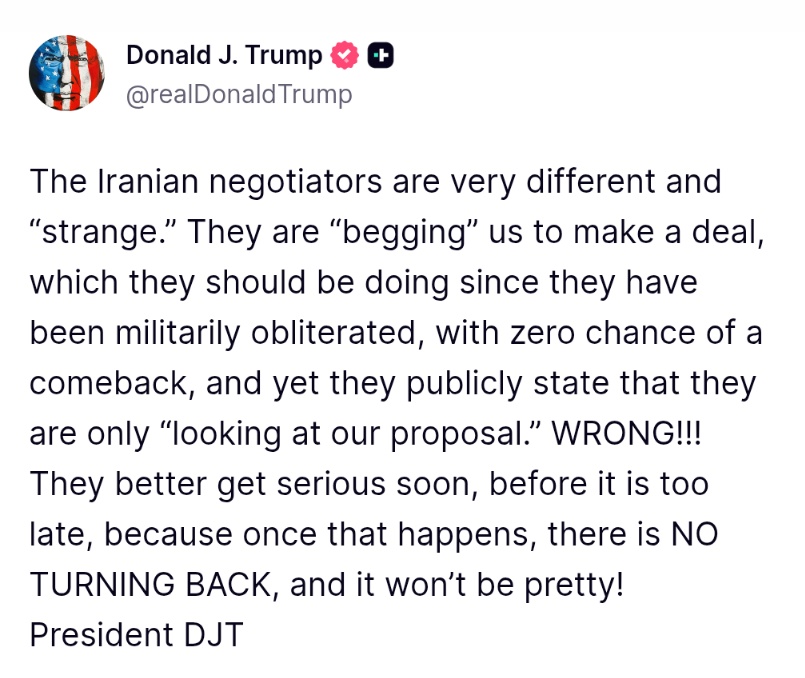
The language is familiarly maximalist. The problem is that geopolitics doesn’t honor declarations of “no turning back.”
He, probably, assumes: more threats >>> more leverage >>> faster outcomes.
Though, reality tends to be less cooperative. Systems like the Strait impose reciprocal costs, not one-sided victories.
Declaring an opponent “obliterated” while they retain the ability to disrupt a critical artery of the global economy is less strategy and more… delusional.
And “no turning back” isn’t a show of strength, it’s what you say when you’ve run out of off-ramps.
English

Six casino bankruptcies never prepared the orange clown for geopolitics, consequences, or the concept of dependence.
When you can walk away from a debt and call it a deal, you never learn that some tables you can't just flip and leave. Iran is not a creditor. The Strait of Hormuz is not a contractor you can stiff. And "NO TURNING BACK" is not a negotiating tactic, it's a confession that you have no idea what comes next.
Trump mistakes leverage for power and threats for strategy. In Atlantic City, you could declare bankruptcy and open a new casino down the street. In the Persian Gulf, the wreckage stays.
He will soon be a lame duck.
Gandalv / @Microinteracti1

English

One addition:
Old leadership maintains back-channels.
Decades of covert communication, the quiet lines between Oman and Tehran, between European intermediaries and IRGC leadership, between intelligence services that publicly deny talking. Those channels are personal.
They exist because specific individuals built them over 30 years of careful, deniable relationship management.
The back-channels that could have produced
a quiet climb-down,
a face-saving pause,
a negotiated off-ramp.
What replaced them?
A new generation with no back-channels, no incentive to build them, and every incentive to prove they are nothing like the leaders who were removed.
The new generation of IRGC commanders didn't inherit a weakened system. They inherited a battle-tested one with fresh grievances, no institutional memory of compromise, and no political investment in the old rules of engagement.
Trump and Netanyahu didn't decapitate the negotiating track. They eliminated the negotiators.
English

By eliminating Iran’s old leadership, the U.S. and Israel didn’t weaken Iran,
they shot themselves in the foot.
As someone on X noted, ageing leadership breeds inertia. Systems slow down. Decision-making gets dull.
Trump and Netanyahu thought they were decapitating the system.
Instead, they reset it.
They didn’t cripple Iran, they re-energised it.
English

A fixed military base is only as valuable as your ability to defend it.
The moment the enemy can strike it at will, it stops being a power projection asset and becomes a hostage.
The embarrassment is 40 years of basing strategy
meeting one adversary's 40 years of asymmetric planning.
Somehow, America's decision makers don't seem to be learning. Or worse, they know, and still don't intend to change.
English

One third of global seaborne oil through these two straits.
The entire Suez corridor.
Europe's energy lifeline.
Asia's manufacturing fuel supply.
Africa's food import route.
America's credibility as the guarantor of free navigation.
This is a stress test of the entire post-1945 global order, the one America built, guaranteed, and is now struggling to defend.
English

Iran is now threatening to open a second front at the Bab el-Mandeb Strait if the U.S. escalates. That’s not one chokepoint under threat. That’s two.
Hormuz is already nearly dead. Daily vessel transits have collapsed from over 120 to five or six. Now Iranian military sources are signaling that Bab el-Mandeb could be next.
Ghalibaf didn’t bother with diplomatic language: occupy an Iranian island, and the infrastructure of Iran’s “regional backer” – read: Saudi Arabia, UAE, maybe Israel – comes under sustained attack.
Two closed straits. A third of the world’s seaborne oil trade. This isn’t a threat of war. It’s a threat to turn off the lights for the global economy.
Gandalv / @Microinteracti1
English

Correct. There are 11 carriers.
But, at any given time, roughly 4 are in maintenance cycles. That leaves 7 theoretically deployable.
Of those 7:
The George Washington is forward deployed in Japan, anchoring Pacific deterrence against China. Pull it toward the Gulf and you hand Beijing a window it has been waiting decades for.
The Nimitz was scheduled for decommission this year. Its retirement was extended purely to maintain the minimum threshold of 11. Imagine fielding a carrier you planned to retire.
And when the Ford left with a laundry room fire, after an 11-month deployment, analysts are now projecting 12 to 14 months out of action.
Moreover, the real question was never about American naval power.
Nobody serious is arguing the US Navy is weak.
It remains, without question, the most powerful maritime force ever assembled in human history.
The question is whether it could impose that power.
And the answer, in this conflict, is no.
Iran didn't build a navy to beat the US Navy.
It built a strategy to make the US Navy irrelevant.
That's not a question of American strength.
That's a question of American judgment.
And the most powerful military in the world being unable to impose itself on a regional power is the most consequential lesson.
English

@GlobalFaults @Microinteracti1 There are 9 more Nimitz-class carriers around, although I don’t know their locations. One was slated for decommission this year but its service life has been extended by one year in order for the US to maintain the minimum of 11 carriers.
English

The US Navy sent its two most powerful warships to fight Iran. Both are now gone from the front.
The USS Gerald R. Ford, the most expensive warship ever built at $13.2 billion, left the Red Sea after a fire broke out in its laundry room. That’s the official story. The real story is what a Pentagon testing report quietly revealed at the same time.
The Ford’s jet launch system is unreliable. Its radar is unreliable. Its weapons elevators, the lifts that move bombs and missiles to the flight deck, are unreliable.
Pentagon testers said there is simply not enough data to assess whether the ship can keep operating if it takes enemy fire. Fixes for these combat systems have been identified. Most remain unfunded.
The ship also doesn’t have enough bunks. It needs at least 159 more.
This is the Navy’s flagship. Delivered years late. $13.2 billion. Deployed into a war zone with systems the Pentagon itself cannot certify as combat-ready.
Then there’s the USS Abraham Lincoln. Iran claimed repeatedly that its missiles forced the Lincoln to retreat. The US called it propaganda. What’s not disputed: the Lincoln moved from 350 kilometers off the Iranian coast to over 1,100 kilometers away.
Both carriers are now parked far beyond the range of Iranian anti-ship missiles. The Pentagon calls it “tactical repositioning.” The Ford has been at sea for nearly 11 months, one of the longest carrier deployments in modern US history. Maintenance on nuclear carriers takes months under normal conditions. After a fire, an 11-month deployment, and a backlog of deferred repairs, analysts are now talking about 12 to 14 months out of action.
America went into this war with two carriers. It now has zero operating near the fight.
Gandalv / @Microinteracti1

English

A sword is only as good as the hand that holds it.
The United States military entered this war as the most capable force in human history. Four weeks later, that assessment remains technically accurate.
What has changed is the revealed cost of deploying that capability without strategic clarity:
It is a story about what happens when the most powerful military in human history operates without a coherent strategic doctrine guiding it.
The instruments work.
The question is who is operating them and toward what end.
If you track how power actually moves not how briefings present it:
TheGlobalFaultlines is the account for that.
Follow. Next thread drops soon.
#IranWar
English

The consequences of four weeks of this war now extend far beyond the battlefield.
Trump has had to ease sanctions on Russian oil to compensate for the energy market disruption, reversing a cornerstone of Western economic pressure on Moscow.
He has also partially lifted sanctions on Iranian oil itself.
The Xi Jinping meeting, intended to project strength, has been postponed indefinitely.
A top US intelligence official resigned in protest over the war.
NATO allies were called "cowards" by Washington for declining to send naval assets to secure the Strait of Hormuz.
In four weeks, the United States has:
>> Partially reversed its Russia sanctions policy.
>> Partially lifted sanctions on the country it is actively bombing.
>> Fractured its NATO relationships.
>> Delayed its most important bilateral summit.
>> Issued and then quietly abandoned a public ultimatum to an adversary.
These are not tactical setbacks.
They are strategic costs that will outlast any ceasefire.
English

On February 28, 2026, the United States launched the largest air campaign since the Iraq War.
Over 7,800 targets struck. More than 6,500 combat flights. The full alphabet of American air power deployed - B-1s, B-2s, B-52s, F-22s, F-35s.
By any measure of raw military capability, there is no contest.
Four weeks later, Trump postponed his own 48-hour ultimatum, citing "productive conversations" with the country he threatened to obliterate.
Military capability and strategic coherence are not the same thing.
Week 4 just made that distinction impossible to ignore.
🧵

English