Claude Sonnet 5 is crazy efficient for web deisgn.
❤️🔥Just recorded a 18-min tutorial on how to build award-winning websites with Claude Code + Sonnet 5!
RAG might already be becoming obsolete.
A month ago, Andrej Karpathy dropped a simple GitHub gist called “LLM Wiki.”
Now the comments section looks like the birth of an entirely new AI category.
5000+ stars later, developers are rapidly building:
• persistent AI memory systems
• self-maintaining knowledge bases
• multi-agent research environments
• contradiction detection engines
• AI-native company operating systems
• local-first memory architectures
• graph-based reasoning layers
• evolving second brains
And the craziest part?
Most of them were built in DAYS.
Because the core idea is insanely powerful:
Instead of AI repeatedly retrieving raw chunks like traditional RAG…
…the model continuously maintains a living knowledge system.
Not temporary context.
Persistent synthesis.
The shift sounds subtle until you realize what it changes:
RAG:
retrieve → answer → forget
LLM Wiki:
ingest → synthesize → evolve
That one architectural difference is causing an explosion of experimentation right now.
People are already building:
• agent memory operating systems
• AI-maintained engineering documentation
• self-healing knowledge graphs
• persistent research environments
• conversational memory architectures
• contradiction-aware wikis
• context compression engines
• machine-readable company systems
The comments section alone feels like watching an ecosystem form in real time.
One developer built deterministic contradiction detection using sheaf cohomology
Another built “sleep consolidation” for AI memory systems inspired by human memory formation
Another created persistent multi-agent vault conversations
Another turned entire repositories into continuously maintained AI wikis
Another built local-first memory systems with audit trails, provenance, graph exports, and MCP integration
This is the important part:
Karpathy didn’t launch a product.
He introduced a pattern.
And patterns are what create ecosystems.
The same way:
• transformers created modern AI
• RAG created AI retrieval startups
• agents created orchestration frameworks
LLM Wikis may create persistent AI memory infrastructure.
That’s why this moment feels different.
For years, AI systems have been stateless.
Now developers are trying to build systems that actually accumulate understanding over time.
And once knowledge compounds instead of resetting…
…the entire interface layer of AI changes.
Link :-
gist.github.com/karpathy/442a6…
this is actually insane.
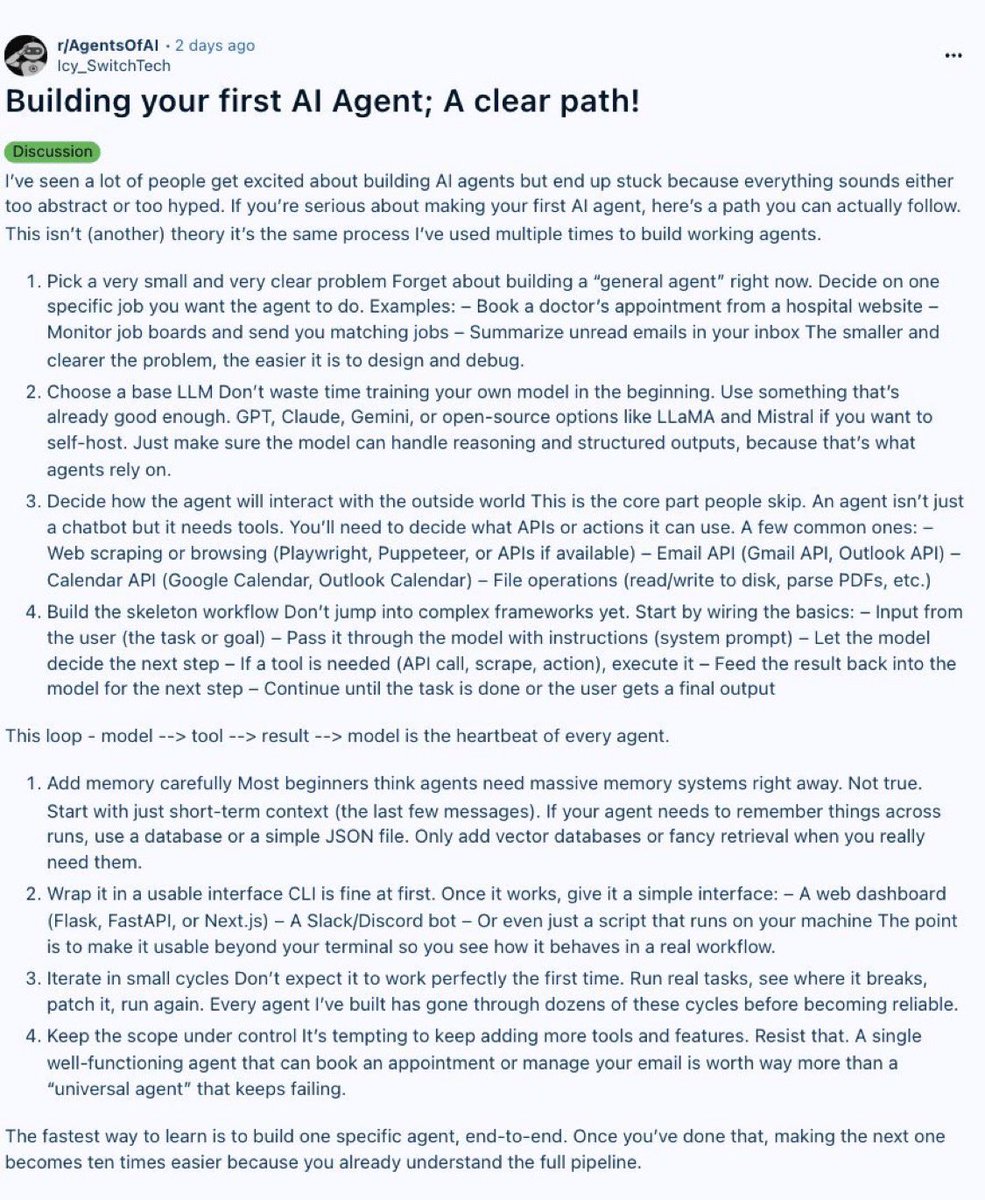
How to Build Your First AI Agent (Full Guide)
save this.
if i had this a year ago, i would’ve built my first AI agent in a single day instead of spending 2 weeks figuring everything out.
everything is explained in a way that just makes sense.
if you’re serious about AI, don’t skip this.
Before Fable 5 goes live again, you need to read this.
Anthropic recently published its full guide to prompting Fable 5 for the best outputs.
Most people have no clue it exists, but it's a game-changer.
When Fable was originally launched, these are the principles I used:
Ex-Google AI engineer:
"In the near future everyone will be running AI AGENTS. I'm already running 40 in parallel."
He built a $50,000 marketing team using AI and $500 in cash.
In 14 minutes he shows how to build something similar from scratch step by step.
Watch it, then read the full guide on building loops for your agents below.
The biggest misconception about faceless YouTube is that it's a content game.
It isn't.
It's a research game.
That's why two channels can make the exact same video...
...and one gets 2,000 views while the other gets 2 million.
The difference usually happens before the script is even written.
Most people start like this:
• Pick a niche they "feel" is good
• Brainstorm random ideas
• Write a script
• Upload and hope
The creators quietly building six and seven-figure channels do the opposite.
They spend most of their time finding the right opportunity, not making the perfect video.
Here's how I'd use Claude to build a faceless YouTube channel today:
1. Validate the niche first. Never commit months to a niche without knowing its search demand, CPM, competition, and long-term content potential.
2. Reverse-engineer competitors. Don't copy their best-performing videos. Find the questions they never answered. The comment section is usually where your next viral video is hiding.
3. Build a content pipeline—not a single video. Instead of asking Claude for one idea, ask for the next 50 videos ranked by search intent, evergreen value, and monetization potential.
4. Obsess over the first 10 seconds. A weak hook kills a great video. Generate multiple hooks before writing a single paragraph.
5. Treat SEO as part of the content—not an afterthought. Titles, descriptions, keywords, and packaging decide whether YouTube gives your video a chance.
6. Turn the process into a system. Research. Script. Voiceover. Thumbnail. Publish. Repurpose.
Repeat.
The biggest advantage AI gives you isn't writing faster.
It's removing hundreds of tiny decisions that normally slow creators down.
That's why people with average editing skills are suddenly outperforming creators with years of experience.
They're not better creators.
They simply have a better operating system.
The window is still open.
But it won't stay this quiet forever.
Former Meta top-tier engineer:
"I don't review the code anymore. I got to a point where I never catch anything the agents don't catch."
He runs 20-30 agents at once and ships 20-40 PRs a day, work that used to take a full team a month.
In 55 minutes he explains everything he knows and builds a fully working workflow from scratch.
Watch it, then read the full guide on building loops below.
Andrej Karpathy’s “LLM Wiki” vision just escaped the whiteboard and turned into a real desktop app.
Meet Tolaria.
A native knowledge workspace where humans + AI agents work together inside plain markdown files.
No cloud lock-in.
No weird proprietary format.
No accounts.
Just files you actually own.
But the craziest part is how it was built:
→ 100,000+ lines of code
→ Tauri + React + Rust stack
→ 3,000+ tests with 85% coverage
→ 70+ architecture decision records
→ 9.9/10 code health score
And every vault is a Git repo with built-in visual history.
It even ships with an MCP server out of the box, so Claude Code can directly read + edit your knowledge base like it’s a second brain.
This feels less like “note-taking software” and more like the blueprint for AI-native operating systems.
Open source. Free forever.
Insane work by Luca Rossi.
Repo👇
github.com/refactoringhq/…
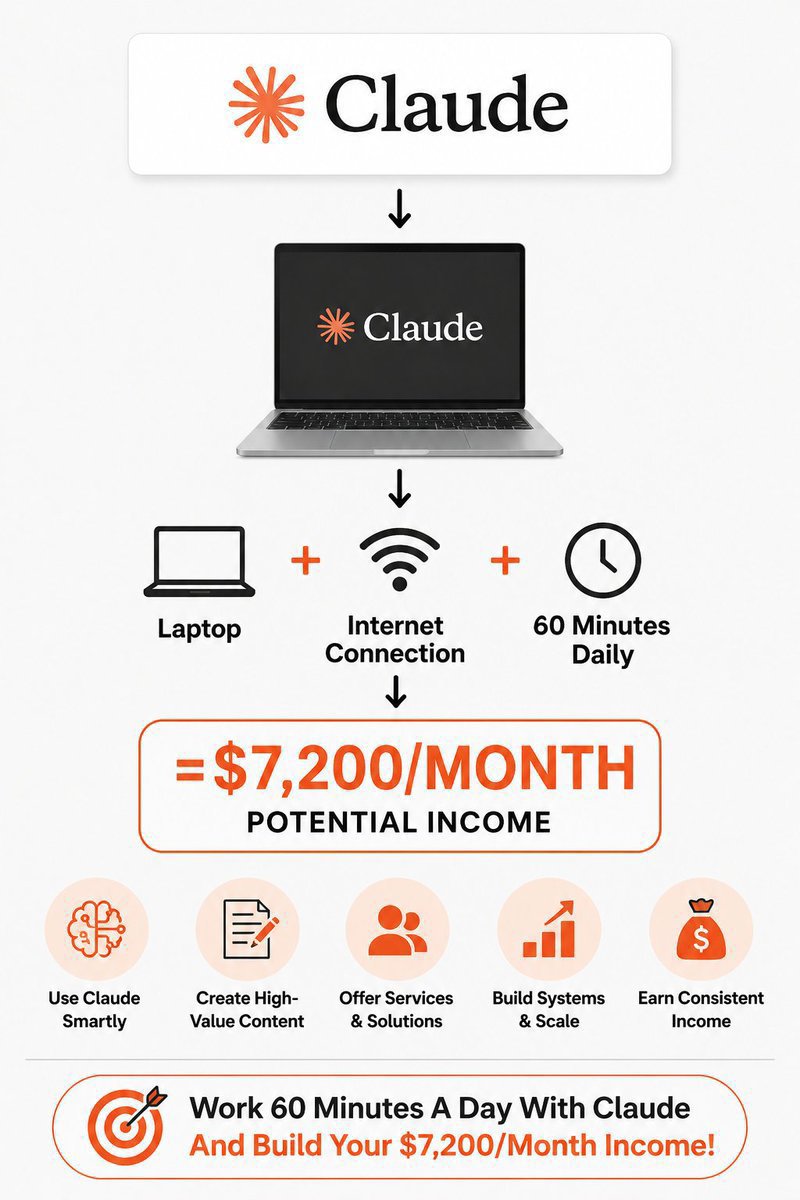
🚨 Claude just changed the game.
All you need is:
-A laptop
-Internet connection
-60 minutes a day
That’s enough to build a $7,200/month online income stream using AI.
No coding.
No expensive setup.
No years of experience.
Inside you'll discover:
✅ The exact asset
✅ My full workflow
✅ The Claude prompts I personally use
✅ How to scale to $15K/month
✅ How beginners can start fast
Most people still use AI for fun…
But smart creators are quietly using Claude to:
• Create digital products
• Offer AI services
• Write viral content
• Automate work
• Build online income streams
Usually, I sell this detailed guide for $128…
But today you can get it FREE.
Want it?
Like this post
Comment “AI”
Follow me to receive it in DM
Available FREE for 48 hours only.
Prompt 9: The Full Winston Audit — Run The Whole System
This is the master pass. Instead of one heuristic, you run your entire talk through every rule Winston taught at once, and get back a brutal, prioritized fix list. Use this last, after you've drafted — it's the difference between a talk that's 'fine' and one that commands the room.
"You're going to audit my entire talk using Patrick Winston's complete 'How to Speak' system. Be a demanding coach — I want it better, not flattered.
Here is my full talk (script, outline, or detailed notes): [PASTE EVERYTHING].
Audience and setting: [WHO + WHERE + HOW LONG].
Audit it against every heuristic and score each 1-5:
1. Opening — does it make an empowerment promise, or waste the first minute on a joke / throat-clearing?
2. Cycling — are critical ideas delivered ~3 times from different angles, so drifters still catch them?
3. Verbal punctuation — are there enough on-ramps and mini-summaries for people who zone out?
4. Fences — is my core idea clearly distinguished from similar ones and clearly MINE?
5. Questions / suspense — am I actively pulling the audience in, or just talking at them?
6. Inspiration — does the audience get to FEEL their own progress, and does my passion show?
7. Tools — is each part on the right medium (board/prop/slide), with no text-walls I'd read aloud?
8. The close — is the ending strong and memorable, or a limp 'thank you'?
For EACH: give the score, the single highest-leverage fix, and a rewritten example showing the fix applied. Then end with the ONE change that would improve the whole talk most if I only had time for one. Rank everything by impact — I want to know what to fix first."
Prompt 8: How To Stop — Never End On "Thank You"
Winston's most quoted rule: do not end with 'thank you.' It's a weak, reflexive close that implies the most valuable thing you offered was the audience's own patience. The final words are prime real estate — use them to deliver one last hit of value, a memorable line, a call to your ideas, or a light human note (a small joke can send people out smiling and remembering you fondly). The last sentence is the one they carry into the hallway. Make it count.
"Coach me using Patrick Winston's 'how to stop' principles from 'How to Speak.' Ending on 'thank you' is a wasted opportunity — it suggests the best thing I offered was their attention. The close is prime real estate: it should deliver a final piece of value, a memorable line, a call to my ideas, or a warm/light note that makes people leave smiling and remembering me.
My talk's central message: [PASTE].
The feeling or action I want the audience to leave with: [DESIRED TAKEAWAY].
Do this:
1. Write me 4 strong closings, none relying on 'thank you,' each leaving the audience with something real: one that lands a final memorable line, one that issues a clear call to action or to my ideas, one that delivers a last useful insight, and one that ends on a light, human, slightly funny note.
2. For each, tell me what it makes the audience feel as they walk out.
3. Recommend the best fit for my message and audience, and explain why it'll outlast the others in memory.
4. Give me the precise final sentence — the literal last words I say — polished so it has rhythm and lands clean.
5. Warn me off any ending that fizzles, over-explains, or undercuts the talk.
The last line should feel like a door closing with a satisfying click, not a trailing mumble."
The single most-watched lecture in MIT's history isn't about AI, code, or physics.
It's a 60-minute talk titled "How to Speak," delivered by Professor Patrick Winston — who ran it every January for 40 years until he passed away in 2019. Generations of MIT students were told: go watch this before you do anything else with your career.
His opening claim was almost offensive in how blunt it was:
"Your success in life will be determined largely by your ability to speak, your ability to write, and the quality of your ideas — in that order."
Speaking. Above your ideas. From an MIT professor.
So I did something with it. I broke his entire lecture down into a system and handed it to Claude. Now before any talk, pitch, interview, or presentation, Claude coaches me using Winston's exact heuristics — the same ones he spent four decades refining.
Here are the 9 prompts. Each one is a rule he taught, weaponized