
Labour Law Reporter

28.8K posts

Labour Law Reporter banner
Labour Law Reporter

Labour Law Reporter

@LabourReports

A monthly journal, popularly known as LLR, publishes HR articles, court judgments, much more related to HR and Indian labour laws.

Lajpat Nagar, New Delhi,India انضم Mayıs 2015
2.1K يتبع10.1K المتابعون
Labour Law Reporter
Labour Law Reporter@LabourReports·
𝗧𝗵𝗲 𝟯𝟬𝟬-𝗪𝗼𝗿𝗸𝗲𝗿 𝗧𝗿𝗮𝗽: 𝗔𝗿𝗲 𝗬𝗼𝘂 𝗕𝘂𝗶𝗹𝗱𝗶𝗻𝗴 𝗮 𝗕𝘂𝘀𝗶𝗻𝗲𝘀𝘀 𝗼𝗿 𝗮 𝗖𝗹𝗼𝘀𝘂𝗿𝗲 𝗖𝗹𝗶𝗳𝗳?🚨 ➤ Here are the 𝟑 𝐦𝐚𝐣𝐨𝐫 𝐥𝐞𝐠𝐚𝐥 𝐭𝐫𝐢𝐠gers you need to navigate before hiring your 300th worker: ❶. 𝐓𝐡𝐞 "𝐂𝐡𝐚𝐩𝐭𝐞𝐫 𝐗" 𝐂𝐥𝐨𝐬𝐮𝐫𝐞 𝐂𝐥𝐢𝐟𝐟 🏗️ Under the Industrial Relations (IR) Code, 2020, Section 77 sets a hard boundary. Once your establishment hits 300 workers (calculated on an average per working day in the preceding 12 months), you enter the "Special Provisions" zone of Chapter X. Sections 78 (Lay-off), 79 (Retrenchment), and 80 (Closure) now strictly apply. You can no longer downsize or shutter at will. You must seek prior permission from the Appropriate Government (90 days prior for closure). Crossing 299 isn't just growth; it’s a legal handover of managerial autonomy to the State. ❷. 𝐓𝐡𝐞 𝐒𝐭𝐚𝐧𝐝𝐢𝐧𝐠 𝐎𝐫𝐝𝐞𝐫 𝐌𝐚𝐧𝐝𝐚𝐭𝐞 📜 While Chapter X looks at an average, Section 28 is much stricter. It mandates that any industrial establishment where 300 or more workers were employed on any single day in the preceding 12 months must have Certified Standing Orders. These are the strict statutory "service rules" governing everything from shift timings to misconduct. The 300th worker triggers a strict legal deadline under Section 30 to prepare, submit, and certify these draft rules with the Certifying Officer. ❸. 𝐓𝐡𝐞 "𝐘𝐨-𝐘𝐨" 𝗪𝗼𝗿𝗸𝗳𝗼𝗿𝗰𝗲 𝗗𝗶𝗹𝗲𝗺𝗺𝗮 ⏱️ Employers are actively asking: "If my headcount drops back to 250, do my certified standing orders automatically become void?" The legally verified answer is No. Once certified under Section 30, these orders become vested conditions of service in the employment contract. Dropping below 300 does not magically void your policies. To legally alter them, you must follow Section 40 (Notice of Change), which strictly requires giving a 21-day advance notice to workers before changing any condition specified in the Third Schedule. ➠ Here is the exact verified breakdown of why this threshold matters: ➝ 𝘞𝘩𝘢𝘵 𝘵𝘩𝘪𝘴 𝘮𝘦𝘢𝘯𝘴 𝘪𝘯 𝘱𝘳𝘢𝘤𝘵𝘪𝘤𝘦: Hiring that 300th person is a quasi-permanent legal commitment. Even if you downsize later, the "Certified" status of your employment rules stays locked in. ➝ 𝘞𝘩𝘺 𝘥𝘰𝘦𝘴 𝘵𝘩𝘪𝘴 1-𝘮𝘢𝘯 𝘥𝘪𝘧𝘧𝘦𝘳𝘦𝘯𝘤𝘦 𝘮𝘢𝘵𝘵𝘦𝘳 𝘴𝘰 𝘮𝘶𝘤𝘩? ✦ The Void & Pay Rule: For establishments over 300, a layoff without government nod is deemed illegal under Section 78(8). You will owe full wages to workers as if no layoff ever occurred. ✦ The 10-Lakh Penalty: Under Section 86(1), contravening the layoff, retrenchment, or closure rules of Chapter X triggers massive financial penalties starting at ₹1 Lakh and extending up to ₹10 Lakhs. ✦ The Discipline Rigor: Under certified Standing Orders, you cannot fire a worker for "general cause." You must meticulously follow the exact domestic inquiry procedures outlined in your certified rules or face immediate reinstatement orders from tribunals. labourlawreporter.com/labourcodeadvi…
Labour Law Reporter tweet media
English
0
0
2
214
Labour Law Reporter
Labour Law Reporter@LabourReports·
Enquiry cannot be vitiated merely because second show cause notice was not served. Employers in relations to the Management of M/s. Central Coalfields Limited v. Their Workman Dasrath Gope, 2026 LLR 266 (Jhar. HC) labourlawreporter.com/labourcodeadvi…
English
0
0
0
127
Labour Law Reporter
Labour Law Reporter@LabourReports·
Termination of an employee for prolonged non-performance would be proper. Tata Consultancy Services Limited v. Mr. Krishna Raju Ananthamurthy and Ors., 2026 LLR 293 (Karn. HC)
English
0
0
2
205
Labour Law Reporter
Labour Law Reporter@LabourReports·
Some payments through vouchers by principal employer won’t establish employer-employee relationship. Krantikari Kamgar Union v. Kuoni Travel (I) Private Limited & Anr., 2026 LLR 283 (Bom. HC)
English
0
0
1
123
Labour Law Reporter
Labour Law Reporter@LabourReports·
𝗧𝗵𝗲 𝗢𝘃𝗲𝗿𝘁𝗶𝗺𝗲 𝗧𝗿𝗮𝗽: 𝗚𝗶𝘃𝗶𝗻𝗴 𝘀𝗼𝗺𝗲𝗼𝗻𝗲 𝗮 "𝗠𝗮𝗻𝗮𝗴𝗲𝗿" 𝘁𝗶𝘁𝗹𝗲 𝘄𝗶𝗹𝗹 𝗡𝗢𝗧 𝘀𝗮𝘃𝗲 𝘆𝗼𝘂 𝗳𝗿𝗼𝗺 𝗱𝗼𝘂𝗯𝗹𝗲 𝗢𝗧. 🛑 Under India’s new Labour Codes, linking 𝐃𝐞𝐬𝐢𝐠𝐧𝐚𝐭𝐢𝐨𝐧𝐬 to overtime 𝐄𝐱𝐞𝐦𝐩𝐭𝐢𝐨𝐧𝐬 is a dangerous assumption. ➠Here is the exact, legally codified shift in overtime eligibility you need to know today: 📜 𝐓𝐡𝐞 𝐁𝐫𝐨𝐚𝐝 𝐍𝐞𝐭 (Code on Wages, 2019) ✦The Status Quo: This Code defines an "employee" incredibly broadly, explicitly including people in supervisory, managerial, and administrative roles. ✦The Threat: Section 14 mandates double overtime pay for covered employees. This broad classification has sparked fear that standard managers could technically fall into legal disputes over overtime entitlements. 🚫 𝐓𝐡𝐞 𝐔𝐥𝐭𝐢𝐦𝐚𝐭𝐞 𝐅𝐢𝐥𝐭𝐞𝐫 (OSHWC Code, 2020) ✦Who it impacts: This code governs actual working hours and restricts overtime benefits strictly to a "worker." ✦𝙏𝙝𝙚 𝙂𝙖𝙢𝙚-𝘾𝙝𝙖𝙣𝙜𝙚𝙧 (𝙎𝙚𝙘𝙩𝙞𝙤𝙣 2(𝙯𝙯𝙡): An individual is legally NOT a worker if they are: (a) Employed mainly in a managerial or administrative capacity. (b) Employed in a supervisory capacity drawing wages exceeding ₹18,000 per month. 👉 𝐓𝐡𝐞 "𝐏𝐫𝐢𝐦𝐚𝐫𝐲 𝐃𝐮𝐭𝐢𝐞𝐬" 𝐑𝐞𝐚𝐥𝐢𝐭𝐲 𝐂𝐡𝐞𝐜𝐤 ➝𝘞𝘩𝘢𝘵 𝘵𝘩𝘪𝘴 𝘮𝘦𝘢𝘯𝘴 𝘪𝘯 𝘱𝘳𝘢𝘤𝘵𝘪𝘤𝘦: If you pay an "Assistant Manager" ₹25,000 a month, you are not necessarily safe. Indian Labour Courts do not care about the fancy titles printed on your offer letters. ➝𝘞𝘩𝘺 𝘥𝘰𝘦𝘴 𝘵𝘩𝘪𝘴 𝘮𝘢𝘵𝘵𝘦𝘳 𝘴𝘰 𝘮𝘶𝘤𝘩? Because courts apply the "Primary Duties Test." If a designated "Manager" spends 80% of their day doing routine clerical work or manual data entry—with zero independent power to hire, fire, sanction leave, or make business policies—the court will strip away their managerial title. 🏛️ 𝐓𝐡𝐞 𝐒𝐮𝐩𝐫𝐞𝐦𝐞 𝐂𝐨𝐮𝐫𝐭 𝐏𝐫𝐞𝐜𝐞𝐝𝐞𝐧𝐭𝐬 ❶. 𝗕𝘂𝗿𝗺𝗮𝗵 𝗦𝗵𝗲𝗹𝗹 𝗢𝗶𝗹 𝗦𝘁𝗼𝗿𝗮𝗴𝗲 𝘃. 𝗠𝗮𝗻𝗮𝗴𝗲𝗺𝗲𝗻𝘁 𝗦𝘁𝗮𝗳𝗳 𝗔𝘀𝘀𝗼𝗰𝗶𝗮𝘁𝗶𝗼𝗻 (𝟭𝟵𝟳𝟬): The Supreme Court established the landmark rule that a person's legal status depends purely on the dominant nature of their daily duties, completely ignoring their corporate designation. ❷. 𝗦.𝗞. 𝗠𝗮𝗶𝗻𝗶 𝘃. 𝗠/𝘀 𝗖𝗮𝗿𝗼𝗻𝗮 𝗦𝗮𝗵𝘂 𝗖𝗼. 𝗟𝘁𝗱. (𝟭𝟵𝟵𝟰): The Court explicitly ruled that if an employee's primary work is manual or clerical, assigning them a fraction of supervisory duties does not strip away their status as a "workman" (and subsequently, their statutory benefits like OT). 𝐓𝐡𝐞 𝐔𝐥𝐭𝐢𝐦𝐚𝐭𝐞 𝐑𝐞𝐚𝐥𝐢𝐭𝐲 𝐂𝐡𝐞𝐜𝐤: ❶. 𝗔𝘂𝗱𝗶𝘁 𝗔𝗰𝘁𝘂𝗮𝗹 𝗗𝗮𝗶𝗹𝘆 𝗧𝗮𝘀𝗸𝘀: Do not rely on designations. Audit the day-to-day responsibilities of every supervisor and manager to prove real administrative authority. ❷. 𝗪𝗮𝘁𝗰𝗵 𝘁𝗵𝗲 ₹𝟭𝟴,𝟬𝟬𝟬 𝗧𝗵𝗿𝗲𝘀𝗵𝗼𝗹𝗱: Any shift-in-charge or supervisor earning ₹18,000 or less per month is legally a "worker" entitled to double OT.
Labour Law Reporter tweet media
English
0
0
2
284
Labour Law Reporter
Labour Law Reporter@LabourReports·
Retrenchment may be illegal if notice was not served to the appropriate Government. Rajeev Gupta v State of H.P. and Ors., 2026 LLR 424 (HP HC).
English
0
0
0
102
Labour Law Reporter
Labour Law Reporter@LabourReports·
Principal employer liable to pay contract labour's dues even the contractor was unlicenced. M/s. New Consolidated Construction Co. Ltd. v. Nakula Biswal(dead) and others, 2026 LLR 402 (Ori. HC).
English
0
1
0
156
Labour Law Reporter
Labour Law Reporter@LabourReports·
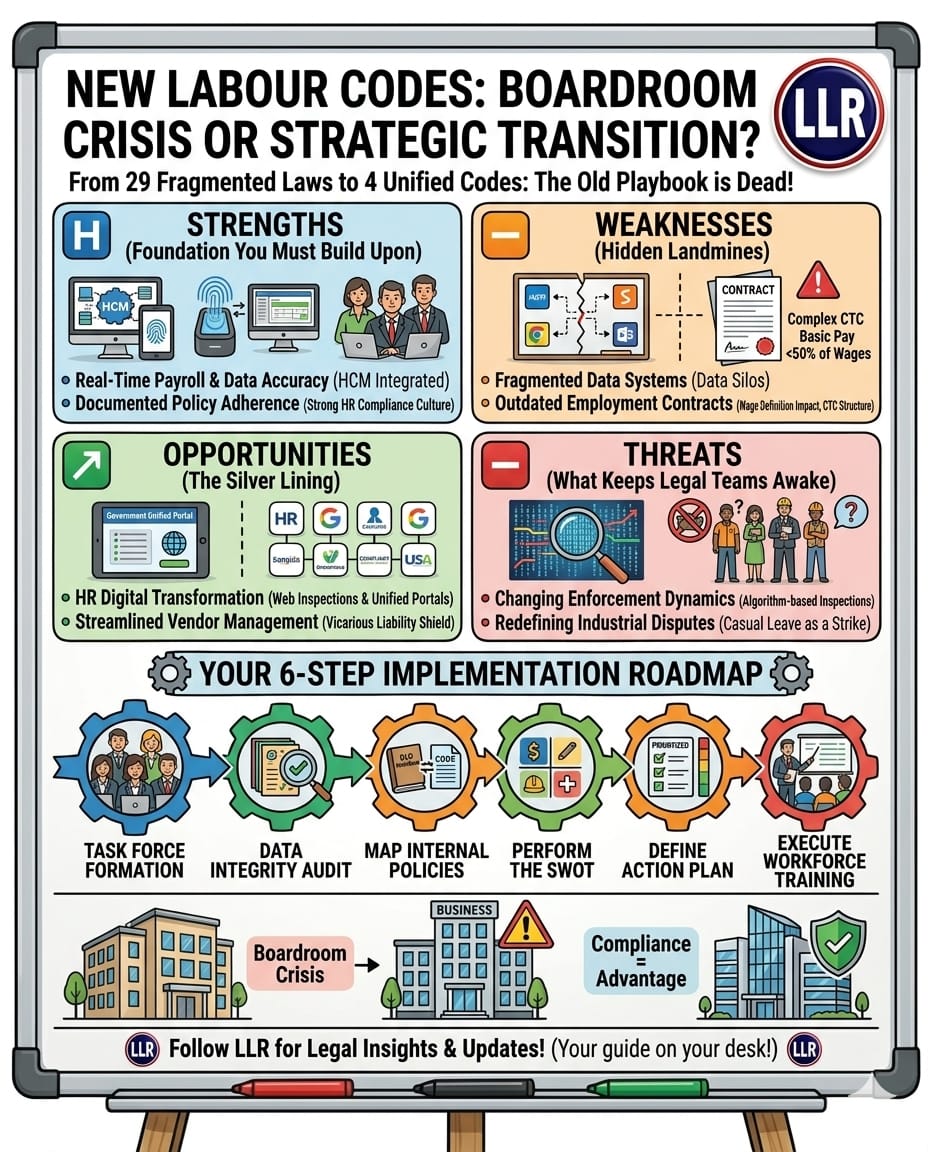
𝐓𝐡𝐞 𝐧𝐞𝐰 𝐋𝐚𝐛𝐨𝐮𝐫 𝐂𝐨𝐝𝐞𝐬 𝐚𝐫𝐞𝐧'𝐭 𝐣𝐮𝐬𝐭 𝐚𝐧 𝐇𝐑 𝐡𝐞𝐚𝐝𝐚𝐜𝐡𝐞—𝐭𝐡𝐞𝐲 𝐚𝐫𝐞 𝐚 𝐛𝐨𝐚𝐫𝐝𝐫𝐨𝐨𝐦 𝐜𝐫𝐢𝐬𝐢𝐬 𝐰𝐚𝐢𝐭𝐢𝐧𝐠 𝐭𝐨 𝐡𝐚𝐩𝐩𝐞𝐧. 🛑 ➠Here is a deep dive into the Pre-Implementation SWOT Analysis: 🟦 𝐒𝐭𝐫𝐞𝐧𝐠𝐭𝐡𝐬 Your strengths are the processes that will prevent the new codes from completely disrupting your daily operations. ✦ Real-Time Payroll & Data Accuracy: The new Wage Code mandates full and final settlements within two days of an employee's exit. ➝ 𝘗𝘳𝘢𝘤𝘵𝘪𝘤𝘢𝘭 𝘌𝘹𝘢𝘮𝘱𝘭𝘦: If your company uses an integrated Human Capital Management (HCM) system where biometric attendance syncs automatically with payroll, you have a massive strength. If HR still chases managers for physical timesheets at the end of the month, you are going to fail this compliance metric instantly. 🟧 𝐖𝐞𝐚𝐤𝐧𝐞𝐬𝐬𝐞𝐬 (The Hidden Landmines) Where are your blind spots? ✦ Fragmented Data Systems: If your payroll is on one vendor's software, your attendance on another, and your contractor data sitting in a factory manager's Excel sheet, auditing for the new Social Security Code will be a nightmare. ✦ Outdated Employment Contracts: The definition of "wages" is changing drastically (capping allowances at 50%). 🟩 𝐎𝐩𝐩𝐨𝐫𝐭𝐮𝐧𝐢𝐭𝐢𝐞𝐬 (The Silver Lining) ✦ HR Digital Transformation: The government is pushing for web-based inspections and unified portals. This is your ultimate business case to finally secure the budget for that end-to-end HR digital transformation. ✦ Streamlined Vendor Management: Under the new codes, principal employers have stricter liabilities regarding contract workers. Weed out the non-compliant "mom-and-pop" agencies. 🟥 𝐓𝐡𝐫𝐞𝐚𝐭𝐬 The external factors that can derail your business if misinterpreted. ✦ Changing Enforcement Dynamics: ➝ 𝘗𝘳𝘢𝘤𝘵𝘪𝘤𝘢𝘭 𝘌𝘹𝘢𝘮𝘱𝘭𝘦: Did you know that 50% or more workers taking casual leave on the same day can now be legally classified as a "strike"? If your local HR misinterprets this and takes punitive action without following the mandatory conciliation processes, you could face severe litigation and union backlash. ⚙️ 𝐘𝐨𝐮𝐫 𝟔-𝐒𝐭𝐞𝐩 𝐈𝐦𝐩𝐥𝐞𝐦𝐞𝐧𝐭𝐚𝐭𝐢𝐨𝐧 𝐑𝐨𝐚𝐝𝐦𝐚𝐩 ❶ Task Force Formation: Form a squad comprising HR, Legal, Finance (for the wage bill impact), and IT (for systems integration). ❷ Data Integrity Audit: Audit one month of your current records against the new code requirements. Find the gaps. ❸ Map Internal Policies: Update grievance redressal, leave policies, and fixed-term employment rules. ❹ Perform the SWOT: Gather your task force and brutally assess the points above. ❺ Define Action Plan: Triage the issues. Fix the high-financial-risk items (like wage structuring and contractor compliance) first. ❻ Execute Workforce Training: The best policies fail if frontline managers don't know them. Train your managers on the new definitions of working hours, leave, and dismissals to prevent accidental breaches.
Labour Law Reporter tweet media
English
0
0
2
203
Labour Law Reporter
Labour Law Reporter@LabourReports·
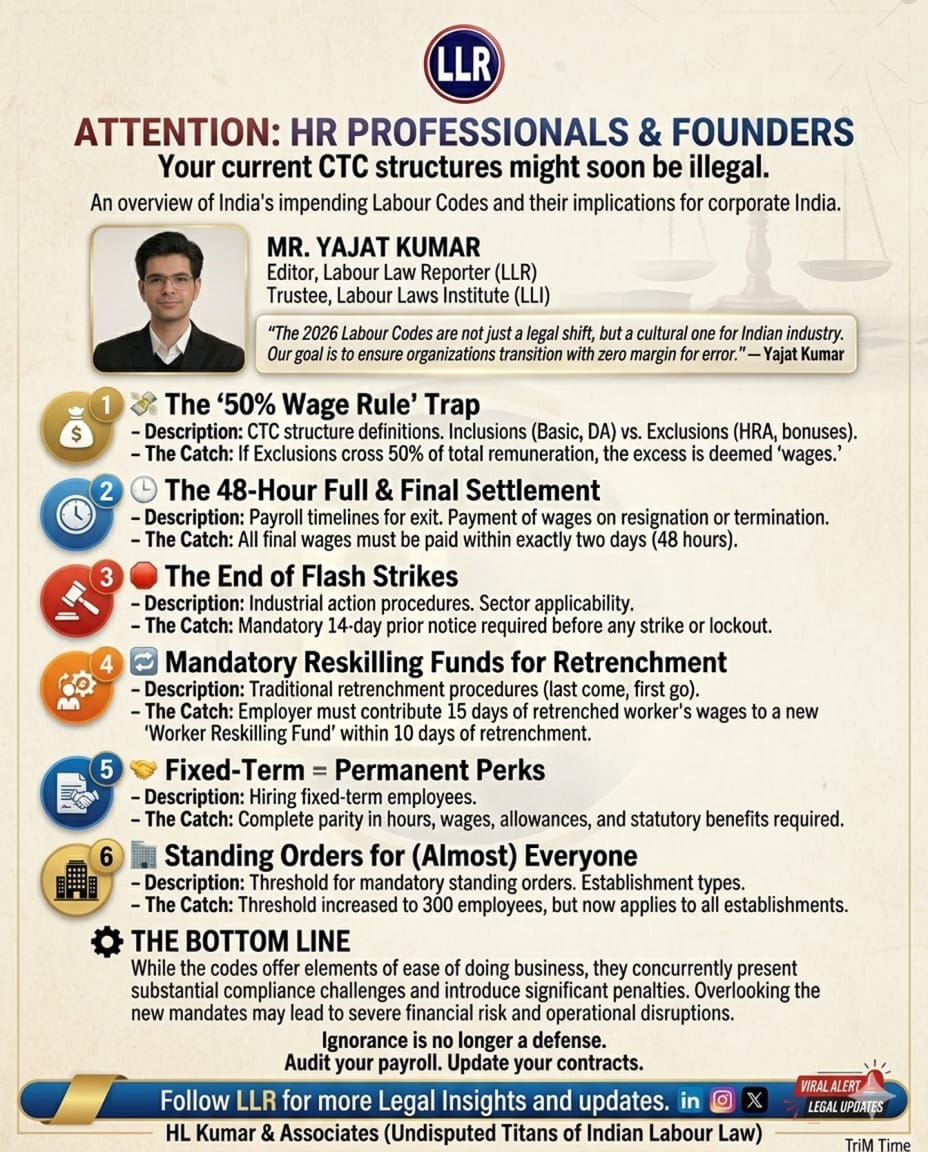
🚨 𝐀𝐓𝐓𝐄𝐍𝐓𝐈𝐎𝐍 𝐇𝐑 𝐏𝐑𝐎𝐅𝐄𝐒𝐒𝐈𝐎𝐍𝐀𝐋𝐒 & 𝐅𝐎𝐔𝐍𝐃𝐄𝐑𝐒: 𝐘𝐨𝐮𝐫 𝐜𝐮𝐫𝐫𝐞𝐧𝐭 𝐂𝐓𝐂 𝐬𝐭𝐫𝐮𝐜𝐭𝐮𝐫𝐞𝐬 𝐦𝐢𝐠𝐡𝐭 𝐬𝐨𝐨𝐧 𝐛𝐞 𝐢𝐥𝐥𝐞𝐠𝐚𝐥. 🚨 ✦ In a recent masterclass by 𝐌𝐫.𝐘𝐚𝐣𝐚𝐭 𝐊𝐮𝐦𝐚𝐫, Editor of the 𝘓𝘢𝘣𝘰𝘶𝘳 𝘓𝘢𝘸 𝘙𝘦𝘱𝘰𝘳𝘵𝘦𝘳 (Watch the full deep dive here: youtu.be/KJOHv9WzZkY), the complex legal jargon was stripped away to reveal massive operational shifts. ➠ Here are the 6 reality checks your HR and legal teams need to know before the new rules fully hit: ❶ 𝐓𝐡𝐞 "𝟓𝟎% 𝐖𝐚𝐠𝐞 𝐑𝐮𝐥𝐞" 𝐓𝐫𝐚𝐩 ✦ Gone are the days of artificially restructuring salaries to lower PF liabilities. The new code splits wages into inclusions (Basic, DA) and exclusions (HRA, bonuses). ➝ 𝘛𝘩𝘦 𝘊𝘢𝘵𝘤𝘩: If your excluded components cross 50% of the total remuneration, the excess amount is automatically deemed "wages." You can no longer hide statutory bonuses inside a bloated CTC! ❷ 𝐓𝐡𝐞 𝟒𝟖-𝐇𝐨𝐮𝐫 𝐅𝐮𝐥𝐥 & 𝐅𝐢𝐧𝐚𝐥 𝐒𝐞𝐭𝐭𝐥𝐞𝐦𝐞𝐧𝐭 ✦ Processing resignations at your own pace? Not anymore. ➝ 𝘛𝘩𝘦 𝘊𝘢𝘵𝘤𝘩: Under the new rules, the payment of wages must be cleared within exactly two days of an employee's resignation or termination. Furthermore, gratuity calculations will retroactively adapt to the new definition of wages. ❸ 𝐓𝐡𝐞 𝐄𝐧𝐝 𝐨𝐟 𝐅𝐥𝐚𝐬𝐡 𝐒𝐭𝐫𝐢𝐤𝐞𝐬 ✦ Regardless of the sector you operate in, flash strikes are now universally prohibited. ➝ 𝘛𝘩𝘦 𝘊𝘢𝘵𝘤𝘩: The new code mandates a compulsory 14-day prior notice before any strike or lockout can take place, giving businesses a crucial buffer to mediate. ❹ 𝐌𝐚𝐧𝐝𝐚𝐭𝐨𝐫𝐲 𝐑𝐞𝐬𝐤𝐢𝐥𝐥𝐢𝐧𝐠 𝐅𝐮𝐧𝐝𝐬 𝐟𝐨𝐫 𝐑𝐞𝐭𝐫𝐞𝐧𝐜𝐡𝐦𝐞𝐧𝐭 ✦ The traditional "last come, first go" rule still generally applies when letting people go. But here is the new twist. ➝ 𝘛𝘩𝘦 𝘊𝘢𝘵𝘤𝘩: Employers must now contribute an amount equivalent to 15 days of the worker's wages into a newly established "Worker Reskilling Fund" within 10 days of retrenchment. ❺ 𝐅𝐢𝐱𝐞𝐝-𝐓𝐞𝐫𝐦 = 𝐏𝐞𝐫𝐦𝐚𝐧𝐞𝐧𝐭 𝐏𝐞𝐫𝐤𝐬 🤝 ✦ Hiring fixed-term employees? The law now demands parity. ➝ 𝘛𝘩𝘦 𝘊𝘢𝘵𝘤𝘩: Fixed-term employees must receive the exact same hours, wages, allowances, and statutory benefits as permanent workers. They are even eligible for proportionate gratuity without completing a multi-year qualifying period. ❻ 𝐒𝐭𝐚𝐧𝐝𝐢𝐧𝐠 𝐎𝐫𝐝𝐞𝐫𝐬 𝐟𝐨𝐫 (𝐀𝐥𝐦𝐨𝐬𝐭) 𝐄𝐯𝐞𝐫𝐲𝐨𝐧𝐞 🏢 ✦ The threshold for mandatory standing orders has jumped from 100 to 300 employees. ➝ 𝘛𝘩𝘦 𝘊𝘢𝘵𝘤𝘩: Don't let the higher number fool you—it now applies to all establishments, not just factories. You will have exactly six months to get your orders certified once enforced. ⚙️ 𝐓𝐡𝐞 𝐁𝐨𝐭𝐭𝐨𝐦 𝐋𝐢𝐧𝐞 ➝ 𝙄𝙜𝙣𝙤𝙧𝙖𝙣𝙘𝙚 𝙞𝙨 𝙣𝙤 𝙡𝙤𝙣𝙜𝙚𝙧 𝙖 𝙙𝙚𝙛𝙚𝙣𝙨𝙚 ✦ It’s time to audit your payroll, update your employee contracts, and rethink your compliance strategies.
YouTube video
YouTube
Labour Law Reporter tweet media
English
0
0
3
269
Labour Law Reporter
Labour Law Reporter@LabourReports·
The Editor of Labour Law Reporter, Yajat Kumar, delivered a session on the Industrial Relations Code, 2020 in the Seminar held on 21st March, 2026 at Constitution Club of India, New Delhi. The full video of the session can be viewed here: youtu.be/KJOHv9WzZkY
YouTube video
YouTube
English
0
2
3
334
Labour Law Reporter
Labour Law Reporter@LabourReports·
2026 LLR WEB 763 (RAJASTHAN HIGH COURT) Where termination violates Section 25F, compensation at Rs.1.5 lakhs per year of service is just and proper in lieu of reinstatement. ILLEGAL TERMINATION - Section 25F - Lump sum compensation in lieu of reinstatement -Proportionality - Pro-rata calculation - Industrial Disputes Act, 1947, Sections 25F, 17B and 25H -The workman was engaged with the respondent-Department for one year and was illegally terminated without compliance of Section 25F - Labour Court awarded reinstatement; Single Judge modified the award - Division Bench appeal filed by workman seeking enhanced compensation - Held, where termination is found illegal on account of non-compliance of Section 25F,... subscribe to read more.....
English
0
0
3
182
Labour Law Reporter
Labour Law Reporter@LabourReports·
2026 LLR WEB 761 (RAJASTHAN HIGH COURT) Compassionate appointment claim raised after inordinate and unexplained delay is hopelessly time-barred. COMPASSIONATE APPOINTMENT - Delay and laches - Immediacy of need - Vested right - Articles 14, 16 of the Constitution of India - The petitioner's father, a Driver with RSRTC, was terminated from service; his industrial dispute was decided in his favour, but he died during pendency of the reference - The petitioner applied for compassionate appointment several years after the father''s death, which was rejected on the ground that the father was not in active employment at the time of death - Petitioner challenged the rejection - Held, compassionate appointment is not... subscribe to read more.....
English
0
0
1
170
Labour Law Reporter
Labour Law Reporter@LabourReports·
A lockout never lifted and resulting in indefinite closure amounts to termination in substance irrespective of nomenclature. 2026 LLR WEB 762 (RAJASTHAN HIGH COURT) LOCKOUT - TERMINATION IN SUBSTANCE - EMPLOYER-EMPLOYEE RELATIONSHIP - TRANSFER OF UNDERTAKING - Section 25-FF of the Industrial Disputes Act, 1947 - The respondent-workmen were employed in Jaipur Syntex Ltd. s factory at Behror since 1987 - A lockout was declared on 08.12.1996 following an alleged illegal strike, which was never lifted - The factory was declared sick by BIFR, wound up, and its assets transferred to M/s Siddhi Multi Trade Pvt. Ltd. by Sale Deed dated 14.03.2007 - Workmen raised industrial disputes; Labour Court held termination illegal... subscribe to read more.....
English
0
0
4
300
Labour Law Reporter
Labour Law Reporter@LabourReports·
𝗬𝗼𝘂𝗿 𝗔𝗻𝗻𝘂𝗮𝗹 𝗕𝗼𝗻𝘂𝘀 𝗶𝘀 𝗻𝗼 𝗹𝗼𝗻𝗴𝗲𝗿 𝗷𝘂𝘀𝘁 𝗮𝗯𝗼𝘂𝘁 𝘆𝗼𝘂𝗿 𝗞𝗣𝗜𝘀. 🛑💼 Under India’s new Labour Codes, linking 𝐂𝐨𝐧𝐝𝐮𝐜𝐭 to financial 𝐃𝐢𝐬𝐪𝐮𝐚𝐥𝐢𝐟𝐢𝐜𝐚𝐭𝐢𝐨𝐧 is now black-and-white law. ⏰⚖️ ➠Here is the exact, legally codified shift in the bonus landscape you need to know today: 📜 𝐓𝐡𝐞 𝐎𝐋𝐃 𝐑𝐔𝐋𝐄𝐒 (Payment of Bonus Act, 1965) ✦The Status Quo: Historically, an employee only lost their statutory bonus if dismissed for very specific reasons: fraud, theft, or riotous/violent behavior on the premises. ✦The Limitation: Behavioral misconduct, specifically sexual harassment, did not carry an explicit, mandatory statutory financial penalty regarding the bonus. 🚫 𝐓𝐡𝐞 𝐍𝐄𝐖 𝐋𝐀𝐖 (Code on Wages, 2019) ✦Who it impacts: All employees covered under the Code, universally. ✦𝙏𝙝𝙚 𝙂𝙖𝙢𝙚-𝘾𝙝𝙖𝙣𝙜𝙚𝙧 (𝙎𝙚𝙘𝙩𝙞𝙤𝙣 29): The new Code explicitly states an employee shall be disqualified from receiving a bonus if dismissed from service for: (a) Fraud (b) Riotous or violent behaviour (c) Theft, misappropriation, or sabotage 👉 (𝙙) 𝘾𝙤𝙣𝙫𝙞𝙘𝙩𝙞𝙤𝙣 𝙛𝙤𝙧 𝙎𝙚𝙭𝙪𝙖𝙡 𝙃𝙖𝙧𝙖𝙨𝙨𝙢𝙚𝙣𝙩. ➝𝘞𝘩𝘢𝘵 𝘵𝘩𝘪𝘴 𝘮𝘦𝘢𝘯𝘴 𝘪𝘯 𝘱𝘳𝘢𝘤𝘵𝘪𝘤𝘦: Terminating an offender is no longer the maximum punishment. Stripping them of their financial incentives is now a statutory mandate upon conviction. ➝𝘞𝘩𝘺 𝘥𝘰𝘦𝘴 𝘵𝘩𝘪𝘴 𝘚𝘦𝘤𝘵𝘪𝘰𝘯 29(𝘥) 𝘢𝘥𝘥𝘪𝘵𝘪𝘰𝘯 𝘮𝘢𝘵𝘵𝘦𝘳 𝘴𝘰 𝘮𝘶𝘤𝘩? Because it hits perpetrators where it hurts the most—their wallets—and transforms a safe workplace from an HR perk into a non-negotiable right. This legislative shift rests on the robust backbone of landmark 𝐒𝐮𝐩𝐫𝐞𝐦𝐞 𝐂𝐨𝐮𝐫𝐭 precedents: ❶. 𝗩𝗶𝘀𝗵𝗮𝗸𝗮 𝘃. 𝗦𝘁𝗮𝘁𝗲 𝗼𝗳 𝗥𝗮𝗷𝗮𝘀𝘁𝗵𝗮𝗻: The historic genesis declaring sexual harassment a direct violation of fundamental rights to equality, life, and liberty (Articles 14, 15, and 21). ❷. 𝗡𝗶𝘀𝗵𝗮 𝗣𝗿𝗶𝘆𝗮 𝗕𝗵𝗮𝘁𝗶𝗮 𝘃. 𝗨𝗻𝗶𝗼𝗻 𝗼𝗳 𝗜𝗻𝗱𝗶𝗮: Emphasizing that a safe working environment is a constitutional guarantee for workplace dignity. ❸. 𝗔𝘂𝗿𝗲𝗹𝗶𝗮𝗻𝗼 𝗙𝗲𝗿𝗻𝗮𝗻𝗱𝗲𝘀 𝘃. 𝗦𝘁𝗮𝘁𝗲 𝗼𝗳 𝗚𝗼𝗮: The recent, powerful reminder that the PoSH Act cannot be treated as a mere "tick-box" formality; strict institutional enforcement is required. 𝐓𝐡𝐞 𝐔𝐥𝐭𝐢𝐦𝐚𝐭𝐞 𝐑𝐞𝐚𝐥𝐢𝐭𝐲 𝐂𝐡𝐞𝐜𝐤: For Employers, this provides the statutory teeth to enforce true zero-tolerance. For Employees, it signifies that technical brilliance and sales targets mean absolutely nothing if not paired with fundamental human respect. We are finally moving from just "compliance" to actual "consequence." 𝙅𝙤𝙗 𝙥𝙚𝙧𝙛𝙤𝙧𝙢𝙖𝙣𝙘𝙚 𝙙𝙤𝙚𝙣'𝙩 𝙨𝙖𝙫𝙚 𝙮𝙤𝙪. 𝙅𝙤𝙗 𝙩𝙞𝙩𝙡𝙚𝙨 𝙙𝙤𝙣'𝙩 𝙨𝙖𝙫𝙚 𝙮𝙤𝙪. 𝙔𝙤𝙪𝙧 𝙖𝙘𝙩𝙪𝙖𝙡 𝙘𝙤𝙣𝙙𝙪𝙘𝙩, 𝙧𝙚𝙨𝙥𝙚𝙘𝙩 𝙛𝙤𝙧 𝙙𝙞𝙜𝙣𝙞𝙩𝙮, 𝙖𝙣𝙙 𝙎𝙚𝙘𝙩𝙞𝙤𝙣 29(𝙙) 𝙙𝙤.
Labour Law Reporter tweet media
English
0
0
3
262
Labour Law Reporter
Labour Law Reporter@LabourReports·
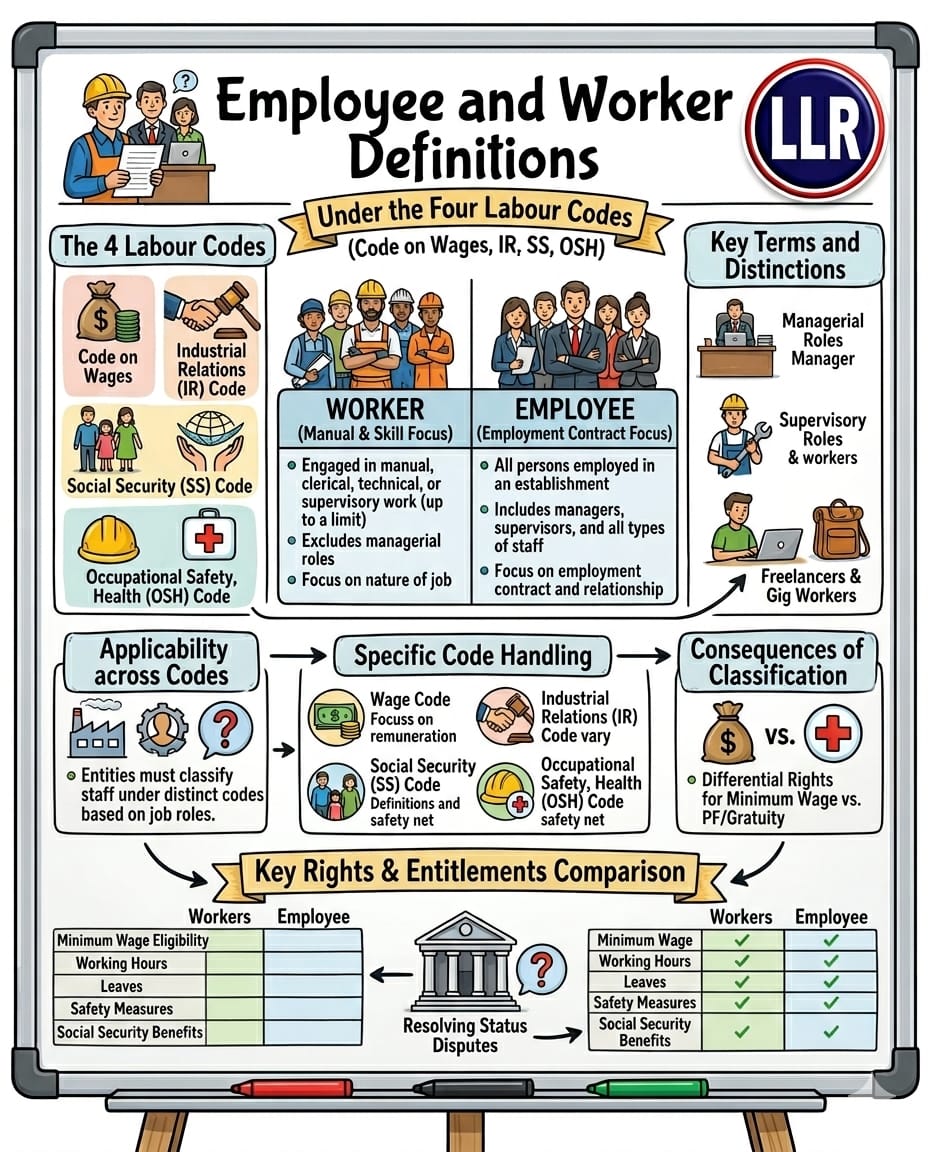
𝗦𝘁𝗼𝗽 𝗰𝗮𝗹𝗹𝗶𝗻𝗴 𝗲𝘃𝗲𝗿𝘆𝗼𝗻𝗲 𝗼𝗻 𝘆𝗼𝘂𝗿 𝗽𝗮𝘆𝗿𝗼𝗹𝗹 𝗮𝗻 "𝗘𝗺𝗽𝗹𝗼𝘆𝗲𝗲."🛑 Under India’s new Labour Codes, mixing up "𝐄𝐦𝐩𝐥𝐨𝐲𝐞𝐞" and "𝐖𝐨𝐫𝐤𝐞𝐫" is a legal ticking time bomb. ⏰💣 ➠Here is the exact, legally verified breakdown of the new rules you need to know today: 👔 𝐓𝐡𝐞 𝐄𝐌𝐏𝐋𝐎𝐘𝐄𝐄 (The Broader Umbrella) ✦Who they are: Anyone employed on wages by an establishment to do skilled, unskilled, manual, supervisory, managerial, or administrative work. ✦The Big Change: Under the new Code on Wages, basic protections (like timely payment of wages and non-discrimination) now apply universally to all employees. The old ₹24,000/month wage ceiling under the previous Payment of Wages Act has been completely scrapped. 👷‍♂️ 𝐓𝐡𝐞 𝐖𝐎𝐑𝐊𝐄𝐑(The Protected Subset) ✦Who they are: Those doing manual, unskilled, skilled, technical, operational, or clerical work. ✦𝙏𝙝𝙚 𝙈𝙖𝙜𝙞𝙘 𝙉𝙪𝙢𝙗𝙚𝙧 (₹18,000): Under the Industrial Relations (IR) Code and the OSH Code, a person in a supervisory role is officially excluded from the "Worker" definition only if they draw wages exceeding ₹18,000 per month. ➝ 𝘞𝘩𝘢𝘵 𝘵𝘩𝘪𝘴 𝘮𝘦𝘢𝘯𝘴 𝘪𝘯 𝘱𝘳𝘢𝘤𝘵𝘪𝘤𝘦: If you have junior supervisors earning ₹17,500/month, the law views them as Workers. If they earn ₹18,500/month, they cross the threshold and become just "Employees." ➝𝘞𝘩𝘺 𝘥𝘰𝘦𝘴 𝘵𝘩𝘪𝘴 1-𝘸𝘰𝘳𝘥 (𝘢𝘯𝘥 ₹18,000) 𝘥𝘪𝘧𝘧𝘦𝘳𝘦𝘯𝘤𝘦 𝘮𝘢𝘵𝘵𝘦𝘳 𝘴𝘰 𝘮𝘶𝘤𝘩? Because your financial liabilities and legal risks completely depend on it. ❶ Overtime & Working Hours: The strict daily limits (typically 8 hours), 48-hour weekly caps, and mandatory double-pay for overtime heavily protect Workers. If your junior supervisors (under ₹18k) are pulling 10-hour shifts, you owe them double-time. ❷. The Radical New Leave Rules (OSH Code): ↳Faster Eligibility: Workers are now eligible for annual paid leave after working just 180 days in a calendar year (down from the old 240 days). ↳The 30-Day Cap & Encashment: Workers can only carry forward up to 30 days of earned leave. Anything beyond 30 days must be mandatorily encashed by the employer at the end of the year. ↳ The Penalty for Denying Leave: If a Worker applies for leave and you deny it, that refused leave carries forward without any cap. ❸. Hiring, Firing, & Disputes: Retrenchment rules, mandatory 14-day strike notices, layoff compensation, and union negotiation protections under the IR Code apply specifically to Workers. Upper management and supervisors earning over ₹18,000 do not get these specific statutory shields. 𝐓𝐡𝐞 𝐔𝐥𝐭𝐢𝐦𝐚𝐭𝐞 𝐑𝐞𝐚𝐥𝐢𝐭𝐲 𝐂𝐡𝐞𝐜𝐤: You cannot just slap a "Manager" or "VP" title on someone to avoid compliance. 𝙇𝙖𝙗𝙤𝙪𝙧 𝙩𝙧𝙞𝙗𝙪𝙣𝙖𝙡𝙨 will look at their actual daily tasks and their salary threshold. 𝙅𝙤𝙗 𝙩𝙞𝙩𝙡𝙚𝙨 𝙙𝙤𝙣'𝙩 𝙨𝙖𝙫𝙚 𝙮𝙤𝙪. 𝙅𝙤𝙗 𝙙𝙚𝙨𝙘𝙧𝙞𝙥𝙩𝙞𝙤𝙣𝙨, 𝙖𝙘𝙩𝙪𝙖𝙡 𝙙𝙪𝙩𝙞𝙚𝙨, 𝙖𝙣𝙙 𝙩𝙝𝙚 ₹𝟏𝟖,𝟎𝟎𝟎 𝙢𝙖𝙧𝙠 𝙙𝙤.
Labour Law Reporter tweet media
English
0
0
3
230
Labour Law Reporter
Labour Law Reporter@LabourReports·
2026 LLR WEB 758 (GUJARAT HIGH COURT) Reinstatement award modified to lump sum compensation where workman dies during pendency and service was irregular. INDUSTRIAL DISPUTES - Illegal termination - Irregular appointment - Workman deceased - Reinstatement award - Lump sum compensation - Legal heirs - Industrial Disputes Act, 1947 - The deceased workman, appointed as Watchman/Mali by a Panchayat resolution without following any selection process, was terminated and reinstated once earlier, and was again terminated for alleged misconduct... subscribe to read more.....
English
1
0
2
104
Labour Law Reporter
Labour Law Reporter@LabourReports·
Retrospective repeal of the Industrial Disputes Act is legal. Glastronix LLP v. The President/General Secretary, Glastronix Karmika Sangha and Others, 2026 LLR 390 (Karn. HC).
English
0
0
1
131
Labour Law Reporter
Labour Law Reporter@LabourReports·
2026 LLR WEB 757 (GUJARAT HIGH COURT) Lump sum compensation is appropriate remedy where reinstatement is impractical due to short tenure and absence of sanctioned post. ILLEGAL TERMINATION - Watchman - Casual/daily-rated workman - No sanctioned post - Grant-based work - Lump sum compensation in lieu of reinstatement - Industrial Disputes Act, 1947 - The respondent-workman, engaged as a Watchman on grant-based work for about three years, was orally terminated - Legal heirs filed reference before the Labour Court, which partly allowed the same granting 25% compensation in lieu of reinstatement... subscribe to read more.....
English
0
0
0
158
Labour Law Reporter
Labour Law Reporter@LabourReports·
𝗜𝗻𝗱𝗶𝗮’𝘀 𝗣𝗮𝘆𝗿𝗼𝗹𝗹 𝗥𝗲𝘃𝗼𝗹𝘂𝘁𝗶𝗼𝗻: 𝟭𝟯 𝗥𝗲𝗮𝘀𝗼𝗻𝘀 𝗬𝗼𝘂𝗿 𝗖𝘂𝗿𝗿𝗲𝗻𝘁 𝗛𝗥 𝗣𝗼𝗹𝗶𝗰𝗶𝗲𝘀 𝗮𝗿𝗲 𝗔𝗯𝗼𝘂𝘁 𝘁𝗼 𝗚𝗼 𝗢𝗯𝘀𝗼𝗹𝗲𝘁𝗲🚨 𝐖𝐞 𝐡𝐚𝐯𝐞 𝐛𝐫𝐨𝐤𝐞𝐧 𝐝𝐨𝐰𝐧 𝐭𝐡𝐞 𝐜𝐫𝐢𝐭𝐢𝐜𝐚𝐥 𝐩𝐢𝐥𝐥𝐚𝐫𝐬 𝐨𝐟 𝐭𝐡𝐢𝐬 𝐦𝐚𝐬𝐬𝐢𝐯𝐞 𝐫𝐞𝐟𝐨𝐫𝐦 𝐢𝐧 𝐭𝐡𝐞 𝐜𝐡𝐞𝐚𝐭 𝐬𝐡𝐞𝐞𝐭 𝐛𝐞𝐥𝐨𝐰. ➤ Here are the 𝟔 𝐦𝐚𝐣𝐨𝐫 𝐬𝐡𝐢𝐟𝐭𝐬 you need to prepare for right now: ❶. 𝐓𝐡𝐞 𝟓𝟎% 𝐁𝐚𝐬𝐢𝐜 𝐒𝐚𝐥𝐚𝐫𝐲 𝐑𝐮𝐥𝐞 ⚖️ The unified definition of "Wage" is finally here. Basic Pay, Dearness Allowance, and Retaining Allowance must now constitute at least 50% of total remuneration. Any other allowances (like HRA or special allowances) exceeding this 50% threshold are deemed as "wages," which directly impacts and increases your statutory calculations for PF and Gratuity. ❷. 𝐒𝐭𝐫𝐢𝐜𝐭 𝟐-𝐃𝐚𝐲 𝐒𝐞𝐭𝐭𝐥𝐞𝐦𝐞𝐧𝐭 𝐑𝐮𝐥𝐞 ⏱️ Timelines for clearing final dues will no longer rely on varied state rules, company policies, or the nature of an employee's exit. The Code mandates the full settlement of all wages within exactly two working days following an employee's removal, dismissal, retrenchment, or resignation. ❸. 𝐔𝐧𝐢𝐯𝐞𝐫𝐬𝐚𝐥 𝐌𝐢𝐧𝐢𝐦𝐮𝐦 𝐖𝐚𝐠𝐞 𝐂𝐨𝐯𝐞𝐫𝐚𝐠𝐞 🌍 The restrictive, historical concept of "scheduled employments" (which limited minimum wage protection to specific industries like mining or textiles) is completely abolished. Minimum wages will now apply universally to all employees across both the organized and unorganized sectors. ❹. 𝐏𝐎𝐒𝐇 𝐋𝐢𝐧𝐤𝐞𝐝 𝐭𝐨 𝐁𝐨𝐧𝐮𝐬 𝐄𝐥𝐢𝐠𝐢𝐛𝐢𝐥𝐢𝐭𝐲 🛑 A crucial update tying compliance to compensation: the Code introduces a "conviction for sexual harassment" as a strict legal disqualification for receiving a statutory bonus. This adds severe financial consequences to workplace misconduct. ❺. 𝐒𝐭𝐚𝐧𝐝𝐚𝐫𝐝𝐢𝐳𝐞𝐝 𝐎𝐯𝐞𝐫𝐭𝐢𝐦𝐞 & 𝐃𝐞𝐝𝐮𝐜𝐭𝐢𝐨𝐧 𝐂𝐚𝐩𝐬 💰 Overtime calculations are no longer fragmented; they are standardized at 2x the normal rate of wages across all sectors and industries without exception. Furthermore, total authorized deductions from an employee's wages (for advances, loans, damages) are strictly capped and cannot exceed 50% of their total wages in any given month. ❻. 𝐃𝐞𝐜𝐫𝐢𝐦𝐢𝐧𝐚𝐥𝐢𝐳𝐚𝐭𝐢𝐨𝐧 𝐨𝐟 𝐌𝐢𝐧𝐨𝐫 𝐎𝐟𝐟𝐞𝐧𝐬𝐞𝐬 🏛️ The old inspection regime is shifting to an "Inspector-cum-Facilitator" model focused on advising compliance. Penalties are graded: minor, first-time administrative or clerical non-compliance is decriminalized and settled via compounding (financial penalties), while imprisonment is strictly reserved for repeat offenders. 𝐓𝐡𝐞 𝐁𝐨𝐭𝐭𝐨𝐦 𝐋𝐢𝐧𝐞: The consolidation of these historical acts into the Code on Wages represents a structural shift toward greater transparency, unified definitions, and standardized financial security for India's modern workforce.
Labour Law Reporter tweet media
English
2
3
5
322