Pakistan-China Faultline Focus

600 posts

Pakistan-China Faultline Focus banner
Pakistan-China Faultline Focus

Pakistan-China Faultline Focus

@LineOfDeceit

Deconstructing hybrid war tactics, territorial propaganda, and cross-border deceit. Strategic insight on PoK, GB, Ladakh and the China-Pak nexus.

انضم Temmuz 2025
21 يتبع955 المتابعون
Pakistan-China Faultline Focus
PoJK is no longer just a disputed territory under Pakistan’s control, it is increasingly being seen as a hub of terror infrastructure, especially for Lashkar-e-Taiba. The UN identifies LeT as a Pakistan-based terrorist organisation, and after the 2025 Pahalgam attack, India said it struck LeT/JeM-linked sites in Pakistan and Pakistan occupied Kashmir during Operation Sindoor. Pakistan denied the allegations, but the pattern is what matters: terror networks do not keep resurfacing around PoJK by accident.
English
1
27
55
2.4K
Pakistan-China Faultline Focus
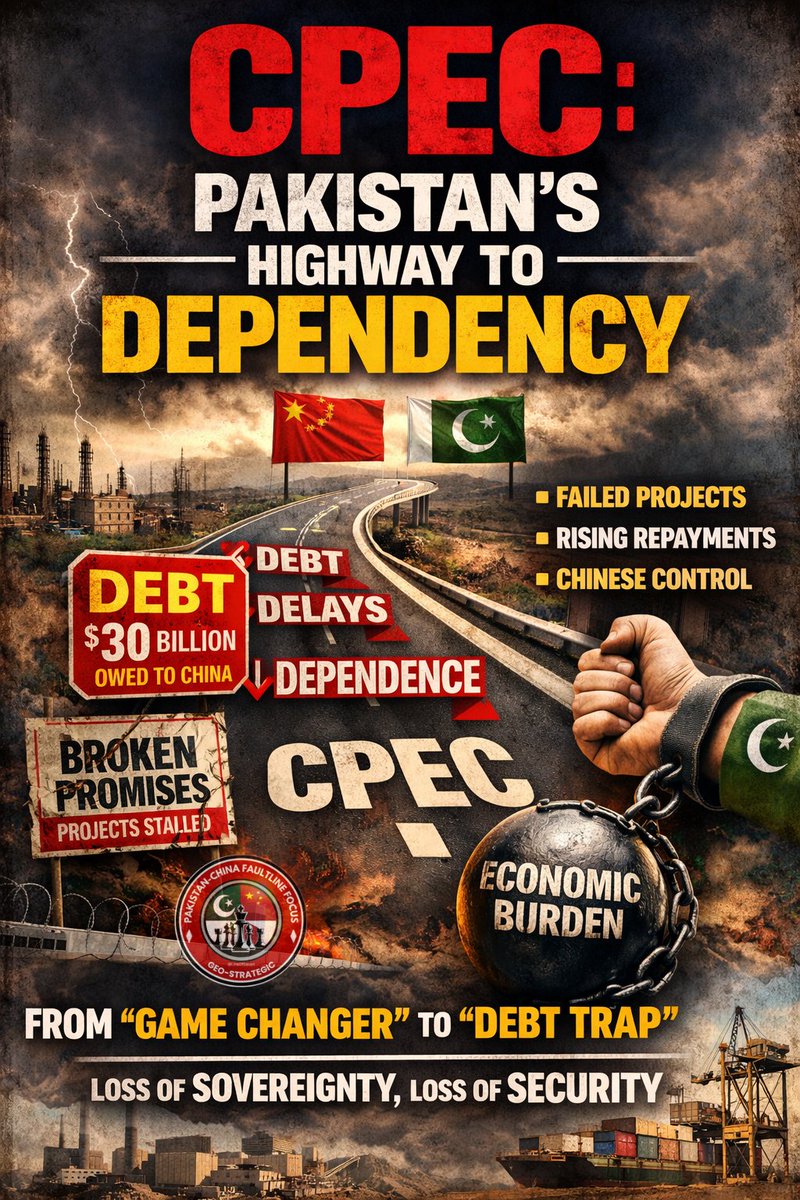
Debt, Delay, Dependence: Pakistan’s CPEC Trap Pakistan sold CPEC to its people as a “game changer.” What it delivered instead was a classic dependency trap. A decade later, Islamabad is weighed down by roughly $30 billion in debt linked to China, while large parts of the much-hyped corridor have slowed, stalled, or been put on hold. Recent Reuters reporting has also noted that much of the planned Chinese investment under CPEC had been put on hold, with security concerns repeatedly cited as a major factor. This is the real story of Pakistan’s economic weakness: It borrowed in the name of development, advertised dependency as strategy, and called geopolitical subservience “partnership.” CPEC was marketed as the road to prosperity. But where is that prosperity now? Where are the jobs at the scale promised? Where is the export boom? Where is the industrial transformation? Where is the self-sustaining growth? Instead, Pakistan is left with repayments, pressure, and shrinking room to maneuver. Even now, the country is juggling major external repayment obligations, showing how fragile its finances remain. That is Pakistan’s pattern in one line: take loans, make announcements, build narratives, then beg for rollovers. And the worst part? This was never just an economic problem. It became a sovereignty problem. Because when one country holds such a large chunk of your external obligations, funds your flagship infrastructure, and keeps pressing you on security guarantees for its personnel and projects, the relationship stops looking like equal cooperation and starts looking like strategic leverage. China has repeatedly pushed Pakistan to improve protection for Chinese workers after repeated attacks, underlining how security failure has become central to the CPEC crisis. So what did Pakistan really build? Not an economic miracle. Not a resilient state. Not an independent growth model. It built: • debt without depth • infrastructure without stability • announcements without delivery • and dependence without dignity CPEC was supposed to change Pakistan. Instead, it exposed Pakistan. It exposed an elite that prefers ribbon-cutting optics over structural reform. It exposed a state that cannot secure even its most strategic foreign projects. And it exposed an economy so weak that every “partnership” turns into another repayment headache. Pakistan wanted CPEC to be remembered as its rise. It may end up being remembered as the clearest symbol of how badly the state mismanaged its future. When a country mortgages strategy, security, and sovereignty for borrowed headlines, this is how the bill arrives. #Pakistan #CPEC #China #DebtTrap #EconomicCrisis #PakistanEconomy
Pakistan-China Faultline Focus tweet media
English
0
4
15
2.2K
Pakistan-China Faultline Focus
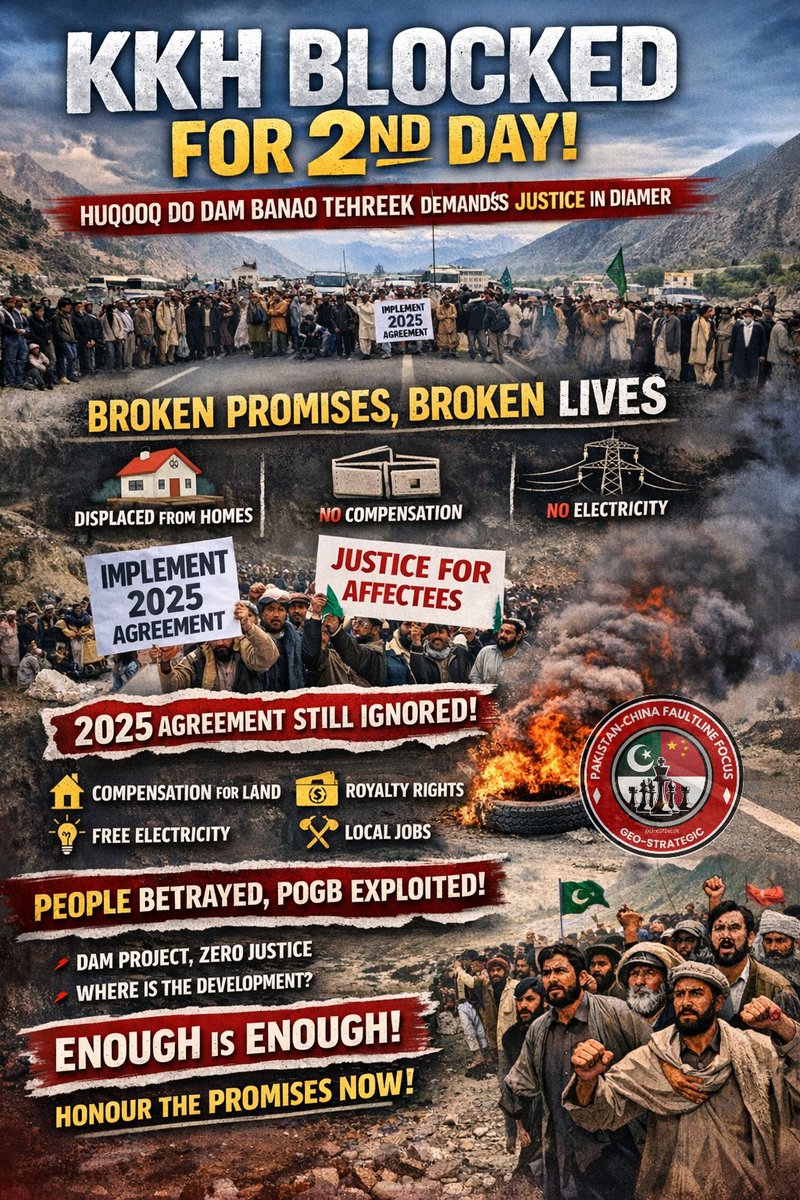
Diamer Demands What Was Promised The Karakoram Highway remaining blocked for a second straight day in Diamer is not just a traffic disruption. It is the result of accumulated anger, broken promises, and the continued neglect of the people living under Pakistan’s control in Gilgit-Baltistan. The protest is being led by the Huqooq Do Dam Banao Tehreek, whose members say they will continue the sit-in until the 2025 agreement signed between a federal ministerial committee and dam affectees is actually implemented, not just announced on paper. This did not happen overnight. For years, people affected by the Diamer-Bhasha Dam project have been told to sacrifice their land, their homes, their livelihoods, and their future in the name of “development.” But when it comes to compensation, rehabilitation, rights, and local benefit, the same people are pushed into endless delay. Reports on the current protest say demonstrators believe they showed patience for over a year after the 2025 agreement, yet saw no meaningful progress. That is exactly why the road is blocked today. And it is ordinary people who are paying the price twice. First, dam-affected communities have suffered displacement, uncertainty, and an unresolved fight for their rights. Second, with the KKH blocked at multiple points, commuters, passengers, and transporters are now stranded and facing major disruption. Reports say thousands have been affected as the blockade continues. What makes this even more damning for Pakistan-occupied Gilgit-Baltistan is that the demands are not abstract or unreasonable. Reporting on the protest says they include compensation for acquired land, royalty rights, free electricity for Diamer, support for remaining affected families, local hiring, and infrastructure commitments. These are basic justice demands from people whose land is being used for a mega project. This exposes the real model of governance in PoGB. Take the land. Take the resources. Announce mega projects. Pose for headlines. Then leave the local population to protest on highways for rights that should have been guaranteed from the beginning. That is not development. That is extraction without justice. If a project of this scale cannot protect the rights of the very people forced to bear its burden, then Pakistan’s claims of progress in Gilgit-Baltistan collapse instantly. A state that remembers the dam but forgets the displaced is not building prosperity. It is manufacturing resentment. The continued protest in Diamer is a warning. People in PoGB are tired of agreements that exist only in files, committees that exist only for optics, and promises that vanish once the cameras are gone. When even dam affectees have to block one of the region’s most critical roads just to be heard, it says everything about how little political dignity and economic justice the people of Gilgit-Baltistan actually receive under Pakistani rule. Diamer is not asking for charity. Its people are asking for what was promised. And the fact that they still have to fight for it proves that in PoGB, the people come last while the project comes first. #Diamer #KKH #GilgitBaltistan #PoGB #DiamerBhashaDam #DamAffectees #HuqooqDoDamBanaoTehreek #JusticeForDiamer #BrokenPromises
Pakistan-China Faultline Focus tweet media
English
0
4
16
2.3K
Pakistan-China Faultline Focus
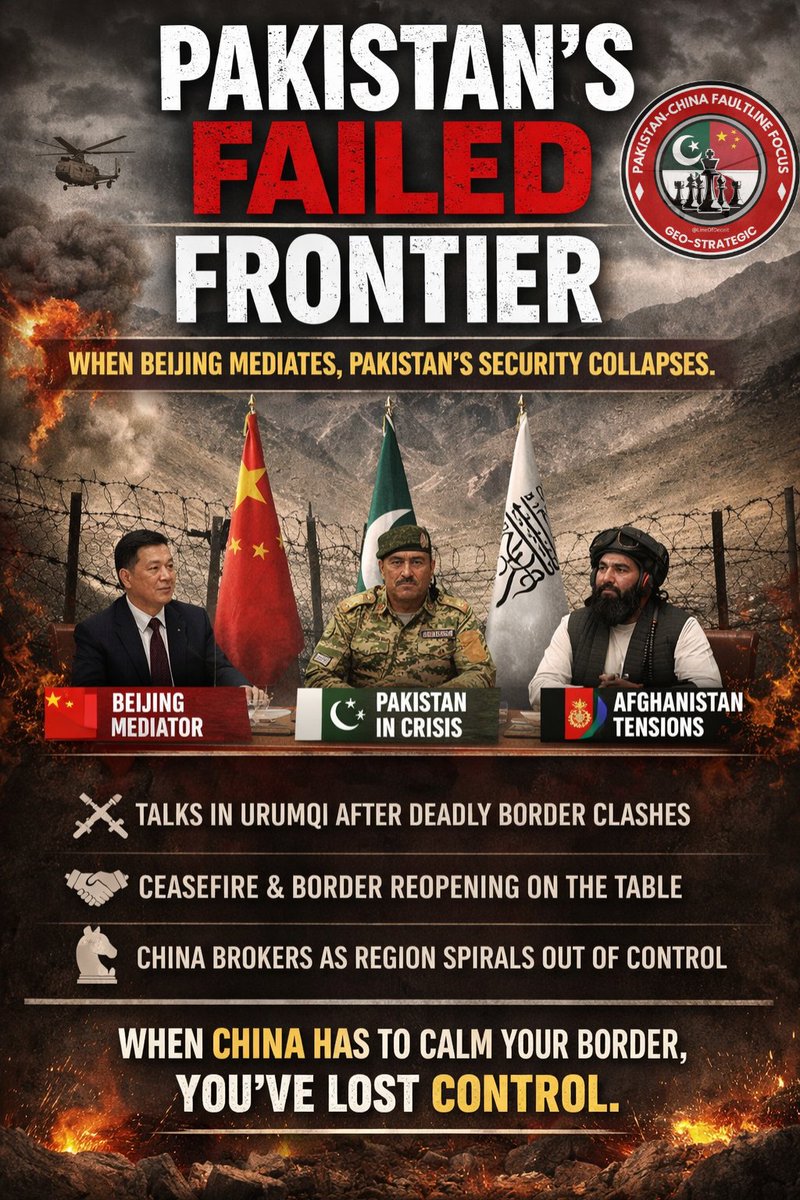
When China has to mediate between Pakistan and Afghanistan in Urumqi, after months of deadly cross-border fighting, it says something brutal about Pakistan’s security model. The doctrine has failed on its own frontier. Reuters reports the talks were held at China’s request to address the worst conflict between the two neighbours since the Taliban returned to power in 2021, with ceasefire, border reopening and security cooperation on the table. This is the deeper humiliation for Islamabad. For years, Pakistan tried to project itself as the manager of regional militancy and the architect of strategic depth. Now it cannot stabilise the very ecosystem it helped shape, and Beijing has to step in to prevent further collapse. AP reports China says the talks are advancing after weeks of fighting that killed hundreds. When another capital must broker calm on your border, your sovereignty may remain on paper, but your strategic credibility is already damaged. Pakistan is not controlling the region anymore; it is increasingly being managed through external mediation.
Pakistan-China Faultline Focus tweet media
English
0
3
15
3.4K
Pakistan-China Faultline Focus
Gilgit-Baltistan is rich in hydropower, minerals, rivers and strategic value. Yet its people are left with rising prices, shrinking relief, land disputes, weak representation and a growing sense of exclusion. That is the real story. For years, the region has been treated less like a homeland and more like a corridor to be used, a resource zone to be exploited and a population expected to stay silent while others profit. CPEC, dams, highways, mining, mega-projects all sold as “development.” But for many locals, the question is simple: If the land is so rich, why are the people feeling poorer, angrier and more ignored? Fuel prices rise. Transport costs surge. Freight becomes costlier. Daily life gets harder. Meanwhile, people watch their resources leave, but do not see equal benefits return. This is not inclusive development. This is extraction without justice. The anger in Gilgit-Baltistan is not against progress. It is against a model where land is taken, resources are used, decisions are imposed and locals are denied a meaningful share in power, profit and future planning. A region cannot be praised for its strategic importance while its own people are denied dignity, fair participation and control over what happens on their land. Gilgit-Baltistan is not just a route. It is not just a map point. It is home to people who are tired of being exploited in the name of development. When a land is treated as valuable but its people are treated as voiceless, resentment is not created by outsiders. It is created by the system itself. Gilgit-Baltistan’s tragedy is this: the land is prized, but the people are sidelined. #GilgitBaltistan #PoGB #CPEC #ResourceExploitation #HumanRights
Pakistan-China Faultline Focus tweet media
English
1
4
19
1.3K
Pakistan-China Faultline Focus
The significance of this statement is not in rhetoric alone, but in what it reflects. When voices from outside the usual political establishment begin openly saying that PoJK’s future lies in reintegration with India, it shows that the old Pakistan-sponsored narrative is losing both energy and credibility. Territory can be held through force, propaganda and censorship for a time, but not indefinitely against the direction of political aspiration. What has changed the conversation is not slogans, but contrast. On one side is a region under Pakistan’s illegal occupation, long marked by democratic deficit, controlled politics, economic suppression and chronic public unrest. On the other is a Jammu & Kashmir that, despite every challenge, has visibly moved forward in infrastructure, governance, tourism, connectivity and public confidence. That comparison is not theoretical anymore. It is being watched. That is why such remarks matter. They underline a deeper truth: people do not remain emotionally invested in systems that deny them dignity, development and agency. The more J&K changes on the ground, the harder it becomes for Pakistan to sustain the fiction that occupation can be sold forever as solidarity. PoJK is not Pakistan’s unfinished victory. It is Pakistan’s exposed failure. And if more voices continue to speak of reintegration, it will not be because of coercion from India, but because Pakistan’s own model in the region has exhausted itself. The real battle is no longer over maps alone. It is over legitimacy. And Pakistan is steadily losing that battle.
English
0
5
20
2.2K
Pakistan-China Faultline Focus
Final warning from PoJK. When agreements become stage props and reforms remain trapped in files, the street starts speaking the language of ultimatum. That is exactly where Pakistan now stands in PoJK. The Jammu Kashmir Joint Awami Action Committee (JKJAAC) has reportedly given Islamabad and the local dispensation a May 31, 2026 deadline to implement the October 4, 2025 Muzaffarabad Agreement, its charter of demands, and a fresh package of electoral reforms failing which it says it will launch a June 9 long march, a region-wide shutdown, and an indefinite sit-in outside the Legislative Assembly in Muzaffarabad. This is not a routine protest threat. It is an indictment. The message is blunt: broken promises on electricity relief, governance reform, and fair elections have pushed public patience to the edge. The committee has said elections held without implementing the accord, without addressing the issue of the 12 controversial reserved seats and without broader constitutional and electoral reform would be unacceptable. Among the demands reported are an independent Election Commission, constituency redistribution on a population basis and withdrawal of elite privileges. And this frustration did not emerge in a vacuum. In May 2024, protests over flour and electricity prices turned deadly before Pakistan’s government approved a 24 billion rupee package and protesters temporarily called off their march. Then in October 2025, unrest in Pakistan-occupied Kashmir again turned violent, leaving at least 10 dead before an agreement was signed that included Rs10 billion for improving the electricity system. The fact that the same movement is again threatening confrontation tells you everything: Pakistan knows how to sign papers under pressure, but not how to honour them with credibility. That is the deeper crisis in PoJK. This is no longer just about tariffs, subsidies, or procedure. It is about a collapsing belief that governance in the region is either fair, responsive, or sincere. A state that repeatedly reaches the table only after bloodshed, then delays implementation until the next explosion, is not governing, it is merely managing unrest in instalments. Pakistan’s problem in PoJK is no longer only political opposition, it is a legitimacy deficit. If May 31 passes without action, Pakistan will not just face another protest. It will face the verdict of a population that has learned the difference between a promise made to defuse anger and a promise intended to be kept.
English
0
6
17
3K
Pakistan-China Faultline Focus
Pakistan-China Faultline Focus@LineOfDeceit·
In PoJK, what we are witnessing is not the dismantling of terrorism but its strategic redistribution. Families linked to the TTP being reportedly moved from Kunar to Ghazni and Zabul, while terror infrastructure in PoJK is said to be shifted, rebuilt, or reconstituted after military pressure, points to a familiar pattern: Pakistan’s ecosystem does not truly uproot extremism, it merely rearranges it. That is the deeper problem with Pakistan’s security doctrine. It has spent decades trying to distinguish between good and bad terrorists, between assets to be preserved and threats to be managed. But terror networks do not disappear because a camp changes location, a family is shifted inland, or an operational node is rebuilt under new cover. Relocation is not counterterrorism. Reconstruction is not denial. It is continuity by other means. India’s Operation Sindoor was officially described as targeting nine sites used as terrorist infrastructure in Pakistan and Pakistan-occupied Kashmir. If, within months, the response is to reassemble those ecosystems elsewhere, then Islamabad’s old fiction stands exposed again: the issue is not incapacity alone, but tolerance, utility and strategic intent. A state that genuinely wants peace does not allow militancy to survive through logistical adaptation. And this is why the world should stop being distracted by Pakistan’s rhetoric. Whether the theatre shifts from Kunar to Ghazni, from Zabul to PoJK, the underlying architecture remains disturbingly intact. This is not the erosion of terror infrastructure. It is the mobility of terror infrastructure. Pakistan does not solve the problem; it keeps finding new coordinates for it.
Pakistan-China Faultline Focus tweet media
English
0
2
17
1.2K
Pakistan-China Faultline Focus
Pakistan-China Faultline Focus@LineOfDeceit·
THE PATIENCE OF THE BALTI PEOPLE IS NOT ENDLESS. Our Balti community has always been known for peace, patience, and dignity. But how long can any people remain silent when faced with continuous humiliation, arbitrary arrests, police brutality, and military repression in Pak-occupied Gilgit-Baltistan? Today, that patience is being tested to its absolute limit. The continued oppression by the Pakistan Army and Pakistani police is pushing the people into a corner where they feel they are being left with no option but to rise for their dignity, their basic rights, and their future. This is not instability created by the people. This is the direct result of systematic injustice imposed on them. The recent arrest of social activist Nazir Kazmi from Gangche District exposed the reality of this repression in full view. A serious confrontation and physical struggle broke out with the police during his arrest a powerful sign of the anger, frustration, and despair that has been building among the people for far too long. When peaceful voices are harassed, when activists are treated like criminals, and when fundamental rights are crushed under force, the state itself creates the explosion it later tries to blame on the people. Pakistan cannot keep ruling occupied regions through fear, intimidation, and arbitrary detentions while pretending everything is normal. You cannot cage a population forever. You cannot baton-charge dignity forever. You cannot arrest an entire people’s demand for justice. The people of Gilgit-Baltistan are not asking for charity. They are asking for what is theirs by right: freedom of expression, civil dignity, justice, and an end to state brutality. The world must stop ignoring what is happening in Pak-occupied Gilgit-Baltistan. Every unjust arrest, every act of intimidation, and every abuse of power is only deepening public anger and exposing the ugly reality of Pakistan’s rule in the region. The voices of oppressed communities cannot be silenced forever. Repression has consequences. And the Balti people’s patience should never be mistaken for weakness. #GilgitBaltistan #Baltistan #PakistanArmy #HumanRights #POGB #JusticeForBaltistan #EndStateBrutality #StandWithGilgitBaltistan
English
0
7
20
1.6K
Pakistan-China Faultline Focus
Pakistan-China Faultline Focus@LineOfDeceit·
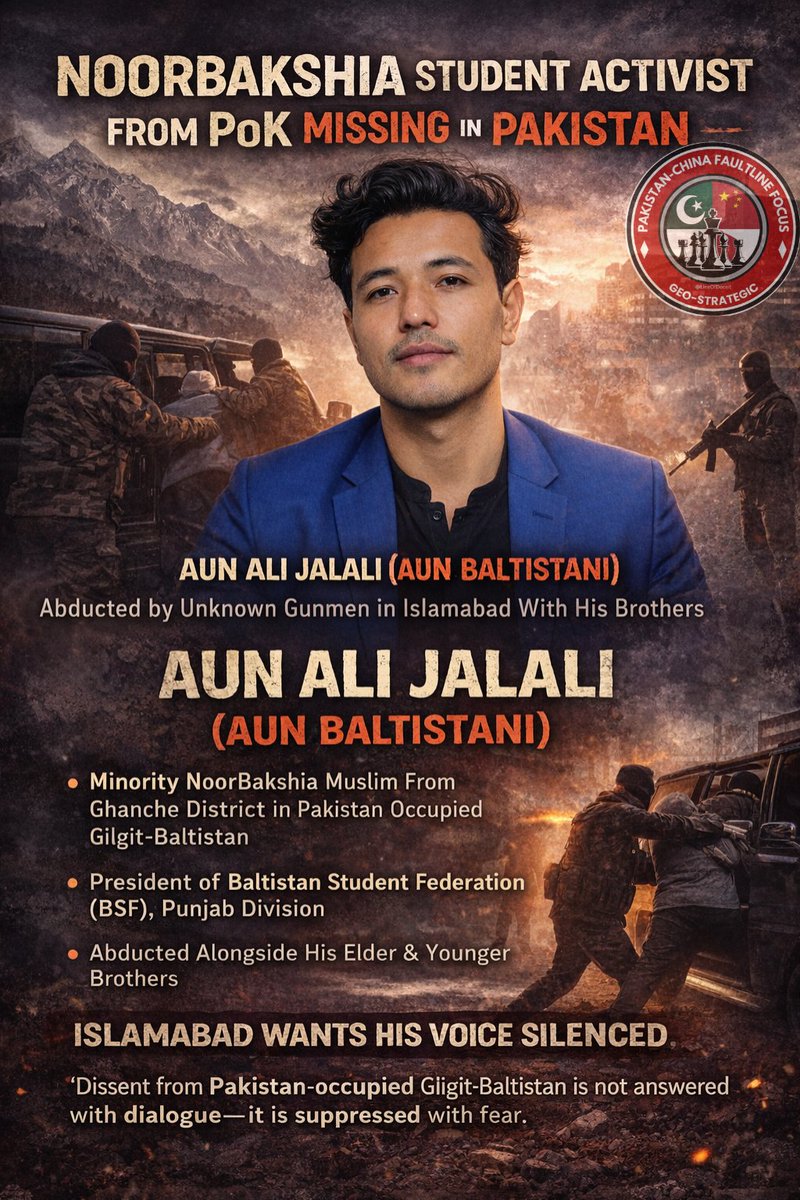
Reports are that Aun Ali Jalali (Aun Baltistani) and his brothers were seized at gunpoint from their student accommodation in Islamabad, Pakistan has once again exposed how it treats voices from its occupied peripheries: not as citizens with rights, but as bodies that can be intimidated into silence. What is not in doubt is the wider pattern Amnesty said enforced disappearances in Pakistan continued unabated in 2024 and explicitly noted that activists, students and journalists were among those targeted. That is why this case, would be far bigger than one missing student. It would fit a well-documented structure in which dissent from marginalised regions is answered not with law, transparency or due process, but with fear. UN experts warned in April 2025 about the unrelenting use of enforced disappearances in Pakistan and called it both a serious human rights violation and an international crime. Even in Islamabad, student activism has already intersected with missing persons politics; Dawn reported in December 2023 that more than 100 Baloch students were reportedly still missing after a crackdown tied to protests in the capital. If a young Balti student activist from a minority community can disappear in the national capital, then Pakistan’s claim of constitutional order becomes impossible to take seriously. This is not governance. This is coercive federalism at its ugliest, a system in which the centre extracts loyalty from regions like Gilgit-Baltistan while denying them security, dignity and equal citizenship. The message such incidents send is chillingly simple: speak, organise, represent your people and you may be made to vanish. Amnesty also noted that people in Pakistan have been recorded as missing for days and then reappearing without explanation or accountability. Pakistan keeps demanding allegiance from Gilgit-Baltistan while reproducing the very conditions that destroy it. You cannot claim national unity while minority students and activists live under the shadow of disappearance. You cannot preach democracy while the state’s coercive reflex remains stronger than the rule of law. And you certainly cannot ask oppressed regions to trust a centre that too often responds to uncomfortable voices with intimidation instead of answers.
Pakistan-China Faultline Focus tweet media
English
0
4
17
1.8K
Pakistan-China Faultline Focus
Pakistan-China Faultline Focus@LineOfDeceit·
Another reported gathering in PoJK, another reminder of what Pakistan has turned that territory into. If newly recruited Lashkar-e-Taiba cadres are indeed being publicly welcomed under the gaze of senior commanders, then this is not a fringe incident. It is a window into the real ecosystem Pakistan keeps denying exists. Terrorism in PoJK is not merely surviving in the shadows, it is repeatedly appearing in organised, public, socially sanctioned form. Reports through 2025 already documented rallies in Rawalakot where LeT and JeM figures were present, while in January 2026 an LeT-linked JKUM commander, Abu Musa Kashmiri, was reported delivering an openly violent speech in PoJK. That is the core hypocrisy of Pakistan’s Kashmir posture. It speaks the language of rights and solidarity, but repeatedly gives space, symbolism and oxygen to proscribed actors. LeT is not a misunderstood pressure group; it is a UN-designated terrorist organisation. When such elements are able to gather, recruit, celebrate, threaten and radicalise in Pakistan-administered territory, the issue is no longer plausible deniability. The issue is state tolerance, ideological patronage, or both. PoJK under Pakistan has been reduced from a political territory into a strategic staging ground. And every such event tears apart Islamabad’s old fiction that it is merely a diplomatic advocate for Kashmiris. States that genuinely stand for people do not allow their soil to become a theatre for jihadist pageantry. They do not let terror networks wear the mask of politics. They do not confuse radicalisation with representation. Pakistan is not supporting Kashmir. It is discrediting it. The more openly these outfits operate in PoJK, the clearer it becomes: this is not resistance politics, this is the normalisation of terrorism under official convenience. And that is why PoJK increasingly looks less like a cause Pakistan protects and more like a terror hub Pakistan enables.
English
1
4
19
4K
Pakistan-China Faultline Focus
Pakistan-China Faultline Focus@LineOfDeceit·
Gilgit-Baltistan is economically suppressed by design. Its resources feed the state, but its people remain deprived of opportunity, ownership and dignity. When wealth leaves the region but deprivation stays behind, that is not development, that is exploitation. Pakistan takes the value. Gilgit-Baltistan bears the burden.
English
0
2
17
2.9K
Pakistan-China Faultline Focus
Pakistan-China Faultline Focus@LineOfDeceit·
CPEC was marketed as Pakistan’s road to destiny. What it actually exposed was the bankruptcy of Pakistan’s ruling class. For years, Islamabad sold CPEC as a miracle. A golden corridor. A development revolution. A historic partnership that would transform the economy. Instead, what did Pakistan deliver? Delays. Corruption. Policy chaos. Security failures. Debt pressure. Broken promises. And endless propaganda to hide the rot. Let’s be honest. China came to serve its own interests. It was never doing charity for Pakistan. Beijing wanted access, leverage, strategic depth and control over key infrastructure. But Pakistan’s elites made it even worse. They took a major strategic project and turned it into a circus of commissions, incompetence and political point-scoring. Every government used CPEC for slogans. None built the governance, discipline or institutional seriousness needed to make it work. This is the truth Pakistan does not want to admit: CPEC did not just expose Chinese ambition. It exposed Pakistani failure at every level. A state obsessed with headlines but incapable of delivery. A leadership class that screams about sovereignty while mortgaging policy space. A system that celebrates announcements but cannot sustain execution. Gwadar was hyped as the future. SEZs were sold as industrial takeoff. Energy projects were presented as salvation. And yet Pakistan still ended up with economic fragility, structural weakness and a public forced to survive under inflation, shortages and dysfunction. So who killed the promise of CPEC? Yes, China designed it around its own advantage. But Pakistan’s corrupt and clueless elite made sure whatever opportunity existed was buried under greed, mismanagement and chronic instability. That is the real scandal. Pakistan was not trapped only by Beijing. It was trapped by its own rulers who packaged dependency as development and called submission a success story. CPEC today stands as a monument not to progress, but to Pakistan’s elite betrayal of its own people. They sold the nation a dream. Then looted the road before it was even built. #CPEC #Pakistan #China #Gwadar #DebtTrap #PakistanEconomy #BeltAndRoad #SouthAsia #Geopolitics
Pakistan-China Faultline Focus tweet media
English
1
7
17
2.6K
Pakistan-China Faultline Focus
Pakistan-China Faultline Focus@LineOfDeceit·
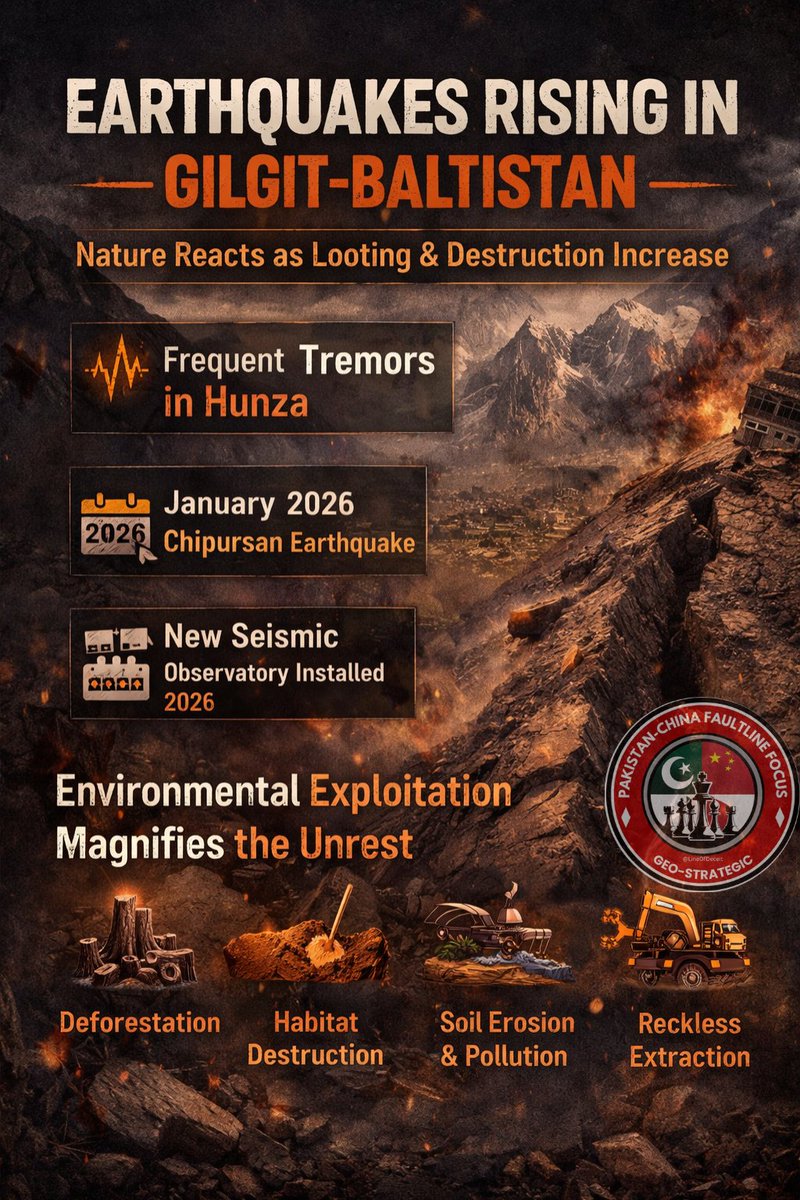
Something serious is unfolding in Gilgit-Baltistan, especially in Upper Hunza. The repeated tremors, the January 2026 earthquake that badly hit Chipursan/Upper Hunza, and the aftershocks reported since October 2025 are not events that can simply be normalised and forgotten. Even Pakistan’s own meteorological authorities installed a new seismic observatory in Hunza in February 2026 to improve monitoring of the region’s low-intensity tremors. That alone tells you this is not a routine matter. Now, let us be intellectually honest Earthquakes in northern Pakistan are fundamentally tectonic. This is one of the most seismically active and geologically unstable belts in the region because of the ongoing collision of the Indian and Eurasian plates and Hunza is already known for active faults, landslides and fragile slopes. But that scientific reality does not absolve governance of responsibility. It sharpens it. Because when a mountain system this fragile is simultaneously burdened by reckless extraction, deforestation, habitat destruction, soil erosion, landslide-prone construction and poorly checked mega-projects, people are right to ask harder questions. Recent academic work on Gilgit-Baltistan has already flagged serious environmental concerns linked to CPEC-era development, including deforestation, habitat destruction, soil erosion, landslides and pollution in water bodies. Even the Draft Gilgit-Baltistan Environment Policy says significant development projects should face environmental impact assessment and regular environmental audits, which itself is an admission that the ecological stress is real. So when locals say nature is reacting, read it not as crude geology but as a political indictment. A wounded mountain does not send press releases; it sends cracks, slides, collapses and fear through entire valleys. The question is not whether officials can blame tectonics. The question is why they keep disturbing a highly vulnerable ecology, looting natural resources and then treating every disaster as if governance had no role in magnifying the risk.
Pakistan-China Faultline Focus tweet media
English
0
3
15
2.6K
Pakistan-China Faultline Focus
Pakistan-China Faultline Focus@LineOfDeceit·
What is being described in Pakistan-occupied Gilgit-Baltistan is not ordinary governance. It is the reported use of state power to intimidate, punish and silence people. If these allegations are true, then the government is not protecting vulnerable communities. It is targeting them. Night raids. Mass detentions. Curfews. Pressure on activists. Fear used as a method of control. That is not stability. That is coercion. The most disturbing part is the pattern: when unrest grows, the response reportedly is not accountability or reassurance, but force, suspicion and suppression. Communities are treated as security threats, religious identity becomes grounds for scrutiny, and public voices are pressured into silence. The result is a system where ordinary people pay the price for the state’s insecurity and regional power games. If a government answers tension with raids, detentions and fear, it is revealing not strength, but its dependence on repression. #GilgitBaltistan #PoGB #Pakistan #HumanRights #SouthAsia
Pakistan-China Faultline Focus tweet media
English
0
5
16
2.7K
Pakistan-China Faultline Focus
Pakistan-China Faultline Focus@LineOfDeceit·
Humiliation for Asim Munir in PoGB. 23 March is meant to be a day of state pageantry in Pakistan, a reminder of the Lahore Resolution and the coming into force of the 1956 Constitution. But in Gilgit-Baltistan, the symbolism is turning against the state itself. What was supposed to look like national unity is increasingly looking like political exhaustion, sectarian anger and a widening legitimacy crisis. If the reported Astore boycott is what it appears to be, then this is not a minor local embarrassment. It is a message. And the message is brutal, a state cannot demand loyalty from communities it insults, militarises and treats as expendable. That is why the backlash against Asim Munir matters. When the Army Chief is reported to have told Shia clerics that those who “love Iran so much should go to Iran,” he was not projecting strength, he was exposing contempt. In a region where Shia and Ismaili communities form a major part of the social fabric, such rhetoric does not consolidate Pakistan’s authority; it corrodes it from within. And this comes after Pakistan had already been forced to deploy the military and impose curfews in Gilgit and Skardu following deadly unrest. That alone tells you the truth, this is no longer a governance success story, nor a stable national periphery. It is a region under pressure, governed through force and drifting further away in sentiment. PoGB is not humiliating Asim Munir because of one remark alone. It is humiliating him because the old script has stopped working. You cannot preach nationalism while insulting sects. You cannot demand unity while ruling through fear. And you cannot stage state rallies in regions where the people increasingly see the state itself as the problem. This is the real crisis for Pakistan, not just loss of narrative, but loss of moral authority. Grounding used for this draft, Pakistan Day on 23 March commemorates both the Lahore Resolution and the 1956 Constitution; Reuters reported military deployment and curfews in Gilgit and Skardu after deadly unrest this month; and several outlets reported Munir’s go to Iran remark to Shia clerics. I could not independently verify the exact turnout claim for the Astore rally or the casualty figure of over 50 in your note, so I kept those parts framed more carefully.
English
0
12
31
3.7K
Pakistan-China Faultline Focus
Pakistan-China Faultline Focus@LineOfDeceit·
Pakistani forces stand accused of a horror that should shake every conscience. The alleged killing of 17 minors in Gilgit-Baltistan. Not militants. Not combatants. Minors. And yet the same state that lectures the world about rights, justice and victimhood is again being accused of turning violence on its own occupied periphery. Reports citing, excessive force in Gilgit and Skardu, describe fear on the ground and call for an independent investigation. This is the brutal truth about Pakistan’s rule in Gilgit-Baltistan. No real constitutional dignity, no meaningful local sovereignty, no genuine accountability, just coercion, suppression and force dressed up as governance. When a state responds to unrest and dissent with bullets, raids and crackdowns, it exposes what it really is. Not a protector. Not a democracy. But a coercive machine terrified of the people it claims to represent. And the hypocrisy is staggering. Pakistan spends years manufacturing propaganda on human rights elsewhere, while serious allegations of killings, repression and intimidation keep emerging from territories under its own control. That is not a moral concern. That is political fraud. If even children are not safe from the state’s heavy hand, then this is no longer just a law-and-order question. It is an indictment of the entire structure of control in Gilgit-Baltistan. The world should stop being fooled by Islamabad’s diplomatic vocabulary. Behind the speeches lies a system many critics describe as extractive, unaccountable and violently intolerant of dissent. If these allegations are true, then this is not merely excess. It is barbarity. And if Pakistan refuses transparency, refuses accountability and refuses an independent probe, it will only strengthen the belief that impunity is built into the system. Gilgit-Baltistan does not need propaganda. It needs truth. It needs justice. And it needs the world to stop looking away. #GilgitBaltistan #Pakistan #HumanRights #PoGB #JusticeForVictims #ExposePakistan
Pakistan-China Faultline Focus tweet media
English
0
5
18
4K
Pakistan-China Faultline Focus
Pakistan-China Faultline Focus@LineOfDeceit·
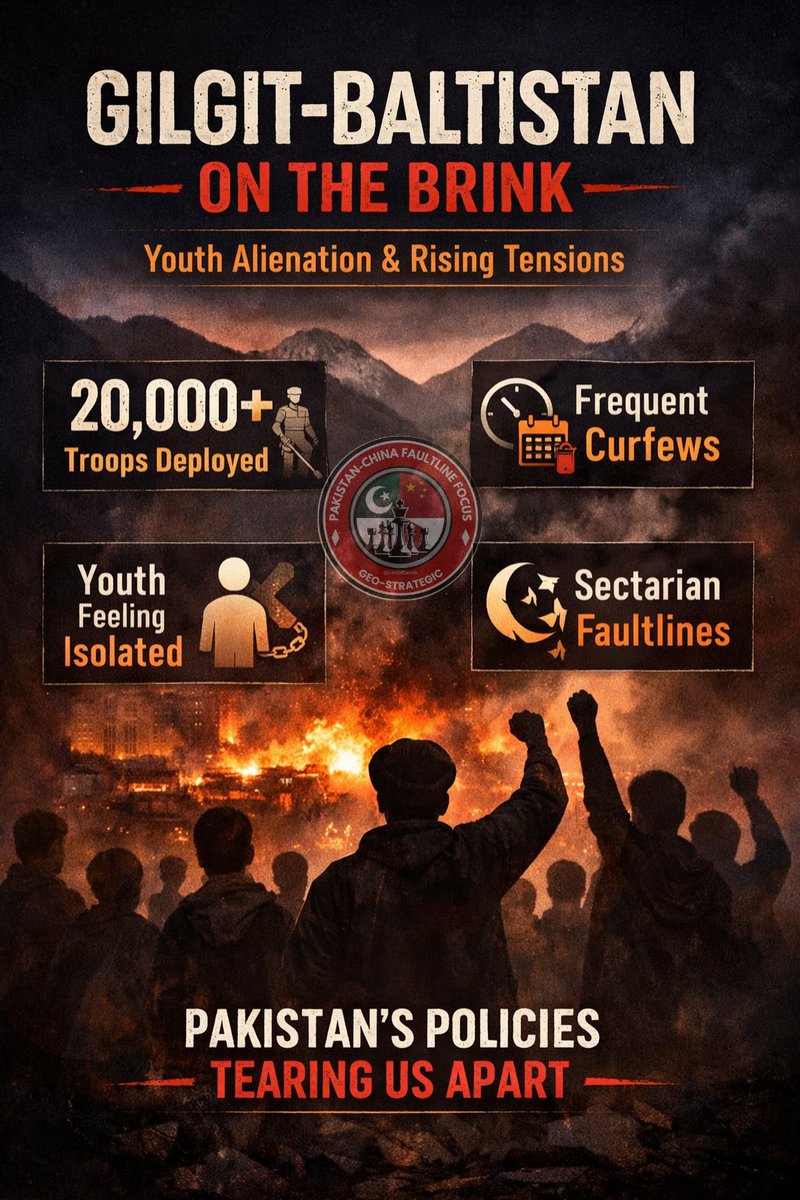
A direct warning to Islamabad from Gilgit-Baltistan. You are not merely losing the narrative in Gilgit-Baltistan, you are losing the youth, the trust and eventually the ground beneath your own claim. When young voices in Skardu speak with this degree of alienation, it signals something far deeper than anger, it signals a collapse of political belonging. A state fails long before it fractures on a map. It fails when its own citizens begin to view travel across the country not as freedom, but as danger; when sectarian identity becomes a liability; when military presence replaces civic legitimacy; and when governance is experienced as coercion, not representation. Recent events have already exposed that crisis: troops were deployed and curfews imposed in Gilgit and Skardu after deadly unrest, while external advisories now warn of clashes between protesters and security forces in Gilgit-Baltistan. Pakistan keeps trying to manage Gilgit-Baltistan through force, sectarian engineering and administrative control. But regions do not stay loyal to states that cannot guarantee dignity, security, or equal citizenship. Skardu’s alienation is not a side story, it is a warning flare. Keep pushing this sectarian and militarised model, and Pakistan will not just face dissent; it will deepen the very internal fracture it pretends does not exist. You can hold territory by force for a time, but you cannot hold a generation that has stopped believing in you. This is how states begin to lose regions, first in sentiment, then in legitimacy and only later on the map.
Pakistan-China Faultline Focus tweet media
English
0
4
17
2.3K
Pakistan-China Faultline Focus
Pakistan-China Faultline Focus@LineOfDeceit·
Alternatives: Occupied, Exploited, Silenced The Truth Behind CPEC in PoGB Gilgit-Baltistan. Land Taken, Voices Crushed Not Development. Occupation. With elections in Pakistan-occupied Gilgit-Baltistan expected in 2026, the real issue is no longer just provincial status. The anger on the ground has moved far deeper to land grab, resource plunder, demographic pressure and the slow erasure of local identity. Senge Sering, President of the Institute for Gilgit Baltistan Studies, has laid it bare, Pakistan and China are tightening their grip over vast stretches of land in PoGB in the name of development, while the actual people of the region are pushed out of decision-making, denied fair revenue and treated as spectators on their own soil. This is the truth behind the polished propaganda around CPEC. It was never about local welfare. It was never about empowerment. It was never about rights. It has always been about strategic control, extraction and occupation. Roads, projects and corridors are being showcased as progress, but for locals, the story is one of dispossession. Their land is being taken, their resources exploited, their culture diluted and their political voice systematically weakened. And the greatest irony is this: PoGB still has no genuine constitutional status in Pakistan. No full rights. No meaningful representation. No sovereign control over its own future. A region historically tied to India’s Ladakh continues to be held in legal and political limbo, exploited for geography, minerals and strategy, while its people are denied dignity, ownership and voice. This is not governance. This is an occupation dressed up as administration. This is colonial extraction repackaged as development. The world must stop buying Islamabad’s narrative. Behind the official statements and CPEC brochures lies a silenced population facing media blackout, political marginalisation and a steady assault on identity and rights. Until Pakistan withdraws its control and the truth of PoGB is acknowledged, the people of Gilgit-Baltistan will continue to live under disenfranchisement, not democracy. PoGB is not a development success story. It is a warning sign of how occupation, exploitation and narrative management work together. #GilgitBaltistan #PoGB #CPEC #PakistanOccupiedGilgitBaltistan #Ladakh #HumanRights #ChinaPakistanAxis #LandGrab #ResourceExploitation
Pakistan-China Faultline Focus tweet media
English
0
4
17
2.3K
Pakistan-China Faultline Focus أُعيد تغريده
Kashmir Beyond Myths
Kashmir Beyond Myths@KashmirUnfolded·
Baramulla’s Dudran, known as Kashmir’s Milk Village,is not just a charming rural curiosity. It is a living example of how traditional knowledge, ecological intelligence and community-based sustainability can solve practical problems without dependence on modern energy systems. In this remote village in Boniyar tehsil, around 70 to 80 families still preserve milk using an indigenous system called Dadore small wooden-and-stone structures built near natural cold springs, where icy water flow and cool air together keep milk fresh for days without electricity. That alone makes Dudran remarkable. But its real importance goes far beyond milk preservation. At a time when the world is searching for sustainable models of food storage, climate adaptation and low-energy rural livelihoods, Dudran offers something modern systems often overlook: inherited wisdom refined through generations. This is not technology in the conventional industrial sense, but it is absolutely a form of technology local, tested, efficient and rooted in the natural geography of Kashmir. The Dadore system reflects a deep understanding of environment-based living. Instead of fighting nature, the people of Dudran work with it. Instead of relying on costly refrigeration, they use spring-fed cooling. Instead of high-consumption infrastructure, they depend on locally available materials, natural temperature control and ancestral design. The result is a zero-electricity preservation method that is economical, practical and environmentally sustainable. This matters even more in hilly and remote regions where power supply may be inconsistent and where rural households need affordable ways to reduce spoilage and protect income. In Dudran, milk is not only stored but later converted into curd, butter and traditional cheese, helping families preserve value, minimise waste and sustain dairy-based livelihoods. There is also a deeper civilisational lesson here. Too often, traditional rural practices are dismissed as outdated simply because they are old. Dudran challenges that mindset. It shows that many so-called old systems are in fact highly advanced in their own context designed for resilience, resource efficiency and long-term survival. In an era shaped by climate anxiety, energy costs and conversations around sustainability, villages like Dudran should not be seen as relics of the past, but as repositories of solutions. The architecture of the village itself strengthens that message. Homes built with stone, wood and mud blend into the environment and reflect a way of life that is materially modest yet ecologically intelligent. The Dadore structures, secured with wooden planks and positioned strategically near springs, are not accidental rural improvisations they are evidence of accumulated local knowledge that deserves recognition, documentation and preservation. Dudran therefore represents three important things at once: • A model of sustainable rural living. • A lesson in climate-resilient food preservation. • And a reminder that Kashmir’s villages hold knowledge systems as valuable as any formal innovation lab. The story of Dudran deserves attention because it proves that development is not only about replacing the old with the new. Sometimes, real progress lies in identifying what has worked for centuries, understanding why it worked, and ensuring that such knowledge is neither forgotten nor erased. Kashmir’s future will not be built only through roads, tunnels, grids and institutions. It will also be strengthened by recognising the wisdom already embedded in its villages, landscapes and communities. Dudran is important because it shows that sustainability is not always invented in conferences or laboratories. Sometimes, it is quietly preserved in a mountain village where nature itself becomes a refrigerator. #Kashmir #Baramulla #Dudran #MilkVillage #TraditionalKnowledge #Sustainability #ClimateResilience
Kashmir Beyond Myths tweet media
English
0
6
19
2.1K