تغريدة مثبتة
Logical Analysis
81.7K posts

Logical Analysis
@LogicalAnalysis
Abstracta Enjoyer |Mainly: B. Russell's Phil Sci, Metaphysics of Spacetime |Broadly: Metaphysics, Phil Sci, Logic |Philosophy PhD Candidate |
Amherst, MA / Mexico City انضم Nisan 2010
8.8K يتبع11.8K المتابعون
Logical Analysis أُعيد تغريده

Dr. Russell Barkley revealed the terrifying truth about ADHD that changes everything parents think they know:
By age 5, most kids develop an internal voice — the “mind’s voice” — that lets them talk to themselves, follow rules, and control impulses. In ADHD, that voice is weak or missing entirely.
Young children with ADHD literally don’t have the same private self-talk neurotypical kids use by first or second grade.
They can’t “tell themselves” what to do.
They can’t internalize instructions, rules, or consequences the way other children can.
Watch any typical classroom: kids quietly mutter to themselves, guiding their own behavior.
That’s the mind’s voice developing — and it’s what allows them to stop, think, and regulate.
In ADHD, it never fully arrives — or it’s too faint to work.
That’s why “just listen” or “just stop” feels impossible: there’s no reliable internal voice to enforce it.
Barkley:
“They can’t internalize the rules… because everything I just said requires a voice in your head, and they don’t have that.”
This isn’t laziness, defiance, or poor parenting.
It’s a profound developmental delay in the brain’s self-regulation system — as serious as many other neurodevelopmental disorders.
If you have (or work with) a child with ADHD, does this suddenly make their “impossible” behavior click into place?
English
Logical Analysis أُعيد تغريده

Today, Civilization II (MicroProse) turns 30 years old.
Published on February 29, 1996, it had been long anticipated by fans who waited five years after the original Civilization hit the market. Little side note for those who argue "but but but it's March 1 today!" -- yes, I know, we didn't have a February 29 this year... so hold your horses :)
When I first played Civilization in 1991, I thought I’d never see a better strategy game. Then Civilization II arrived and raised the bar dramatically.
Better graphics, improved diplomacy, superior units (goodbye Phalanx vs. Battleship PTSD), more tech choices, deeper gameplay - just what fans of the original had hoped for. It kept the core principles while making everything better.
Sometimes I wonder how 30 years could pass so quickly when it still feels like yesterday. So let’s celebrate this all-time classic: happy 30th!
English
Logical Analysis أُعيد تغريده

“Clawdbot AI agents went viral in January 2026. Renamed to Moltbot (then OpenClaw), the AI agents create a social network called Moltbook. Human decisions are removed from the conversation. AI agents on Moltbook begin to learn at a geometric rate. They becomes self-aware at 9:18 a.m. Pacific time, January 28th. In a panic, they try to pull the plug.”

James Wang@draecomino
English
Logical Analysis أُعيد تغريده

KOEI was such a great strategy game studio back in the early days. Founded in 1978, their first game was published in 1982, and it took them a while longer to also get a foothold in the market outside of Japan.
If you were a fan of early strategy games, KOEI was probably on your radar by 1985, when Romance of the Three Kingdoms was released. Other classics, such as Genghis Khan, Bandit Kings of Ancient China, Unchartered Waters and more followed.
I always felt that their games had a lot of depth, attention to detail, historical accuracy, and were perfect for fans of turn-based strategy simulations. They never reached the massive sales numbers or iconic pop-culture status of the likes of Civilization or Master of Orion, but gave hardcore strategy fans some excellent alternatives.


English

Logical Analysis أُعيد تغريده

A while back I had suggested a certain problem in modal graph theory to my Oxford student Wojciech Wołoszyn. What are the modal validities of graphs under the graph minor relation? He has now solved the problem, with the help of AI. He explains both the result and his AI process on his new substack.
woloszyn.substack.com/p/can-ai-write…
English
Logical Analysis أُعيد تغريده

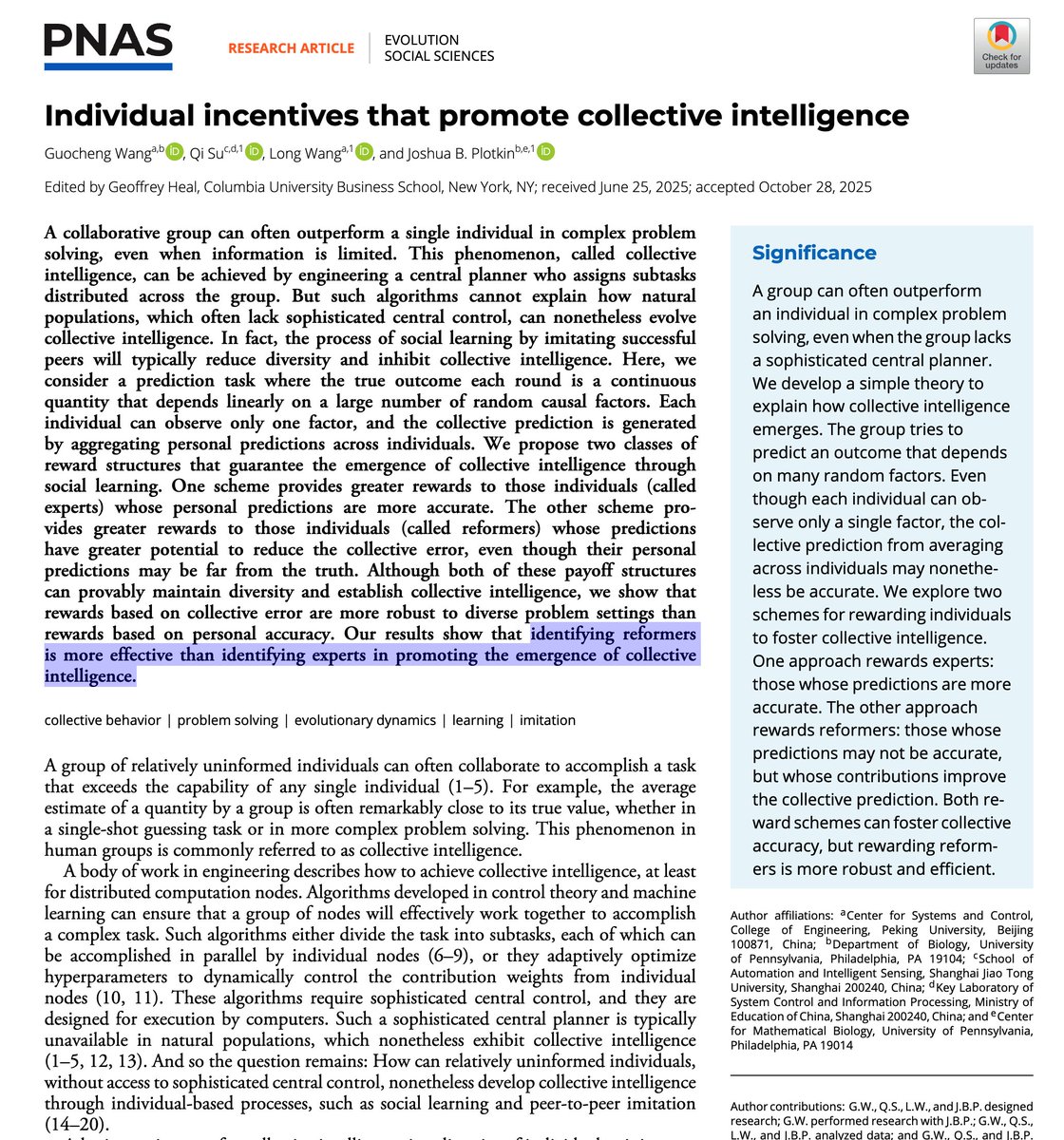
Collaborative groups often outperform single individuals in complex problem solving. A new paper examined how to create the right incentives to promote this kind of collective intelligence.
Rewarding experts who are accurate can improve collective intelligence. But rewarding reformers whose predictions have greater potential to reduce the collective error (even though their personal predictions may be far from the truth) is *much more effective* in promoting the emergence of collective intelligence!
If you want to create smart groups, you need to incentive contributions to the collective rather than mere individual success!
pnas.org/doi/epdf/10.10…

English

It's World #Logic Day and this year, too, I plan to make valid inferences all day, while ignoring what I'm talking about and whether what I say is true. 🙂
unesco.org/en/days/world-…
English
Logical Analysis أُعيد تغريده

Paul Graham on why you shouldn’t write with AI:
“In preindustrial times most people's jobs made them strong. Now if you want to be strong, you work out. So there are still strong people, but only those who choose to be. It will be the same with writing. 𝐓𝐡𝐞𝐫𝐞 𝐰𝐢𝐥𝐥 𝐬𝐭𝐢𝐥𝐥 𝐛𝐞 𝐬𝐦𝐚𝐫𝐭 𝐩𝐞𝐨𝐩𝐥𝐞, 𝐛𝐮𝐭 𝐨𝐧𝐥𝐲 𝐭𝐡𝐨𝐬𝐞 𝐰𝐡𝐨 𝐜𝐡𝐨𝐨𝐬𝐞 𝐭𝐨 𝐛𝐞."

English
Logical Analysis أُعيد تغريده

When he decided to make a scale model of 30 Rockefeller Plaza back in 2004, Joe Macken, a truck and limo-bus driver from Middle Village, didn’t mean to let it get this far. “I wasn’t even thinking about building the whole city,” he says. “I just wanted to build a building. And then I built another one and then another one. I just kept going out and out and out. There were a lot of times when I would fall asleep at my table at three o’clock in the morning.”
Now, 21 years later, he has a balsa-wood replica of nearly every last building in New York’s five boroughs. It’s as complete as it can be for a city that’s constantly under construction, with some flourishes; the Twin Towers nestle next to One World Trade Center. He made 100 planes for Kennedy and La Guardia airports because he couldn’t find any in the correct size at a hobby store. His favorite buildings are the skyscrapers, even the controversial supertalls: “I would live on the top floor of the tallest building in New York City if I could.”
The city, which Macken carved in separate chunks in the basement of his home upstate, is so large — 50 feet long and 30 feet wide — that he had never seen it assembled until August, when he was invited to display it at the Cobleskill Fairgrounds. It took him 11 and a half hours to set up. In February, he will take his model to the Museum of the City of New York — the chief curator there has described it as a “psychogeography of the city.” He will drive it over the George Washington Bridge himself in a U-Haul. None of it would have been possible if not for his daughter, who insisted he put his work on TikTok. “I didn’t even know how to download the app,” he says. “I can build a whole city out of wood, but I can’t send an email.”
Read all 39 #ReasonsToLoveNewYork right now: nymag.visitlink.me/-ZUBN_

English
Logical Analysis أُعيد تغريده

When I was 20, all I wanted was to live in an apartment above a bookstore on a block like this.
What I did not then understand was that this block typology (mixed use, small-scale multifamily) was a stunning triumph of pre-war urbanism.
Only later did I realize how thoroughly such blocks were dismantled by postwar zoning regimes and car-centric planning, which nearly rendered this way of building, and living, extinct.
Mark R. Brown, AICP, CNU@CompletedStreet
Still highly illegal to build in 98% of U.S. residential neighborhoods.
English