Finance implies scarcity, expected return, and diversification.
You don't have unlimited attention. Some curiosities deserve more capital because they update important priors, diversify your worldview, and improve judgment under uncertainty.
Allocate time across ideological and disciplinary lines. Allocate money to experiences that challenge defaults. Allocate attention to primary sources over media summaries.
To limit stress, finance your curiosity.
The return accrues to your investment account and your quality of life.
When you become genuinely curious, dopaminergic circuits activate and tag new information as valuable.
Memory improves. Motivation to explore increases. The autonomic state shifts from threat to exploration.
Curiosity is the physiological opposite of defensive certainty.
It doesn't just make you a better thinker. It literally lowers the stress load in real time.
Most of the stress in your life doesn't come from events.
It comes from the gap between what you expected and what happened.
That gap is a function of how rigid your mental model is.
A thread on epistemic humility as stress relief — and why commodity traders already understand this better than most. 🧵
Every experienced trader knows the most dangerous moment in a position is when you stop questioning it.
The same thing happens to your worldview. And the cost isn’t just bad trades. It’s chronic stress, narrowing attention, and a mind that can’t update fast enough to stay useful.
Finance your curiosity.
It pays better than you think
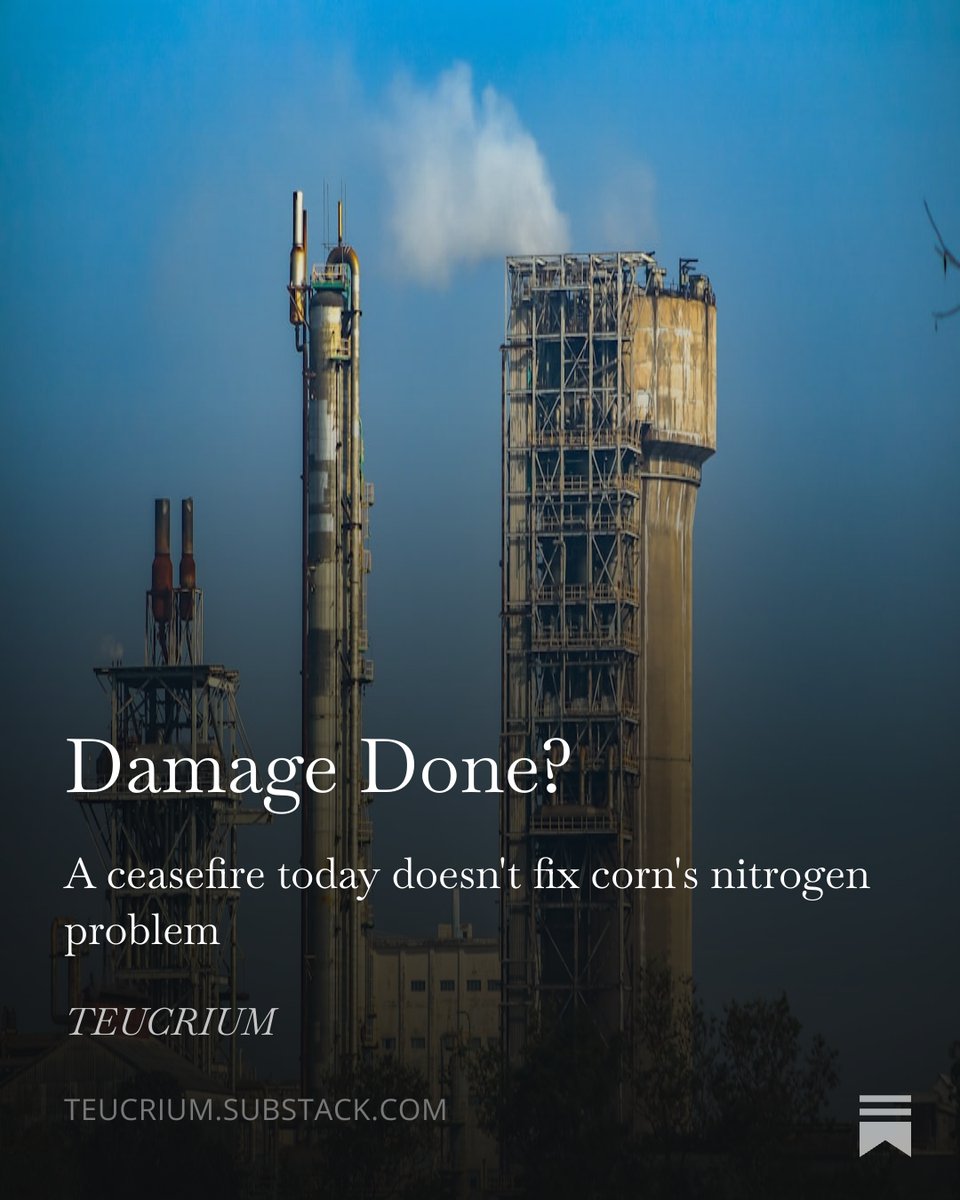
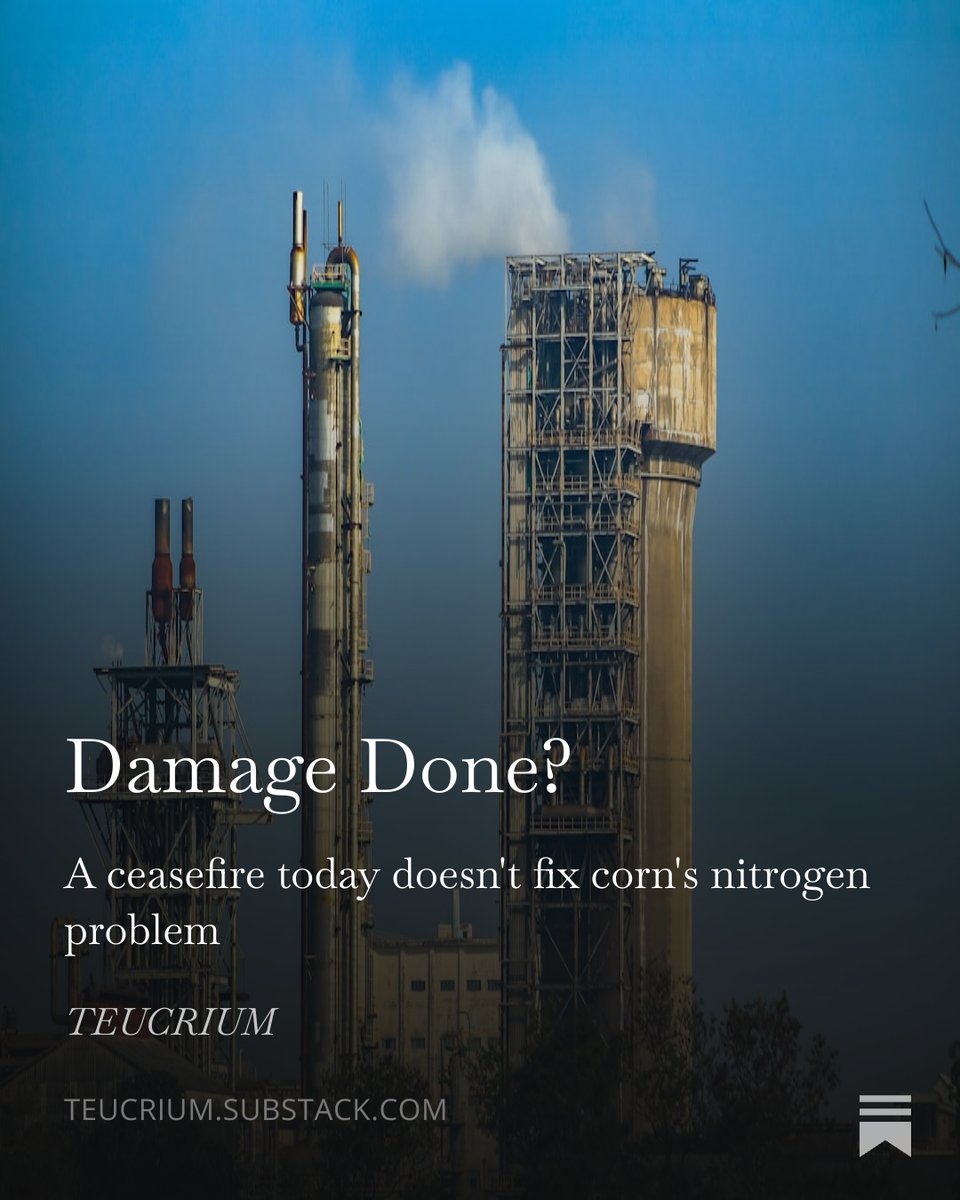
Damage Done?
A ceasefire today doesn't fix corn's nitrogen problem
Announce a ceasefire today, reopen the Strait of Hormuz tomorrow, and the corn market still has a problem that doesn’t resolve until 2027 at the earliest.
It is a risk that the market may not fully comprehend. Grain traders are chasing oil prices and ceasefire headlines, treating the nitrogen shock as a geopolitical risk premium that fades when the shooting stops.
It won’t.
Disappearing Corn Acres?
Final corn planting decisions in the United States run from February through early April. The Strait of Hormuz closed on February 28. Anhydrous ammonia averaged $865 per ton nationally that week.1 By the end of March, the national average price of anhydrous ammonia rose to $1,035, with seven of the eight major fertilizers seeing price increases.2
That $185 per ton increase adds roughly $18 per acre at a standard 160-pound nitrogen application rate. At a 180-bushel yield, that’s approximately $0.10 per bushel baked into the cost of production. A ceasefire doesn’t bake it back out.
Some farmers will absorb the cost. Others may cut application rates. Some will switch and plant soybeans instead.
USDA’s March 31 Prospective Plantings report showed corn intentions down 3% from 2025, with soybeans gaining acreage.3 That survey ran in early March, before the full price spike hit. In our view, the shift will likely be larger than what USDA captured.
A ceasefire doesn’t replant those soybean fields as corn. It doesn’t retroactively apply nitrogen that wasn’t purchased. The 2026 US corn crop is set.
South American Impacts
The corn market is likely to feel the impact most directly in the Southern Hemisphere first.
Brazil is the world’s largest corn exporter and imports roughly 85% of its fertilizers.4 Its Agriculture Ministry has classified the fertilizer supply outlook as an "extremely high risk" to the 2026/27 harvest.5 Brazilian safrinha corn, planted February through March across Mato Grosso and Parana, receives nitrogen top-dressing in April and May. Those farmers are finding the Middle East supply gone, and Chinese exports under quota. If application rates fall short, those yields would be decided regardless of any potential ceasefire announcement.
2027: The potential capacity impact
The second timeline is where the ceasefire argument fully collapses.
One of the world’s largest single-site facilities, QAFCO’s urea and ammonia complex at Ras Laffan, remains offline.6 QatarEnergy CEO Saad al-Kaabi confirmed 17% of Qatar's LNG export capacity is sidelined for 3 to 5 years, with repair costs estimated at $26 billion.7 QAFCO represents roughly 14% of the global seaborne urea trade. A ceasefire today starts a 3-to-5-year clock. It does not skip it. (There is no diplomatic workaround for a destroyed LNG train.)
Iran’s situation is no better. Israeli strikes damaged four processing plants at South Pars.8 All seven major Iranian urea producers suspended operations.9 Some catalyst damage from uncontrolled shutdowns may be permanent. Even with a ceasefire, restarts take months at a minimum. Full production recovery is years out.
Those two suppliers together represent roughly 25% of globally traded urea. They are not coming back on a diplomatic timeline.
Global nitrogen markets will likely still be short in September as farmers start buying inputs for the next crop. They’ll be making the same corn-versus-soybeans calculation under similar cost pressure. The 2026 acreage shift doesn’t end in 2026.
China and Russia, the only potential swing suppliers, provide no relief. China has maintained strict urea export controls since mid-2024.10 Russia escalated its own restrictions in late March, suspending ammonium nitrate exports.11 European producers are running well below normal capacity.12 To our knowledge, there is no available backstop.
Marginal Reprieve if the Strait Opens and the Shooting Stops
Reopening the Strait of Hormuz for regular shipping traffic would be a positive step forward. A ceasefire would help too. The question is how much.
Egypt’s nitrogen plants run on Israeli natural gas from the Leviathan and Karish fields, which Israel suspended as a precaution.13 If those fields restart, Egypt’s urea output could recover within weeks. Saudi Arabia’s eastern export terminals could resume within months if the damage to Ras Tanura was limited.14 That is real supply, and it matters for the tail end of 2026.
But Egypt and Saudi Arabia together don’t replace Qatar. They narrow the gap. They don’t close it.
The Case for Corn
December 2026 corn futures closed at $4.81 per bushel on April 3. The market appears to be pricing a ceasefire and increased shipping traffic through the Strait of Hormuz.
In our view, the market isn’t yet pricing in two full growing seasons of elevated nitrogen cost, years of lost production capacity from Qatar and Iran, or the Brazil safrinha risk that could show up as early as June.
The farmer’s cost structure for 2026 is largely locked in. The supply risk isn’t.
If application rates fall short across the U.S. corn belt and Mato Grosso, and corn yields come in below expectations, we’d expect additional upward pressure for corn futures.
Watch both the U.S. planting/crop condition reports as well as Brazilian safrinha crop condition reports through June. Signs of stress in either or both crops could be the catalyst that puts the December corn contract on a path to $5.00 or higher.
Looking further out, Qatar’s rebuild timeline alone should keep nitrogen costs elevated through at least 2028. With the damage already done, we believe that the corn markets will be dealing with the impacts of this war at least into 2027, and likely beyond.
A ceasefire and a return to business as usual through the Strait of Hormuz would be good news. But for corn markets, it might not be a fast fix.
Originally published on Substack open.substack.com/pub/teucrium/p…
Sources below