

{'name': 'Joseph Mikaelson'}
3.4K posts

{'name': 'Joseph Mikaelson'}
@Mikaelson_Py
Interested in Crypto & DeFi || I ban scammers @kybernetwork || prev @levva_fi || Python
On the move انضم Ekim 2021
1.2K يتبع1.6K المتابعون



{'name': 'Joseph Mikaelson'} أُعيد تغريده

Gm Guys, just built a complete dashboard of
@GMX_IO
on Avalanche. I tracked;
Market Share & Volume Analysis
Trading Behavior: Longs vs. Shorts
Network Health...
Full Dashboard: dune.com/henchway/overv…
Report:eu.docworkspace.com/d/sbOaktxrpYwJ…
Data Community:
@AnalyticSages
English

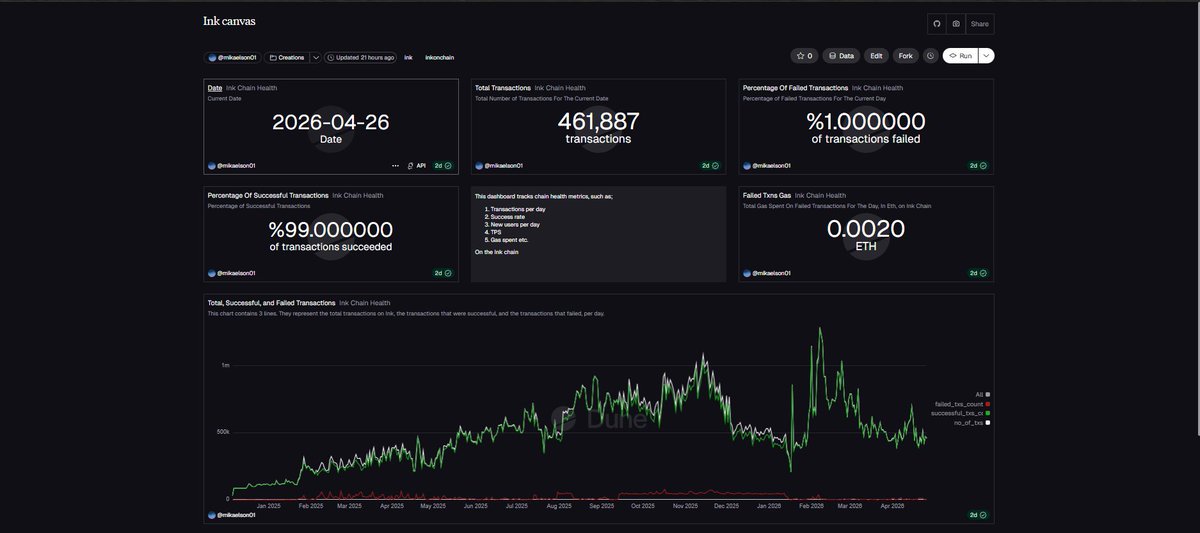
What's Ink without a canvas?
I made a first iteration of a Chain Health dashboard for @inkonchain
The dashboard shows total number of transactions per day, transactions success rate/day...
I really enjoyed doing this. I believe that with some support from the Ink team, I can make more refined and tailored dashboards, that will improve data-driven decision making.
Checkout the dashboard here: dune.com/mikaelson01/th…
English
Have you ever wondered how platforms like @Dune get data for swaps, borrows, liquidation, mint etc, and put them in a table?
As a regular user, you look at a transaction hash, you see tokens transferred from one address to another, multiple times in one transaction. So which one is which? How does dune know which one was actually the borrow or lend? Well, it comes down to what's known as events. For every smart contract transaction you make, the contract emits an event for the particular transaction that you made. Platforms like Dune analytics are able to listen for those events, and index them into a table, where you can then query conveniently.
I did a little demo of this, using the cDAI token from @compoundfinance, and I pulled the mint events that occured within a specific block range.
You can find the repo here: github.com/Mikaelson03/Sa…
This was made possible with teachings from @AnalyticSages , a data community that I belong to.
English
{'name': 'Joseph Mikaelson'} أُعيد تغريده
I enrolled with @AnalyticSages to become a blockchain analyst,and they rest is mystery.And today I built a dashboard on perpetual trading
Link to my dune dashboard
dune.com/henchway/dashb…
Link to my report:eu.docworkspace.com/d/sbOaktxrpYwJ…
Date tribe:@AnalyticSages
English
RT @Asiel_amaka: A few weeks ago in my Python class, I learnt about APIs, so I was given a task to build a Crypto Price Fetcher using the C…
English
Link to the Dune query: dune.com/queries/698856…
Nothing flashy, just straight up insight.
English
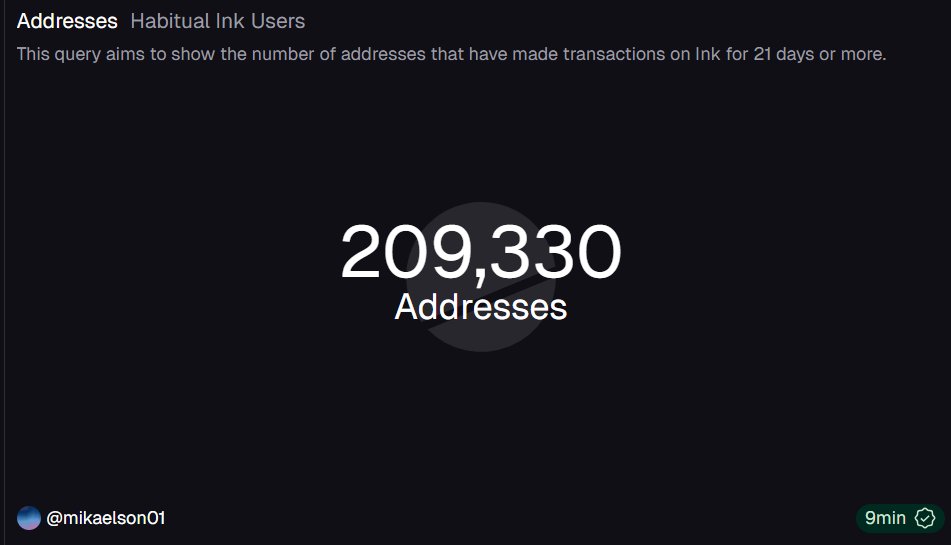
They say that if you do one thing for up to 21 days, it becomes a habit.
With over 1 million active wallets on @inkonchain, a whooping ~20% have built a habit on there.
This query that I wrote, highlights wallets that have made it a habit to perform transactions on @inkonchain
English

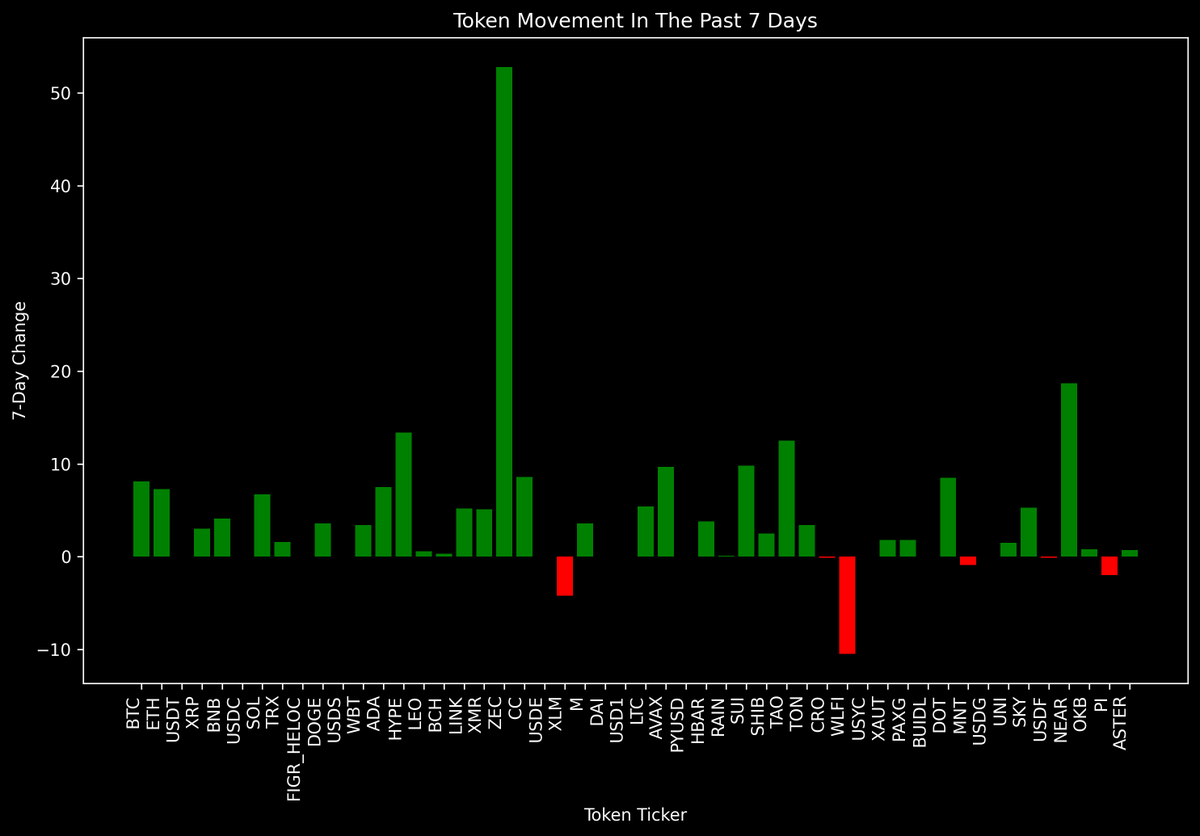
Why query an API, when you can simply scrape the frontend? 🌚 Right?😆
On my Journey to become the best data analyst in web3, my task for the week was to scrape some data from the coingecko website and do something with it. So, this is what I did:
English
This journey was made possible with @AnalyticSages
English
It could be better, and I will do better. This is the worst I'll ever be.
Full code and process on how I scraped the coingecko website, constructed the tables, and built out something nice, is public on my github: github.com/Mikaelson03/Sa…
English
@Vecoyenka @ez0xai NAFDAC? API? Lmao. Have you see the way their site looks. Lol.
He's probably scraping the data off of the front-end.
English


{'name': 'Joseph Mikaelson'} أُعيد تغريده

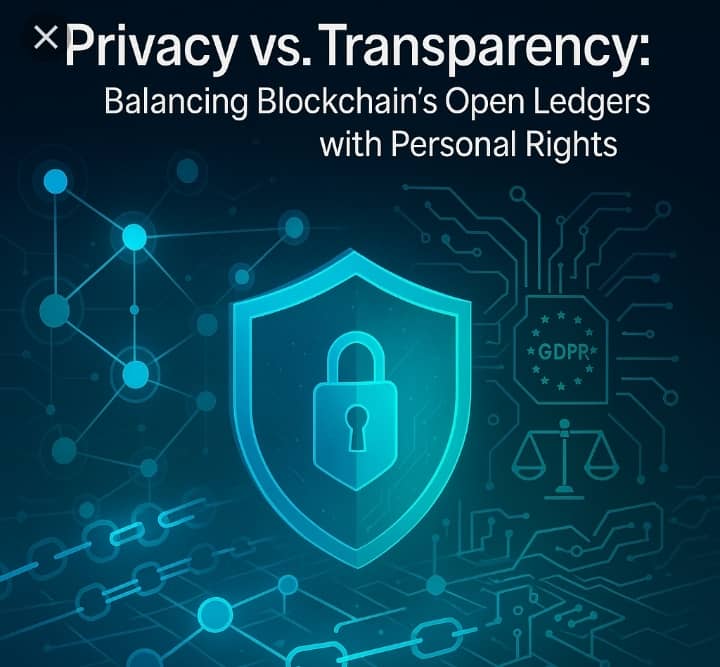
Privacy vs Transparency in Web3: What Actually Matters
In Web3, this is not a philosophical debate.
It is a system design problem.
Protocols must be fully transparent: token supply, emissions, treasury, validator, behavior, governance...
Without this, you cannot audit risk. And un-auditable systems collapse (FTX, Celsius, Terra).
But users must be private: identity, balances, behavior, and relationships; otherwise blockchains become global financial surveillance.
The correct model is:
Transparent infrastructure.
Private participants.
This is how you get: trustless finance, sovereign users, and analyzable systems
Anything else is either TradFi or authoritarian crypto.
English
@macanthonyeke @Zun2025 @zama The amount of tokens transfered is encrypted to this: 22719D5F3C95B23C65EA2B8A3A352B69ABDCF0FC48FF00000000000000010500
English


What if DeFi could protect your financial privacy like banks do, but staying decentralized?
No more "what if"
First confidential stablecoin (cUSDT) transfer executed on Ethereum Mainnet powered by @zama
🔗 Tx : etherscan.io/tx/0x6928259ab…
▫️ FHE-encrypted amounts
▫️ Full composability
This is programmable privacy in action, Smart contracts now compute on encrypted data, maintaining privacy while preserving verifiability. FHE in production now.
English
{'name': 'Joseph Mikaelson'} أُعيد تغريده

"Eight-Handled Sword, Divergent Sila, Divine General Mahoraga!"

ChukwuNonso✍️@Mazi_Chinonso1
GUO motors launches Bulletproof luxurious vehicles ahead of the season
English