
SAR
69 posts

SAR
@RMHCASE
Prof agrégé de Mathématiques, amateur d’informatique, algorithmique, statistiques, probabilités, intelligence artificielle, … Sing, sing…
انضم Temmuz 2025
287 يتبع13 المتابعون


SAR أُعيد تغريده


@HorizonsLeParti Vous avez été Premier ministre : pourquoi ces objectifs n'ont-ils pas davantage avancé lorsque vous étiez au gouvernement ? Au contraire, la situation à l'école s'est dégradée...
Français

« L'école, ça sert aux élèves, mais ça marche avec les profs.
Si vous n'avez pas des professeurs qui sont à l'aise avec leur métier, cela ne peut pas marcher.
Il faut bien former et rémunérer nos professeurs. »
— Édouard Philippe dans Génération Do It Yourself.
➜ youtube.com/watch?v=jfcXp_…

YouTube
Français

Inverse of a 2×2 Matrix in 20 Seconds
That’s it. No magic. Just logic.
Save this for revision and share it with someone who struggles with matrices.
#maths #mathematics
English

The shape that breaks physics
Meet Gabriel's Horn! Formed by rotating the curve y=1/x, this mind bending geometric paradox has a finite volume but an infinite surface area.
English
SAR أُعيد تغريده

New book chapter: "How to Weigh a Cell."
This chapter explains how scientists have weighed cells throughout history, often using simple equipment and back-of-the-envelope calculations.
It has lots of interactives, so you can "repeat" the experiments directly in your browser.
English
SAR أُعيد تغريده

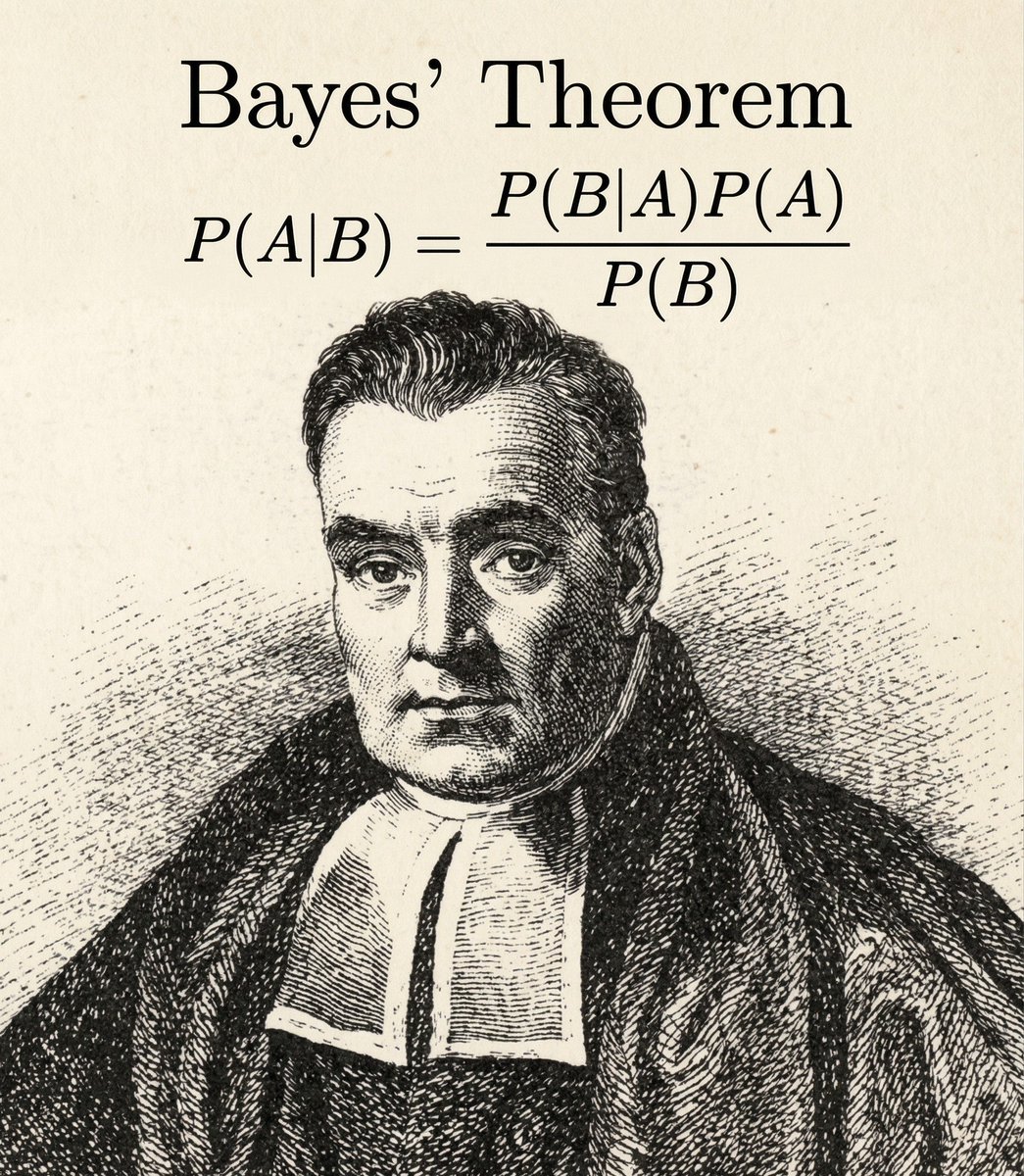
Most engineers have seen this formula.
P(A|B) = P(B|A) × P(A) / P(B)
Almost none can explain what it actually does.
Here's Bayes' Theorem in plain English, and where it's hiding inside systems you use every day.
The core idea in one sentence:
Bayes' Theorem updates your belief about something after seeing new evidence.
That's it. Four terms:
Prior → what you believed before the evidence
Likelihood → how probable the evidence is, given your hypothesis
Evidence → how common the evidence is overall
Posterior → your updated belief after seeing the evidence
A concrete example:
Say 40% of all emails are spam (your prior).
You see a new email containing the word "lottery."
10% of spam emails contain "lottery." Only 1% of legitimate emails do.
Plug into Bayes:
P(spam | "lottery") = (0.10 × 0.40) / P("lottery") ≈ 87%
The word "lottery" updated your belief from 40% → 87%.
That's Bayes in action. Prior belief + new evidence = updated belief.
Where it lives in AI:
1/ Spam filters
The Naive Bayes classifier, the algorithm behind most spam filters - applies this exact calculation word by word across an entire email. Each word shifts the probability up or down. It's called "naive" because it assumes each word is independent of the others, which isn't realistic, but works remarkably well in practice.
2/ Medical diagnosis AI
A patient has symptom X. What's the probability of disease Y? Bayes updates the base rate (how common the disease is) with the likelihood of seeing that symptom in patients who have it. Same formula, different domain.
3/ Your LLM's uncertainty
Modern language models don't just predict the next token, they assign a probability to every possible token. The sampling process (temperature, top-p) is directly working with those probability distributions. Bayesian reasoning is embedded in every response your model generates.
The insight most engineers miss:
Bayes doesn't give you certainty. It gives you a rational way to update uncertainty.
That's exactly why it's foundational to AI - real-world systems are never certain. They're always working with incomplete, noisy, probabilistic information.
Every model that learns from data is, at its core, doing some version of this:
Start with a belief. See evidence. Update the belief.
That's Bayes. That's machine learning.
English
SAR أُعيد تغريده

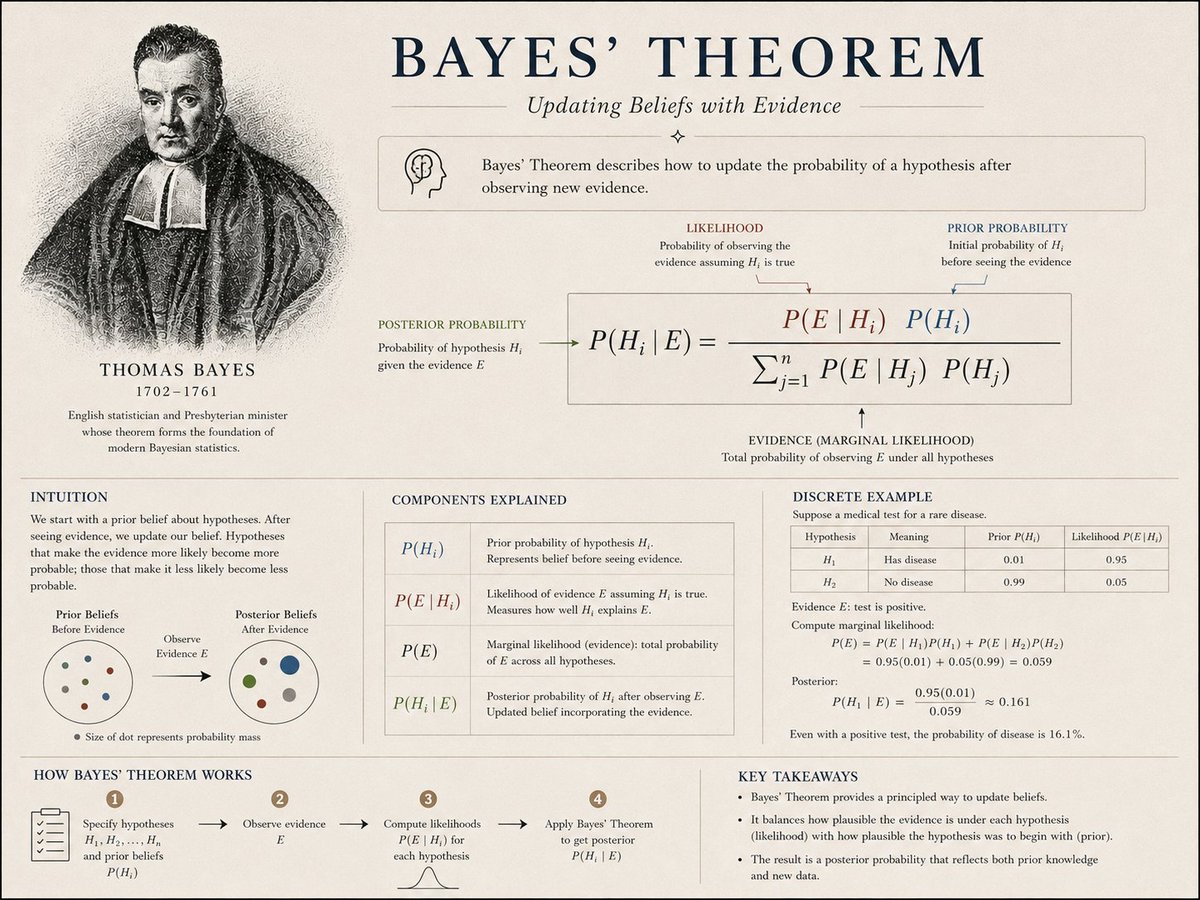
What if an AI could update its belief... every time it sees new evidence?
That concept behind it is called Bayes’ Theorem.
At first, it may look like just another probability formula. But in reality, it is one of the most important ideas behind intelligent decision-making. Don't get scared. It's easy to understand...
Bayes’ Theorem helps us answer a simple question:
“How should we change our prediction when new information arrives?”
Imagine a medical test.
A person tests positive for a disease.
Does that definitely mean the person is sick?
Not necessarily.
Bayes’ Theorem Works With:
- prior belief
- new evidence
- probability of correctness
to calculate a more realistic answer.
That is what makes it powerful.
It does not blindly trust new data. It updates belief step-by-step. You can think of it as learning from evidence.
And that idea appears everywhere in AI & machine learning.
For example:
- Spam filters use Bayesian probability
- Recommendation systems
- Self-driving systems continuously update - environmental understanding
- Medical AI models revise diagnosis probabilities
- LLMs also work through probabilistic prediction mechanisms underneath
The interesting part is this:
Intelligence is often not about being 100% certain. It is about updating beliefs correctly when new information appears.
Step-by-step intuition:
- Start with an initial belief
- Observe new evidence
- Measure how likely that evidence is
- Update the belief mathematically
- Repeat continuously as more data arrives
Thomas Bayes introduced this idea centuries ago. But today, modern AI systems silently depend on this way of thinking every second.
Sometimes the smartest systems are not the ones that “know” everything.
They are the ones that continuously learn from uncertainty.
English

SAR أُعيد تغريده

SAR أُعيد تغريده

Anthropic engineer showed how one person can run 5 AI agents, that code, test, review, and deploy at the same time.
In 30 minutes they built the whole thing live in one session.
Here's what they cover:
> when to use one agent vs a full team
> how to split work so agents don't step on each other > the exact framework for deciding what each agent handles
that's exactly why, I put together a guide on building agent teams that actually work.
full guide in the article below 👇
rody@0x_rody
English
@beyoumf Avoid allowing your mind, body, and soul to become stagnant.
English
SAR أُعيد تغريده

Bac Maths 2026 – Amérique du Nord
Le sujet vient de sortir et il est disponible sur Math93.
📌 Le corrigé détaillé est en cours de réalisation et sera ajouté progressivement.
👉 math93.com/index.php/anna…
#Bac2026 #Maths #SpécialitéMaths #Math93

Français
SAR أُعيد تغريده


SAR أُعيد تغريده
What warm water does to your body when you start your day.
English
SAR أُعيد تغريده