Rahul Sondhi

6.7K posts

Rahul Sondhi banner
Rahul Sondhi

Rahul Sondhi

@RahulMarkets

US Stock Trader | Real-Money Trades & Daily Market Analysis | Hot Takes + Position Shares | Open Discussions 🔥

New York انضم Kasım 2012
20 يتبع1.2K المتابعون
تغريدة مثبتة
Rahul Sondhi
Rahul Sondhi@RahulMarkets·
Hi, I’m Rahul Sondhi 🇺🇸 I share US equity market insights, including structured trade ideas and risk-managed setups based on price action and data Focus: discipline, consistency, and long-term process over emotion 💼 Join discussions here 💬 WhatsApp: wa.me/+17078976461
Rahul Sondhi tweet media
English
0
0
3
475
Rahul Sondhi
Rahul Sondhi@RahulMarkets·
🚀 Space Stocks Are Breaking Out — And Semis Deserve Attention Too Space names are ripping again today, especially $ASTS, $RKLB, and $LUNR. The entire sector is seeing strong momentum and renewed investor interest. The New Space economy is increasingly looking like a long-term structural trend rather than just another short-term trade. Satellite communications, commercial launch services, and lunar/deep-space exploration are all gaining traction — and ongoing SpaceX IPO speculation is adding fuel to the move. Global satellite deployment demand continues to accelerate, driven by direct-to-device (D2D) connectivity, Starlink competition, and expanding defense contracts. The ecosystem is becoming more complete, from launch providers and infrastructure to application-layer businesses. Near term, there are plenty of catalysts: successful launches, new contracts, and deployment milestones. Longer term, commercialization and execution will determine who wins. Risks still matter: launch failures, regulatory delays, and heavy capital spending can create volatility. But for now, strong growth expectations continue to support valuations. $ASTS ASTS surged 19%+ today, pushing above $127 intraday. The main catalyst appears to be BlueBird satellites arriving in Florida ahead of launch preparations, increasing confidence around near-term execution. The company’s goal is ambitious: creating a space-based cellular network that allows regular smartphones to connect directly to satellites, eliminating coverage dead zones worldwide. Partnerships with major telecom names like AT&T, Verizon, and Vodafone create a significant long-term opportunity. The upside is massive if the network scales successfully. The challenge remains execution and capital intensity. Momentum is strong right now, but long term, investors will want to see commercial revenue follow the story. Current valuation isn't small anymore — but the market is still pricing in future potential. $RKLB RKLB also continues to show strength. Recent Space Force contract wins, consistent Electron launch cadence, and progress on the Neutron rocket program are keeping momentum alive. Backlog now exceeds $2B, supported by both defense and commercial demand. Personally, this continues to look like one of the more established names in the space sector because the revenue base is becoming increasingly real rather than purely narrative-driven. If a SpaceX IPO eventually happens, the entire ecosystem could benefit, and RKLB likely remains one of the clearest secondary beneficiaries. $LUNR LUNR also posted a strong double-digit move today. Multiple NASA lunar contracts, backlog above $1B, and record Q1 revenue and gross profit continue to strengthen the story. The company is focused on lunar landing systems and infrastructure development, with the IM-3 mission later this year becoming a major execution milestone. This is more of a government contract and application-driven story. Volatility can be significant, but catalysts also tend to come frequently. Potentially attractive for higher-risk investors looking for event-driven opportunities. Now shifting to semiconductors ($MU, $AMKR): Semis remain the foundation of the broader tech trade. AI demand and high-performance computing trends remain strong, while inventory conditions continue improving. $MU remains a memory leader and could benefit from HBM demand and AI server growth. $AMKR is a major OSAT player (outsourced semiconductor assembly and testing), potentially benefiting from both advanced packaging demand and U.S. semiconductor supply-chain reshoring trends. The broader sector still looks constructive. Earnings season and tariff/supply-chain developments remain important factors to watch. $MU brings stronger fundamentals but remains cyclical. $AMKR feels more like a supply-chain sleeper with relatively attractive valuation levels. Today, space remains the momentum theme while semiconductors continue looking like a core positioning sector. Market sentiment is strong, but chasing extended moves still carries risk. Position sizing and discipline matter. The biggest winners usually come from staying with trends that continue executing over time. Want deeper breakdowns, real-time market data, or portfolio discussions? 👉 Feel free to DM me through my pinned contact. I focus on market logic, trade ideas, and ongoing research — always happy to discuss setups and opportunities. What’s your view on these names? Drop your thoughts or positions below 👇 #Stocks #SpaceStocks #ASTS #RKLB #LUNR #Semiconductors #MU #AMKR #Investing
Rahul Sondhi tweet media
English
1
0
2
218
Willonacci
Willonacci@godswill_okoro·
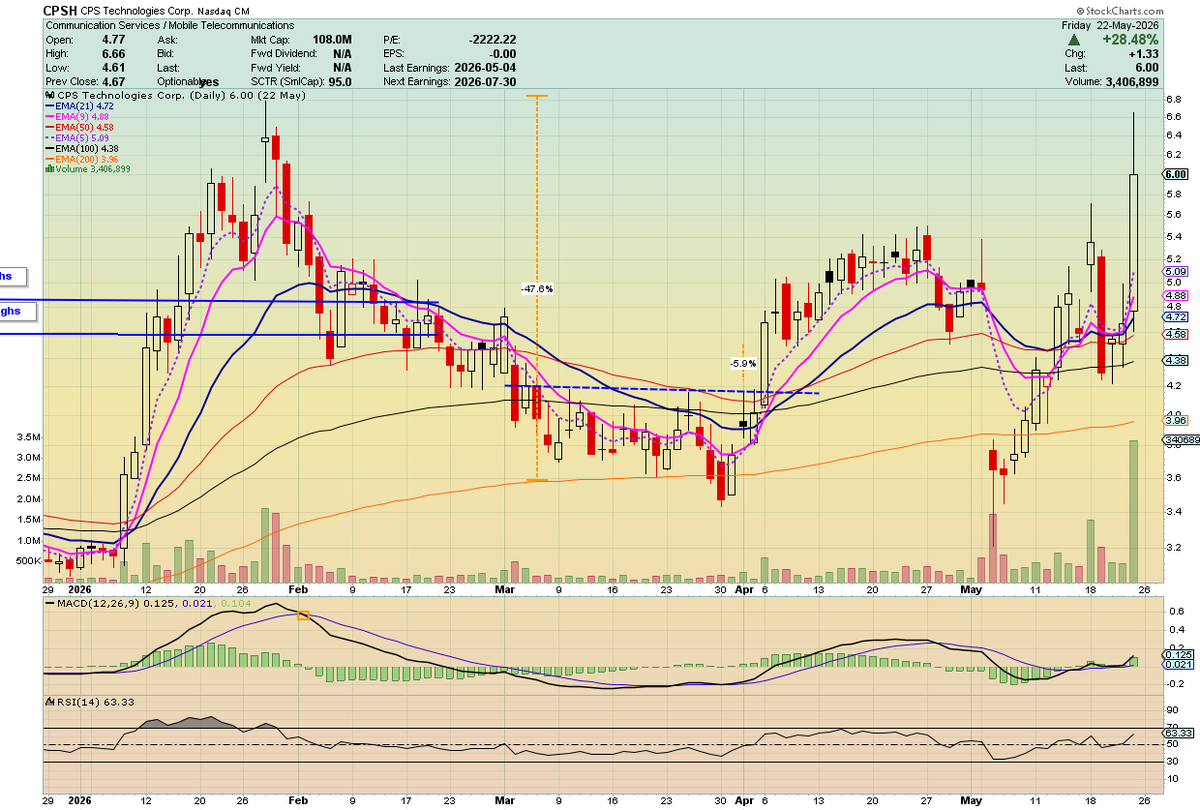
+92% on $CPSH shares. 720% on 6/18. Setup: daily A+ buy signals last Friday + base breakout through $5.46 Trimmed 80% size.
Willonacci tweet media
English
2
0
1
117
Pep Invest
Pep Invest@PepInvestStocks·
$CPSH - Bottleneck Monopoly" in High-Tech Supply Chains In modern investment and supply chain strategy, CPS Technologies is a prime example of a hidden "bottleneck monopoly“, often referred to as an economic moat or a "Niche Hegemony." Despite its relatively small market capitalization, the company controls a critical chokepoint in global technology, aerospace, and defense infrastructure. 1. The Anchors of the Monopoly The AlSiC Technological Standard CPS dominates the commercial manufacturing of Aluminum Silicon Carbide (AlSiC) metal matrix composites. While the physics of blending metal and ceramics is well-known, mastering the precise, net-shape molding process at an industrial scale is incredibly difficult. For industries requiring maximum thermal conductivity with zero structural warping (like artificial intelligence data centers), CPS is effectively the only game in town. Military "Single-Source" Lock-In In the defense sector (such as radar systems for the US Navy and next-generation combat vehicles), CPS often operates as a single-source supplier. Defense procurement requires years of rigorous qualification, strict ITAR compliance, and security clearances. Once a CPS component is vetted and approved by the Department of Defense, switching to a competitor is legally and logistically prohibitive. The "Design-In" Chokepoint In the high-power semiconductor and aerospace industries, CPS components are not commodities bought off the shelf; they are "designed-in" during the initial blueprint phase of a product. If a railway giant like Alstom or a mega-cap chip manufacturer builds a power module around a CPS baseplate, they cannot easily swap it out. Changing the supplier would require a total, multi-million-dollar redesign of the entire system. 2. The Twin-Gilded Chokepoint (The Two-Sided Bottleneck) While a bottleneck monopoly grants immense pricing power, it also cuts both ways, exposing CPS to structural supply chain vulnerabilities: Severe Customer Concentration: CPS serves a highly exclusive niche. Because their monopoly is so specialized, they only have a handful of potential buyers worldwide. If a single semiconductor giant delays an order, as seen in early 2026, CPS's quarterly revenue immediately faces a sharp contraction. Upstream Raw Material Dependence: CPS relies heavily on ultra-pure ceramic powders and precious metals like gold for plating. This makes their profit margins highly sensitive to global commodity shocks and geopolitical supply constraints.
English
9
4
38
6.9K
Hunter Allen
Hunter Allen@HunterAllen4·
$BRAI gimme 20$ 😤 might not lol I called this at 8 to everyone. $CPSH huge move gave to subs. Repost. Subscribe. Bookmark $MWC $HOVR $CODX $JEM $PHOE Very few accounts on x you get this many opportunities with My WiFi is ass right now lol Pulling 100% out of a hat daily And doing research 24/7 Swings & longs Appreciate you all x fam
Hunter Allen@HunterAllen4

$BRAI Halted at 12$ fam Haha

English
12
4
21
2.9K
Sun Liao
Sun Liao@sunxliao·
What a day for SPACE! 🔥 Congrats to everyone. Well deserved. I got a starter position in $CPSH too. Quick facts (NFA): NASA and US Space Force and use them for GPS satellites... also in many systems onboard the International Space Station. Not to mention the Mars Rover missions. Renaissance Tech, best performing hedge fund in history, increased their positions... disclosed in latest 13F filing. $NASA ETF, quickly becoming a popular space ETF... also holds it... which results in a LOT of inflows. So every time someone buys the $NASA ETF, they have to buy a little bit of $CPSH... Looking at the daily timeframe... looks like the "start" of a powerful wave 3. Daily chart also has enough bullish confirms for us to be confident. It's holding gold support very nicely. Not much meaningful resistance above. We continue to be incredibly bullish on the entire space theme... $SPCX SpaceX IPO is still many days away, leaving room for many tickers to run. My plan is completely transparent... long the space theme until the IPO (at which point we seek to lock in gains), with the possibility of quick rotations between different space tickers. Mid East situation looks stable too. I'm just ignoring headlines at this point...
English
29
17
263
63.5K
CK Capital
CK Capital@CKCapitalxx·
I am Long with a starter positon. This is just a super compelling setup imo. nfa. $CPSH
CK Capital@CKCapitalxx

$CPSH has one of the best setups here and is one of the more interesting micro cap situations I have come across. CPS Technologies manufactures advanced metal matrix composite components. Aluminum silicon carbide. Hybrid materials that combine the light weight of aluminum with the thermal conductivity and stiffness of ceramics. The kind of precision engineered materials that go inside power electronics for defense systems, satellites, electric vehicles, hypersonic vehicles, and aerospace applications. This is not commodity manufacturing. These components take years to qualify into programs. The thermal management properties of what CPS makes are critical for high power electronics that cannot fail. Defense contractors. Aerospace primes. Government programs. Once you are qualified into a program you stay qualified. The switching cost is enormous because requalifying a new supplier takes years and risks program delays nobody can afford. That is the moat. Quiet. Unglamorous. But real. Now look at the fundamentals. 2025 was a record year. $32.6 million in annual revenue. Improved balance sheet. New contract wins across defense and aerospace. Strong backlog heading into 2026. Q1 came in light on revenue but management was explicit that it was order timing not demand weakness. The backlog and new contract activity support a strong recovery through the rest of the year. Revenue is forecast to grow 19% annually over the next two years against a 12% industry average. Director Ivo Cavoli bought shares personally in March. Insider buying at micro cap level is always worth paying attention to. Now here is the angle that makes this setup genuinely unique. $CPSH is included in a NASA themed ETF. That means passive institutional buying flows into this stock on a consistent and automatic basis. Every time the ETF rebalances. Every time new money flows into the fund. $CPSH gets bought. For a micro cap trading at $65 million market cap with naturally thin volume that institutional bid changes the supply demand dynamic of the entire stock. Most micro caps live and die on retail interest alone. $CPSH has a structural institutional buyer that never goes away regardless of market conditions. That is an underappreciated advantage that almost nobody talks about. Defense spending is accelerating globally. Hypersonic programs require exactly the thermal management materials CPS specializes in. Every electric vehicle and power electronics application needs advanced thermal solutions. The tailwinds behind this business are not going anywhere. $65 million market cap. Record revenue last year. NASA ETF inclusion. Strong backlog. New contracts being won. Insider buying. This is exactly the kind of hidden gem that gets discovered quietly before it moves.

English
16
7
100
40.2K
Wayne Liang
Wayne Liang@wliang·
TLDR: $CPSH Defense/government angle is strengthening, AI optionality is still on the table for Rubin generation thermal management, and most importantly, the forced-flow mechanic via $NASA ETF inclusion.
English
5
1
52
13K
Wayne Liang
Wayne Liang@wliang·
So I was deep diving into $NASA ETF holdings to see what will heavily benefit from $SPCX IPO... And I came across $CPSH. At the start of this year, it was a solid US AlSiC play, but quickly became a multi-thesis bet. As of last week, $NASA ETF holds ~1.8M shares of $CPSH (I immediately started a relatively large position). This is important because $NASA is the only pure-play space ETF with direct SpaceX exposure pre-IPO. And a portion of every dollar flowing into $NASA for SpaceX exposure becomes a purchase of $CPSH. As SpaceX IPO momentum builds toward June 12, that flow accelerates. But let's go over why $CPSH even made the cut into $NASA's portfolio. At the beginning of 2026: > It was the only meaningful US/Western hedge against East Asian AlSiC supply (Denka, Sumitomo, JFC, etc.) > Existing customers: US Military, NASA, $LMT, $RTX, Northrop, General Dynamics, and more > AI optionality as $NVDA Rubin generation scales towards multi-thousand watt requirements (this angle alone deserves a whole new post) And the foundation has only gotten stronger... > Record 2025 annual revenue of $32.6M and Q4 2025 revenue $8.2M vs $5.9M prior year (+39% YoY). Q4 gross margin recovered to 14.6% from a Q4 2024 gross loss > New $4M hermetic packaging order announced post-Q1 > Navy SBIR office extended Phase I program for Amphibious Combat Vehicles > Potential US Navy destroyer ballistic shield contracts with Congressional funding already secured Now add the $NASA ETF layer... Large asymmetry here.
English
32
21
205
111.5K
Tom Skey
Tom Skey@tomskeyz·
🚨 $CPSH update At $10.07 now, this stock already broke way past the old analyst targets, which honestly shows how underestimated the move was. $CPSH Technologies is still one of the more overlooked advanced materials/defense names in the market. The company supplies high-performance composite materials used in: -defense -aerospace -semiconductors -EVs -AI/server thermal systems What’s driving the move is the revenue acceleration and contract momentum. FY2025 revenue came in around $32.6M, up over +54% YoY, with the company finally showing improving profitability and stronger margins. Analysts are also forecasting continued revenue growth into 2026 and 2027. The interesting part is that the market cap is still relatively small considering the industries CPSH has exposure to: AI infrastructure defense spending semiconductor cooling aerospace systems That’s why some traders see this as a hidden infrastructure/materials play instead of just another microcap. Technically, the stock already confirmed a major breakout after clearing the old $6-7 resistance zone. Now the key level to hold is probably around $12-$14. Long term, if revenue keeps compounding and larger defense/AI infrastructure contracts continue landing, I honestly think this could become a much bigger rerating story because the float is still relatively tight and institutional ownership continues growing. #CPSH #StocksToWatch #SmallCaps #DefenseStocks #AIInfrastructure #SemiconductorStocks #Aerospace #HiddenGem #MicrocapStocks #GrowthStocks #StockMarket #Investing #Trading #Bullish #TechStocks #AIStocks #DefenseTech #BreakoutStocks #NASDAQ #StockAnalysis
Tom Skey tweet media
English
1
2
5
1.1K
Saso Capital
Saso Capital@saso_capital·
$CPSH I started a position. Every SiC and GaN power module needs a baseplate that manages heat and matches thermal expansion to the ceramic substrate above it. Get it wrong and the module delaminates, overheats, and fails. CPS's aluminum silicon carbide (AlSiC) composites are one of a handful of materials that solve this problem at scale and the markets they serve are about to grow 8x. I believe $CPSH will be the biggest beneficiary. Power semiconductors convert and regulate electricity. As they switch, they generate heat. The module that houses the semiconductor die sits on a baseplate, which spreads that heat laterally and transfers it to a cooling system. The baseplate must do two things simultaneously: conduct heat efficiently (high thermal conductivity) and expand at the same rate as the ceramic substrate above it (matched coefficient of thermal expansion). If CTE is mismatched, repeated thermal cycling causes the solder interface to crack, delaminate, and eventually destroy the module. Copper baseplates, the industry default, fail this second test. Copper conducts heat well (~400 W/mK) but its CTE (~17 ppm/°C) is far higher than the ceramic substrates it bonds to (~7 ppm/°C). After roughly 4,000 thermal cycles, copper baseplates begin to delaminate. CPS's AlSiC composites offer 180 W/mK thermal conductivity with a CTE below 10 ppm/°C, a near-perfect match to ceramics. CPSH claims its AlSiC baseplates survive tens of thousands of thermal cycles without delamination. This matters more as power density rises. SiC and GaN devices run hotter, switch faster, and pack more power into smaller modules than silicon IGBTs. The thermal management problem gets harder, and the case for AlSiC over copper gets stronger. $CPSH $CPSH is the only publicly traded, U.S.-based pure-play in this space.
CK Capital@CKCapitalxx

$CPSH has one of the best setups here and is one of the more interesting micro cap situations I have come across. CPS Technologies manufactures advanced metal matrix composite components. Aluminum silicon carbide. Hybrid materials that combine the light weight of aluminum with the thermal conductivity and stiffness of ceramics. The kind of precision engineered materials that go inside power electronics for defense systems, satellites, electric vehicles, hypersonic vehicles, and aerospace applications. This is not commodity manufacturing. These components take years to qualify into programs. The thermal management properties of what CPS makes are critical for high power electronics that cannot fail. Defense contractors. Aerospace primes. Government programs. Once you are qualified into a program you stay qualified. The switching cost is enormous because requalifying a new supplier takes years and risks program delays nobody can afford. That is the moat. Quiet. Unglamorous. But real. Now look at the fundamentals. 2025 was a record year. $32.6 million in annual revenue. Improved balance sheet. New contract wins across defense and aerospace. Strong backlog heading into 2026. Q1 came in light on revenue but management was explicit that it was order timing not demand weakness. The backlog and new contract activity support a strong recovery through the rest of the year. Revenue is forecast to grow 19% annually over the next two years against a 12% industry average. Director Ivo Cavoli bought shares personally in March. Insider buying at micro cap level is always worth paying attention to. Now here is the angle that makes this setup genuinely unique. $CPSH is included in a NASA themed ETF. That means passive institutional buying flows into this stock on a consistent and automatic basis. Every time the ETF rebalances. Every time new money flows into the fund. $CPSH gets bought. For a micro cap trading at $65 million market cap with naturally thin volume that institutional bid changes the supply demand dynamic of the entire stock. Most micro caps live and die on retail interest alone. $CPSH has a structural institutional buyer that never goes away regardless of market conditions. That is an underappreciated advantage that almost nobody talks about. Defense spending is accelerating globally. Hypersonic programs require exactly the thermal management materials CPS specializes in. Every electric vehicle and power electronics application needs advanced thermal solutions. The tailwinds behind this business are not going anywhere. $65 million market cap. Record revenue last year. NASA ETF inclusion. Strong backlog. New contracts being won. Insider buying. This is exactly the kind of hidden gem that gets discovered quietly before it moves.

English
2
1
8
2.5K
CK Capital
CK Capital@CKCapitalxx·
$CPSH has one of the best setups here and is one of the more interesting micro cap situations I have come across. CPS Technologies manufactures advanced metal matrix composite components. Aluminum silicon carbide. Hybrid materials that combine the light weight of aluminum with the thermal conductivity and stiffness of ceramics. The kind of precision engineered materials that go inside power electronics for defense systems, satellites, electric vehicles, hypersonic vehicles, and aerospace applications. This is not commodity manufacturing. These components take years to qualify into programs. The thermal management properties of what CPS makes are critical for high power electronics that cannot fail. Defense contractors. Aerospace primes. Government programs. Once you are qualified into a program you stay qualified. The switching cost is enormous because requalifying a new supplier takes years and risks program delays nobody can afford. That is the moat. Quiet. Unglamorous. But real. Now look at the fundamentals. 2025 was a record year. $32.6 million in annual revenue. Improved balance sheet. New contract wins across defense and aerospace. Strong backlog heading into 2026. Q1 came in light on revenue but management was explicit that it was order timing not demand weakness. The backlog and new contract activity support a strong recovery through the rest of the year. Revenue is forecast to grow 19% annually over the next two years against a 12% industry average. Director Ivo Cavoli bought shares personally in March. Insider buying at micro cap level is always worth paying attention to. Now here is the angle that makes this setup genuinely unique. $CPSH is included in a NASA themed ETF. That means passive institutional buying flows into this stock on a consistent and automatic basis. Every time the ETF rebalances. Every time new money flows into the fund. $CPSH gets bought. For a micro cap trading at $65 million market cap with naturally thin volume that institutional bid changes the supply demand dynamic of the entire stock. Most micro caps live and die on retail interest alone. $CPSH has a structural institutional buyer that never goes away regardless of market conditions. That is an underappreciated advantage that almost nobody talks about. Defense spending is accelerating globally. Hypersonic programs require exactly the thermal management materials CPS specializes in. Every electric vehicle and power electronics application needs advanced thermal solutions. The tailwinds behind this business are not going anywhere. $65 million market cap. Record revenue last year. NASA ETF inclusion. Strong backlog. New contracts being won. Insider buying. This is exactly the kind of hidden gem that gets discovered quietly before it moves.
CK Capital tweet media
English
14
5
69
39.1K
Rahul Sondhi
Rahul Sondhi@RahulMarkets·
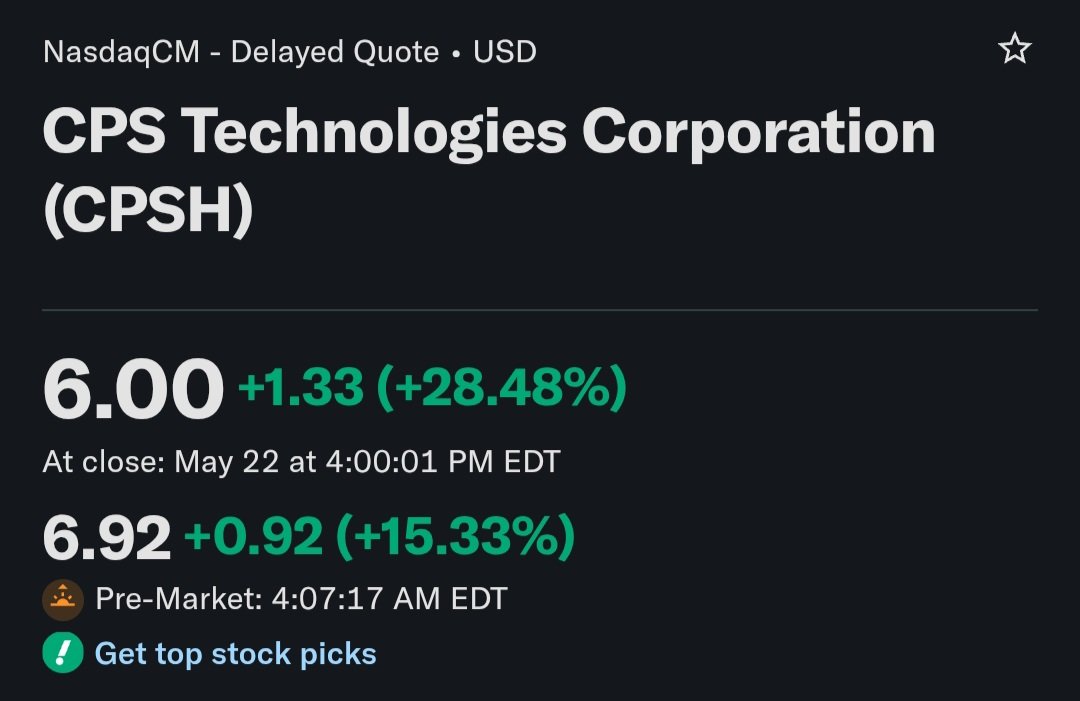
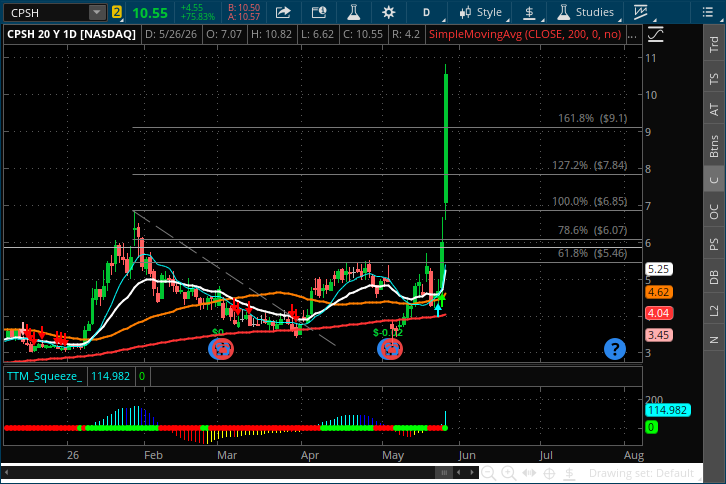
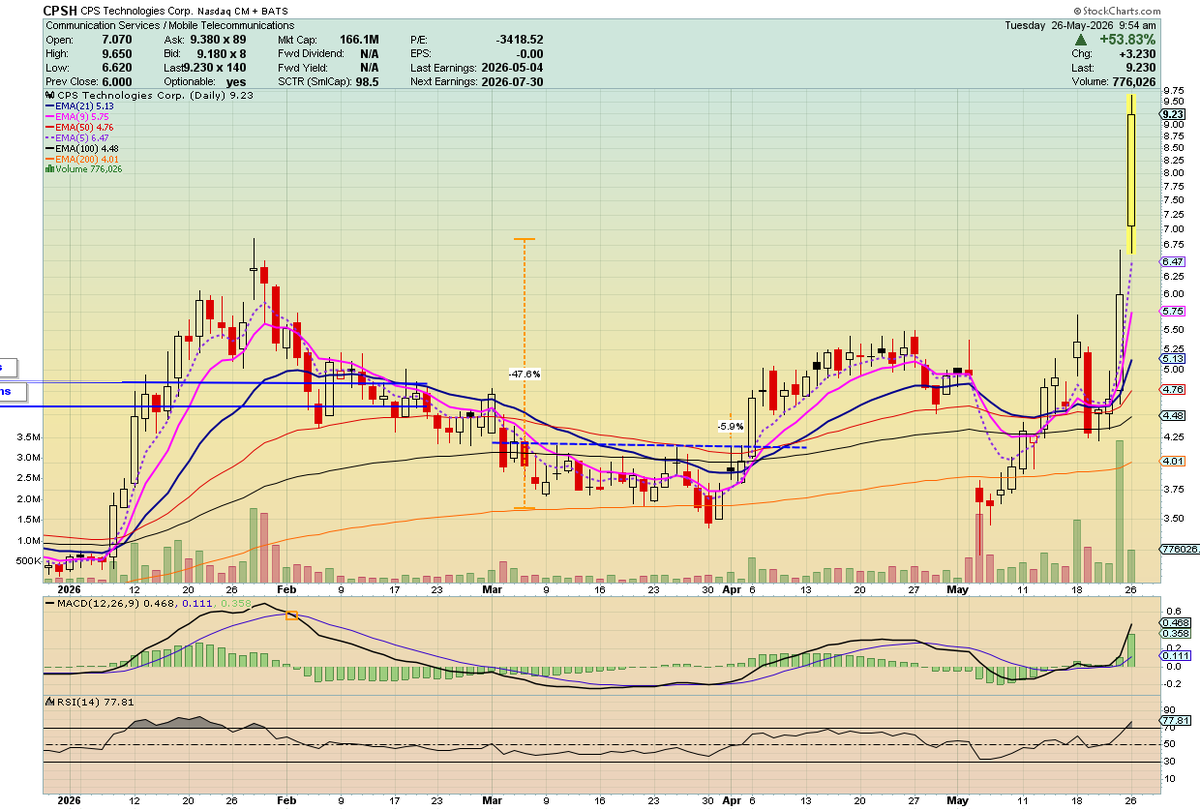
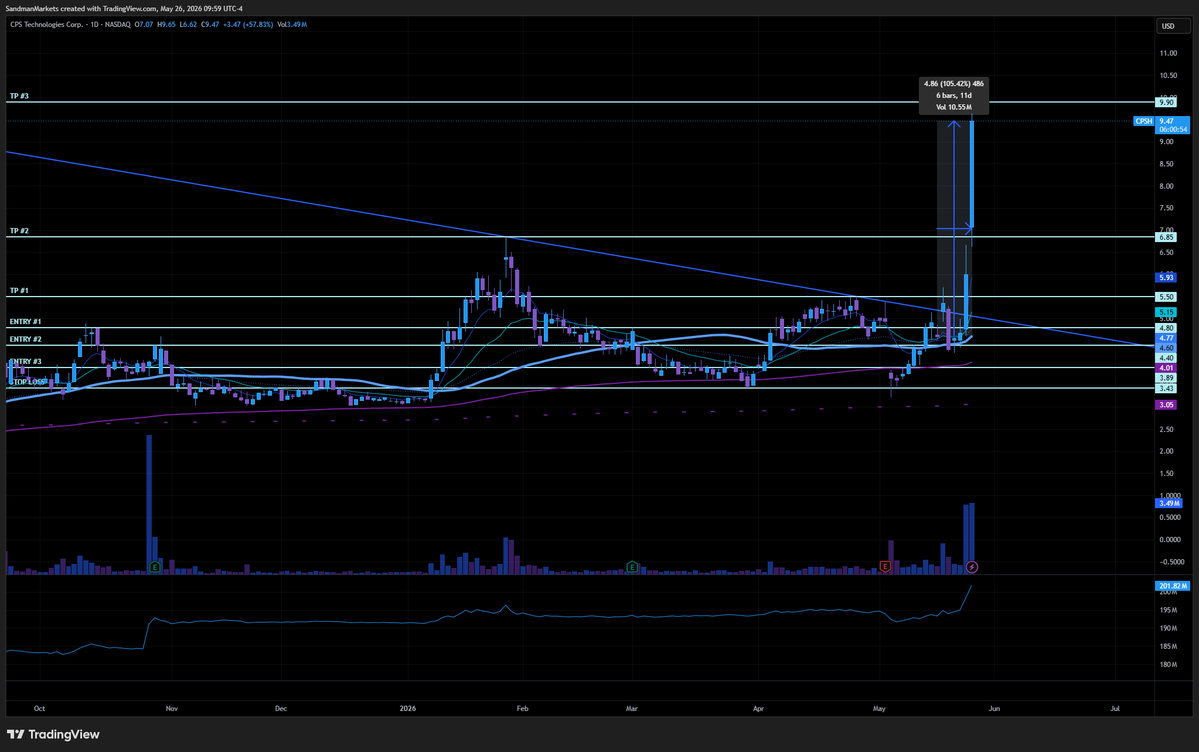
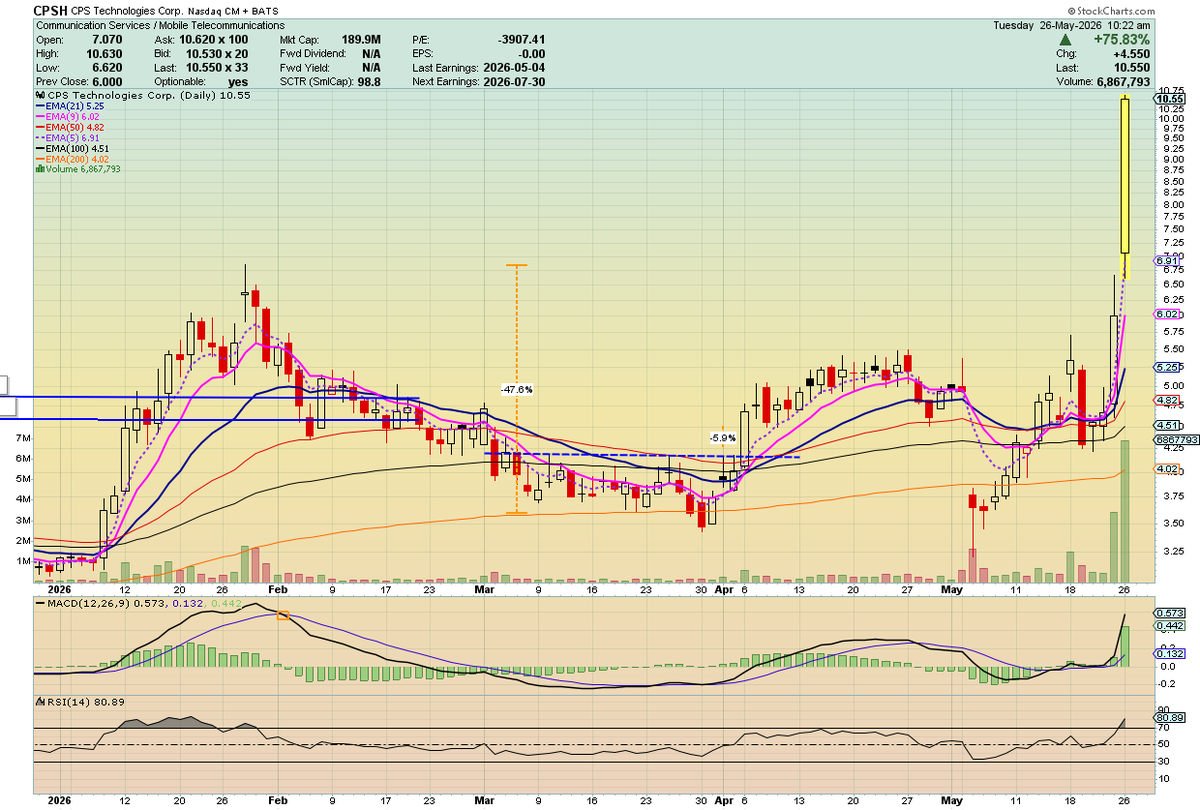
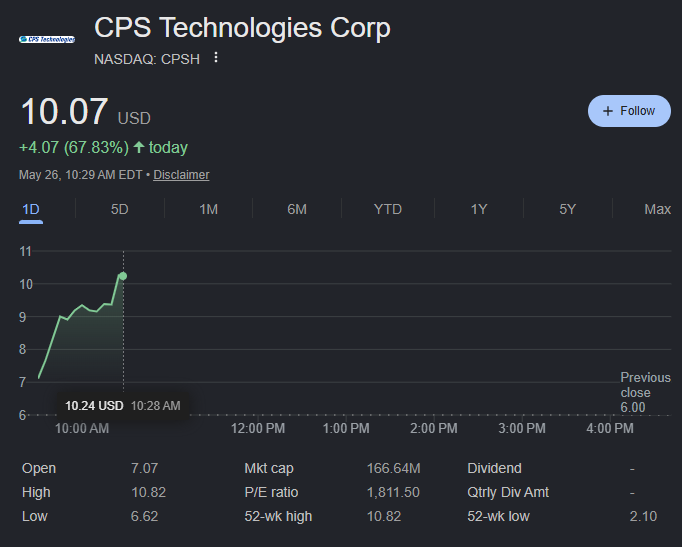
🚀 Trade Recap: $CPSH Before the market opened, I called out an entry on $CPSH at $6.75–$6.80. 🎯 Target: $10+ 📈 Expected gain: 50%+ After the open, $CPSH surged to a high of $10.82. ✅ Peak gain: 75%+ in a single move This wasn’t about chasing green candles — it was about identifying momentum early, managing risk, and letting the setup play out. Entries matter. Timing matters. Execution matters. Congrats to everyone who caught this move with me 👏 More importantly, stay disciplined. Protect profits and avoid getting emotional after big runs. Who caught $CPSH today? 👇 #CPSH #Stocks #StockMarket #Trading #MomentumTrading
Rahul Sondhi tweet media
English
2
0
3
1.9K