Michael Shellenberger

32.3K posts

Michael Shellenberger banner
Michael Shellenberger

Michael Shellenberger

@shellenberger

CBR Chair of Politics, Censorship & Free Speech @UAustinOrg : Dao Journalism Winner : Time, "Hero of Environment" : Author, “Apocalypse Never,” "San Fransicko"

Berkeley, CA انضم Mayıs 2014
1.8K يتبع1.4M المتابعون
تغريدة مثبتة
Michael Shellenberger
Michael Shellenberger@shellenberger·
The Hormuz crisis is the precipitating factor in the current energy crisis, but the underlying cause is too little oil and gas production outside the Persian Gulf. Had the world spent the past decade building the oil, gas, LNG, pipeline, and fertilizer infrastructure that engineers designed and companies proposed, the Hormuz crisis would still be a serious geopolitical event, but it would not threaten to cause a recession. North America — The Atlantic Coast Pipeline, a 600-mile natural gas line from West Virginia to North Carolina, saw its cost double from $4.5 billion to $8 billion during years of environmental litigation before Duke Energy and Dominion Energy cancelled it in July 2020. — The Constitution Pipeline from Pennsylvania to New York died the same year. — The PennEast Pipeline won its case at the United States Supreme Court in 2021 and still could not get built because New Jersey refused to issue state permits. — In Canada, TransCanada abandoned the $15.7 billion Energy East pipeline in 2017 after the National Energy Board required an unprecedented review of upstream and downstream emissions. — In January 2024, the Biden administration paused all pending approvals for LNG export terminals shipping to non-free-trade-agreement countries, freezing projects representing tens of billions of cubic feet per day of potential capacity. — Venture Global’s CP2 terminal in Louisiana, designed for 20 million tonnes per annum, sat in regulatory limbo for over a year. — NextDecade’s Rio Grande LNG in Texas, with 48 MTPA of planned capacity, stalled alongside it. — PTT Global Chemical’s proposed $10 billion ethane cracker in Belmont County, Ohio, first announced in 2015, remains on indefinite hold after failing to attract financing partners amid climate-driven investor sentiment. — Across the US Gulf Coast, nearly 60% of planned plastic and petrochemical production projects sit on hold. — LNG Canada, the Shell-led terminal at Kitimat, British Columbia, took over six years from construction start to first cargo, with its pipeline running 263% over budget. Environmental review, Indigenous disputes, and contractor cost escalation all contributed. — Pieridae Energy’s Goldboro LNG project in Nova Scotia, a 10 MTPA facility first proposed in 2012, was abandoned in November 2023 after more than a decade of permitting and financing obstacles. Australia — Australia’s Santos’s Barossa gas project was halted midway through construction after a Federal Court ruling overturned its environmental approval. — Woodside’s Scarborough project faces ongoing litigation from the Australian Conservation Foundation seeking to block it on climate grounds. Africa — Perhaps nowhere has the damage been more consequential than in Africa. At COP26 in 2021, wealthy nations pledged to halt overseas development finance for gas projects, a commitment that fell hardest on the continent least responsible for climate change and most in need of energy infrastructure. — The World Bank stopped financing oil and gas extraction in 2019 and imposed restrictive conditions on downstream gas projects. — The European Investment Bank announced a complete ban on unabated fossil fuel financing by the end of 2021, with its president declaring that “gas is over.” — At least 21 other development finance institutions followed suit. As a result: — TotalEnergies’ Mozambique LNG project sat under force majeure for four and a half years after the UK Export Credit Agency and other backers withdrew climate-motivated financing. — The East African Crude Oil Pipeline lost financing commitments from more than 30 major international banks under pressure from climatists. Europe — France prevented the completion of a third gas interconnector with Spain, citing climate neutrality goals. — The United Kingdom imposed a moratorium on fracking in 2019 despite sitting atop one of Europe’s most promising shale gas formations. — Germany, which shuttered its last three nuclear plants in April 2023, compounded its gas dependency by refusing to develop domestic shale resources. — CF Industries permanently shut the UK’s largest ammonia plant at Billingham, a facility that also produced 60% of Britain’s food-grade CO2. — Yara International curtailed output across plants in France, Italy, and Belgium before permanently closing its 400,000 tonne per year ammonia facility at Tertre, Belgium, in October 2024. These closures occurred because European climate policy made gas too expensive for the domestic industry to survive.
Michael Shellenberger@shellenberger

We should have spent more on green energy, say the media. No, we shouldn't have. The $2 trillion we spent did nothing to prevent the energy crisis and may even have caused it.

English
304
2.6K
7.8K
523.9K
Michael Shellenberger
Michael Shellenberger@shellenberger·
11/ Real energy abundance means piped natural gas at $4, nuclear plants running at 90% capacity for 100 years, and domestic oil production that cannot be disrupted by a drone strike, not solar panels at the supermarket.
English
0
3
31
2K
Michael Shellenberger
Michael Shellenberger@shellenberger·
9/ The US produces natural gas at $4 per million BTU and delivers it through 3 million miles of pipeline. Europe pays $16 for the same gas because it arrives by tanker. The difference is decades of policy choices. America built pipelines while Europe built dependency. regit.cars/car-news/globa…
English
5
17
85
5.8K
Michael Shellenberger
Michael Shellenberger@shellenberger·
UK Energy Secretary @Ed_Miliband called North Sea drilling "climate vandalism." Now he's waffling on new drilling, which he should have approved long ago. What changed? The war exposed the fraudulence of his net-zero, anti-oil-and-gas fantasy. 🧵
Michael Shellenberger tweet media
Department for Energy Security and Net Zero@energygovuk

From cutting energy bills & cracking down on price gouging, to building homegrown clean energy that protects the UK from volatile international markets - we are committed to helping households with the cost of living. @Ed_Miliband explains👇 youtube.com/watch?v=wP0f6W…

English
7
65
267
23.6K
Michael Shellenberger
Michael Shellenberger@shellenberger·
Australian PM to address nation on fuel crisis
Michael Shellenberger tweet media
English
9
2
44
17.5K
Michael Shellenberger
Michael Shellenberger@shellenberger·
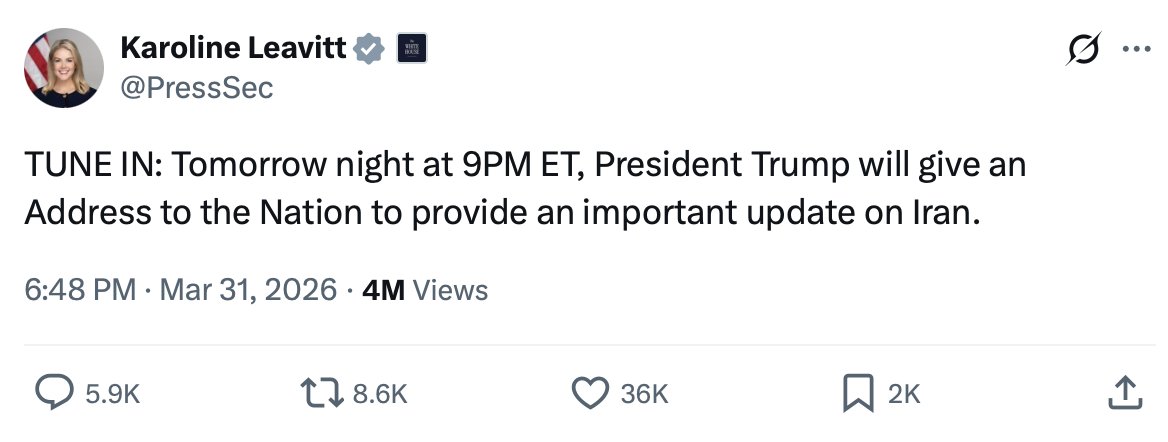
Remarkable acceleration of events 7:48 pm ET: White House announces Trump speech on Iran for prime time tomorrow 9 pm: WSJ reports UAE will use force to open Hormuz 9:57 pm: Iranian drones hit fuel tanks at Kuwaiti airport, says government. (X posts in Central Time)
Michael Shellenberger tweet mediaMichael Shellenberger tweet mediaMichael Shellenberger tweet media
Michael Shellenberger@shellenberger

The Hormuz crisis is the precipitating factor in the current energy crisis, but the underlying cause is too little oil and gas production outside the Persian Gulf. Had the world spent the past decade building the oil, gas, LNG, pipeline, and fertilizer infrastructure that engineers designed and companies proposed, the Hormuz crisis would still be a serious geopolitical event, but it would not threaten to cause a recession. North America — The Atlantic Coast Pipeline, a 600-mile natural gas line from West Virginia to North Carolina, saw its cost double from $4.5 billion to $8 billion during years of environmental litigation before Duke Energy and Dominion Energy cancelled it in July 2020. — The Constitution Pipeline from Pennsylvania to New York died the same year. — The PennEast Pipeline won its case at the United States Supreme Court in 2021 and still could not get built because New Jersey refused to issue state permits. — In Canada, TransCanada abandoned the $15.7 billion Energy East pipeline in 2017 after the National Energy Board required an unprecedented review of upstream and downstream emissions. — In January 2024, the Biden administration paused all pending approvals for LNG export terminals shipping to non-free-trade-agreement countries, freezing projects representing tens of billions of cubic feet per day of potential capacity. — Venture Global’s CP2 terminal in Louisiana, designed for 20 million tonnes per annum, sat in regulatory limbo for over a year. — NextDecade’s Rio Grande LNG in Texas, with 48 MTPA of planned capacity, stalled alongside it. — PTT Global Chemical’s proposed $10 billion ethane cracker in Belmont County, Ohio, first announced in 2015, remains on indefinite hold after failing to attract financing partners amid climate-driven investor sentiment. — Across the US Gulf Coast, nearly 60% of planned plastic and petrochemical production projects sit on hold. — LNG Canada, the Shell-led terminal at Kitimat, British Columbia, took over six years from construction start to first cargo, with its pipeline running 263% over budget. Environmental review, Indigenous disputes, and contractor cost escalation all contributed. — Pieridae Energy’s Goldboro LNG project in Nova Scotia, a 10 MTPA facility first proposed in 2012, was abandoned in November 2023 after more than a decade of permitting and financing obstacles. Australia — Australia’s Santos’s Barossa gas project was halted midway through construction after a Federal Court ruling overturned its environmental approval. — Woodside’s Scarborough project faces ongoing litigation from the Australian Conservation Foundation seeking to block it on climate grounds. Africa — Perhaps nowhere has the damage been more consequential than in Africa. At COP26 in 2021, wealthy nations pledged to halt overseas development finance for gas projects, a commitment that fell hardest on the continent least responsible for climate change and most in need of energy infrastructure. — The World Bank stopped financing oil and gas extraction in 2019 and imposed restrictive conditions on downstream gas projects. — The European Investment Bank announced a complete ban on unabated fossil fuel financing by the end of 2021, with its president declaring that “gas is over.” — At least 21 other development finance institutions followed suit. As a result: — TotalEnergies’ Mozambique LNG project sat under force majeure for four and a half years after the UK Export Credit Agency and other backers withdrew climate-motivated financing. — The East African Crude Oil Pipeline lost financing commitments from more than 30 major international banks under pressure from climatists. Europe — France prevented the completion of a third gas interconnector with Spain, citing climate neutrality goals. — The United Kingdom imposed a moratorium on fracking in 2019 despite sitting atop one of Europe’s most promising shale gas formations. — Germany, which shuttered its last three nuclear plants in April 2023, compounded its gas dependency by refusing to develop domestic shale resources. — CF Industries permanently shut the UK’s largest ammonia plant at Billingham, a facility that also produced 60% of Britain’s food-grade CO2. — Yara International curtailed output across plants in France, Italy, and Belgium before permanently closing its 400,000 tonne per year ammonia facility at Tertre, Belgium, in October 2024. These closures occurred because European climate policy made gas too expensive for the domestic industry to survive.

English
23
123
775
155.5K
Michael Shellenberger
Michael Shellenberger@shellenberger·
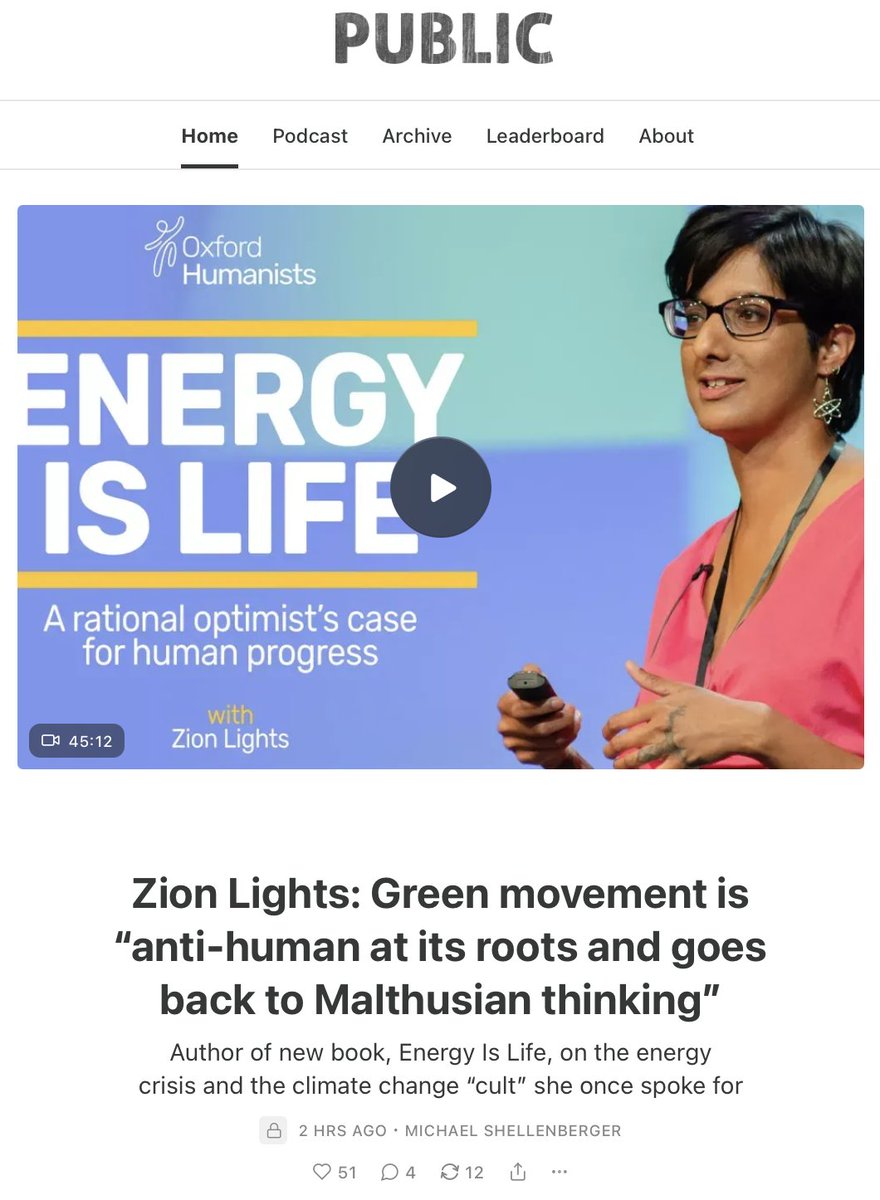
In a small village in the Punjab, a girl of about eight years old crouches over a clay stove, feeding it patties of dried cow dung. Smoke billows into her face. She coughs while feeding the fire. There is no reliable electricity. When the family gets a little extra money, they buy liquified petroleum gas (LPG), which burns cleanly, as natural gas does in stoves in the wealthy West. Unfortunately, that LPG just got priced out of reach for hundreds of millions like her. The 2026 Iran war and the closure of the Strait of Hormuz were the triggers for the current energy crisis, but the underlying cause is the chronic underinvestment and underdevelopment of oil and gas resources by poor, developing, and rich nations alike over the last ten years. Policymakers diverted that money into green energy, which failed to prevent the crisis. Zion Lights, the author of an essential new book, Energy Is Life, watched the above scene during a visit to her parents’ ancestral village in India. Her parents had emigrated to Birmingham, England, in the late 1960s and 1970s to work in factories. The factories gave them wages, dignity, and a foothold in the developed world. The family they left behind in the Punjab remained trapped in a poverty so total that it touched everything: health, education, opportunity, lifespan. At the root of it all is the lack of energy. The energy crisis will hurt poor people in poor nations far more than anyone in the U.S. or the rest of the West. Asian countries receive 80 percent of their energy supply through the Strait of Hormuz. For Bangladesh, which sources 72 percent of its LNG from Qatar and the UAE, the supply disruption translates to an extra $760 to $830 million in monthly import costs. “All poverty is energy poverty, when you think about it,” Lights said in our new podcast. “They’re living in 40-degree Celsius heat. No air conditioning. You can give them an air conditioner, you can give them money for an air conditioner, but how’s it going to work if you don’t have the electricity?” It would be unfair to entirely blame the lack of oil and gas supplies on Western climate policy. Beyond the Iran war, governance failures, corruption, conflict, and infrastructure decay all play important roles. India’s power sector dysfunction predates any climate agreement. Pakistan’s circular debt crisis has roots in decades of mismanagement and subsidy distortions. Sub-Saharan Africa’s electricity deficit reflects bad governance, underinvestment, and the difficulty of building transmission infrastructure across vast, sparsely populated territories. But climate policy has been the dominant priority in wealthy nations’ engagement with the developing world for two decades, and Western green NGOs have even blocked the construction of hydroelectric dams, which tend to be the first reliable source of power that poor nations develop as they rise the development ladder. Beginning in the early 2010s and accelerating sharply after the 2015 Paris Agreement, Western development banks, private financial institutions, and national governments began systematically restricting financing for oil, gas, and coal projects in the developing world. The stated rationale was climate change. The practical effect was to deny poor countries the energy infrastructure that every wealthy nation used to climb out of poverty... x.com/shellenberger/… Please subscribe now to support Public's award-winning investigative journalism, watch the full podcast, and read the rest of the article. x.com/shellenberger/…
English
14
92
537
42.1K
Michael Shellenberger
Michael Shellenberger@shellenberger·
The Iran conflict triggered the energy crisis, but its roots lie in the West's opposition to the production of oil and gas outside the Persian Gulf. The climate movement is, says former radical environmentalist @ziontree, "fundamentally anti-human in its thinking."
Michael Shellenberger tweet media
English
14
227
970
51.2K