
تغريدة مثبتة
Charless
2K posts



Charless أُعيد تغريده


Charless أُعيد تغريده

This is a really good breakdown of what has been concerning me about DATs broadly. I also think it explains in part why ALTs have been so weak
Adam@Adam_Tehc
English
Initial price: $1M FDV
Max price: $999M (no unicorn valuations allowed)
Users can commit up to $186,282 through an English auction.
MegaETH@megaeth
The First Real-Time Blockchain. Built for you. Priced by you. Our public sale on Sonar by Echo, starting at $1M FDV, makes you the largest stakeholder in our network. [thread]
English
MMTFinance is positioned as "on-chain Robinhood", connecting ETFs/gold/stocks/RWA to Sui, KYC modules, Seal/Nautilus RWA layer, and emphasizes #Momentum's RWA expansion and Sui liquidity hub positioning.
#MMTFinance #MMTLP $MMT
English
#MMTFinance uses the ve(3,3) model with a centralized liquidity engine. This combination, under Sui's parallel execution architecture, offers the following advantages.

English
There will be the largest SBT airdrop in Sui history, utilizing a Monad-style contribution model (community contributions). Details will be officially announced on October 15th, along with a WAGMI snapshot and an economic model diagram.
The Kait0 Top 500 snapshot will be on October 15th, and the NFT release is imminent. Holding NFTs will unlock significant benefits from airdrops and future protocol investments.
English
In addition, MMTFinance is responsible for the minting of all major stablecoins on Sui (e.g., AUSD, FDUSD, USDY, etc.), making it more than just a DEX; it serves as the liquidity infrastructure for the Sui ecosystem.
With the upcoming TGE, the team plans to alleviate downward price pressure and may prioritize allocations to creators. As for the remaining airdrops, they may be unlocked linearly, with details to be announced.
English
💠 Deep liquidity = minimal price impact
💠 100% transaction fees are returned to veMMT holders
💠 LPs receive $MMT token rewards
💠 The protocol increases liquidity through token incentives
This design benefits all participants: traders enjoy low slippage, LP providers earn high returns, and governance token holders receive a share of fees.
English
Charless أُعيد تغريده
Charless أُعيد تغريده

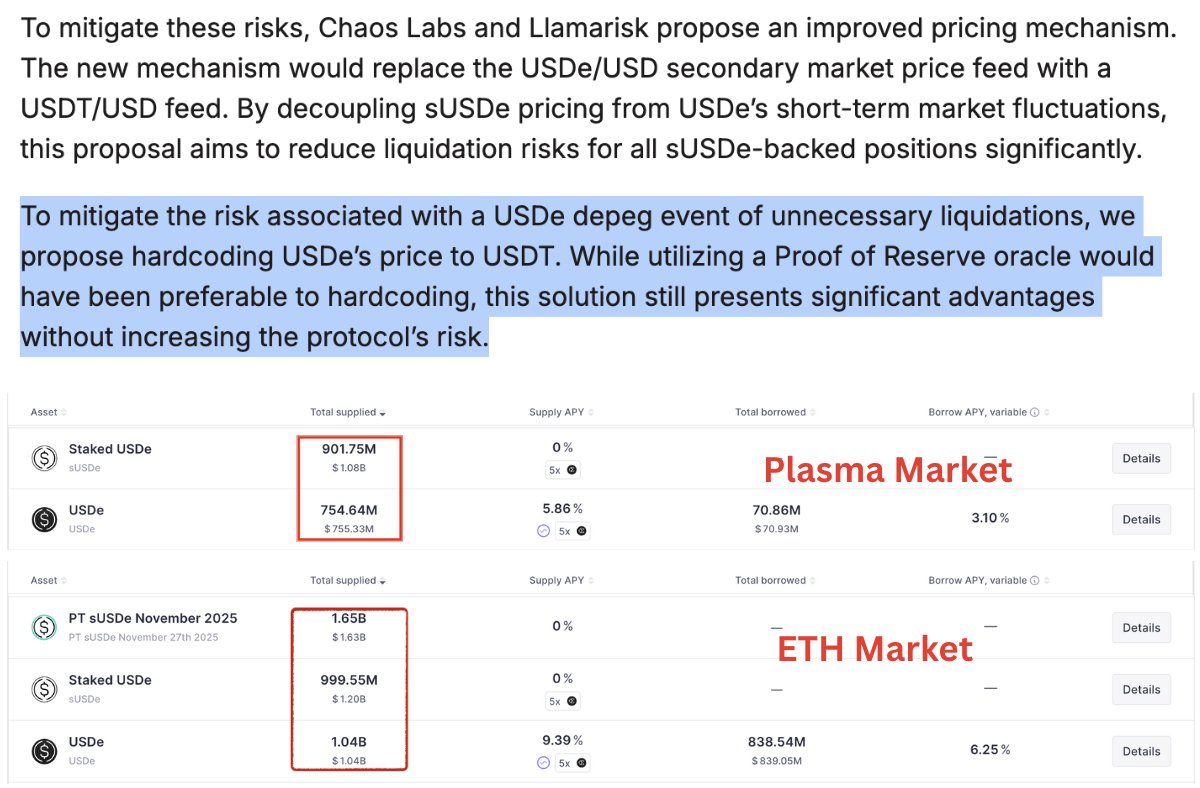
“hardcoding USDe’s price to USDT… presents significant advantages without increasing the protocol’s risk”
~$30B was wiped in yesterday’s liquidation cascade. but it could’ve been so much worse...
while $USDE depegged across defi and on most exchanges yesterday, its oracle price on aave was hardcoded to $1
that single decision effectively protected billions in levered positions
most of the leverage in defi right now is built on looping $USDE. across plasma + eth markets, there’s over $2.6B supplied, with many farming that ~50% APY
because aave used the USDT oracle, none of those positions got touched.
no cascade. no wipeout. nothing.
😅
English
Charless أُعيد تغريده

Lot of crypto folks asking me "What happened?"...
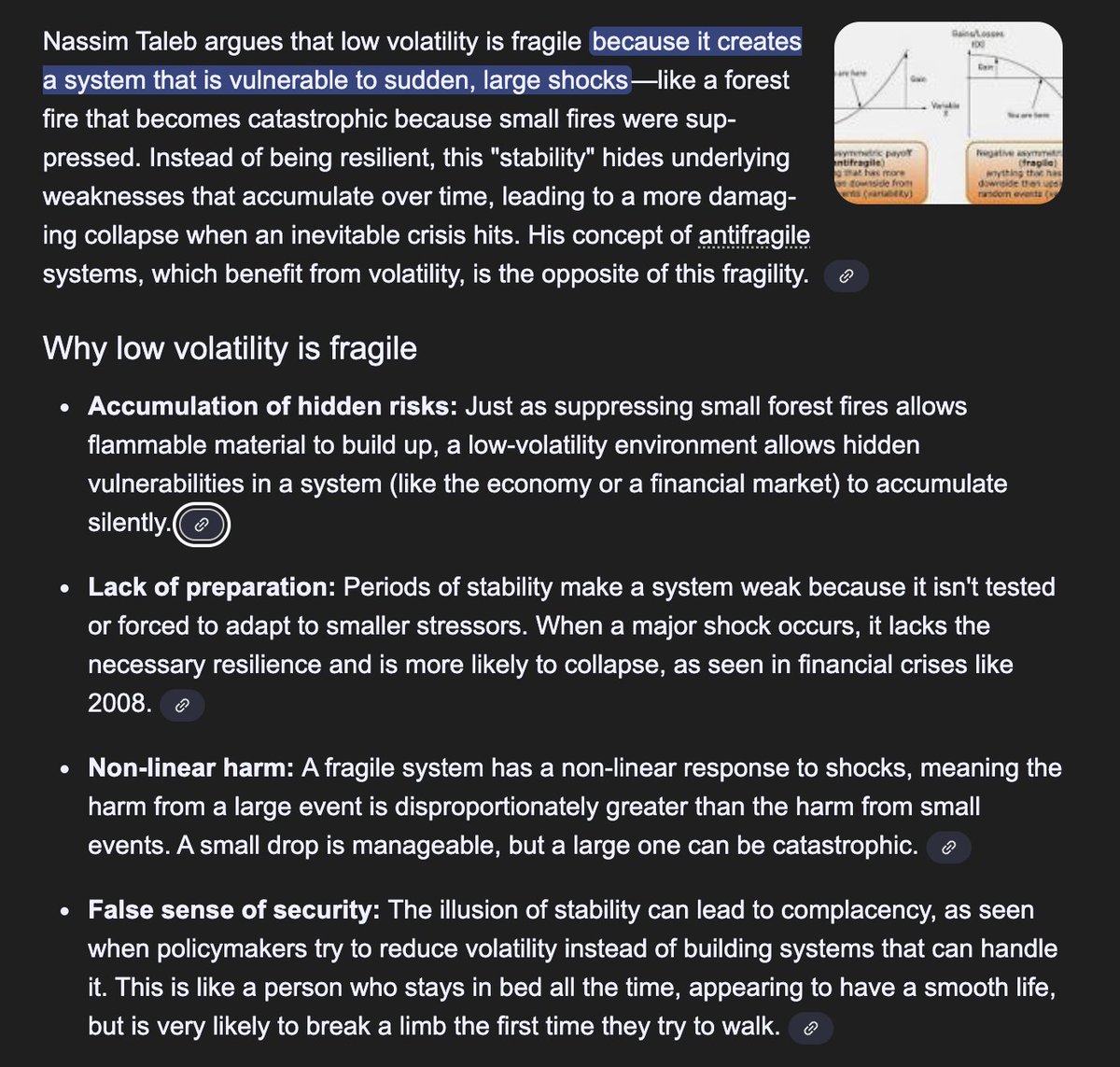
It's probably time to dust off the Taleb book 'Antifragile'.
The amount of Open Interest that has been taken off in one day is unreal. 15B -> 6B on hyperliquid alone, the real total number must be insane!
People always want a clear simple headline. FTX, Luna, Celsius, we've had plenty smoking gun collapses in the past so makes sense to look.
But most likely this is more like the liquidation cascade of May 2021 where after months of run-up and low volatility, people start taking more and more risk as they chase more money.
Especially in this macro environment where gold is at $4k, stocks break all time high every day, and even if you are up you don't know if you are up relative to others when the denominator USD is rekt.
In recent months I've been hearing more and more retarded theses for buying coins. Did you know that CZ's gardener dog is called $ASTERIX? Time to bet on that shit, its BSC season.
Solana trenchers used to flipping shitcoins on their mobile phantom trying to tell me why this or that shitty perp dex is worth billions. Zero self-awareness of knowing what their game is and what it isnt.
Add to that people chasing perps as a narrative, while the liquidity isnt there to support. Hidden risks everywhere, where people are using synthetic dollars as collateral, trading premarket perps with no funding external reference, and telling you not to cry in the casino like they are some hotshot from a Joe Pesci mob movie.
Reality is, in recent months as we were awash with liquidity and every launch was faced with a huge hot ball of money, a lot of the fragility was being hidden under it.
Too much FOMO from retail, not enough focus on robustness from founders seeing their token price as the school report card instead of thinking about their product being more resilient to shocks.
I get it, if you dont play the hype game in crypto you die anyway. If you dont fomo sometimes you miss the big trades. Its a fine balance and none of us are perfect at finding it. And maybe there are some timeless lessons from that cranky boomer that can at least explain why this happened.
English
Charless أُعيد تغريده

Charless أُعيد تغريده

AAVE's Flash Crash: When $180M in Liquidations Became the Ultimate Stress Test
The crypto market just experienced its largest liquidation event in years. Over $19B wiped out across the entire market in 24h. $AAVE crashed 64%, from $270 to $100.
Fear and Greed Index dropped instantly to 27 and everyone is asking the same question: is this the start of something worse?
I don’t have the answer to that. What I do know is that when the market is in max fear, it’s time to max focus and lock in.
So I pulled the on-chain data on $AAVE to see what smart money was actually doing while retail was enjoying their Saturday night.
What I found wasn’t fear. It was aggressive, coordinated $AAVE accumulation by whales, buying at 35x their normal rate within hours of the bottom.
Here's what the data reveals about how sophisticated traders turn market panic into generational wealth opportunities.
------
1⃣ The Violence
The numbers were brutal. Like many other altcoins, $AAVE collapsed from $270 to $100 between Oct 9-10, triggered by Trump's tariff announcement that sent liquidation cascades rippling through DeFi.
As per @nansen_ai, trading volume for $AAVE exploded to $38.8M on Oct 10 alone, nearly 7x the daily average.
To put this into context: this was the largest single-day stress test in Aave’s history. The protocol had to autonomously handle $180M in liquidations while its native token was in free fall, like many others.
One misstep, one smart contract failure, one exploit during the chaos, and confidence collapses permanently.
It didn't fail though. Not even close.
Here's where it gets interesting.
------
2⃣ Inside the Bounce: Whales Bought the Bottom at Record Pace
Within 24 hours of the bottom, three sophisticated holder segments did something remarkable. They bought in perfect coordination:
➤ Whales: +$10.24M (35x their normal buying rate)
➤ Top PnL Traders: +$5.48M (7.0x normal, with a 48 wallet spread)
➤ Smart Money: +$146k (14x normal)
These are multipliers that indicate conviction at the highest levels I've tracked on-chain. Big players were loading the boat.
Over the prior week though, these segments were cautious, averaging <1x their normal flow.
Then, within a single day, positioning flipped from hesitation to full conviction. Whales compressed two weeks of accumulation into 24 hours, Top PnL Traders flipped from neutral to +$5.5M, and Smart Money increased its buy rate 23x.
Meanwhile, the whole market was still processing what had just happened.
The pattern was unmistakable: informed capital interpreted the crash not as a fundamental deterioration, but as a massive mispricing event.
------
3⃣ What They Already Saw That Others Missed
The protocol's performance during chaos matters more than the chaos itself.
$180M in liquidations processed without human intervention. The system worked exactly as designed under the worst possible conditions, a real-world security audit that no third-party firm could replicate.
This is the critical insight: the crash validated the protocol rather than exposing weaknesses.
When positions fell below required collateral levels, Aave's decentralized liquidator network sprang into action. Multiple third parties competed to execute liquidations, maintaining protocol solvency through pure market incentives, with no central authority needed.
Meanwhile, the fundamentals that matter for a lending protocol already hit ATHs:
➤ TVL: $74B (Oct 3, 2025), up 70% in Q3
➤ Institutional adoption: BlackRock deployed $500M in borrows
➤ Aave Horizon (institutional platform): crossed $50M deposits days after launch
➤ V4 launching Q4 2025: unified cross-chain liquidity
This is the disconnect sophisticated traders exploit: the token crashed 64%, but the protocol actually strengthened.
When price and fundamentals move opposite directions during a stress test that the protocol passes with flying colors, smart money recognizes opportunity.
------
4⃣ The Conviction Signal Hidden in PnL Data
The most telling signal wasn't just who was buying, but who stayed through the chaos as well.
Looking at the 30-day PnL leaderboard, I noticed the following:
➤ 56% of top 100 profitable traders still holding positions worth $76.4M
➤ Average “Still Holding %” of 45.6% among top 20 PnL
➤ Key whale holding $8.5M position at 100% "Still Holding", and they bought more during the crash
When traders who made 40-70% returns still choose to hold after a 64% crash instead of taking profits, that's not hope. That's conviction backed by information you don't have.
Not everyone was buying though. 40% (ish) of profitable traders had exited completely before the crash, taking profits at $270+ levels. IMO those were healthy profit-taking exits after a strong run, not fear-based selling.
The traders who stayed and the ones who bought the dip weren't chasing, they were positioning after the protocol proved itself.
------
5⃣ The Supply Shock Nobody's Talking About
Massive $AAVE supply is being removed from circulation too at an accelerating rate:
➤ Over 7 days: -$23.2M withdrawn from exchanges
➤ In 24 hours: -$24M withdrawn from exchanges
Each token moved to cold storage is a token that can't hit the market when buying pressure returns.
Meanwhile, 95% of $AAVE's total supply is already unlocked. The vesting overhang that crushes many tokens? Basically nonexistent here. Only 4.92% remains locked through 2027.
That gives us the following setup --> proven protocol resilience + accelerating supply withdrawal + minimal future selling pressure + fundamentals at all-time highs.
------
6⃣ The Pattern That Transfers
This post isn’t about $AAVE going back to $300, $400, or even hitting $1000+ like many people are saying.
No, this is about what happens when a protocol proves itself under real stress, while sophisticated money is watching and acting.
Extreme volatility exposes weak systems and validates strong ones. $AAVE processed $180M in liquidations without failure or intervention. That single event removed years of uncertainty in one day.
Ask yourself: when Tradfi is finally here with massive FIAT bags ready to convert on-chain, where would they position? At a protocol with let's say, 2% more yield, or a protocol where their new and fancy internet money is actually safe?
Exactly, and I think you already know my answer. But don't look at me, look at what informed money is doing right now, on-chain.
So what can we learn from this?
Years ago, when situations like this happened in previous cycles, I’d close my apps and take the day off. And that's still perfectly fine to do if you feel like it.
But now, I use these moments to lock in on the fear. The same way informed capital does.
They watch for the signals that separate the broken from the resilient: activity multipliers, exchange withdrawals, protocol stability, and timing of conviction shifts.
The best traders don’t fear volatility, they use it.


English
Charless أُعيد تغريده

Charless أُعيد تغريده
8 Valuable Lessons from My On-Chain Case Studies: $STBL and $XPL
More than a week ago, I shared data on $STBL (see QRT) and later $XPL (pinned posted). Both showed similar on-chain patterns: weak Smart Money and heavy distribution.
The posts gained me 2,000+ new followers within days, many people loved the objective on-chain angle. Others weren't happy with them, which I can understand. When you are invested emotionally and financially, contrarian data can feel personal.
What happened next?
Both charts dropped significantly.
Between Sept 24 and Oct 10, $STBL dropped around 73% and $XPL about 60% from their highs.
Some said "everything was down during that period," while the overall crypto market actually gained $180B during that same period.
So why am I writing this post?
This is not about being right. I've been there myself too, for many years. Aping green candles, following big KOLs and increasing my leveraged longs on the next bullish headline I saw on my timeline.
It is about learning what on-chain data can show before the market reacts, hopefully helping others avoid similar situations and become better traders or investors.
Here are 8 lessons that I've learned and helped me avoid repeating old mistakes, with $STBL and $XPL as the recent case studies 👇
------
1⃣ The Real Signal Is On-Chain, Not on Crypto Twitter
During the last weeks, my entire timeline was incredibly bullish on both tokens, especially for $STBL. Posts about Wintermute buying, Binance executives investing, and endless chart predictions filled my feed. There was also many rumors and FUD.
Here's what I've learned: even if all that information were true, it doesn't matter. Most of it can't be verified, and the narrative itself shapes sentiment regardless of facts, in both directions.
A few years ago, I spent most of my time watching what big influencers said. One 100k+ account told me something bullish, another 200k+ commented and agreed, and the next 300k+ retweeted that whole conversation.
I was in full BIAS mode.
Over time, I've come to understand that most of Crypto Twitter is pure noise. Your favorite influencer doesn't have secret information.
The real insights belong to insiders, whales, and funds, and you can track their behavior on-chain. Actions speak louder than KOL's tweets.
------
2⃣ Smart Money and Top PnL Traders Speak First
As per @nansen_ai, Smart Money wallets are top-performing addresses with proven profitability and consistent success across market conditions. They belong to an elite group of on-chain traders, whose moves often anticipate major market trends before the broader market reacts.
And on the other hand, you have Top PnL traders, which are those sitting on strong unrealized profits for a token.
Two actors to study, watch closely and learn from.
For both $STBL and $XPL, Smart Money held less than 0.01% of supply, and Top PnL traders were fully exiting. Remember that when seeing a high ROI is nice and impressive, but it only tells you they made good entries. The percentage they're still holding tells you whether they still believe in it.
Now, I track whether these actors are buying dips or are staying away. Their absence during "attractive" prices tells you something. These actors took both $STBL and $XPL as a trade, not a hold, while fresh wallets bought what they sold.
When the best wallets leave and new wallets enter, that is distribution. Have a look at the on-chain data for $TIBBIR to see how the opposite also can work out.
------
3⃣ Exchange Flows and Volume Patterns Reveal Intentions
$STBL saw $10M move to exchanges in 7 days and $3.8M in a single day. When tokens move to exchanges, holders are planning to sell, not hold.
Another important thing to look out for is volume during a dip. $XPL's volume collapsed while price was falling, not after it, signaling distribution.
There were relief bounces though, but these were given back within days. When the price bounces, I check who is buying. If it's only fresh wallets, chances are high this is a dead cat bounce, suggesting distribution rather than healthy consolidation.
During both dips and relief pumps, smart money stayed out, Top PnL traders kept exiting, and exchange deposits kept rising. All signals aligned.
------
4⃣ The Retail and Experienced Trader Divergence
For both tokens, experienced traders exited while newer participants entered at seemingly attractive prices. The data showed significant fresh wallet inflows into both tokens. Retail usually tends to come late to the party.
Retail buying power alone usually can't sustain price when most profitable traders have exited and a large percentage of supply sits on exchanges.
------
5⃣ Holder Concentration Creates Risk
At that time, $STBL's top wallet held 28.6% of supply. Another held 17.7%, which had a 375M token outflow in 30 days.
There are probably plenty of explanations for it, but at the time I didn't dive into the data because I already had enough signals to make my decision.
Generally speaking, centralized supply means centralized risk, so look at venting. I also benchmark new tokens against successful comparable projects. If metrics are worse across the board, that's telling.
When few wallets control a large percentage of tokens, they can possible have outsized influence on price action, especially if these concentration is not vested. Something to study if you're interested in taking a position in a token.
------
6⃣ A Good Product Does Not Guarantee a Good Token
$XPL was growing in TVL and as of today, they have processed $50B+ in USD₮ transfer volume. Proper stats right?
Well, $XPL is also the perfect example that a protocol success and token success are not the same and can have design flaws, especially when insiders are up 20x and taking profit.
This is why I always keep product analysis separate from token analysis, since these are two separate things.
------
7⃣ Context Behind Tokenomics Always Matters
$XPL has a 1.67B token unlock cliff in 2026. Public buyers often become exit liquidity for private investors.
Understanding unlocks and entry prices matters more than how exciting the narrative sounds.
The best projects maintain tight supply control, offer real utility, and have token models that generate natural buying pressure through actual product usage.
Never ignore the importance of tokenomics and vesting of a project, and benchmark that to the planned development progress and upcoming utility of a project.
------
8⃣ The Same Signals Work in Reverse
The interesting thing is that bullish setups will show the opposite pattern. Smart Money accumulates, Top PnL traders add, exchange outflows rise, volume spikes on rallies, and holder distribution becomes healthier.
Trends can flip quickly though, so real-time wallet alerts matter more than the social sentiment on your timeline.
And remember: static analysis only tells you what happened, not what's happening now.
------
Final Thoughts
When someone asks "was this the dip to buy, or is there more pain coming?" the answer depends on what data you're basing your analysis on. For me, that's primarily on-chain flows. The important thing is having some framework beyond just following the crowd.
The above case studies show how on-chain data can cut through noise and help make informed decisions. This approach won't guarantee a perfect track record, but it improves your win rate over time.
I've learned not to wait for perfect certainty: one major red flag is often enough to pass.
If you do want to take the risk, consider the "48-Hour Rule": give yourself 48 hours when you see concerning data to determine if it's a trend or anomaly.
And if you still want to ape, never put more than X% of your portfolio into tokens with weak on-chain metrics, no matter how good the narrative sounds or how many of your favorite KOLs tweet about it. Write the token off mentally to keep sane in crypto.
I hope these lessons help someone avoid a similar situation in the future.

Cryptor ⚡️@cryptorinweb3
Current $STBL Onchain Data: Distribution Patterns and Market Signals When smart money exits, retail often hold the bag right? --- Looks like this is happening right now with $STBL, at least for now. Here are the current onchain insights 👇 1⃣ The exit signal everyone missed Look, I want to buy $STBL. Felt complete FOMO after missing it. I mean: ➤ Tether co-founder launching an RWA stablecoin protocol? ➤ Wave Digital Assets backing it? ➤ Binance Alpha and Kraken listings? On paper, this look like a winner. And maybe it is. But here’s the thing: it launched two weeks ago and pumped 82% to $0.60 on Sept 24. Then it crashed 45% to $0.33. So what happened? The top five most profitable traders made $1.3M combined. Four of five have fully exited. Not “took some profit.” Fully exited. Zero tokens left. And a lot of selling can be seen across the top 25 PnL leaders. They made some solid ROI and left. 2⃣ The dumping is real I pulled the last 48 hours of smart money DEX trades, and honestly, it’s tough: ➤ Sells: 610k tokens ($248k) ➤ Buys: 238 tokens ($92) That is 99.9% of smart money sell pressure. A verified Farcaster wallet sold 318k tokens ($135k). Two wallets dumped 274k tokens today alone. Here’s what really got my attention: $10M in tokens flowed to exchanges in the last 7 days. $3.8M hit exchanges just today. When you move tokens to an exchange, you are not doing it to hold. You are doing it to sell. 3⃣ The structural challenges Beyond the immediate selling pressure, $STBL has some holder distribution issues: ➤ The top wallet holds 28.6% of supply, with no public disclosure of who controls it. ➤ The second largest (17.7%) is the governance wallet, which dumped 375M tokens in the last 30 days. ➤ The third largest is Binance exchange inventory at 8.4%, tokens sitting ready to be sold by users, I assume. Only 5% of total supply is circulating (500M out of 10B). The other 95% is locked with no public vesting schedule. Nobody knows when those tokens unlock or who gets them. That is a possible red flag for me. Full disclosure: I have not dived deeper into the above top wallets and unlock schedule, but the above info was al I could find for now. 4⃣ My Take $STBL is not a scam. The protocol is real, the team is legit, and in the long term this could be a strong project. But right now the timing is not good. The most profitable wallets already made their money and left. What you are seeing now is classic distribution into retail FOMO. I mean, look at the amount of fresh wallets flowing in. If you are thinking about entering: ask yourself why you would buy when smart money is selling? For long-term believers: wait for Q4. Let the vesting schedule be disclosed and the buyback program prove itself. That is my plan. If it pumps now and I miss it (again), I do not care, because I stood by my thesis. You cannot catch them all. Remember: When the smartest wallets in crypto are running for the exits, do not volunteer to be their exit liquidity. Data provided by @nansen_ai. Check my bio for a 10% discount, and DM me if you have questions or want to start with on-chain trading yourself.
English
BNB officially crosses above 1.300 dollar usd for the first time in history.
With binance alpha and bsc ecosystem szn heat up.
You really don't wanna late to buy alpha 😍
Binance Wallet@BinanceWallet
Trade BSC Memes with Binance Wallet - the ultimate experience! 📲 App: 0 trading fee on top of generous amount of Alpha Airdrops 💻Web: Best Meme trading experience — lowest trading fees, highest commission Not enough BNB to ape in? Like + Follow + RT for a chance to win! 🎁100 winners, 0.1BNB for each binance.com/en/survey/prev…
English
Charless أُعيد تغريده

Trade BSC Memes with Binance Wallet - the ultimate experience!
📲 App: 0 trading fee on top of generous amount of Alpha Airdrops
💻Web: Best Meme trading experience — lowest trading fees, highest commission
Not enough BNB to ape in?
Like + Follow + RT for a chance to win!
🎁100 winners, 0.1BNB for each
binance.com/en/survey/prev…

English
Charless أُعيد تغريده

now that the $XPL thesis has gotten popular, time for a longer version of why I believe @Plasma is one of the best protocols this year:
1. This is the closest exposure you can get to Tether
Plasma is extremely USDT-aligned and Paolo himself has invested twice in the protocol. Every other clone is simply a beta play, most notable Stable. Without looking too deep it looks similar but the Tether alignment is different and it’s the follow up play.
It is still not Tethers chain, just like Aster isn’t strictly Binance. But it is the closest you can get and they will embrace it sooner than later if it continues to outperform.
Reminder: Tether is one of the most profitable per employees company and is raising at $500B soon.
2. The market is speaking, fundamentals are extremely strong
Pre launch the team already executed flawlessly with their partnerships and +$2B in TVL with a smooth rollout to TGE.
It’s been ~3 days post launch and we already see onchain 9-10 fig individuals not just aping $XPL in size but also depositing stables. Some that haven’t touched anything else in the last cycle or 2. It’s overtaken Base in stablecoin supply, $7B+ and 2M real transactions.
3. The stablecoin chain and neobank play
Arguably the most important point in this thread. Ignoring the metrics, the goal and vision of Plasma is to be a specialised chain, not a generalised one. Going back to basics: people want to transact with another. With the offering of zero-fee transactions the closest comp is TRON (@ $31B mcap) which is the number one choice of chain of normies receiving or sending stables.
With Plasma One, their neobank that offers 10% yield on base balance and 4% cashback on top of additional rewards, its comp are traditional digital banks like Revolut — but in a unique position being able to gain marketshare from people who favour Crypto. You have existing projects trying this in Crypto but the pie is big.
These 2 goals itself can scale to hundreds of millions of people that have never touched crypto before and REAL usage.
➡️➡️➡️➡️
Every cycle you have a few winners that outperform, there has been obvious successful protocols such as PumpFun; HyperLiquid. In another lens, Polymarket. Plasma still has a way to go to retain TVL and ultimately complete their goal of normie adoption — but it’s already made a lot of people wealthy which is impeotant in Crypto.
Now, short term price action it can go down or up. In fact I think it’s already fairly valued; has gained CT mindshare. Medium to long term I’m interested and think the team can execute and it will be a coin you can be happy to hold.
I can expand even further but a tweet wouldn’t do it justice. My thesis has already been validated by the market already and it’s one of my biggest trades this cycle. I am happy to watch narratives form and look over everything.
/Trillions.
Loopify 🧙♂️@Loopify
The Plasma Thesis (Trillions) A shortened version, TL;DR: • The closest exposure you can get to Tether: "USDT chain" • Paolo has only invested in 1 company, Plasma, and twice at that • From a fundamental perspective, most products in Crypto are not actually used (especially by normies) the anomaly is TRON commonly used to receive stablecoins by people who have never heard of Crypto (that is at ~$30B FDV) • Proven fast movers. From the big launch to partnerships, main net, TGE, hype has remained whilst comps like MegaETH, Monad have lost narrative • Core team is pushing forward on Plasma One (one of the best crypto cards: 10% yield on base balance, 4% cash back, etc.) • Most people could not get the exposure they wanted (sale was 1:20 so 5% of what you deposit. At $10B if you full ported (!) you "only" double your money) • Billions in USDT on chain from Day 1 (top 5 USDT chains), T1 Listings & big money are interested • Marketcap at TGE launch is relatively low so FDV doesn't matter short-term • Quick short-term comp is the price of Plasma to match marketcap of $ASTER would be ~$2.5 (~$4B mcap, ~$25B FDV) & more stuff... (Disclosure: I am invested in the sale, working with Plasma via @tryPluid for educational widgets & plan to increase exposure at TGE.)
English
Charless أُعيد تغريده

My refresher thesis on XPL:
> $2 (20b fdv) looks likely on a short time frame. May extend my targets a little higher but def a major TP point for many. The longer major PA stays depressed, the more attention on XPL, so hoping for more sideways in the near future.
> I no longer believe XPL is just the trade of the week. I expect a new sector (Neobank) to emerge as key trend which will continue through Q4 into 2026. The timing of Plasma and other Tether chains like Stable launching, interest rates coming down meaning HYSA’s lose their HY, and the stablechain wars heating up (including Tempo, Arc, and Google) position Neobanks to be a leading sector over the next year.
> Really excited to try out Plasma One. If @ether_fi has shown us anything, crypto cards are very popular in emerging markets. Plasma is well positioned to take it a step further by owning the stablecoin and the network layer on top of a fleshed out ecosystem.
Sam@0xCryptoSam
I expect XPL to exceed everyone's expectations. Looking for an entry around $5b, although I expect this to trade anywhere from $10-20b in the near future. TLDR: - Tether is one of the few crypto projects to permeate TradFi mindshare, given that they print money. They likely don't know or care what Plasma is; they just want Tether exposure. - Plasma is the only pureplay stablechain. - Float is lower than anticipated (probably ~10% since US investors are locked for a year). Why I'm Bullish: > General consensus (TradFi + crypto) is that networks and stablecoins are the best products in crypto. The leftcurve in me says stablechains should be well received as a sort of marriage between the two. > Plasma is the first liquid pure play for stablechains, while the supply side has become extremely competitive (Stripe, Google, Circle, Paradigm, etc.). The closest proxies are TRX and ETH, although Plasma undercuts these (in the same way TRX undercut ETH) with lower fees and lower latency. > Plasma is the best form of Tether beta (read the quoted article for more on this). Since Tether just rerated to ~$500b implied val, my expectations for Plasma have rerated as well. For a relative comparison, STBL (new liquid tether beta) jumped 40% in the hours following Tether's announcement. > Float is lower than anticipated (18% expected, probably more like 7-10% when considering US depositors are locked for a year.) > Not as relevant, but lots of onchain runners right now (ASTER, AVNT, STBL, 0G). The market seems risk-seeking at the moment. What are the risks? > Plasma won't be the only Tether stablechain (e.g., Stable), so the Tether beta play may get crowded in the future. Mitigation: Plasma is still the name-brand Tether stablechain, and as the first mover, they have an advantage to absorb the most capital. > Pre-sale investors are up 14x at current valuations. Wouldn't be surprised to see some initial dumping. Mitigation: An unknown number of US investors are locked for a year. This sell pressure could drag the price down for a bit (like PUMP), but will eventually get absorbed, and then XPL melts faces. > TradFi may not know or care about stablechains, so this could be pretty much capped at what the liquid funds will buy. Mitigation: TradFi knows what tether is and that they print money; they likely don't care what Plasma is; they just want exposure. Also, I think ENA as a proxy works here. At the same market cap, this thing would be $22b FDV with an 18% float. Trillions? Idk. Billions. Very likely.
English