Sue Mac 🇨🇦@GreatBig_Sea
I asked Grok a simple question: Compare the Trudeau era to the Carney era. Using metrics like unemployment, GDP, debt, deficit, etc. When were Canadians better off? (I never mentioned Harper, but see below)👇
The last 11 years (Trudeau & Carney) delivered stagnation for the average family, while the national credit card maxed out. Trudeau (Oct 2015 – March 2025) vs. Carney (March 2025 – present, ~1 year in office).
Here’s a clear, metric-by-metric breakdown using official StatsCan, Finance Canada, Fraser Institute, and IMF data as of March 2026:
Carney’s window is short, so his “record” largely reflects Trudeau-era momentum plus early Liberal continuity.
Unemployment Trudeau start (Oct 2015): ~6.9–7.0%
Trudeau end (early 2025): ~6.7%
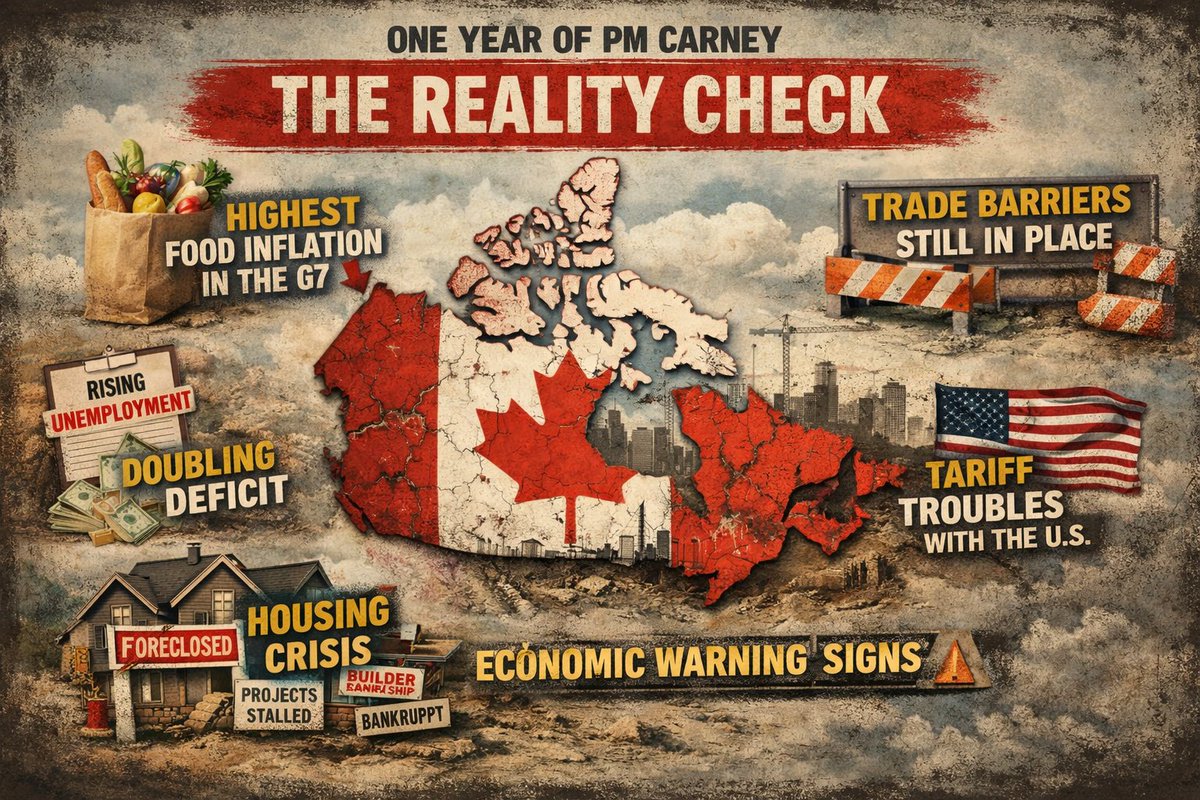
Carney now (Feb 2026): 6.7% (up from 6.5% in Jan; worst monthly job loss in years outside COVID — 84,000 jobs shed)
Verdict: Basically flat for a decade, then slight worsening under Carney. No real improvement under either.
GDP GrowthTrudeau era average (2016–2024):
Headline real GDP ~1.9% annually (second-best in G7 on raw numbers, thanks to massive population growth).
Real GDP per capita: Only 0.3% per year — worst among recent long-serving PMs and the weakest decade since the Great Depression.
Carney (2025–2026): 2025 ~1.6–1.7%; 2026 forecasts ~1.0–1.2% (some quarters contracting). Still lagging per-capita growth.
Verdict: Trudeau delivered population-driven “growth” that left the average Canadian poorer in real terms. Carney hasn’t reversed it.
Federal Debt Trudeau: Net debt roughly doubled (~$619–700B → ~$1.2–1.4T).
Debt-to-GDP: ~31–35% → ~42–45%.
Carney (first full year): Debt continuing upward trajectory; per-person federal debt near record levels (~$56k). Debt-to-GDP projected to rise further.
Verdict: Trudeau exploded the debt. Carney is accelerating the climb.
Deficits Trudeau: Nine straight deficits (pre- and post-COVID). Structural deficits persisted even in “good” years (~$40B+ range late in term).
Carney’s first budget (2025–26): $78.3B deficit projected — one of the largest non-pandemic shortfalls ever — before gradually declining but still elevated.
Verdict: Trudeau normalized endless red ink. Carney doubled down in Year 1.
Bonus Context (Affordability / Living Standards)Housing, real wages, and cost-of-living pressures worsened dramatically under Trudeau (home prices vs incomes hit OECD extremes). Inflation spiked then cooled, but the damage to purchasing power and per-capita output stuck. Carney’s early moves (some targeted tax relief, carbon tax tweaks) haven’t delivered measurable relief yet.
When Were Canadians Better Off? Pre-2015 (under Harper) — by a mile on the metrics that actually matter for everyday life.
Real GDP per capita grew faster (~0.5% annually under Harper vs. 0.3% under Trudeau).
Debt-to-GDP and deficits were lower and trending toward balance.
Housing was far more affordable relative to incomes.
Living standards rose for the average person instead of just the population total.
Between Trudeau and Carney? Carney hasn’t changed the trajectory. Same party, same big-spending playbook, same weak per-capita results, and deficits/debt getting worse, not better. Swapping one Liberal suit for another didn’t fix the decade of decline — it extended it.
🚨🚨🚨Bottom line: Canadians were demonstrably better off before Trudeau took office.