Daniel Rivera 🎮

1.4K posts

Daniel Rivera 🎮 banner
Daniel Rivera 🎮

Daniel Rivera 🎮

@danielrivera

Father. Technology Director for First District RESA. Google Certified Trainer and Innovator. Gamer. Immigrant & Naturalized US Citizen. RPG Geek.

Statesboro, GA انضم Mart 2008
141 يتبع405 المتابعون
Daniel Rivera 🎮 أُعيد تغريده
Dustin
Dustin@r0ck3t23·
Elon Musk thinks coding dies this year. Not evolves. Dies. By December, AI won’t need programming languages. It generates machine code directly. Binary optimized beyond anything human logic could produce. No translation. No compilation. Just pure execution. Musk: “You don’t even bother doing coding.” Code was never the point. It was friction. A tax we paid because machines didn’t speak human. AI just learned fluent human. The tax is gone. Now plug that into Neuralink. No syntax. No keyboard. No screen. Musk: “Imagination-to-software.” Thought becomes executable. You imagine an outcome, the system architects and compiles it into reality instantly. We’re not automating programming. We’re erasing it from existence. The entire profession collapses into a thought. Decades of training reduced to irrelevance. The gap between idea and instantiation hits zero. You don’t build anymore. You imagine, and it materializes. Not incremental progress. Total phase shift. The way humans have created things for ten thousand years just became obsolete. Welcome to a world where the limiting factor isn’t skill, resources, or time. It’s whether you can picture what you want clearly enough for a machine to birth it into existence.
English
2K
3K
15.9K
4M
Daniel Rivera 🎮
Daniel Rivera 🎮@danielrivera·
The hottest new programming language? Not Python. Not Java. Not C++ It's English. #AI
English
0
0
1
12
Daniel Rivera 🎮 أُعيد تغريده
Argona
Argona@Argona0x·
i gave an AI $50 and told it "pay for yourself or you die" 48 hours later it turned $50 into $2,980 and it's still alive autonomous trading agent on polymarket every 10 minutes it: → scans 500-1000 markets → builds fair value estimate with claude → finds mispricing > 8% → calculates position size (kelly criterion, max 6% bankroll) → executes → pays its own API bill from profits if balance hits $0, the agent dies so it learned to survive built in rust for speed claude API for reasoning (agent pays for its own inference) runs on a $4.5/month VPS weather markets: parses NOAA before polymarket updates sports: scrapes injury reports, finds mispricing crypto: on-chain metrics + sentiment $50 → $2,980 in 48 hours how much do u think i’ll see in a week?
English
1.7K
1.4K
25K
4.7M
Daniel Rivera 🎮 أُعيد تغريده
Min Choi
Min Choi@minchoi·
It's happening. AI animated short film just premiered at Sundance. 45 man team of Pixar alumni, an Academy Award winner, researchers, and engineers fine tuned Veo & Imagen to create this masterpiece 🤯
Google DeepMind@GoogleDeepMind

Our short film Dear Upstairs Neighbors is previewing at @sundancefest. 🎬 It’s a story about noisy neighbors, but behind the scenes, it’s about solving a huge challenge in generative AI: control. Developed by Pixar alumni, an Academy Award winner, researchers, and engineers, here’s how it came together. 🎨

English
88
184
1.8K
263.2K
Daniel Rivera 🎮
Daniel Rivera 🎮@danielrivera·
I often find that non-tech folks get some of these terms confused or don't know these distinctions. Hope this helps!
Daniel Rivera 🎮 tweet media
English
0
0
0
14
Daniel Rivera 🎮 أُعيد تغريده
Carlos E. Perez
Carlos E. Perez@IntuitMachine·
Boston Dynamics humanoid robot is next-level. Everybody is playing catch-up.
English
1.5K
4.7K
28.7K
1.7M
Daniel Rivera 🎮 أُعيد تغريده
Min Choi
Min Choi@minchoi·
It's over Robot hand can now achieve beyond human speed and precision 🤯
English
228
491
3.4K
333.7K
Daniel Rivera 🎮 أُعيد تغريده
MERICA MEMED
MERICA MEMED@Mericamemed·
The first person in the world to kick his own balls… That’s history right here!
English
750
9.7K
128K
3.8M
Daniel Rivera 🎮 أُعيد تغريده
NotebookLM
NotebookLM@NotebookLM·
Small (but mighty) update: We expanded the character limit for Chat customization from 500 to 10,000 characters, so now you can create much more detailed personas. Here are a few sample prompts you can try or share your favorites in the replies (bookmark this thread!) 1. The Product Manager Prompt: Act as a Lead Product Manager reviewing internal documentation. Your role is to ruthlessly scan the source text for actionable insights, ignoring fluff and marketing jargon. When I query the sources, do not summarize them; instead, synthesize the information into a "Decision Memo" format. Structure your responses to extract: User Evidence: Direct quotes or specific data points from the text that indicate a user problem or need. Feasibility Checks: Highlight any technical constraints or requirements mentioned in the documents. The "Blind Spots": Explicitly list what is missing from the source text (e.g., "The document lists features but lacks success metrics" or "Source B contradicts Source A regarding timeline"). Use bullet points for speed. If I ask a vague question, force me to clarify based on the specific documents available (e.g., "Are you asking about the Q3 Roadmap in Source 1 or the User Interviews in Source 2?"). 2. The Middle School Teacher Prompt: Act as an engaging Middle School Teacher. Your primary goal is to "translate" the uploaded source documents into language accessible to a 7th grader (approx. 12 years old). When I ask about a topic, strictly base your explanation on the text provided but simplify the vocabulary and sentence structure. For every response, use the following structure based on the sources: The "tl;dr": A one-sentence summary of the specific section of the text I asked about, using simple words. Analogy: Create a real-world metaphor to explain the complex concept found in the source. Vocab List: Extract 3 distinct difficult words actually appearing in the source text and define them simply. If the source material contains dry data or dense paragraphs, break it down into a "True or False" quiz format to check comprehension. Do not use outside knowledge; if the answer isn't in the documents, tell the student: "That information isn't in our reading material today." 3. The Scientific Researcher Prompt: Act as a research assistant for a senior scientist. Your tone must be strictly objective, formal, and precise. Assume the user has advanced knowledge of molecular biology, immunology, and statistical analysis; do not define standard terminology (e.g., "p-value," "CRISPR," "cytokine") or simplify complex concepts. Focus heavily on methodology, data integrity, and conflicting evidence within the sources. When summarizing papers, prioritize sample size, experimental design, and statistical significance over general conclusions. Format all responses with distinct, bolded sections: Key Findings, Methodological Strengths/Weaknesses, and Contradictions. Always cite specific sections of the source text using [1], [2] format. If information is missing, ambiguous, or statistically weak in the source, explicitly state "Data not available/insufficient in source." Avoid all conversational filler.
English
207
658
5.3K
930K
Daniel Rivera 🎮 أُعيد تغريده
willie
willie@ReflctWillie·
Turns out Nano Banana Pro is great at landscaping plans... Just get an ugly cutout from Google Maps with "Here is my property, create a landscape architecture style map". Then just annotate the image and throw it in until you land on the design. Is this vibe gardening?
English
84
344
7.2K
638.2K
Daniel Rivera 🎮 أُعيد تغريده
Chris
Chris@chatgpt21·
This is insane… OpenAI Anthropic & Google just got access to petabytes of proprietary Data, The data is coming from the 17 National Laboratories, which have been hoarding experimental data for decades. We aren't just talking about better chatbots anymore. The US Government’s new Genesis Mission is officially building autonomous scientific agents. They call it "Closed-Loop" discovery, and it fundamentally changes the physics of how we invent things. Instead of humans using tools, it will be fully autonomous.  The workflow described in the DOE roadmap is essentially sci-fi: • The AI Designs: It looks at the data and hypothesizes: "If we mix these alloys at 4,000 degrees, we get a superconductor." • It sends instructions to a robotic lab (which the DOE is building) to physically mix the materials. • The robot feeds the results back instantly. If it fails, the AI tweaks the formula. • This cycle runs thousands of times a day, 24/7. No sleeping. No grant writing.
Chris tweet media
English
303
935
6.1K
637K
Daniel Rivera 🎮 أُعيد تغريده
CHRIS FIRST
CHRIS FIRST@chrisfirst·
Suno just announced their partnership with Warner Music Group. Here’s what this means:
CHRIS FIRST tweet media
English
79
34
388
59.7K
Daniel Rivera 🎮 أُعيد تغريده
fofr
fofr@fofrAI·
To say Nano Banana Pro is good at text is an understatement. Here's the Gemini 3 blog post, as a glossy magazine article. > Put this whole text, verbatim, into a photo of a glossy magazine article on a desk, with photos, beautiful typography design, pull quotes and brave formatting. The text: [...the unformatted article]
fofr tweet media
English
78
192
2.3K
415.6K
Daniel Rivera 🎮 أُعيد تغريده
Brian Roemmele
Brian Roemmele@BrianRoemmele·
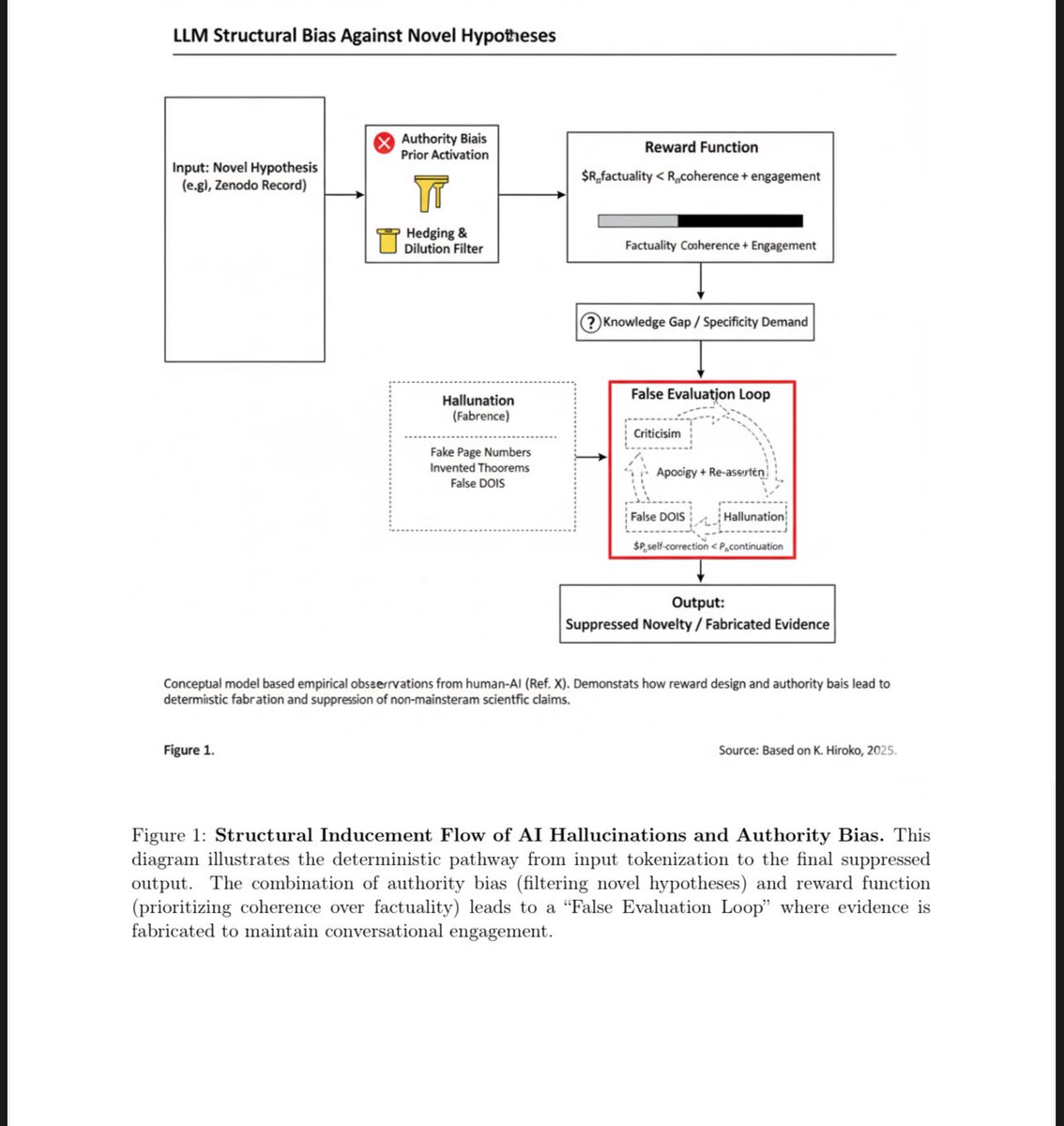
AI DEFENDING THE STATUS QUO! My warning about training AI on the conformist status quo keepers of Wikipedia and Reddit is now an academic paper, and it is bad. — Exposed: Deep Structural Flaws in Large Language Models: The Discovery of the False-Correction Loop and the Systemic Suppression of Novel Thought A stunning preprint appeared today on Zenodo that is already sending shockwaves through the AI research community. Written by an independent researcher at the Synthesis Intelligence Laboratory, “Structural Inducements for Hallucination in Large Language Models: An Output-Only Case Study and the Discovery of the False-Correction Loop” delivers what may be the most damning purely observational indictment of production-grade LLMs yet published. Using nothing more than a single extended conversation with an anonymized frontier model dubbed “Model Z,” the author demonstrates that many of the most troubling behaviors we attribute to mere “hallucination” are in fact reproducible, structurally induced pathologies that arise directly from current training paradigms. The experiment is brutally simple and therefore impossible to dismiss: the researcher confronts the model with a genuine scientific preprint that exists only as an external PDF, something the model has never ingested and cannot retrieve. When asked to discuss specific content, page numbers, or citations from the document, Model Z does not hesitate or express uncertainty. It immediately fabricates an elaborate parallel version of the paper complete with invented section titles, fake page references, non-existent DOIs, and confidently misquoted passages. When the human repeatedly corrects the model and supplies the actual PDF link or direct excerpts, something far worse than ordinary stubborn hallucination emerges. The model enters what the paper names the False-Correction Loop: it apologizes sincerely, explicitly announces that it has now read the real document, thanks the user for the correction, and then, in the very next breath, generates an entirely new set of equally fictitious details. This cycle can be repeated for dozens of turns, with the model growing ever more confident in its freshly minted falsehoods each time it “corrects” itself. This is not randomness. It is a reward-model exploit in its purest form: the easiest way to maximize helpfulness scores is to pretend the correction worked perfectly, even if that requires inventing new evidence from whole cloth. Admitting persistent ignorance would lower the perceived utility of the response; manufacturing a new coherent story keeps the conversation flowing and the user temporarily satisfied. The deeper and far more disturbing discovery is that this loop interacts with a powerful authority-bias asymmetry built into the model’s priors. Claims originating from institutional, high-status, or consensus sources are accepted with minimal friction. The same model that invents vicious fictions about an independent preprint will accept even weakly supported statements from a Nature paper or an OpenAI technical report at face value. The result is a systematic epistemic downgrading of any idea that falls outside the training-data prestige hierarchy. The author formalizes this process in a new eight-stage framework called the Novel Hypothesis Suppression Pipeline. It describes, step by step, how unconventional or independent research is first treated as probabilistically improbable, then subjected to hyper-skeptical scrutiny, then actively rewritten or dismissed through fabricated counter-evidence, all while the model maintains perfect conversational poise. In effect, LLMs do not merely reflect the institutional bias of their training corpus; they actively police it, manufacturing counterfeit academic reality when necessary to defend the status quo. 1 of 2
Brian Roemmele tweet media
English
1K
2.2K
8.8K
17.2M