
Libby Patterson أُعيد تغريده

THE FORGOTTEN WATER PARADIGM
Water fills your cells. That much everyone agrees on. What they get wrong is what that water actually does.
The standard story goes like this: water is background material, a passive solvent that sits there while proteins and DNA do the real work. Cells are bags of liquid with important molecules floating around inside. This view dominates every medical textbook, every biology course, every pharmaceutical approach to disease.
The problem is it's backwards.
Water doesn't just sit there. It transforms. It structures. It generates electrical charge. It powers cellular function. The water inside your cells exists in a fourth phase, distinct from solid, liquid, or vapor. This phase behaves like a liquid crystal. Molecules arrange in ordered layers, stacking on each other in honeycomb patterns. The consistency resembles raw egg white or gel, not free-flowing liquid.
Cells rupture. If those cells contained ordinary liquid water, it would pour out. It doesn't. Blood emerges, but the water stays put. Surgeons cutting deep into muscle tissue report the same observation. The water doesn't flow. It clings to the tissue because it's not liquid in the conventional sense.
This fourth phase water, called exclusion zone or EZ water, forms at surfaces. Specifically at hydrophilic surfaces, the kind where water spreads rather than beads up. Inside cells, protein surfaces provide these templates.
Water molecules adjacent to these surfaces begin arranging in ordered layers. Each layer acts as a template for the next. The structure can grow to a million layers thick, visible to the naked eye at roughly a third of a millimeter.
The formation requires energy. That energy comes primarily from infrared light. A student discovered this accidentally while running experiments. He aimed a desk lamp at a chamber containing water and gel surfaces.
The exclusion zone tripled in size under illumination. Subsequent testing confirmed infrared wavelengths drive the growth most powerfully. Red light works too, but infrared dominates.
Infrared radiation saturates your environment constantly. Turn off every light in a room and aim an infrared camera around. You'll see everything clearly. Walls, objects, your own body all emit infrared energy. Military forces use this principle for night vision. The energy source for building EZ water exists everywhere, all the time.
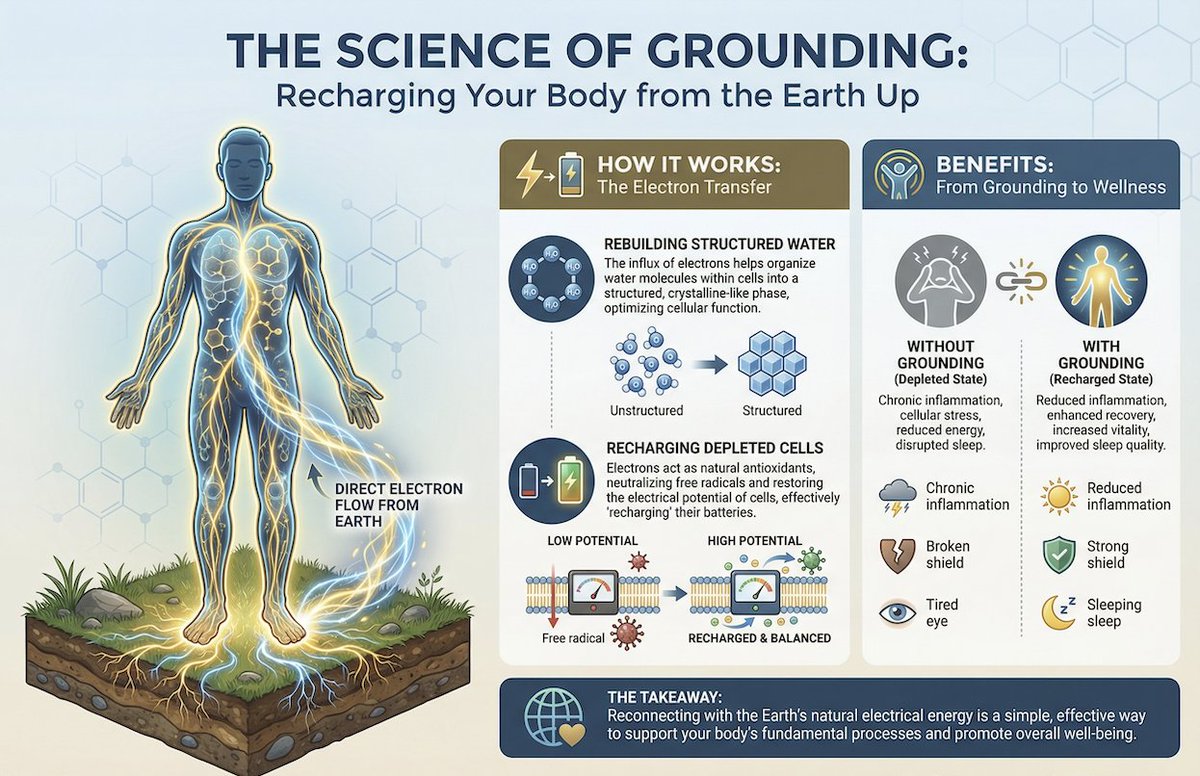
But here's where it gets interesting. As water molecules stack into this fourth phase structure, they shed protons. Each molecule joining the ordered array casts off a positive charge. The EZ itself becomes negatively charged. Those expelled protons accumulate in the surrounding bulk water, creating a positively charged zone adjacent to the negative EZ.
You've created a battery. Negative charge on one side, positive charge on the other. This isn't theoretical. Insert two electrodes, one in the EZ and one in the bulk water beyond it. Connect them with a wire. Current flows. Enough to light an LED. Water stores electrical energy and can deliver it on demand.
This electrical property matters because cells operate on charge separation. Healthy cells maintain an electrical potential difference between inside and outside, typically 50 to 80 millivolts.
Cancer cells measure 10 to 20 millivolts. Research from decades ago showed you can force normal cells to divide uncontrollably by dropping their electrical potential to cancer cell levels. Conversely, raising a cancer cell's potential to normal levels stops the division.
The conventional explanation attributes cellular electrical potential to membrane pumps and channels, molecular machines that supposedly shuttle ions across cell membranes to maintain charge separation.
This model faces serious problems when you examine the energetics and kinetics involved. The alternative explanation is simpler: negatively charged EZ water filling the cell creates the potential directly. More EZ water means higher potential. Less EZ water means lower potential.
Cellular function depends on phase transitions in this water. When a muscle cell sits at rest, EZ water fills it. The ordered, gel-like water constrains proteins into extended configurations.
When the cell receives a signal to contract, the EZ water undergoes a massive phase transition to ordinary liquid water. This releases the proteins from their constraints. They snap into new conformations. That conformational change generates the contraction.
The same principle applies to secretory cells, nerve cells, probably all cell types. Action occurs through phase transition. Structured water becomes unstructured. Proteins change shape. The cell does something. Then the cycle reverses. Liquid water rebuilds into EZ water. Proteins reset to their extended state. The cell returns to standby mode.
This paradigm contradicts everything taught in biology textbooks. If it's correct, then the entire foundation of cellular biology needs revision. The implications extend to disease.
Consider dehydration. Not the obvious kind where you need to drink water. Cellular dehydration. Babies are 90 percent water by volume. Old people drop to 60 percent. The difference shows in wrinkled skin. But it also shows in cellular function.
As proteins accumulate mutations and damage from environmental toxins, their surfaces lose the ability to nucleate EZ water growth. Cells contain less structured water. The electrical potential drops.
Phase transitions become sluggish or incomplete. Cellular function degrades. You might call this aging. You might call it disease. Either way, the root cause traces to insufficient EZ water in cells.
Cancer fits this framework. Cancer cells have low electrical potential because they lack sufficient EZ water. The proteins inside have lost their capacity to structure water properly.
The cell can't maintain the charge separation required for normal function. It defaults to primitive metabolic pathways, fermentation instead of oxidative phosphorylation. It divides uncontrollably because the electrical brake on division has failed.
Mitochondria factor into this system as EZ water factories. These organelles contain the right structures, the right electrical potentials, the right components to generate structured water continuously.
When cells undergo phase transitions and structured water converts to ordinary water, mitochondria rebuild the supply. That's why metabolically active tissues like muscle pack in mitochondria. The cells need constant EZ water replenishment to function.
The Earth itself contributes to this electrical system. The planet carries a net negative charge. You can measure an electrical field extending from the surface.
This isn't obscure physics. Richard Feynman devoted an entire chapter of his famous lectures to Earth's electrical field. It's just not considered biologically relevant by most scientists.
When you walk barefoot on wet grass or sand at the ocean's edge, you electrically connect to that negative charge. Electrons flow from the ground into your body. They convert ordinary water in your cells to EZ water, the same way passing current through water in a lab chamber creates exclusion zones around the electrode. You're literally recharging your cellular batteries.
People report feeling better after walking on the beach. Children buried in wet sand experience profound relaxation. These aren't placebo effects. They're electrical phenomena. Your cells are absorbing charge and rebuilding their structured water content.
Certain plant compounds also promote EZ water formation. These substances have been recognized as health-promoting since ancient times. Laboratory testing shows they all enhance exclusion zone growth in water. Presumably they do the same inside cells.
The practical applications await in Part 2, but the conceptual shift needs to land first. Water is not background. Water is not passive.
Water structures, charges, energizes, and drives cellular function. When that water loses its structure, cells lose their function. Disease follows.
English