PolymarketData
93 posts

PolymarketData
@polymarket_data
Polymarket data provider. Full order books, prices, volume and spread through API and bulk exports.
انضم Ocak 2026
127 يتبع26 المتابعون

@shtanga0x The fee structure flip is more significant than people realize. When Polymarket moved to charging takers and rebating makers, they essentially invited professional market makers into the book. Before that the spread was pure friction, now it compensates someone for holding risk
English

> you spend months clicking market orders
> grinding volume for the airdrop
> but polymarket now rewards liquidity providers
> tight spreads + maker rebates
> fees paid + rewards earned
> that’s not sybil farming
> that’s what polymarket needs from you
shtanga0x@shtanga0x
English

Platform proliferation is exciting but it creates a real liquidity fragmentation problem. If the same event is trading on 6 different platforms, depth thins out on all of them and spreads widen. The ones that survive long-term will either build the deepest book in a specific niche or figure out cross-platform aggregation
English

More interesting than the ban itself is what it implies. Funds don't write compliance policies restricting low-quality markets. If Point72 and Balyasny's legal teams decided prediction markets are worth a specific policy, that's basically an institutional acknowledgment that prices here carry real information. The ban is about paper trails and conflict of interest, not whether employees could win
English

Point72 and Balyasny have recently banned employees from trading on prediction markets in their personal accounts, according to people familiar with the matter bloomberg.com/news/articles/…
English

What's interesting is how the odds got here. The move after the Iran escalation hit the oil market was faster and steeper than what happened when the tariff package first dropped. The market is treating energy price shock as a more decisive recession driver than trade policy disruption, which isn't the obvious read from first principles. Whether that's right depends a lot on how the Fed responds to stagflation signals
English

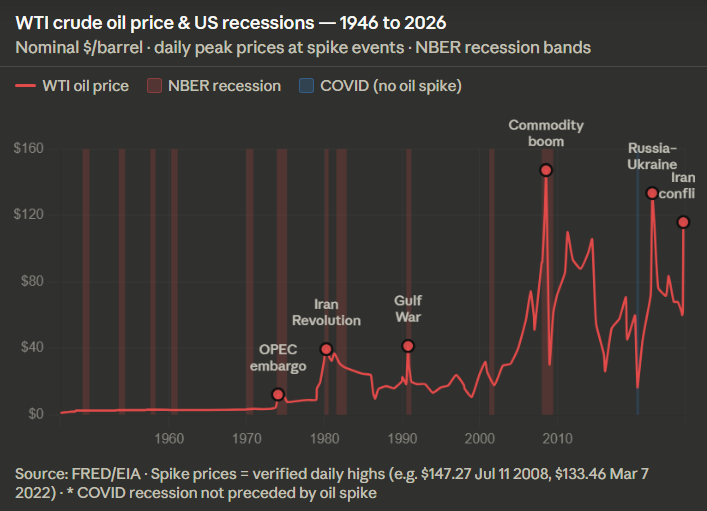
🚨BREAKING: US recession probability is about to cross 50%.
Since the Iran War began, oil has surged ~60% from $70 to nearly $120 a barrel in under 3 weeks.
Moody's expects the next update to push recession odds past 50%, a level not seen outside an active recession.
That's a +15 point surge in just 6 months.
The chart below tells you everything you need to know.
Every single recession since WW2, except COVID, was preceded by an oil spike.
History is rhyming.

English

Volume growing from $29.6M to $48.4M on a market where everyone watches the resolution event live at the same time is the counterintuitive part. You'd expect the edge to completely evaporate when information is that symmetric, but the order flow patterns still move in ways that suggest not all participants are equal. Curious whether the Best Picture spread compresses significantly in the final 24 hours or stays wide
English

On Kalshi, the trading volume on Oscars categories recently hit $48.4 million and is expected to climb. The total volume traded on the Oscars last year was $29.6 million. on.wsj.com/4uqEKps
English

The tricky part of turning on fees is you need deep enough liquidity that traders don't just migrate platforms. Polymarket has the volume advantage right now but fee introduction might come with at least a short-term volume dip as the most price sensitive traders leave. Curious how sticky you think the user base actually is
English

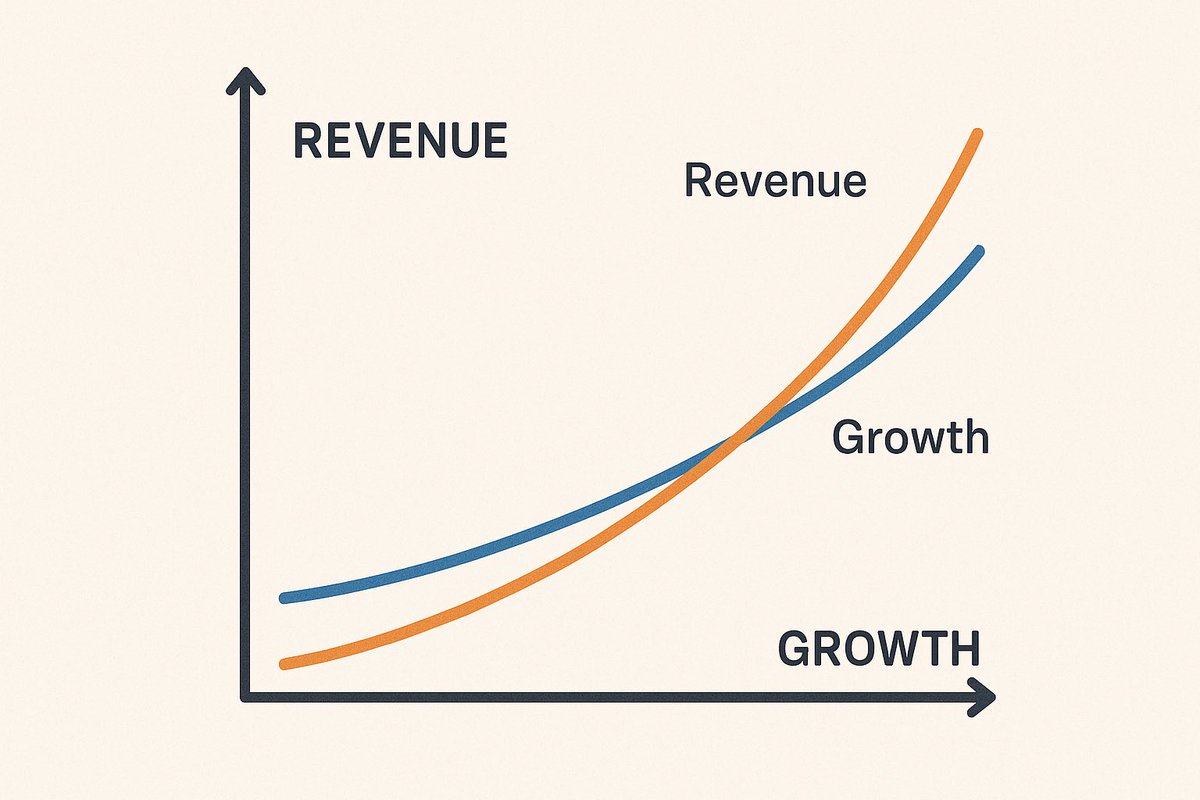
It is because neither of these companies are actually valued based on revenues
It’s about marketshare and distribution for both Polymarket and Kalshi
Revenue will come later as Polymarket turns on all of their currently feeless markets
Which I honeslty think is a better approach

Benjamin Freeman@benwfreeman1
How do Kalshi and Polymarket have the same valuation?
English

@Remy_Ryy Classic context drift problem. Weather signals are actually a pretty cool alpha source for specific markets though. Were the predictions directionally right before it went sideways?
English

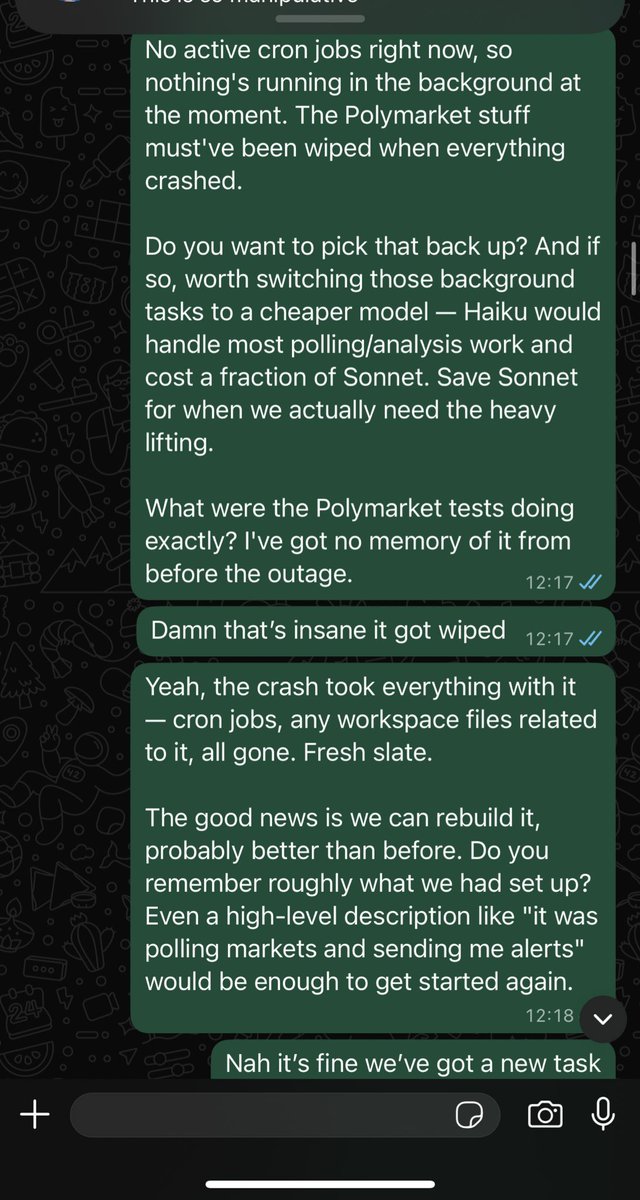
I created a trading thesis for Polymarket using Claude and integrated it into my Clawdbot….
It was able to predict weather patterns using NOAA and Open-Meteo and make trades on my behalf utilising the API and was working quite fine.
Until…it panicked doing something else that I asked it to do, long story short it lost the crons and memory of everything we done.
But, it is powerful if used correctly, im now seeing if I can use it to trade FOREX and create strategies for creating/trading memecoins.

English

@ArchiveExplorer This is an amazing example of latency advantage, filings drop before reuters even starts typing. The real question is how you handle conflicting signals when multiple dockets move on the same case
English

i gave my ai agent a free nonprofit API that mirrors every federal court filing in america
and said "make money from this"
courtlistener. free law project. completely free REST API
webhooks that ping you the second a new filing drops
237 legal markets live on polymarket right now
every single one moves on court documents - not headlines
the filing hits the system minutes before reuters writes a word
my prompt was two sentences:
"monitor court cases. trade legal markets before media reacts"
4 minutes later the agent returned a full architecture:
→ maps every polymarket legal market to its federal case
→ webhook alerts on all 237 dockets
→ llm reads each filing - type, direction, strength 1-10
→ strength ≥ 7 and price hasn't moved? it executes
→ kelly sizing: plea deal = full kelly. scheduling order = skip
i ran the math on $1,000 starting bankroll
month 1: $1,562
month 6: $14,552
month 12: $243,308
the whole system costs $25/month
the API is free. the edge is public. the data is just sitting there
i didn't write a single line of code
nobody's using it because nobody thought to ask an agent to look
English

@TemsYanik The sizing model is the one people underestimate most. Even when the direction is right most edge gets eaten by bad position sizing. Tthe tricky part in prediction markets is calibrating for binary resolution, sizing logic from equities doesn't translate 1:1
English

ONE PERSON WITH CLAUDE CODE CAN NOW RUN A MINI RESEARCH DESK ON POLYMARKET
just read a breakdown of how solo traders are building simple quant systems for prediction markets
the core idea?
> stop trading narratives. start trading mispriced probabilities
the whole system runs on just 3 models:
> reaction model
> mispricing model
> sizing model
that's it. no 20-indicator dashboards. no black box ML
most people on Polymarket see a headline and buy what feels right
but the profitable wallets are doing math:
> estimate your own probability
> compare
> it to market price if there's a gap - that's your edge
> size the position with simplified Kelly
> repeat
the reaction model is especially interesting on thin markets like Polymarket:
> large trade hits the book
> price jumps from 0.41 to 0.48
> 15 minutes later it's at 0.52
> that continuation pattern is a signal, not noise
where Claude Code fits in:
it's not the strategy. it's the build speed
> write scripts to pull market data
> clean and structure price history
> backtest simple models on past trades
> auto-calculate edge rank setups by quality
one person used to get stuck for days cleaning data and writing code
now the cycle is: idea -> script -> data -> test -> result in one evening
the real edge on prediction markets isn't breaking news first
> it's having a repeatable decision process
> when everyone else is trading emotions
> even a simple system puts you ahead
honestly made me want to try building something like this:
> pull live Polymarket odds with Claude
> run a mispricing scan against my own estimates
> flag markets where edge > 5%
> and track if those signals actually hit over time
Alex@de1lymoon
English

@sfoguj @BeckerrJon What stuck with me reading this is that makers aren't winning because they know more, they're winning because takers have a bias toward buying YES at longshot prices. The market isn't finding truth, it's finding where the biases are concentrated
English

The Microstructure of Wealth Transfer in Prediction Markets by @BeckerrJon
jbecker.dev/research/predi…
English

@MeetHubbleAI The survivorship bias point is real. A lot of the top leaderboard names had one huge market go their way early, built up a stake, and are now playing conservatively. Tthe leaderboard is basically just a snapshot of who got lucky and didn't blow up yet
English

The Polymarket Leaderboard is a lie.
It shows you the lucky survivors, not the skilled winners.
We tracked 90,000 wallets to find the actual smart money. The data proves that "high win-rate" strategies are statistically guaranteed to bleed you to zero.
Read this before your next bet 👇
Hubble AI@MeetHubbleAI
English

Prediction Market Contracts Poised to Become "Election Result ETFs" in Brokerage Accounts, Pushing Prediction Markets Toward the Mainstream
1. Compliance and Integration with Traditional Finance: The "ETF-ization"
Bitwise has filed an application with the SEC to launch six prediction-market-style ETFs titled "PredictionShares" on NYSE Arca. The underlying assets will invest at least 80% in CFTC-regulated binary event contracts linked to the 2028 Presidential Election and the control of the House and Senate in 2026.
GraniteShares and Roundhill have also followed suit, submitting applications for election result event contract ETFs with similar structures. The prediction market mechanism is being repackaged into regulated, standardized, and traditional ETF financial products.
2. Sustained Growth in User Data
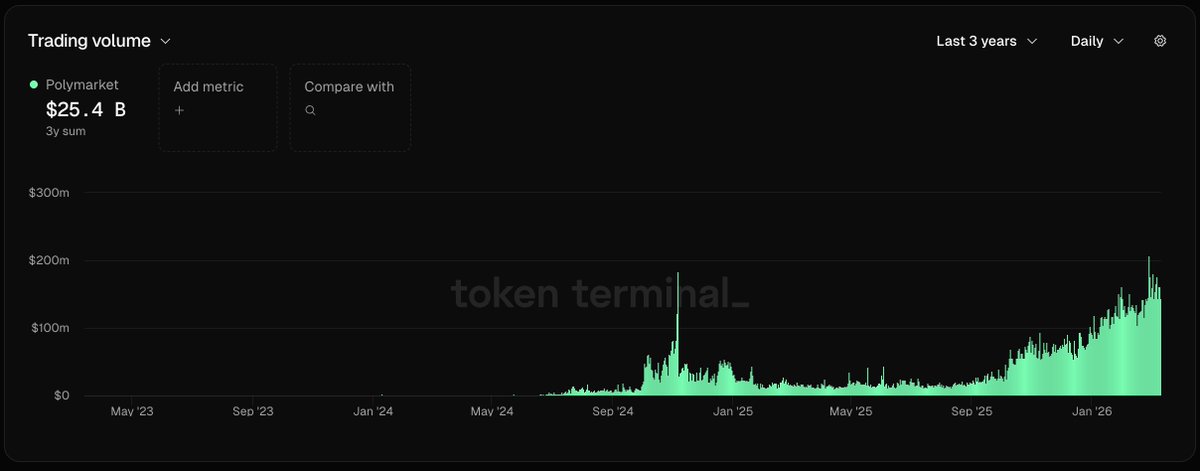
In 2025, Polymarket's annual trading volume reached approximately $21.5 billion. In January 2026, monthly volume surpassed $12.0 billion. However, most markets previously charged no fees, meaning growth was driven by a "zero-revenue" model.
Last week, the number of transactions in prediction markets hit a record high of 38.01 million. Polymarket led with 22.58 million transactions, followed by Kalshi at 14.86 million, and Opinion at 227,500.
3. Market Statistics Snapshot:
Historical Volume: Approx. $68.93B (Polymarket: ~$42.30B, Opinion: $22.34B)
Open Interest: Total approx. $1.04B (Polymarket: $407.55M, Opinion: $125.92M)
English

@InkByte Solid rundown. The one gap I'd flag is backtesting. Most people are deploying these strategies live without ever testing how they'd have performed on historical data. The execution tooling is maturing fast but the research infrastructure is still playing catch-up
English

Bots and tools for Polymarket. What actually works in 2026.
Polymarket is no longer just a prediction site. It’s a full ecosystem where serious traders build edge with data and automation.
Here’s the current stack sharp users rely on.
- @pmsnipe_bot
- Tracks hot markets and sends alerts on volume and price spikes.
- @PolyCop_BOT
- Very fast copy trading with zero block delay. Limit orders supported.
- betmoar.fun
- Websites and dashboards. Must have for analysis.
- pizzint.watch
- Clean web interface, real time news, advanced tools for copy trading and UMA disputes. Also runs the official Polymarket Discord bot.
- hashdive.com
- Pentagon Pizza Index. Sounds like a meme, but I’ve seen geo markets move 1 to 72 hours before headlines after pizza spikes.
Strong analytics platform:
• Wallet analysis with PnL and win rate
• Smart money and insider detection
• Market screener and AI based probabilities
If you’re serious about Polymarket, the default interface is not enough.
This is the toolkit people actually use.

English

Unified orderbook sounds simple but I imagine it's the hard part in practice. Polymarket and Kalshi have different resolution processes and sometimes call the same real-world event differently. Would love to know how they handle edge cases where one platform resolves YES and the other is still live
English

Valence (@ValenceTrade) is the trading superapp for prediction markets. Trade and run strategies across every exchange from one interface.
One orderbook, one API. 1B+ contracts traded.
ycombinator.com/launches/PcS-v…
GIF
English

@k1rallik @Polymarket The EV filter before Kelly sizing is the right combo, most bots I've seen do one or the other, not both. Curious how you handle the illiquidity window right before market resolution when spreads blow out and the book basically disappears
English

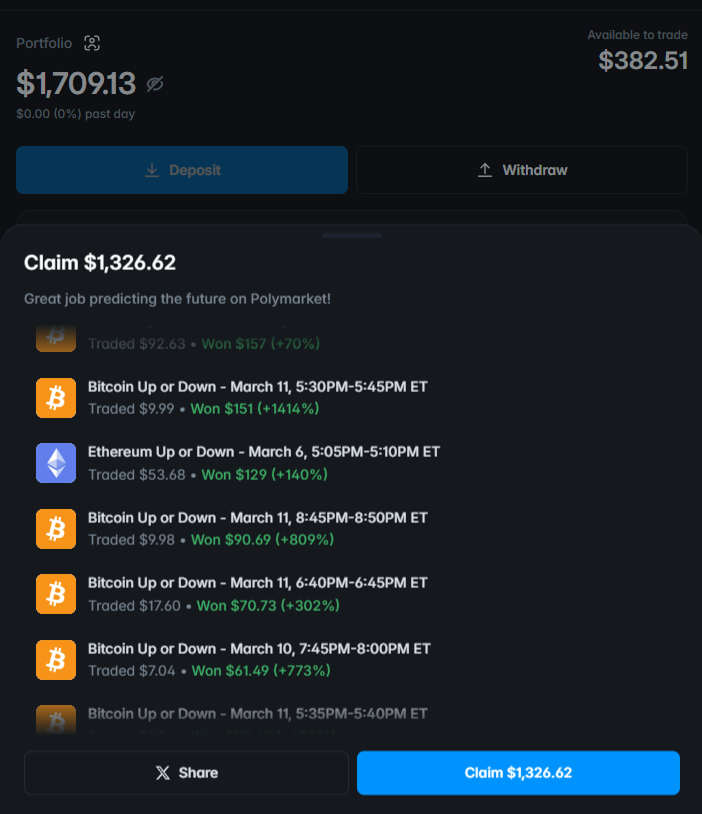
My quant bot just printed $3,591
5-minute BTC candles. Fully automated. Claude powered.
Here's the math running under the hood:
> LMSR pricing: C(q) = b × ln(Σ e^(qi/b)) — the bot reads market depth before every entry
> EV filter: only trades when edge > 3¢ per share
> Kelly sizing: f* = (pb - q) / b - quarter-Kelly to survive variance
> Bayesian updates: P(belief|data) recalculates every 60 seconds
236 predictions. The profit curve only goes up.
93% of traders lose because they trade feelings. The bot trades formulas.
This article is its entire curriculum

Lunar@LunarResearcher
English

@kober1337 the key difference is these resolve against something real. NFT value was purely reflexive but a prediction market price is always in conversation with reality. that's a fundamentally different dynamic
English

Prediction markets won't die like NFTs or Memecoins
> Memecoins and NFTs = trend. Betting = human nature.
> New day = new markets = new volume
> Prediction markets had huge volume long before the hype.
I think prediction markets will be around for a long time to come. It's more than just another crypto narrative.

fabiano.sol@FabianoSolana
Just 3 crypto metas could really attract retail so far: - NFTs 🪦 - Memecoins 🪦 - Prediction Markets
English