JJ

840 posts

JJ banner
JJ

JJ

@qcomplex5

classic gamer 👾 🕹️ • linguist 🗺️🗣️/mathematician 🧮 • 🇳🇴🇨🇭🇺🇸 • 🇪🇺 • 🌿 🇮🇱 🇺🇦 🇮🇷 • ✡️🪬

London/Boston/Charleston انضم Mayıs 2022
175 يتبع47 المتابعون
JJ
JJ@qcomplex5·
Your example perfectly describes the well-documented biphasic pathophysiology of severe viral pneumonitis, proving the exact opposite of your point. A high viral load in an asymptomatic individual simply represents the early viral replication phase, where the pathogen temporarily antagonizes the host's Type I interferon response before clinical symptoms manifest. Conversely, a critically ill patient with a low viral load is in the late-stage immunopathological phase; by the time acute respiratory distress syndrome (ARDS) develops, the virus is often largely cleared, and mortality is instead driven by an aberrant, host-mediated hyperinflammatory cascade involving macrophage activation syndrome and systemic hypercytokinemia. The entire mechanistic purpose of vaccine-induced cellular immunity is to truncate that initial high-titer replication phase to prevent the secondary immunopathological cascade that actually kills the patient. Acknowledging that inter-individual biological variance exists due to diverse HLA genotypes does not invalidate clinical trial endpoints; it simply underscores exactly why macro-level epidemiological modeling and robust biostatistics are a mathematical necessity for public health.
English
1
0
0
22
Ben Sondergaard
Ben Sondergaard@CaptBently·
@qcomplex5 @DavidWolfe All those numbers mean absolutely nothing. The same scientists doing these studies have already said point blank that a persons reaction varies. Someone can show a huge viral load and have no symptoms. Or very little viral load and be near dead. Think dummy think.
English
2
0
0
22
David Wolfe
David Wolfe@DavidWolfe·
Unvaccinated people, check in. We were supposed to be dead…
English
5.2K
3.2K
31.9K
953.9K
JJ
JJ@qcomplex5·
Dismissing modern clinical immunology and molecular epidemiology as "people's word" reveals a staggering ignorance of evidence-based medicine. Vaccine efficacy is not derived from subjective sociological surveys; Phase 3 Randomized Controlled Trials verify infection status via quantitative PCR (qPCR) assays and measure outcomes using immutable metrics like viral load kinetics (Ct values) and pulse oximetry. Furthermore, immune protection is quantified through high-resolution biochemical assays - neutralizing antibody titers are physically measured via ELISA, and cellular memory is evaluated using multiparametric flow cytometry to directly quantify IFN-gamma and TNF-alpha production by CD8+ T-cells. Even population-level transmission chains are established through genomic epidemiology using Next-Generation Sequencing (NGS) and phylogenetic analysis to calculate mathematically rigorous Vaccine Efficacy (VE), not by taking anyone's "word" for who they interacted with. Science relies on empirical, quantifiable molecular data, which your argument entirely lacks.
English
1
0
0
46
Ben Sondergaard
Ben Sondergaard@CaptBently·
@qcomplex5 @DavidWolfe There’s currently no way to prove anything you said. Any data you will foolish attempt to cite, is based on unscientific epidemiological studies. No scientist would ever accept a study based on people’s word. But an idiot like you would.
English
1
0
0
98
JJ
JJ@qcomplex5·
While Omicron (B.1.1.529) achieved unprecedented transmission dynamics due to extensive antigenic drift, specifically Spike glycoprotein mutations that evaded neutralizing immunoglobulins, attributing the pandemic's attenuation solely to ubiquitous infection represents a gross epidemiological miscalculation. If a variant with Omicron's extraordinary basic reproduction number (R0) had propagated through an immunologically naïve population, the absolute volume of concurrent infections would have caused catastrophic mortality regardless of a lower intrinsic case fatality rate. The transition to endemicity was instead catalyzed by the immunological bedrock of vaccination: robust, vaccine-primed CD8+ T-cell responses and Fc-mediated effector functions remained cross-reactive, effectively restricting severe lower respiratory pathogenesis. Ultimately, the acute phase concluded via hybrid immunity, where heterologous exposure in vaccinated individuals drove germinal center affinity maturation, broadening the memory B-cell repertoire and establishing a synergistic barrier against severe morbidity that brute-force viral spread alone could never have achieved.
English
1
0
0
58
Ben
Ben@benkraken·
@qcomplex5 @DavidWolfe Wrong retard. Omicron spread like a wildfire and everyone got it. That’s how it ended.
English
1
0
0
54
JJ
JJ@qcomplex5·
Your claim of "genetic mutations" demonstrates a profound misunderstanding of the central dogma of Molecular Biology. Vaccine mRNA is delivered exclusively to the cytosol; it lacks nuclear localization signals and the requisite enzymatic machinery (reverse transcriptase and integrase) to alter host chromatin. It is rapidly degraded by ubiquitous cytosolic ribonucleases. Insertional mutagenesis is a biochemical impossibility. Furthermore, asserting vaccines don't impact transmission relies on a mathematically flawed, binary view of sterilizing immunity. While intramuscular vaccines don't block all initial mucosal entry, they drastically alter viral clearance kinetics. By rapidly mobilizing neutralizing IgG and CD8+ cytotoxic T lymphocytes, vaccination exponentially accelerates the viral clearance rate. This severely truncates the temporal window of peak viral shedding, fundamentally depressing the secondary attack rate within the population. Finally, claiming the vaccine "never protected you" ignores the cellular immunity paradigm. Robust, cross-reactive T-cell responses target highly conserved intracellular viral epitopes, rapidly initiating apoptosis in infected pneumocytes. This prevents severe lower respiratory cytopathology, ARDS, and systemic hypercytokinemia (cytokine storm). This cellular memory is precisely why severe morbidity and mortality plummeted among vaccinated cohorts.
English
1
0
0
51
Cindy Kiel
Cindy Kiel@cmkiel·
@qcomplex5 @DavidWolfe Maybe you haven’t heard but the genetic mutations they gave you don’t stop infection or transmission of a virus. This, your vaccination never protected you nor did it protect anyone else. Sorry you were lied to
English
1
0
1
90
JJ
JJ@qcomplex5·
I already responded to a couple of the points that you've returned to (returning jobs, Fannie/Freddie, auto bailout, QE). I'd encourage you to re-read my previous reply, because I addressed each of those directly with data. But you've said something new and genuinely interesting, so let me focus on that. You said Clinton "didn't have to do shit because Microsoft" and ended with "not policy but timing." If Clinton's job creation was timing (tech boom) and not policy, then by the exact same logic: • Bush's job losses were timing (housing bust), not policy • Obama's job gains were timing (post-crisis recovery), not policy • Trump's job losses were timing (COVID), not policy So are you arguing that policy is irrelevant? That it's all circumstance. But even under that framework, the Democratic presidents still had better job numbers. You've relabelled the cause from "policy" to "luck" without closing the gap. The 47 million private sector jobs are still there regardless of why they appeared. You can't simultaneously argue "timing, not policy" to excuse Republican numbers AND "bad Democratic policy" to explain away Democratic numbers. Pick one framework and apply it consistently. On the Obama "magic wand" quote: he was talking specifically about manufacturing jobs, not all employment. It's routinely cited out of context. On "lawyers can't run an economy": Clinton was a lawyer. So was Lincoln. So was Calvin Coolidge, whom most fiscal conservatives admire. This isn't an argument really. On the QE/refinancing risk: you're describing a real dynamic, and I've acknowledged that. But QE was the Federal Reserve's decision, not Obama's. The Fed is independent. And the rate hikes that created the refinancing squeeze happened under Powell, who was appointed by Trump. You're attributing a Fed-driven cycle to a single president while ignoring that it spans multiple administrations of both parties. I think you clearly have real-world experience with how these economic cycles affected people on the ground, and I respect that. But the core question hasn't changed: using the same consistent metric across six presidencies, the gap in job creation - total, private sector, or however you want to slice it, is enormous. Everything you've raised explains pieces of individual cycles, but none of it makes that gap disappear. If you believe it does, show me the adjusted numbers.
English
0
0
0
12
Bubba T
Bubba T@brillianttrave1·
@qcomplex5 @ImBreckWorsham Lawyers can't run an economy. lets begin there. never forget, Obama said to the black audience. Those jobs are not coming back. Trump doesn't have a magic wand. Trump doesn't need a magic wand.
English
1
0
0
21
JJ
JJ@qcomplex5·
I feel you're getting into more substantive territory now, so let me engage with each point properly. On Obama's jobs being "returning jobs": partly true for his first term. But total nonfarm payrolls surpassed the pre-recession peak (Jan 2008) by around mid-2014 and then kept growing for another two and a half years. If it were purely recovery, employment would have returned to baseline and plateaued. It didn't. The "just recovery" argument has a shelf life, and it expired halfway through Obama's presidency. On Fannie, Freddie, and the subprime crisis: you're right that Gorelick, Raines, and Johnson received enormous compensation at Fannie Mae, and that GSE lobbying to resist tighter oversight is well-documented. That's real and I won't dispute it. But you're telling one side of a bipartisan story. The Financial Crisis Inquiry Commission concluded that while Fannie and Freddie contributed to the crisis, they were not the primary cause. Private-label mortgage-backed securities issued by Wall Street firms, not the GSEs drove the worst of the subprime explosion. Fannie and Freddie actually lost market share to private lenders during 2004–2006, then tried to catch up late in the game, which made things worse. Meanwhile, under Bush's watch: the SEC loosened net capital requirements for investment banks in 2004, the OCC preempted state predatory lending laws, and the Fed declined to use its authority under HOEPA to regulate subprime lending. These were regulatory failures that occurred under Republican oversight. I'm not saying Democrats were blameless, but framing this as purely a Democratic creation doesn't survive scrutiny. The crisis was bipartisan. On the auto bailout: you're omitting that TARP was signed by Bush in October 2008, and Bush authorised the first $17.4 billion in auto industry loans in December 2008. Obama continued and expanded it. The government did lose roughly $11 billion on GM but the Center for Automotive Research estimated the bailout saved approximately 1.5 million jobs and avoided around $39 billion in government transfer payments (unemployment insurance, lost tax revenue, etc.). Whether that's "sticking taxpayers with the bill" or a net fiscal positive depends on your counterfactual. What happens if GM and Chrysler liquidate entirely? You'd be looking at cascading supplier failures across the Midwest. On healthcare being "already broke": I'd need you to be more specific. Healthcare added millions of jobs under Obama, that's factual regardless of whether the sector faces long-term fiscal challenges. Look, I think you clearly know more about the mechanics of the housing crisis than most people on here, and I respect that. But the core point still holds: even after accounting for recovery dynamics, even separating private sector from government, even acknowledging that presidents inherit economic conditions they didn't create the gap in job creation between Democratic and Republican presidencies is enormous and consistent across six administrations. If you have a specific adjustment methodology that closes that gap, I'd genuinely like to see it.
English
0
0
0
10
Bubba T
Bubba T@brillianttrave1·
Most of Obama jobs were returning jobs as a result of the subprime loan crisis beginning in 06-07 as the loans began to default and AIG didn't have the money to pay off the mortgages. Obama complained about Republicans driving the economy into the ditch, but in fact, the Democrats during Bush Iraq war, would not let up on subprime and Fannie and Freddie Mac hired lobbyists to pay off republicans to keep from shutting off the govt loans. Clintons people ran Freddie and Fannie during Bush 43. Gorelick Raines and Johnson pocketed millions of dollars in bonuses during that period. Healthcare was a huge employer and that's already broke. Obama bailed out GM and stuck taxpayers with the bill. Chrysler was sold to Fiat and several GM brands shutdown. QE like I said was trillions.
English
1
0
0
14
JJ
JJ@qcomplex5·
@krassenstein I think it may just be that age is aging him.
English
0
0
0
206
Brian Krassenstein
Brian Krassenstein@krassenstein·
WOW! Trump can barely get off the plane. The Iran war stress is aging him rapidly.
English
2.4K
1.5K
11.6K
1.3M
JJ
JJ@qcomplex5·
I think you may have missed my follow-up, because your first point, separating government from private sector jobs, is exactly what I did. The BLS numbers broken out: - The last 3 Democratic presidents created ~47 million private sector jobs and ~3 million government jobs. - The last 3 Republican presidents lost ~1 million private sector jobs and added ~2.5 million government jobs. So the Democratic advantage isn't government bloat but it's overwhelmingly private sector employment. That directly contradicts the premise of your objection. On Clinton and the tech boom: yes, he benefited from it. Presidents always inherit economic tailwinds and headwinds so that's a fair comment. But you can't strip Clinton of credit for the boom while also loading him with blame for the housing bubble. The subprime lending explosion happened primarily between 2004 and 2007, under Bush-era regulatory oversight. Clinton's fiscal discipline: consecutive budget surpluses, deficit reduction, which actually helped sustain the expansion. On Obama and "only government growth", that's just not what the data shows. Obama added ~12 million total jobs, of which the vast majority were private sector. Your experience in construction was real, and I don't doubt it was brutal, but the housing crash decimated that sector specifically and one industry's experience doesn't override national payroll data across all sectors. Healthcare, professional services, and tech all grew substantially under Obama. On QE and stock buybacks: you're right that a lot of cheap money went into buybacks rather than productive investment. That's a legitimate criticism of monetary policy. But it's a critique of the Fed, not of presidential job creation numbers. The jobs were still created. BLS counts payrolls, not what corporations did with their bond issuances. Your closing point, that "every variable I described was created under Obama, Trump, and Biden", spans both parties, which undermines rather than supports a argument against my numbers. I'm not saying presidents deserve sole credit or blame for employment. The economy is vastly more complex than that. But if we're going to compare track records using the same consistent metric (BLS nonfarm payrolls, inauguration to inauguration), the gap is enormous and it holds up whether you look at total jobs, private sector only, or net of government employment. If you have an alternative dataset that tells a different story, I'm all ears.
English
3
0
0
50
Bubba T
Bubba T@brillianttrave1·
Well, first of all, you don’t separate out government from non-government jobs. Second of all you give credit for the housing expansion to Clinton and then you turn around and load the bubble popping on the bush 43. Clinton also enjoyed increased employment from the tech boom and the corresponding tech bubble that happened just before the election in 2000 did not reflect significantly on Clinton. Bush got most of the blame for that and someone Obama was elected. The only growth was in government cause I was in the construction trade in 2006 thru 2012 and the banks weren’t even wanting money for homes because like I talk to other contractors. The quantity of easing put a lot of money into the economy, and growth was insignificant and corporations. Took a lot of that money and bought back their own stock. They also borrowed money because it was so cheap. When Biden created all this inflation and interest rates went up the same companies corporations that had borrowed heavily at zero interest rates we’re having a refinance at a higher interest rate so therefore a lot of the loans We’re in trouble and we may escape it but somebody in the finance world that I was telling me that we were supposed to have a huge recession beginning in March 2026. every single variable that I just described was created under Obama two terms Trump one term and Biden one term. So you’re 50 million job count doesn’t hold up
English
1
0
1
64
JJ
JJ@qcomplex5·
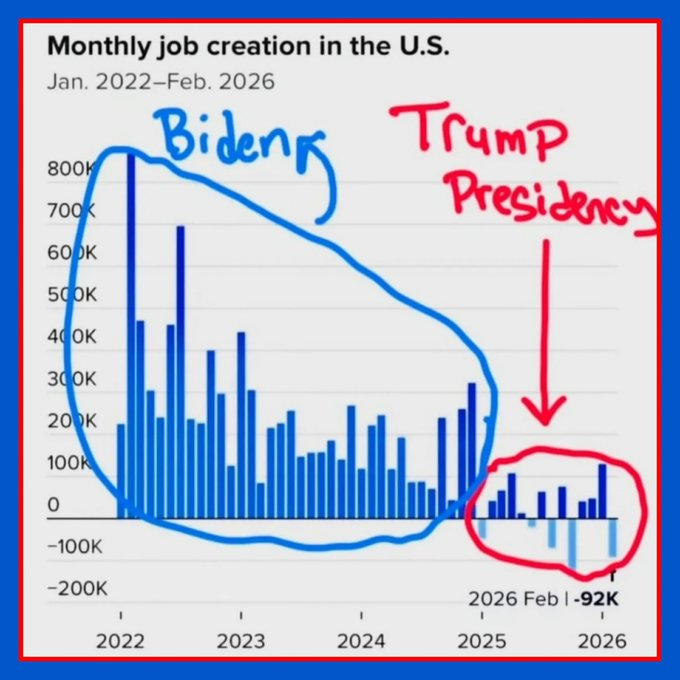
Thank you and I accept your apology, of course any debate can get heated. I do appreciate the back-and-forth, but I don't believe I'm misinterpreting the data, however I'm open to you demonstrating otherwise. The headline numbers as I see are farily straightforward BLS nonfarm payroll data, inauguration to inauguration. Clinton: ~23M. Obama: ~12M. Biden: ~16M. So ~50M. H.W. Bush: ~2.6M. W. Bush: ~1.3M. Trump: −2.7M. That's ~1.2M net. Your point that recoveries from deep downturns (2008, 2020) benefit the sitting president is a fair observation in principle. I'll grant you that. But you're applying it asymmetrically. You want to discount Democratic job gains as "just recovery" while not asking why the crises happened on Republican watches in the first place. The 2008 crash developed under Bush-era deregulation. The COVID job loss, while exogenous, was deepened by the federal response in early 2020. You can't strip one side of credit without assigning the other side responsibility. More importantly, the "just recovery" argument doesn't survive contact with the actual data. Pre-pandemic peak was ~152.5M nonfarm payroll jobs (Feb 2020). By the end of Biden's term: ~158.5M. That's 6 million jobs above the pre-pandemic peak, not a bounce-back to baseline, but net new employment beyond full recovery. If it were purely stimulus-fuelled rehiring, you'd expect a return to ~152.5M and a plateau. However, that didn't happen. And the argument collapses entirely with Clinton. His ~23 million jobs which was the largest single-presidency gain in modern history, weren't recovery from anything. H.W. Bush's recession was mild and brief; the economy was already growing when Clinton took office. On the stimulus/over-hiring point: yes, PPP and ARPA fuelled rapid hiring in 2021–22, and some sectors corrected. But that correction is already baked into the 158.5M figure. That's the number after the layoffs you're referencing. The "gaslighting the data" and that I "don't know how to read data": you're welcome to say that but you haven't cited an alternative dataset, a different methodology, or a specific number that contradicts what I've said. As you've studied econ, I'd be very open to your showing me where the BLS figures are wrong, or show me an adjustment that closes the gap. I'm genuinely open to being corrected.
English
1
0
1
14
asstard
asstard@_asstard·
@qcomplex5 @TheButcher2020 @Flannelman77 @ImBreckWorsham i shouldn't have called out the flags. that was wrong of me and i'll apologize. but i see people misinterpreting the jobs reports from those presidencies all the time just to support their own bias. maybe it was unintentional. should've given you more grace there.
English
1
0
0
20
JJ
JJ@qcomplex5·
The “6 million net new jobs under Biden” claim uses the standard BLS metric every administration and economist relies on: nonfarm payroll employment (establishment survey), not the household survey in your Statista chart. Pre-pandemic peak (Feb 2020): 152.5 million payroll jobs Feb 2026 (latest BLS): 158.47 million -> +5.97 million above the pre-COVID peak. Your household survey numbers (total people employed) also now exceed 2019 peaks. On the Trump claim: From Jan 2017 (145.6M) to the Feb 2020 pre-COVID peak, payroll jobs rose by 6.9 million. That was his strong pre-pandemic record, But, Biden’s numbers reflect recovering all 22 million COVID losses plus net growth beyond the prior peak. Both presidents had solid job gains in their non-crisis periods, using the same payroll metric. Full BLS data (in the link in tables A & B): bls.gov/news.release/e…
English
1
0
1
48
Tim Reisnour
Tim Reisnour@TReisnour48697·
@qcomplex5 @KCH_76 @ImBreckWorsham Bullshit he did. Not one person can point out where we gained 6 million NEW jobs under Biden. Trump highest Employment Total was 157.4 million jobs, 2019 Bidens highest Employment wasmTotal 162.44 Million jobs, 2024 Today under Trump total is 164.59 million.
Tim Reisnour tweet media
English
2
0
2
53
JJ
JJ@qcomplex5·
I appreciate all the replies and thoughts on my post. Many of you have engaged thoughtfully and in good faith. That being said, it's hard to debate with people who just reply "dumbass," "idiot," or similar insults without any reasoning or evidence. If you wish to participate in the discussion (or any other such similar discussion), please explain your view and back it up with data or arguments. I'd genuinely appreciate it. JJ
English
0
0
0
16
JJ
JJ@qcomplex5·
The last 3 Republican presidents have added only 1.5 million jobs, whilst the last 3 Democratic presidents have added 50 million (incl. ~15 million under Biden). No, Biden wasn't perfect, nor Obama, nor Clinton, but when it comes to job creation, clearly the Democrats do a better job. Further, each of the same Republican presidents presided over a recession, whilst there was considerable growth under each of the Democrats.
English
73
30
265
12.1K
JJ
JJ@qcomplex5·
@HappyJR86 @Mbrown0328 @ImBreckWorsham If you had read my post: "Private sector & healthcare: few thousand (mostly state rules + voluntary quits." I'd already covered that.
English
0
0
0
5
JJ
JJ@qcomplex5·
16% of total liquified and gaseous hydrocarbon imports during 2025 yes, with the (now legally enforced) target of 0% by the end of 2026. I will admit its far from optimal to be continuing to import from Russia, however for many EU countries it was impossible to immediately cease Russian imports due to a lack of import terminals/regasification facilities etc. as well as a lack of alternative source powerplants (nuclear, wind etc). I do not support Iran, the flag in my bio is explicitly that of the Persian Empire (Pahlavi) (not the current Islamic Republic). I support the fall of the current dictatorship and its replacement with a western-friendly democracy.
English
1
0
0
10
asstard
asstard@_asstard·
@qcomplex5 @TheButcher2020 @Flannelman77 @ImBreckWorsham so 16% is coming from russia lol brother just admit it's fucked and doesn't make sense. not hard. and also supporting iran.. i mean lol again the main reason i said something initially is you objectively gaslighting the jobs data, which you are.
English
2
0
0
17
JJ
JJ@qcomplex5·
@_asstard @TheButcher2020 @Flannelman77 @ImBreckWorsham Please go ahead and explain the accurate market dynamics to me then in so far as it appears there has been far greater job creation (even when corrected for and normalized) under Democratic administrations than Republican.
English
1
0
0
18
JJ
JJ@qcomplex5·
@ConsultCannaRob @longmiresshadow @ImBreckWorsham Somewhat a losing battle though isn't it? There are those willing to listen to others (and to data/evidence) and perhaps reassess their beliefs, and then there is MAGA. 😂
English
1
0
0
17
JJ
JJ@qcomplex5·
Does the EU have to be perfect for me to support the majority of its principles? Further, the EU receives only around 13% of its total gas from Russia (not oil, which is under 3%), a massive drop from pre-war level, and new EU rules banning Russian gas imports have already started taking effect this month, with a full phase-out by the end of the year.
English
1
0
0
16