Royle Pérez Castillo

14 posts

Royle Pérez Castillo

Royle Pérez Castillo

@royleperezc

انضم Eylül 2023
32 يتبع7 المتابعون
Royle Pérez Castillo
Royle Pérez Castillo@royleperezc·
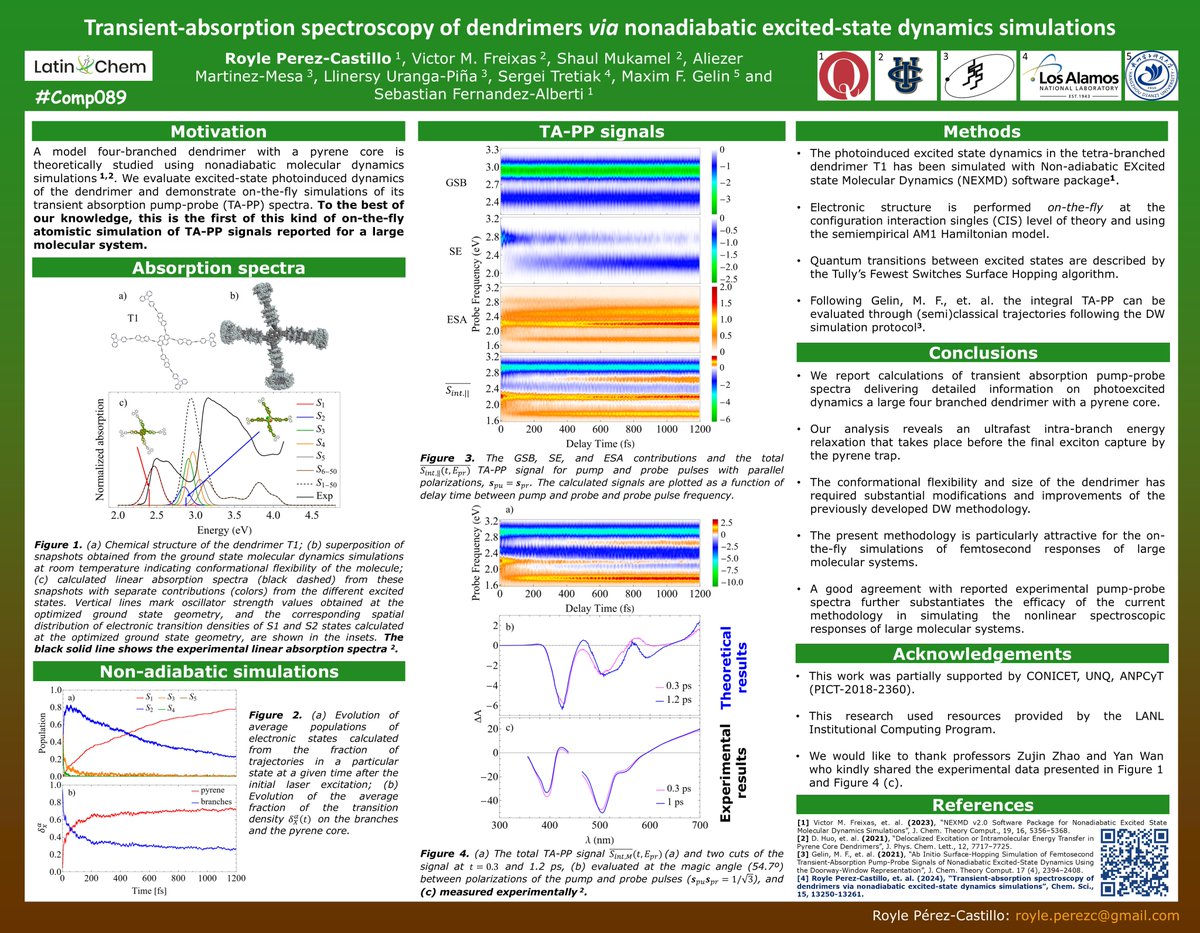
@icorraluam @LatinXChem ...the different contributions (GSB, SE, ESA) of the transient absorption. By controlling the pump and probe polarizations we can also calculate how the changes in the electric dipole orientations corresponding to the different excitations impact the TA-PP signal.
English
0
0
1
53
Royle Pérez Castillo
Royle Pérez Castillo@royleperezc·
@icorraluam @LatinXChem These TA-PP allow to connect the non-adiabatic molecular dynamic simulations to available experiments. For this system in particular, the TA-PP signals allow to track the time evolution of the electronic wave function along the non-radiative relaxation by probing...
English
1
0
1
51
Royle Pérez Castillo
Royle Pérez Castillo@royleperezc·
@CisnerosRes @LatinXChem Hi @CisnerosRes! Thank you very much. We consider 400 initial structures sampled from a GS dynamics with Langevin thermostat at 300 K. A clustering analysis was not required for this system because there aren't notable differences between the structures.
Royle Pérez Castillo tweet media
English
0
0
0
101
Royle Pérez Castillo
Royle Pérez Castillo@royleperezc·
@jotoldo @LatinXChem Hi! Thanks very much! Electronic structure is performed on-the-fly at the CIS level of theory and using the semiempirical Hamiltonian AM1. On the other hand, the theoretical excited state lifetime was 437 fs and the experimental, 830 fs.
English
0
0
1
37
Josene Toldo
Josene Toldo@jotoldo·
@royleperezc @LatinXChem Nice work, Royle. What was the electronic structure method of your simulations? What is the theoretical and experimental excited state lifetime?
English
1
0
0
49
Royle Pérez Castillo
Royle Pérez Castillo@royleperezc·
@icorraluam Experimentally, fluorescence exists but we don’t calculate it because we are limited to the non-radiative relaxation mechanism that occurs on smaller time scales.
English
0
0
0
20
Ines Corral
Ines Corral@icorraluam·
@royleperezc Nice work and nice poster! I have several questions: how do your results compare with experimental data? How long does it take to this system to decay to the S0? What do you mean with S1-50, S6-50? in Figure 1? Does this system present fluorescence?
English
5
0
0
57
Royle Pérez Castillo
Royle Pérez Castillo@royleperezc·
@icorraluam With S1-50 we show the simulated absorption spectrum of the first fifty excited states of the dendrimer. We use the first five excited states in our calculations, so S6-50 is the absorption spectrum due to the rest of them.
English
0
0
1
28
Royle Pérez Castillo
Royle Pérez Castillo@royleperezc·
@icorraluam However, you can see for more information the following reference: Dayujia Huo, Minjie Li, Zujin Zhao, Xian Wang, Andong Xia, Ping Lu, and Yan Wan. The Journal of Physical Chemistry Letters 2021 12 (32), 7717-7725 DOI: 10.1021/acs.jpclett.1c02182
English
0
0
1
43
Royle Pérez Castillo
Royle Pérez Castillo@royleperezc·
@icorraluam And the three contributions to the total integral signal: GSB, SE, and ESA, are in reasonable agreement with experiments. These are some elements to compare our results with the experimental data.
English
0
0
1
26
Royle Pérez Castillo
Royle Pérez Castillo@royleperezc·
@icorraluam Hi! Thank you very much for your questions. The simulated absorption spectrum of the dendrimer corresponds with experimental results. Besides, the overall internal conversion process, calculated by fitting the increase of S1 population, results in a qualitatively good lifetime.
English
0
0
1
31
Royle Pérez Castillo أُعيد تغريده

Hassiel
Hassiel@LightEmrys·
Hi @LatinXChem, my name is Hassiel. I'm doing my doctorate at the National University of Quilmes (UNQ), and this is my work ‘Vibrational Funnels for Energy Transfer in Organic Chromophores’, #LatinXChem23 #LXChemComp #Comp070
Hassiel tweet media
English
2
2
10
609