Sei

6.4K posts

Sei banner
Sei

Sei

@SeiNetwork

The Fastest Layer 1 Blockchain • High-Performance Rails for Digital Asset Markets • RT ≠ endorsement • Account managed by @Sei_FND

انضم Nisan 2022
379 يتبع777K المتابعون
تغريدة مثبتة
Sei
Sei@SeiNetwork·
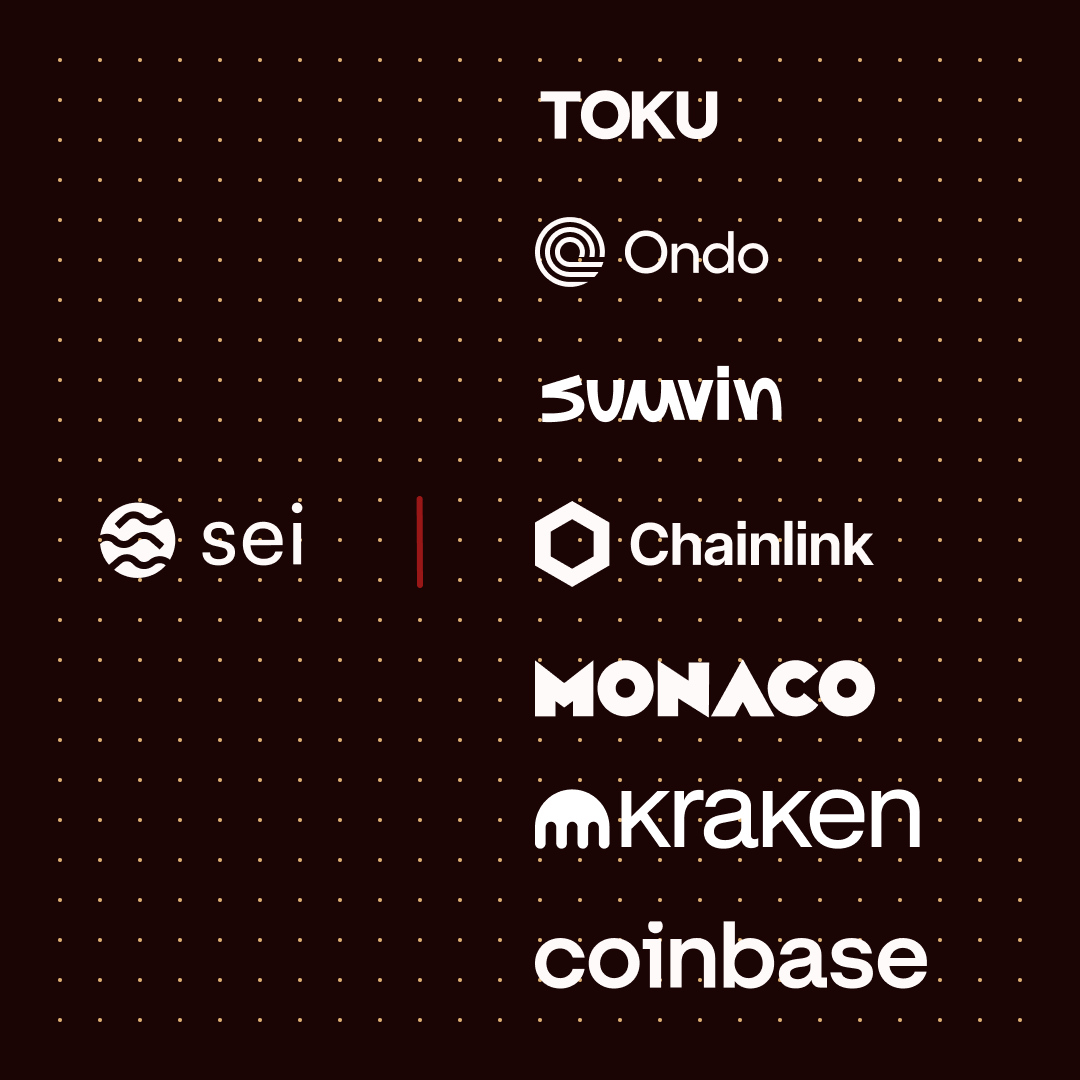
Two months into 2026. The financial stack on Sei is accelerating. • @OndoFinance tokenized US Treasuries, live across Sei lending markets. • @chainlink equities price feeds coming to Sei via @MonacoTrading. • @MonacoTrading's CLOB powering @cultztrade and @m1markets. • @usetoku stablecoin payroll — integrated in 190+ countries. • @Sumvin out of stealth with agentic consumer finance. • @coinbase announced Sei EVM integration. • @krakenfx live with native Sei EVM deposits and withdrawals. • @ledger_business live with enterprise custody for Sei. • DAA at 1.7M. Seven consecutive quarters of growth. Treasuries. Equities. Payroll. Agents. Custody. Exchange access. The stack is filling in. The activity is too.
Sei tweet media
English
70
128
777
57.3K
Sei
Sei@SeiNetwork·
Sei Giga is for global scale finance.
English
31
16
159
7.8K
Sei
Sei@SeiNetwork·
The line between DeFi and TradFi is dissolving. It's just finance, for a global, 24/7 world. Builders from GSR, Jump Crypto, Hudson River Trading, and Robinhood have joined Monaco to bring this to life. @0xturbanurban of @MonacoTrading lays out the architecture for what that actually looks like: Spot, perps, prediction markets, tokenized equities. One order book, sub-second settlement.
0xturbanurban@0xturbanurban

x.com/i/article/2036…

English
35
42
318
16.6K
Sei
Sei@SeiNetwork·
NEW: @krakenfx now supports USDC and USDT0 deposits and withdrawals on Sei EVM.
English
27
65
427
12.8K
Sei
Sei@SeiNetwork·
The road to Sei Giga will live on seilabs.io Check Sei Labs' new site for updates on the next evolution of the Sei protocol ↓
Sei Labs@Sei_Labs

We rebuilt SeiLabs.io to show what we're working on: from Giga to the projects we've been incubating We'll have a lot more going live in the coming months If you like solving hard problems, check the open roles

English
39
47
389
20.1K
Sei
Sei@SeiNetwork·
Institutional-grade DeFi, frameworks for global scale, and consumer apps to look forward to. Here's what you might have missed this week on Sei ↓ 🔴 @Morpho Vaults V2 went live on Sei, bringing institutional-grade controls to dynamic DeFi yield management: x.com/SeiNetwork/sta… 🔴 @Sei_Labs published research on the spectrum of finality and how Giga is approaching it: x.com/Sei_Labs/statu… 🔴 @jayendra_jog broke down the finality frameworks guiding Giga development: x.com/jayendra_jog/s… 🔴 @YeiFinance launched the Clovis Testnet, enabling unified lending rates for crosschain DeFi with Sei as the universal clearing layer: x.com/YeiFinance/sta… 🔴 @YeiFinance and @JumperExchange went live with Sei Nitro Missions: x.com/YeiFinance/sta… 🔴 @Saphyre_xyz crossed 10k signups for their mobile beta waitlist: x.com/Saphyre_xyz/st… 🔴 @Kindred_AI launches globally April 24 with @_LINEFRIENDS: x.com/Kindred_AI/sta… Markets Move Faster on Sei. ($/acc)
English
64
54
392
16.1K
Sei
Sei@SeiNetwork·
The most performant EVM today. The most scalable with Sei Giga next. Global finance moves faster on Sei.
English
65
66
492
19.9K
Sei أُعيد تغريده
Jay ($/acc)
Jay ($/acc)@jayendra_jog·
finality is the most abused word in blockchain. our research team just dropped a very relevant series on this. core thesis: finality is not a boolean. it's a spectrum of credible commitments. the only honest question is — under what assumptions, and at what cost will it break? almost nobody waits for Ethereum's formal finality (~18 min). rollups claim 5-second finality but at that point you're trusting a sequencer and a security council of ~12 entities. not the full validator set. no general-purpose rollup has reached Stage 2. not one. things people get wrong: more stake = more security. not if 3 entities control it. $50B across 3 validators is easier to corrupt than $10B across 50 independent operators. instant finality = real finality. a 200ms commitment from 1 validator is instant and weak. 400ms from 40 validators with 2 rounds of voting is slightly slower and categorically stronger. faster = better. a system that hits 150ms by relaxing fault tolerance from 33% to 20% has made finality faster and weaker. this is why we built Sei the way we did, and why we're designing Sei Giga using the same framework. 400ms finality under classical BFT assumptions studied for decades = credibly fast. read the series below.
English
6
11
79
7.6K
Sei
Sei@SeiNetwork·
@0xturbanurban this guy knows a thing or two
English
1
0
24
1K
0xturbanurban
0xturbanurban@0xturbanurban·
Just some high level thoughts regarding the paper...it reminds of what an old mentor would say: the difference between theory and practice tends to be far greater in practice than in theory. * Although the authors discuss cross-venue arbs across correlated pairs, the flat-spread FBA equilibrium requires universal adoption, in order to be effective. If continuous CLOBs set the next best b/o on competing venues, the x-venue race resumes...creating a persistent arb. Or said another way, the FBA's symmetric-information notion is undermined when a correlated continuous market exists. * The assumption of limited to no inventory risk seems divorced from reality. Actual m/m can have sizable inventory risk, and FBA's discretization dictates that a m/m that's legged into risk can't execute the hedge in a sub-batch timescale, only at the next clearing price (whereas in continuous markets, they will at least dynamically hedge in response to inventory imbalance). This problem is exacerbated when you have - Illiquid assets, where the latency between batches matters much more - Correlated assets trade on different exchange mechanics (e.g. FBA vs continuous CLOB, or valuing price-time priority vs not) - Pin risk you're trying to manage (ie ~ATM short-dated options) * The model assumes away pre-execution information leakage as a design choice (aka non-disclosure of intra-batch order flow), but doesn't look at whether that is itself enforceable or what happens when it breaks down, when either: - The exchange operator itself has privileged access, or - DeFi's public mempools expose pending orders pre-execution.
Logan Jastremski@LoganJastremski

The high-frequency trading arms race is a symptom of flawed market design. Instead of the continuous limit order book market design that is currently predominant, we argue that financial exchanges should use frequent batch auctions: uniform price double auctions conducted, for example, every tenth of a second. That is, time should be treated as discrete instead of continuous, and orders should be processed in a batch auction instead of serially. Our argument has three parts. First, we use millisecond-level direct-feed data from exchanges to document a series of stylized facts about how the continuous market works at high-frequency time horizons: (i) correlations completely break down; which (ii) leads to obvious mechanical arbitrage opportunities; and (iii) competition has not affected the size or frequency of the arbitrage opportunities, it has only raised the bar for how fast one has to be to capture them. Second, we introduce a simple theory model which is motivated by and helps explain the empirical facts. The key insight is that obvious mechanical arbitrage opportunities, like those observed in the data, are built into the market design—continuous-time serial-processing implies that even symmetrically observed public information creates arbitrage rents. These rents harm liquidity provision and induce a never-ending socially wasteful arms race for speed. Last, we show that frequent batch auctions directly address the flaws of the continuous limit order book. Discrete time reduces the value of tiny speed advantages, and the auction transforms competition on speed into competition on price. Consequently, frequent batch auctions eliminate the mechanical arbitrage rents, enhance liquidity for investors, and stop the high-frequency trading arms race.

English
2
0
11
2.2K
Yei Finance
Yei Finance@YeiFinance·
Clovis testnet is live. Your capital is stuck on one chain, earning one way at a time. Clovis fixes that. Deposit and bridge USDC + USDT across four chains: @Ethereum, @base, @BNBChain, @SeiNetwork. Built on $400M in peak TVL and two years of live DeFi infrastructure on Sei.
English
24
24
140
13.1K
Sei
Sei@SeiNetwork·
Clovis testnet by @YeiFinance is live. Yei is one of the most established protocols on Sei, and Clovis expands their scope. One deposit, unified lending rates for crosschain DeFi. With Sei as the universal clearing layer.
English
40
55
380
20.6K