
Ugaitz

896 posts

Ugaitz banner
Ugaitz

Ugaitz

@ugaitz

In the end, everything is a gag. Do not take me too serious.

Manhattan, NY انضم Ağustos 2008
824 يتبع246 المتابعون
Ugaitz أُعيد تغريده
Andrej Karpathy
Andrej Karpathy@karpathy·
LLM Knowledge Bases Something I'm finding very useful recently: using LLMs to build personal knowledge bases for various topics of research interest. In this way, a large fraction of my recent token throughput is going less into manipulating code, and more into manipulating knowledge (stored as markdown and images). The latest LLMs are quite good at it. So: Data ingest: I index source documents (articles, papers, repos, datasets, images, etc.) into a raw/ directory, then I use an LLM to incrementally "compile" a wiki, which is just a collection of .md files in a directory structure. The wiki includes summaries of all the data in raw/, backlinks, and then it categorizes data into concepts, writes articles for them, and links them all. To convert web articles into .md files I like to use the Obsidian Web Clipper extension, and then I also use a hotkey to download all the related images to local so that my LLM can easily reference them. IDE: I use Obsidian as the IDE "frontend" where I can view the raw data, the the compiled wiki, and the derived visualizations. Important to note that the LLM writes and maintains all of the data of the wiki, I rarely touch it directly. I've played with a few Obsidian plugins to render and view data in other ways (e.g. Marp for slides). Q&A: Where things get interesting is that once your wiki is big enough (e.g. mine on some recent research is ~100 articles and ~400K words), you can ask your LLM agent all kinds of complex questions against the wiki, and it will go off, research the answers, etc. I thought I had to reach for fancy RAG, but the LLM has been pretty good about auto-maintaining index files and brief summaries of all the documents and it reads all the important related data fairly easily at this ~small scale. Output: Instead of getting answers in text/terminal, I like to have it render markdown files for me, or slide shows (Marp format), or matplotlib images, all of which I then view again in Obsidian. You can imagine many other visual output formats depending on the query. Often, I end up "filing" the outputs back into the wiki to enhance it for further queries. So my own explorations and queries always "add up" in the knowledge base. Linting: I've run some LLM "health checks" over the wiki to e.g. find inconsistent data, impute missing data (with web searchers), find interesting connections for new article candidates, etc., to incrementally clean up the wiki and enhance its overall data integrity. The LLMs are quite good at suggesting further questions to ask and look into. Extra tools: I find myself developing additional tools to process the data, e.g. I vibe coded a small and naive search engine over the wiki, which I both use directly (in a web ui), but more often I want to hand it off to an LLM via CLI as a tool for larger queries. Further explorations: As the repo grows, the natural desire is to also think about synthetic data generation + finetuning to have your LLM "know" the data in its weights instead of just context windows. TLDR: raw data from a given number of sources is collected, then compiled by an LLM into a .md wiki, then operated on by various CLIs by the LLM to do Q&A and to incrementally enhance the wiki, and all of it viewable in Obsidian. You rarely ever write or edit the wiki manually, it's the domain of the LLM. I think there is room here for an incredible new product instead of a hacky collection of scripts.
English
2.9K
7.2K
59.3K
21.2M
Ugaitz أُعيد تغريده
JUMPERZ
JUMPERZ@jumperz·
karpathy is showing one of the simplest AI architectures that actually works.. dump research into a folder, let the model organise it into a wiki, ask questions, then file the answers back in. the real insight is the loop...every query makes the wiki better. it compounds.. now thats a second brain building itself. i think this is so good for agents if applied right instead of pulling from shared memory every session, they build a living knowledge base that stays. your coordinator is not just coordinating tasks anymore.. it is maintaining institutional knowledge so every execution adds something back to the base. the bigger implication is crazy tho. agents that own their own knowledge layer do not need infinite context windows, they need good file organisation and the ability to read their own indexes. way cheaper, way more scalable, and way more inspectable than stuffing everything into one giant prompt.
JUMPERZ tweet media
Andrej Karpathy@karpathy

LLM Knowledge Bases Something I'm finding very useful recently: using LLMs to build personal knowledge bases for various topics of research interest. In this way, a large fraction of my recent token throughput is going less into manipulating code, and more into manipulating knowledge (stored as markdown and images). The latest LLMs are quite good at it. So: Data ingest: I index source documents (articles, papers, repos, datasets, images, etc.) into a raw/ directory, then I use an LLM to incrementally "compile" a wiki, which is just a collection of .md files in a directory structure. The wiki includes summaries of all the data in raw/, backlinks, and then it categorizes data into concepts, writes articles for them, and links them all. To convert web articles into .md files I like to use the Obsidian Web Clipper extension, and then I also use a hotkey to download all the related images to local so that my LLM can easily reference them. IDE: I use Obsidian as the IDE "frontend" where I can view the raw data, the the compiled wiki, and the derived visualizations. Important to note that the LLM writes and maintains all of the data of the wiki, I rarely touch it directly. I've played with a few Obsidian plugins to render and view data in other ways (e.g. Marp for slides). Q&A: Where things get interesting is that once your wiki is big enough (e.g. mine on some recent research is ~100 articles and ~400K words), you can ask your LLM agent all kinds of complex questions against the wiki, and it will go off, research the answers, etc. I thought I had to reach for fancy RAG, but the LLM has been pretty good about auto-maintaining index files and brief summaries of all the documents and it reads all the important related data fairly easily at this ~small scale. Output: Instead of getting answers in text/terminal, I like to have it render markdown files for me, or slide shows (Marp format), or matplotlib images, all of which I then view again in Obsidian. You can imagine many other visual output formats depending on the query. Often, I end up "filing" the outputs back into the wiki to enhance it for further queries. So my own explorations and queries always "add up" in the knowledge base. Linting: I've run some LLM "health checks" over the wiki to e.g. find inconsistent data, impute missing data (with web searchers), find interesting connections for new article candidates, etc., to incrementally clean up the wiki and enhance its overall data integrity. The LLMs are quite good at suggesting further questions to ask and look into. Extra tools: I find myself developing additional tools to process the data, e.g. I vibe coded a small and naive search engine over the wiki, which I both use directly (in a web ui), but more often I want to hand it off to an LLM via CLI as a tool for larger queries. Further explorations: As the repo grows, the natural desire is to also think about synthetic data generation + finetuning to have your LLM "know" the data in its weights instead of just context windows. TLDR: raw data from a given number of sources is collected, then compiled by an LLM into a .md wiki, then operated on by various CLIs by the LLM to do Q&A and to incrementally enhance the wiki, and all of it viewable in Obsidian. You rarely ever write or edit the wiki manually, it's the domain of the LLM. I think there is room here for an incredible new product instead of a hacky collection of scripts.

English
137
723
8.2K
931.7K
Ugaitz أُعيد تغريده
JUMPERZ
JUMPERZ@jumperz·
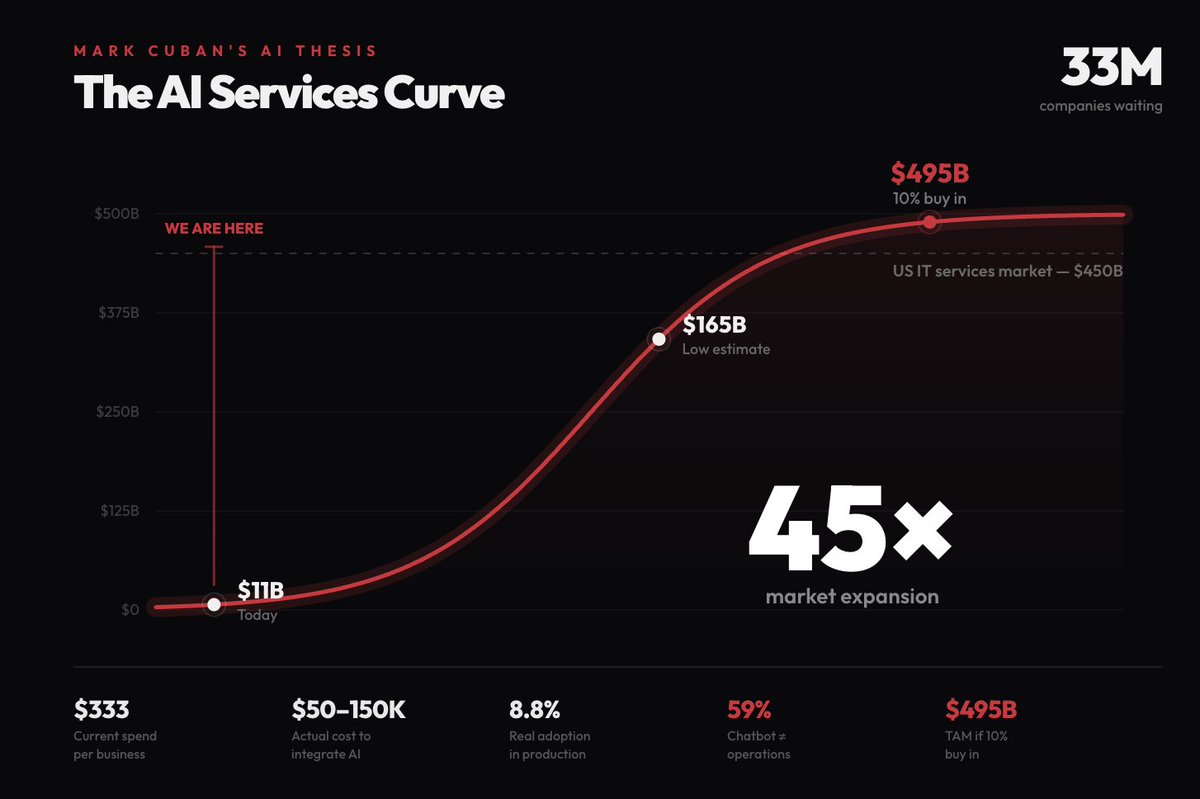
Mark Cuban is calling AI the biggest job creation wave since the internet.. and when you look at the numbers it makes sense.. >33 million US businesses need AI integration and only 8.8% actually have it in production.. >the current market is $11B but the real opportunity is $165B to $495B... and all of that money is going to people who can set up AI systems for businesses, not people who can build AI from scratch this is exactly why betting on agent orchestration makes sense >most people hear "AI opportunity" and think they need to build the next chatgpt or learn to code when they don't.. >33 million businesses need someone to walk in, understand their workflow, and set up agents that actually do the work..not another SaaS subscription.. >68% of businesses say they use AI.. but dig into it and most of them are just prompting chatgpt for emails so the distance between "i used a chatbot" and "AI runs my operations" is where the entire opportunity sits.. and no tool is closing that gap on its own, it needs people who understand both the business and the agentic tech... ive also been saying this for long .. the people who know how to set up and run agent systems are about to be the most in demand people in tech, and most of them won't only be engineers..
JUMPERZ tweet media
English
59
98
1.1K
113.5K
Ugaitz أُعيد تغريده
Garry Tan
Garry Tan@garrytan·
Boil the Oceans You know the phrase: “don’t boil the ocean.” Everyone’s said it in some overly ambitious meeting. It’s good advice in normal times. It keeps teams focused. It prevents scope creep. But we are no longer in normal times, and I think it’s time to retire saying it. Artificial Superintelligence means it’s time to boil the ocean. We’ll start with a few lakes first. I was recently with a university endowment’s head of private investing who told me their engineers were terrified for their jobs after seeing what Claude Code could do. And I get it — that’s the natural first reaction. But it’s the wrong one. It’s a zero-sum reaction to a positive-sum moment. Instead of worrying about doing the same thing we’ve been doing for cheaper, why not focus on doing the thing we never even dreamed of doing? Why can’t that endowment achieve 50% net IRR instead of 10%? Why can’t a startup deliver a service that is 100x better than the incumbent? Why can’t we have fusion energy? Why can’t we talk to every single user and have a perfect understanding of every bug in our product? These aren’t rhetorical questions anymore. They’re engineering problems with paths to solutions. Here is what I think is actually going on with the fear: our fear of the future is directly proportional to how small our ambitions are. If your plan is to keep doing exactly what you’re doing, then yes, a machine that can do it faster and cheaper is terrifying. But if your plan is to do something dramatically bigger, then the machine is the best news you’ve ever gotten. If you’re a worker — someone who trades labor for a living — this is the moment to become a builder. Start a business. And if you’re already management or capital, it’s time to go 10x more hardcore on what your aspirations could be. Not eking out 5% efficiency gains. Not increasing profit margins 2% by lowering cost and firing people. Those are the old games. The new question is: what would it look like to build a product or service so good that people would happily pay 10x what they pay now? The net result of this is more jobs, not fewer. As Ryan Petersen likes to say, the human desire for more things is absolutely limitless. We can actually fulfill that desire now — if we have the agency to prompt it for ourselves. Buckminster Fuller coined the term “ephemeralization” in 1938: doing more and more with less and less until eventually you can do everything with nothing. His entire vision of progress was about technology enabling radical expansion of human capability through dematerialization. He traced this from stone bridges to iron trusses to steel cables — each iteration stronger, longer, lighter, cheaper. He wasn’t describing job destruction. He was describing civilization getting better at being civilization. This is Jevons Paradox for everything. When you make a resource dramatically more efficient, you don’t use less of it — you use vastly more. Steam engines didn’t reduce coal consumption. They made coal so useful that demand exploded. The same thing is about to happen with intelligence, with labor, with every service and product we can imagine. But Jevons Paradox doesn’t activate on its own. It requires capital and management to actually raise their ambitions — to boil lakes and oceans instead of drowning them in committee That’s what startups have always been good at: moving fast in the face of radical uncertainty, building for the 10x future while everyone else is optimizing for the 1.05x present. Time to start.
English
169
297
2.3K
523.1K
Hugo Mercier
Hugo Mercier@hugomercierooo·
𝗜𝗻𝘁𝗿𝗼𝗱𝘂𝗰𝗶𝗻𝗴 𝗧𝘄𝗶𝗻 — 𝘁𝗵𝗲 𝗔𝗜 𝗰𝗼𝗺𝗽𝗮𝗻𝘆 𝗯𝘂𝗶𝗹𝗱𝗲𝗿. No setup. Secure. Infinitely scalable. We just raised a $𝟭𝟬𝗠 𝘀𝗲𝗲𝗱. After a beta with 𝟭𝟬𝟬,𝟬𝟬𝟬+ 𝗮𝗴𝗲𝗻𝘁𝘀 𝗱𝗲𝗽𝗹𝗼𝘆𝗲𝗱, we’re now opening to everyone. RT and comment “Twin” — first agents on us. 👇
English
6K
3.2K
8.4K
3.2M
Ugaitz أُعيد تغريده
Andrej Karpathy
Andrej Karpathy@karpathy·
Agency > Intelligence I had this intuitively wrong for decades, I think due to a pervasive cultural veneration of intelligence, various entertainment/media, obsession with IQ etc. Agency is significantly more powerful and significantly more scarce. Are you hiring for agency? Are we educating for agency? Are you acting as if you had 10X agency? Grok explanation is ~close: “Agency, as a personality trait, refers to an individual's capacity to take initiative, make decisions, and exert control over their actions and environment. It’s about being proactive rather than reactive—someone with high agency doesn’t just let life happen to them; they shape it. Think of it as a blend of self-efficacy, determination, and a sense of ownership over one’s path. People with strong agency tend to set goals and pursue them with confidence, even in the face of obstacles. They’re the type to say, “I’ll figure it out,” and then actually do it. On the flip side, someone low in agency might feel more like a passenger in their own life, waiting for external forces—like luck, other people, or circumstances—to dictate what happens next. It’s not quite the same as assertiveness or ambition, though it can overlap. Agency is quieter, more internal—it’s the belief that you *can* act, paired with the will to follow through. Psychologists often tie it to concepts like locus of control: high-agency folks lean toward an internal locus, feeling they steer their fate, while low-agency folks might lean external, seeing life as something that happens *to* them.”
Garry Tan@garrytan

Intelligence is on tap now so agency is even more important

English
2K
9.3K
49.8K
11.3M
Irene Montero
Irene Montero@IreneMontero·
Seguro que has escuchado a tu cuñado en la mesa diciendo eso de que para acabar con el problema de la vivienda hay que construir más. Aquí desmonto ese bulo 👇
Español
2.4K
1.3K
2.7K
998.8K
Ugaitz أُعيد تغريده
Haider.
Haider.@haider1·
Microsoft AI CEO, Mustafa Suleyman: By the end of 2025, models will move from one-shot answers to continuous planning With persistent memory and long-horizon planning, models will become deeply human-like no new algorithm, mostly compute and scale
English
136
275
1.9K
255.1K
Invertir es vivir
Invertir es vivir@invertiresvivir·
Este es el mejor fondo indexado al S&P500: Fidelity S&P 500 Index Fund P Acc EUR (ISIN IE00BYX5MX67). Te cuento por qué. Dentro hilo🧵
Español
5
3
42
10.2K
Ugaitz أُعيد تغريده
Marc Andreessen 🇺🇸
Why AI Won't Cause Unemployment Marc Andreessen Reposted Jan 24, 2025 "In retrospect, I wish I had known more about the hazards and difficulties of [running] a business." -- George McGovern Fears about new technology replacing human labor and causing overall unemployment have raged across industrialized societies for hundreds of years, despite a nearly continual rise in both jobs and wages in capitalist economies. The jobs apocalypse is always right around the corner; just ask the Luddites. We had two such anti-technology jobs moral panics in the last 20 years — “outsourcing” enabled by the Internet in the 2000’s, and “robots” in the 2010’s. The result was the best national and global economy in human history in pre-COVID 2019, with the most jobs at the highest wages ever. Now we’re heading into the third such panic of the new century with AI, coupled with a continuous drumbeat of demand for Communist-inspired Universal Basic Income. “This time is different; AI is different,” they say, but is it? Normally I would make the standard arguments against technologically-driven unemployment — see good summaries by Henry Hazlitt (chapter 7) and Frédéric Bastiat (his metaphor directly relevant to AI). And I will come back and make those arguments soon. But I don’t even think the standand arguments are needed, since another problem will block the progress of AI across most of the economy first. Which is: AI is already illegal for most of the economy, and will be for virtually all of the economy. How do I know that? Because technology is already illegal in most of the economy, and that is becoming steadily more true over time. How do I know that? Because, [see chart]. This chart shows price changes, adjusted for inflation, across a dozen major sectors of the economy. As you can see, we actually live in two different economies. The lines in blue are the sectors where technological innovation is allowed to push down prices while increasing quality. The lines in red are the sectors where technological innovation is not permitted to push down prices; in fact, the prices of education, health care, and housing as well as anything provided or controlled by the government are going to the moon, even as those sectors are technologically stagnant. We are heading into a world where a flat screen TV that covers your entire wall costs $100, and a four year college degree costs $1 million, and nobody has anything even resembling a proposal on how to systemically fix this. Why? The sectors in red are heavily regulated and controlled and bottlenecked by the government and by those industries themselves. Those industries are monopolies, oligopolies, and cartels, with extensive formal government regulation as well as regulatory capture, price fixing, Soviet style price setting, occupational licensing, and every other barrier to improvement and change you can possibly imagine. Technological innovation in those sectors is virtually forbidden now. Whereas the sectors in blue are less regulated, technology whips through them, pushing down prices and raising quality every year. Note the emotional loading of the interplay of production and consumption here. What do we get mad about? With our consumer hat on, we get mad about price increases — the red sectors. With our producer hat on, we get mad about technological disruption — the blue sectors. Well, pick one; as this chart shows, you can’t have your cake and eat it too. Now think about what happens over time. The prices of regulated, non-technological products rise; the prices of less regulated, technologically-powered products fall. Which eats the economy? The regulated sectors continuously grow as a percentage of GDP; the less regulated sectors shrink. At the limit, 99% of the economy will be the regulated, non-technological sectors, which is precisely where we are headed. Therefore AI cannot cause overall unemployment to rise, even if the Luddite arguments are right this time. AI is simply already illegal across most of the economy, soon to be virtually all of the economy.
Marc Andreessen 🇺🇸 tweet media
English
766
1.5K
9.2K
1.8M
Ugaitz أُعيد تغريده
Carlos Santana
Carlos Santana@DotCSV·
🔴 ¡OPENAI ANUNCIA PROYECTO STARGATE! Una inversión multimillonaria en los próximos 4 años de 500 mil millones de dólares (un tercio el PIB de España) en colaboración con SoftBank, Oracle, MGX, y con partners como ARM, Microsoft, NVIDIA para construir en EE.UU las infraestructuras necesarias para un futuro donde la AGI será una realidad. EE.UU se están preparando para el futuro.
Carlos Santana tweet media
Español
86
409
2.4K
238K
Ugaitz
Ugaitz@ugaitz·
the EU has incredibly sound foundations to foster a vibrant startup ecosystem. There are thus reasons to be optimistic that the region can turn things around if structural factors (…) are addressed. nextbigteng.substack.com/p/american-vs-…
English
0
0
0
29
Ugaitz أُعيد تغريده
The Spectator Index
The Spectator Index@spectatorindex·
World's best cities for food, 2023. 1. 🇪🇸 San Sebastian 2. 🇮🇱 Tel Aviv 3. 🇮🇹 Naples 4. 🇲🇽 Mexico City 5. 🇪🇸 Malaga 6. 🇨🇦 Quebec City 7. 🇦🇺 Melbourne 8. 🇨🇦 Victoria 9. 🇮🇹 Rome 10. 🇰🇷 Seoul (Conde Nast Traveller)
English
1.3K
394
7.3K
1.9M