

Vishal Menon
264 posts

tech bros who live in East Asia, speak an East Asian language fluently, and operate under the assumption that all the girls will go crazy for them (for being White and speaking an East Asian language fluently)
…have got to be some of the most insufferable people on this planet
English
Such an excellent read this…the pivot from chat first to ambient analysis is honestly the real architectural winner here. In 2B scale models, persona management and instruction following consume way too much of the parameter budget. So when u constrain the task to feature extraction and trend analysis, you’re effectively reclaiming those weights for higher precision domain logic. It’s the actual shift from instruction tuning to functional mapping that makes the entire edge intelligence viable. This is why I’d always say that niche and domain locked specialists will beat shallow generalists every time!
English

The problem is that you can't "patch" a probability distribution. When an agent drifts into an unsafe state space, it’s not a code bug but a valid inference path.
We need to move toward a hybrid architecture where the agentic reasoning layer is actually wrapped in a deterministic and formally verified monitor. In most high stakes environments, emergent intelligence is a liability unless it's constrained by a provable logic trace. Would be glad to hear some of your thoughts on this.
English
Diving into formal verification while mapping out autonomous decision paths. There’s a widening verifiability gap in how we deploy agentic AI.
We’re currently making a categorical error in giving probabilistic reasoning engines deterministic execution authority over critical infrastructure. If you can’t mathematically bound the agent’s decision space, you aren't actually securing it. As a matter of fact, you're just gambling on the alignment of the next token.
English
Spot on. The convenience argument is actually a risk adjusted opportunity cost argument.
SG’s real edge isn't as a market but as a laboratory. The outliers here treat SG as a high trust sandbox for R&D but build for global and homogeneous markets to bypass the "SEA localization tax" entirely.
In the US or China capital will buy pure growth. In SEA that same capital is diverted into localization friction. The strategic escape isn't a better regional strategy rather, it’s a global first mandate that prioritizes market uniformity over geographical proximity.
English

Singapore has no startups that scale because there is no large homogeneous market to scale to. If SEA, from day 1 founders have to manage 5-6 language, cultures, regulatory landscapes, cost bases etc. Extremely capital inefficient on top of the immense operational complexity.
Many other reasons but they are all second order. Market stops 90% of the people (founders and investors) from even trying.
Zac@Zac_Pundi
"Singapore has no startups because everything is too convenient" Bro China has the most convenient payment and utility payment systems on earth. That clearly didn't stop them. The real problem: Singapore's system is so well-designed that the rational move for a smart person is to never leave it. NUS → DBS → $10K/month by 30. The expected value genuinely beats startup odds. Smartest locals I know "try" startup for one year — after thinking about it for three. Meanwhile US/China founders just jump. And if Grab started in SG instead of Malaysia, you think MOT wouldn't have shut it down before Series A? It's not convenience. It's a system optimized for comfort, and a culture that counts the odds before jumping.
English


Today, you can build a product in a weekend. You still can't fund it without a lawyer, a cap table, and a decade-long commitment.
🧩We've identified 10 open problems builders of the agentic internet need to solve.
We've set aside capital against this thesis and we're opening a Request for Builders today.

English

Loved reading this. The double squeeze you’ve mentioned abt LLMs lowering the floor for exploits while quantum tech lowers the ceiling for long term security is probably the most sobering take I’ve seen this year.
A lot of this suggests that the 'adoption phase' for payments isn't just a choice but a defensive retreat into the few verticals where speed and trust minimisation still provide a measurable edge over tradfi.
As for meme coins I totally agree too. It feels like we’ve shifted from a positive sum innovation phase to a zero sum “extractive” phase where the only remaining edge is in automating the snooping of insider wallets. If the cool new stuff are all happening in photonics and peptides now, crypto’s main challenge is proving it can be more than just a high velocity casino for the AI augmented elite. Once again, brilliant read.
English


Your next 30 days of content is already written. You just haven't seen it yet.
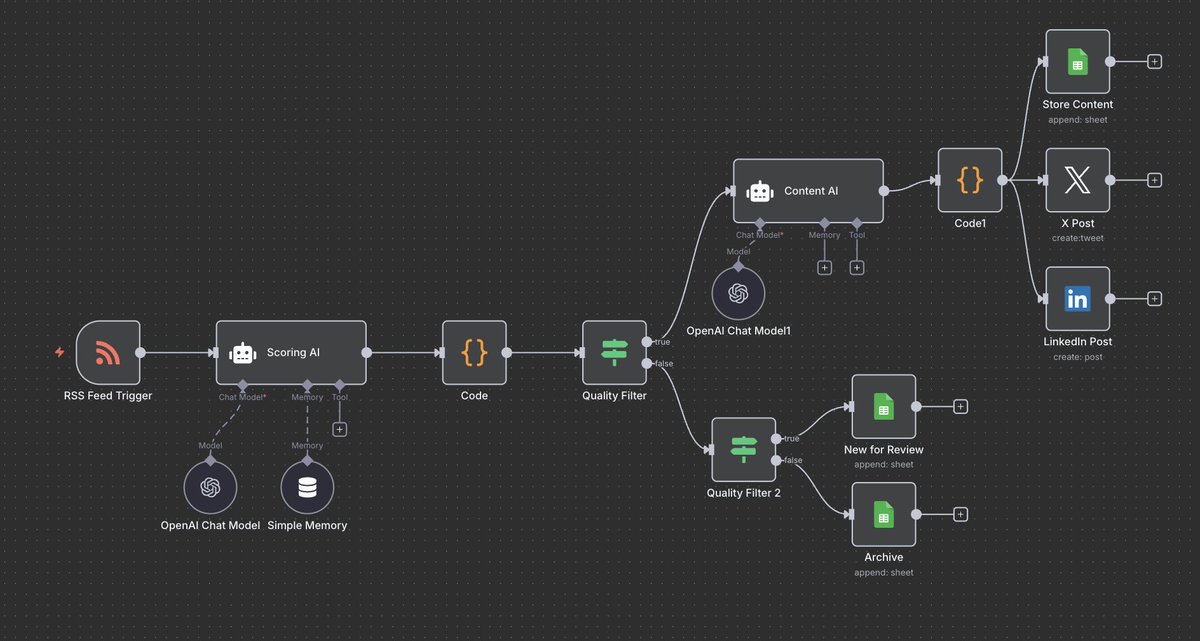
This automation watches 50+ news sources every hour, scores every article for quality and relevance, and turns the best ones into Twitter threads and LinkedIn posts automatically.
High-scoring stories get drafted into platform-specific content ready to post.
Medium scores land in your review queue so you can tweak them if you want.
Junk gets archived before it ever wastes your time.
Never scramble for content ideas at 11pm again. Never post yesterday's trend a day too late.
Your feed stays alive while you sleep, travel, or work on something that actually moves the business forward.
Saves 15-20 hours a month and keeps you ahead of every trend in your niche.
Comment "NEWS" and I'll DM it to you (must be following)
English
Agreed. But that same efficiency makes it a strong base for deeper tech. Funding is growing especially in fintech and AI infra and our ecosystem ranks among the top globally. The focus shifts to building products for the world, not patching local problems.
The real constraint now isn’t in infra but how willing people are to take risks in general.
English

as i paid my singapore taxes last weekend
i realized singapore will never be a great startup hub.
because everything just works too well here. it takes me sub 5 mins to file my taxes. this would have cost thousands and way more hours in the US.
ride hailing and micro mobility are capped because of great public transportation.
healthcare is so cheap you don’t even think about trying to AI compare / navigate care
English
@jasveer10 Very interesting range of responses you seem to have here…I’m flabbergasted
English

IIT grad, top consulting background, applying to Ivy League
Not working for a year. “Can you just give me an offer letter?” The entitlement is insane 🤦♂️
Impressive resume, embarrassing mindset. Degrees don’t fix character

English
Yep fully agreed. Compliance heavy setups like curated, KYC integrated pools do feel more appealing to strict FIs on paper given their plugged in audit trails, structured deals and easier justification for internal risk teams altogether.
But the latest CEX drama flips that narrative fast. A recent report alleged massive USDT flows mostly on Tron, to sanctioned linked entities over the past couple of years with claims that internal compliance flags were ignored or mishandled, leading to senior staff exits. The exchange pushed back strongly, denying violations, firings over concerns and pointing to full internal reviews plus external counsel clearance.
Then came a public ultimatum from an on-chain investigator…Richard I believe was his name? He basically retracted the denial by end of Friday or verified blockchain data which was originally fed to the very analytics tools the exchange pays for and this gets dropped publicly across multiple providers. The framing is blunt eod, facilitation risks tied to sanctioned jurisdictions that create real world safety issues.
If that data surfaces this weekend with solid proofs, it could reignite serious regulatory pressure on CEXes and make institutions even warier of relying on CEX rails for anything sensitive imo.
This then plays directly into the strength of decentralized credit protocols where you bypass single point screening failures completely. Pure onchain transparency, self custody options and modular setups let you layer tailored risk controls without depending on a centralized black box.
In APAC where sanctions enforcement is already tight and regulators obsess over evasion leaks, this kind of stuff could quietly accelerate shifts toward programmable, clean rails like yr tokenized deposits, settlement pilots or direct defi credit access. The flexible, multichain vault models like u pointed out might capture yield hungry treasury flows faster, while the more structured and hands on pools own the credit starved SME niches that need perceived safety. We see a lot of these windows opening up in the Indonesian markets.
So yeah compliance heavy still wins short term trust with ultra conservative FIs but avoiding centralized scandal exposure and composability could hand the velocity edge to onchain players over time.
Any early signals in SG of institutions quietly reducing exposure you reckon? Am trying to look into this more thoroughly as developments come up in the next few weeks or so
English

Totally agree on the ETH gravity for RWAs BUIDL’s sitting at around $2B AUM now, which dwarfs most of those hype-driven L1s that popped up last cycle. It’s the boring reliability that’s winning, not the shiny new chains.
On the credit side, yeah, that repo/money market hybrid without middlemen is quietly revolutionary, especially in Asia where settlement speed and yield hunting are massive for institutions dodging legacy FX headaches. Maple’s TVL has exploded to nearly $3B with heavy institutional inflows from players like Bitwise, and their focus on structured lending feels tailor-made for APAC’s credit-starved SMEs.
Morpho’s even bigger at ~$9B TVL, pulling in corporate treasuries via vaults on Base and beyond, with integrations like Lombard unlocking idle BTC for collateral, that’s already seeing $500B+ potential in dormant institutional liquidity.
If I had to bet on which hits meaningful institutional volume first (say, $10B+ in active loans or equivalent), I’d say Morpho edges it out. Their modular vaults are scaling faster with multichain rollouts and curator-driven yields pulling in big money quicker than Maple’s more curated pools.
But in Asia specifically, watch for pilots like e-HKD or Textile on Celo bridging that $5T+ financing gap in emerging markets could supercharge both.
English
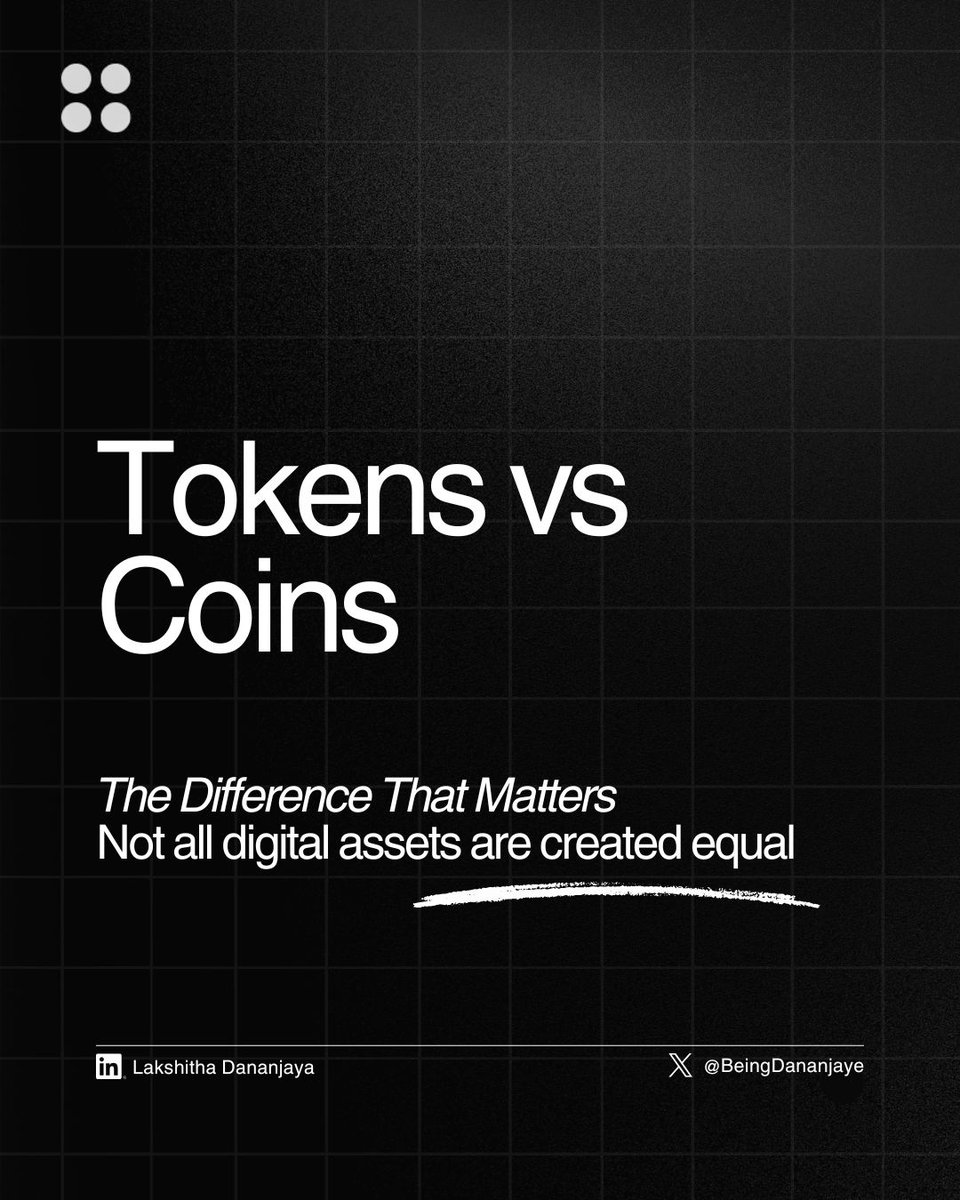
People throw around "crypto" like it's one thing. It's not. Coins and tokens are completely different beasts with different use cases, risks, and enterprise implications.
This confusion has burned billions.
English
Bitcoin isn’t perfect but the discourse around it is cartoonishly bipolar.
Same stochastic process. Different gods.
That’s the real tell.
English
10/ At the end of the day this isn’t analysis.
It’s all vibes masquerading as math.
Most people in finance who talk this way can’t be taken seriously on the topic because the framework completely collapses the moment price goes against them. Playing the card only when it suits their agenda. Funny for self proclaimed rational thinkers.
English
It’s wild how people apply wildly inconsistent math to Bitcoin treating it like a “serious investment” only when the price is going up.
When it dips → suddenly it’s pure speculation with zero utility.
Double standard much? A short thread.
English