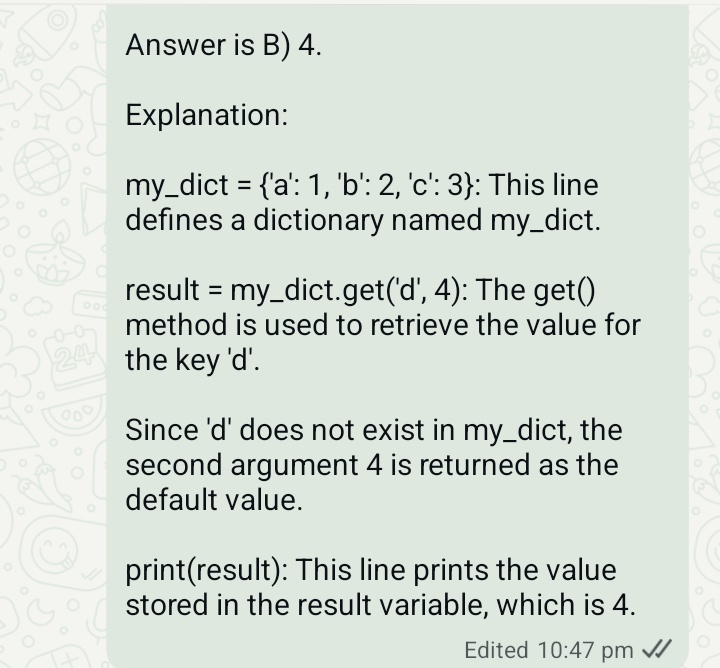
@PythonPr Answer: B) 4
The Python dictionary get() method is used to retrieve the value for a specified key. It takes two arguments: the key you want to search for, and an optional default value to return if the key is not found.
In the provided code:
my_dict is {'a': 1, 'b': 2, 'c': 3}.
@PythonPr Answer: B) 4
Explanation: dict.get(key, default) returns the default value if the key doesn’t exist.
Since 'd' isn’t in my_dict, it returns 4 (no KeyError).
@PythonPr B) 4
my_dict.get(key, default_value):
• This dictionary method tries to find key in the dictionary.
• If key is found, it returns the associated value.
• If key is not found, it returns default_value instead of raising a KeyError (which my_dict['d'] would do).
@PythonPr Answer: B) 4
Explanation:
dict.get(key, default) returns the value for key if it exists, otherwise it returns the default value.
Copy code
Python
my_dict = {'a': 1, 'b': 2, 'c': 3}
result = my_dict.get('d', 4)
'd' is not in the dictionary
So .get() returns the default value 4